Crypto market’s weekly winners and losers – ALGO, OFT, SIREN, CORE

ambcryptoPublicado em 2026-04-05Última atualização em 2026-04-05

Resumo

The crypto market experienced a volatile week marked by a major exploit at Drift Protocol and regulatory concerns, though stablecoins saw $1.24 billion in inflows. Among weekly winners, Algorand (ALGO) surged 43.85%, breaking a three-month consolidation but facing resistance at $0.12. DeXe (DEXE) rose 26.05% with a bullish continuation pattern, while Venice Token (VVV) gained 21.17% but struggled near the $8.5 resistance. Notable smaller winners included ONFA (OFT) up 112% and Layer3 (L3) up 110%. On the losing side, Siren (SIREN) plummeted 67.64%, erasing all March gains, Midnight (NIGHT) fell 15.47%, and Ethena (ENA) dropped 13.37%. Core (CORE) led other decliners with a 66% loss. The week highlighted both resilience and risk in a turbulent market.

The crypto markets had a volatile week.

FUD dominated headlines after Drift Protocol suffered a $280 million exploit. Regulation also came into focus, while stablecoins were a bright spot, attracting $1.24 billion in weekly inflows.

Big picture: This week was about risk, regulation, and resilience. Amid this environment, a few select coins still managed to pull off significant rallies, while others suffered massive losses.

Weekly winners

Algorand [ALGO] – L1 blockchain defended a key level, preventing a deeper downside

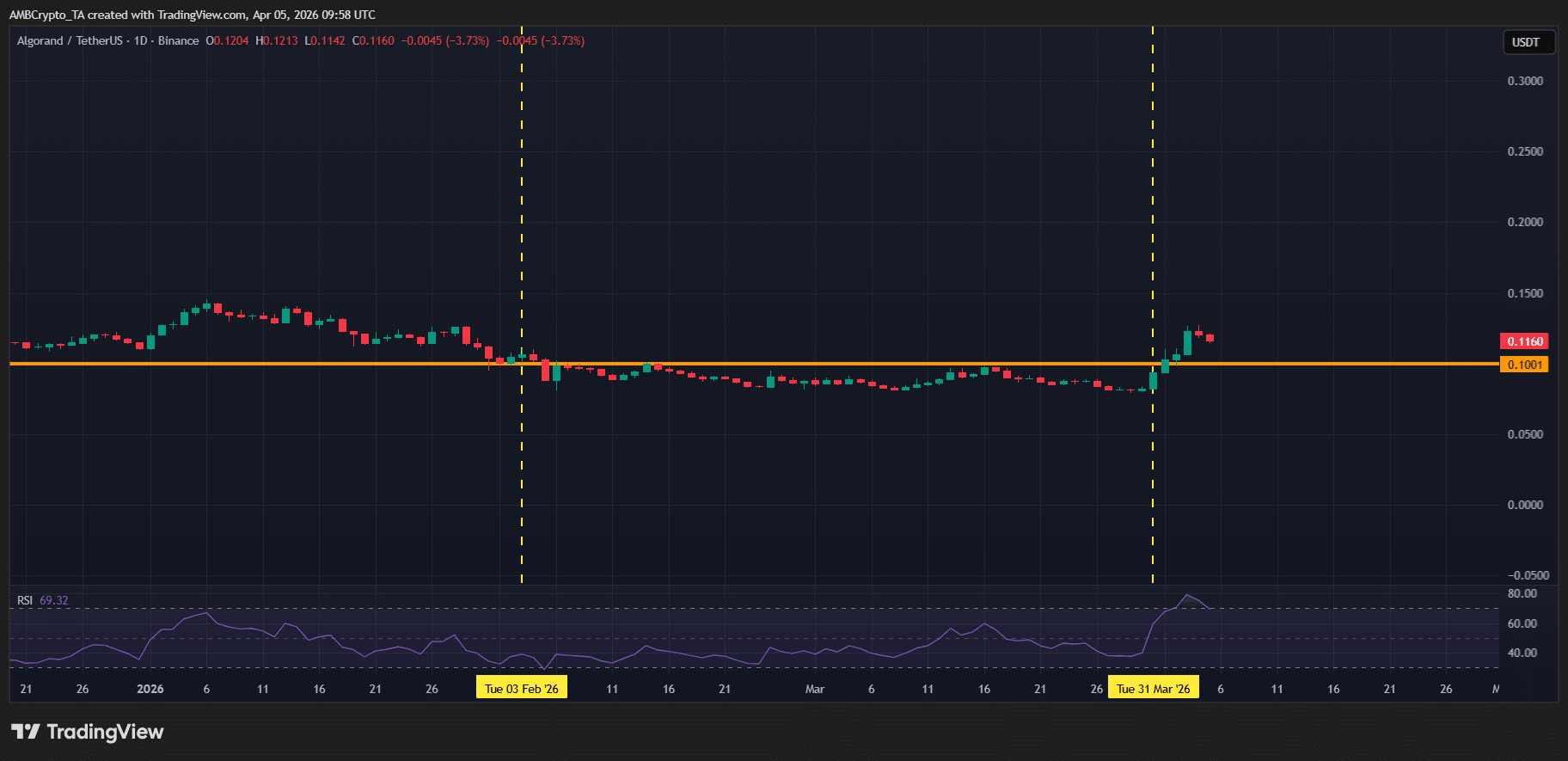
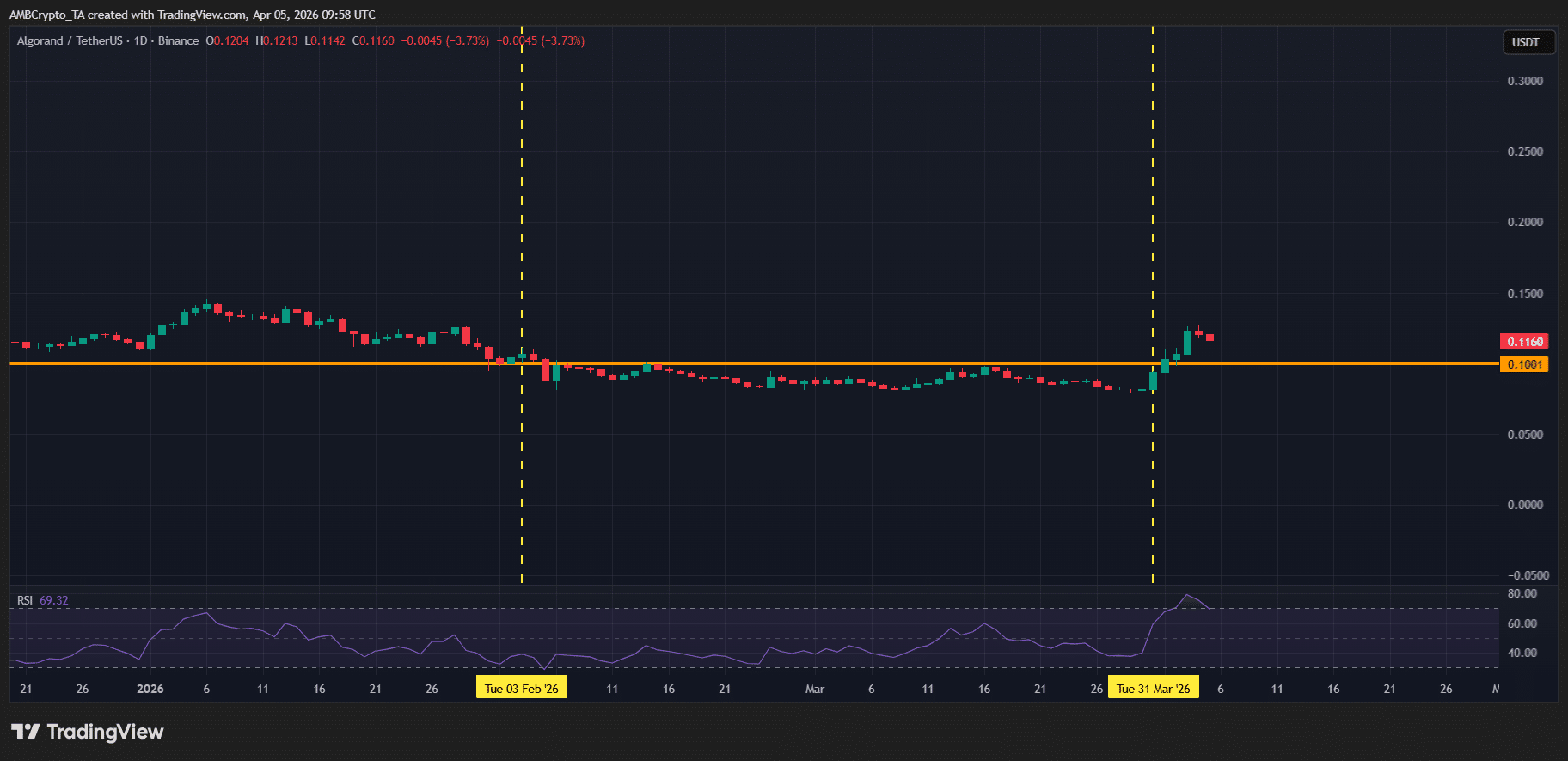
Algorand [ALGO] emerged as this week’s standout performer, posting a 43.85% weekly gain. What makes this move particularly interesting is the context.

After suffering around 15% losses in Q1, ALGO kicked off Q2 with a 14.23% single-day spike, breaking out of a three-month-long consolidation below the $0.10 mark.

From a charting perspective, the breakout was even more telling. Four straight daily candles pushed ALGO above $0.12, triggering a short squeeze that caught many bearish positions off guard.

Naturally, the big question is, can ALGO keep this momentum rolling in the weeks ahead?
Source: TradingView (ALGO/USDT)

From a technical angle, the bulls aren’t completely in control yet. ALGO is down about 6% in less than 48 hours, and the pullback is underscored by the RSI rolling over after hitting a multi-month high above 80, classic overbought territory.

According to AMBCrypto, this cooldown makes sense. ALGO is bumping into resistance around $0.12, a level that held back the price back in mid-January.

Bears are clearly eyeing this overhead supply zone, and unless the bulls defend it, continuing this rally looks like an uphill battle.

DeXe [DEXE] – Decentralized token held uptrend, reinforcing bullish conviction

DeXe [DEXE] claimed the second spot this week with a 26.05% rally, showing a more resilient price structure than ALGO.

From a technical perspective, this week’s gains are a part of a textbook bullish continuation pattern, indicating steady demand and strong underlying support.

In the context of the wider crypto market, DEXE’s performance clearly stands out.

Therefore, crossing $10 and moving toward $15+ could be DEXE’s next key move. When an altcoin pushes past resistance after sustained demand, it often attracts more buyers.

If this trend continues, DEXE is shaping up to be one of the most bullish setups in the altcoin space right now.

Venice Token [VVV] – AI protocol nears key resistance, eyeing breakout or rejection

Venice Token [VVV] grabbed the third spot this week with a 21.17% rally.

However, the real test for its resilience is just getting started. The altcoin has held a solid bullish structure, with four lower highs since February, each met with a higher low, building support and triggering small rebounds along the way.

That said, higher highs haven’t formed since VVV hit resistance around $8.5. Since breaking below that level, it has failed twice to reclaim it, and on the 4th of April, the token pulled back, showing bears are creeping back in.

A clean breakout above $8.5, therefore, will be key for bullish continuation into next week.

Other notable winners

Outside the majors, altcoin rockets stole the spotlight this week.

ONFA [OFT] led the charge with a 112% jump, followed by Layer3 [L3] climbing 110%, while Arkblock [ABT] rounded out the leaderboard with a strong 74% gain.

Weekly losers

Siren [SIREN] – Trading protocol retraced, giving back 100% of its prior gains

Siren [SIREN] ended the week as the biggest loser, plunging 67.64%, and the timing couldn’t have been worse for traders riding its recent rally.

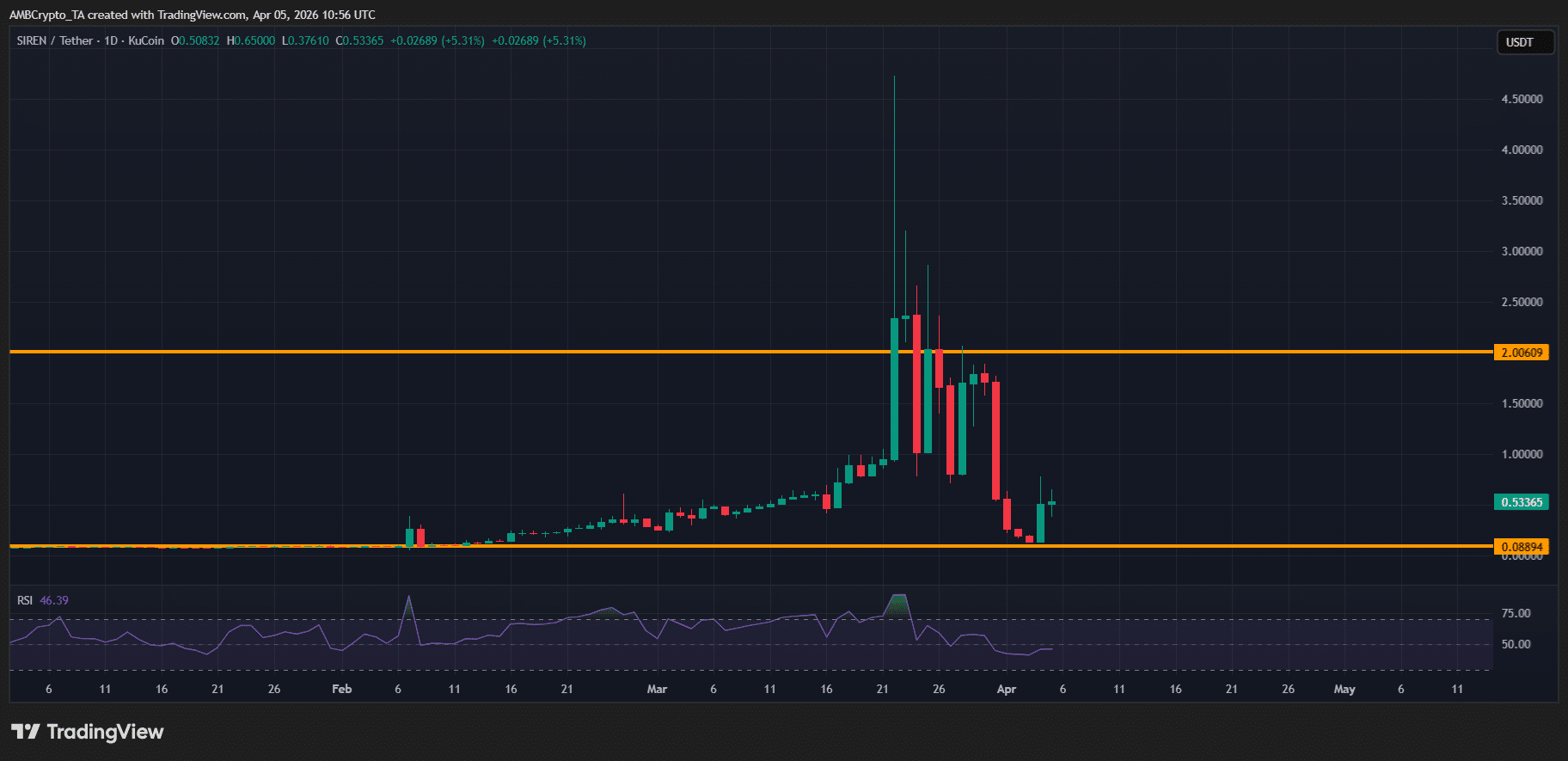
On the weekly chart, this week’s losses extend last week’s 23.58% drop, and over just two weeks, SIREN has erased 100% of the gains from its mid-March 290% surge to $4.7.

From a technical standpoint, this is a textbook cooldown phase following an extreme rally, where profit-taking often dominates price action.

Naturally, the question for traders is whether this is simply a hype-driven correction that will attract buyers back into the market or if it marks the start of a deeper downside phase as selling pressure overwhelms the remaining bullish momentum.
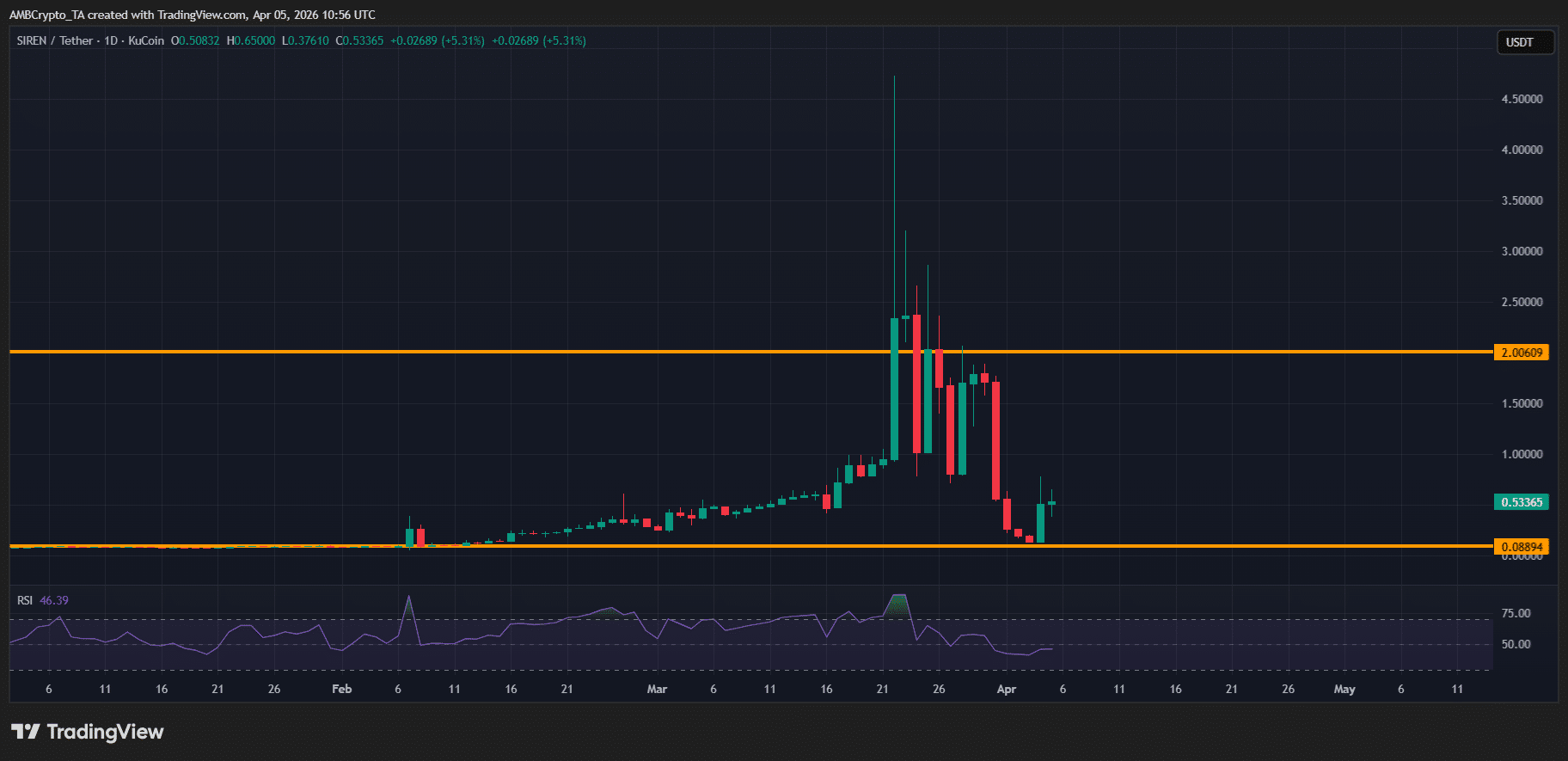
Source: TradingView (SIREN/USDT)

Currently, the first scenario looks more likely.

The daily chart shows bulls stepping in, with a 270% move on the 4th of April, followed by a 6% intraday bounce, and the RSI pulling back from overbought territory.

If this momentum holds, near-term resistance could be around $2, giving buyers a chance to regain control.

Midnight [NIGHT] – Privacy token saw bears regain control, pushing momentum lower

Midnight [NIGHT] ended the week as the second biggest loser, down 15.47%.

Looking at the weekly chart, this pullback wipes out last week’s 14.73% gain, meaning NIGHT has erased all its recent upside.

Even with the prior rally, the token couldn’t break through the $0.05 zone, showing that bulls are struggling to sustain momentum.

From a psychological standpoint, $0.05 naturally becomes a key resistance, and unless buyers step in aggressively, NIGHT risks testing the $0.04 floor, a level it hasn’t touched since Q4 2025.

How the token behaves around this support will likely set the tone for the next few weeks.

Ethena [ENA] – Synthetic dollar protocol reinforced a bearish market structure

Ethena [ENA] came in as the third biggest weekly loser, falling 13.37%.

Unlike some other coins, ENA’s decline this week carries real significance. The altcoin has been printing back-to-back lower lows, and this week’s pullback pushed it even further away from the $0.10 level, signaling that the bearish momentum is still very much in play.

From a technical standpoint, the daily structure reinforces the downtrend, and unless strong support emerges soon, ENA risks testing lower floors in the near term.

Other notable losers

In the broader market, downside volatility hit hard.

Core [CORE] led the losers with a steep 66% drop, followed by BabyBoomToken [BBT] falling 48%, and Cysic [CYS] slipping 42% as momentum sharply cooled.

Conclusion

This week was a rollercoaster. Big pumps, sharp dips, and nonstop action. As always, stay sharp, do your own research, and trade smart.


Final Summary

  • Algorand [ALGO], DeXe [DEXE], and Venice Token [VVV] led the week in gains.
  • Siren [SIREN], Midnight [NIGHT], and Ethena [ENA] saw significant declines.

Criptomoedas em alta

Perguntas relacionadas

QWhich cryptocurrency was the top weekly gainer and what was its percentage increase?

AAlgorand [ALGO] was the top weekly gainer with a 43.85% increase.

QWhat was the main reason for the volatile week in the crypto markets according to the article?

AThe volatile week was driven by FUD following a $280 million exploit on Drift Protocol, a focus on regulation, and stablecoins attracting $1.24 billion in weekly inflows.

QWhich token was the biggest weekly loser and how much did it drop?

ASiren [SIREN] was the biggest weekly loser, plunging 67.64%.

QWhat key resistance level is Venice Token [VVV] trying to break above for a bullish continuation?

AVenice Token [VVV] needs a clean breakout above the $8.5 resistance level for a bullish continuation.

QBesides the major winners, which altcoin had the highest weekly gain and what was it?

AONFA [OFT] had the highest weekly gain among other notable winners, jumping 112%.

Leituras Relacionadas

The Verdict in Choi Tae-won's Divorce Case: Revealing the Inheritance Undercurrent Behind SK Hynix's Trillion-Won Empire

SK Group Chairman Chey Tae-won's high-profile divorce case, involving a record 1.38 trillion won settlement, has drawn attention to the succession plans for Korea's second-largest conglomerate, especially its crown jewel, SK hynix. Unlike traditional chaebol scripts centered on the eldest son, Chey's three children from his marriage to former President Roh Tae-woo's daughter, Roh Soh-yeong, are carving distinct, non-traditional paths. Eldest daughter Chey Yun-jung (b. 1989) is seen as the most evident successor. With a scientific and consulting background, she holds executive roles at SK bioscience and SK Inc.'s growth support department, focusing on future strategy and biopharma. Her marriage is to an AI infrastructure entrepreneur, not a traditional business alliance. Second daughter Chey Min-jung (b. 1991) took a unique route, voluntarily serving as a South Korean naval officer, including an anti-piracy deployment. She later worked on policy and strategy for SK hynix in Washington D.C. before co-founding an AI-driven healthcare startup. She married a former U.S. Marine Corps officer, connecting her to U.S. defense and policy circles—networks crucial for a global semiconductor giant. The only son, Chey In-geun (b. 1995), who studied physics like his father, worked briefly at SK E&S before joining McKinsey. Despite fitting the traditional "heir" profile as the eldest son, he remains silent and holds no public position or shares in SK, suggesting the old succession playbook is obsolete. As SK hynix's valuation soars, becoming a geopolitical asset in the AI era, the heirs' legitimacy is no longer automatic. They must prove themselves in fields like AI biotech, global policy, and strategic consulting. Their marriages also reflect new elite networks in tech and defense, not old political alliances. Their inheritance is the complex challenge of navigating a globalized, tech-driven world, not just a corporate throne.

marsbitHá 22h

The Verdict in Choi Tae-won's Divorce Case: Revealing the Inheritance Undercurrent Behind SK Hynix's Trillion-Won Empire

marsbitHá 22h

From OpenSea to OpenRouter: Is Alex Atallah Repeating His 'Exit at the Peak' Playbook?

From OpenSea to OpenRouter: Is Alex Atallah Repeating His "Exit at the Peak" Playbook? According to the Wall Street Journal, payments giant Stripe is in talks to acquire the AI model aggregation platform OpenRouter in a potential deal valuing the company near $100 billion. This would mark founder Alex Atallah's second creation of a company reaching a $100 billion valuation, following his co-founding of NFT marketplace OpenSea. OpenRouter, founded just over three years ago, has grown rapidly by acting as a unified gateway for developers to access over 400 AI models. It currently has about 10 million users and processes over 200 trillion tokens monthly. While the platform's annualized revenue is around $50 million, its valuation has skyrocketed from $1.3 billion in March 2026. The potential acquisition by Stripe, a company OpenRouter's founder once likened it to, represents a major expansion into AI infrastructure for the payments leader. This move echoes Atallah's previous timing with OpenSea, where he departed before the NFT market's significant downturn. For OpenRouter, selling now may be strategic. Despite its scale, its business model—charging a 5-5.5% fee on AI inference calls—faces pressure from competition, open-source models, and potential price wars among model providers, limiting its profitability narrative for an IPO. A key asset for potential acquirers like Stripe is OpenRouter's vast repository of real-world AI usage data, which offers unique insights into model performance and developer preferences that are difficult to replicate. Whether this potential deal signifies a new valuation benchmark for AI infrastructure or another market peak signal remains to be seen.

链捕手Há 22h

From OpenSea to OpenRouter: Is Alex Atallah Repeating His 'Exit at the Peak' Playbook?

链捕手Há 22h

Trading

Spot

Artigos em Destaque

Como comprar CORE

Bem-vindo à HTX.com!Tornámos a compra de CORE (CORE) simples e conveniente.Segue o nosso guia passo a passo para iniciar a tua jornada no mundo das criptos.Passo 1: cria a tua conta HTXUtiliza o teu e-mail ou número de telefone para te inscreveres numa conta gratuita na HTX.Desfruta de um processo de inscrição sem complicações e desbloqueia todas as funcionalidades.Obter a minha contaPasso 2: vai para Comprar Cripto e escolhe o teu método de pagamentoCartão de crédito/débito: usa o teu visa ou mastercard para comprar CORE (CORE) instantaneamente.Saldo: usa os fundos da tua conta HTX para transacionar sem problemas.Terceiros: adicionamos métodos de pagamento populares, como Google Pay e Apple Pay, para aumentar a conveniência.P2P: transaciona diretamente com outros utilizadores na HTX.Mercado de balcão (OTC): oferecemos serviços personalizados e taxas de câmbio competitivas para os traders.Passo 3: armazena teu CORE (CORE)Depois de comprar o teu CORE (CORE), armazena-o na tua conta HTX.Alternativamente, podes enviá-lo para outro lugar através de transferência blockchain ou usá-lo para transacionar outras criptomoedas.Passo 4: transaciona CORE (CORE)Transaciona facilmente CORE (CORE) no mercado à vista da HTX.Acede simplesmente à tua conta, seleciona o teu par de trading, executa as tuas transações e monitoriza em tempo real.Oferecemos uma experiência de fácil utilização tanto para principiantes como para traders experientes.

339 Visualizações TotaisPublicado em {updateTime}Atualizado em 2026.06.02

Como comprar CORE

Discussões

Bem-vindo à Comunidade HTX. Aqui, pode manter-se informado sobre os mais recentes desenvolvimentos da plataforma e obter acesso a análises profissionais de mercado. As opiniões dos utilizadores sobre o preço de CORE (CORE) são apresentadas abaixo.

活动图片