The crypto market is still struggling to fully shake off the fear that dominated most of April, even though Bitcoin and Ethereum prices have started to show signs of stabilization. The latest Crypto Fear & Greed Index from Alternative.me shows the market at 26, which keeps sentiment still in the fear zone. That is slightly better than last month’s extreme fear reading of 8.
Traders are no longer in panic mode, but they are also not confident enough to call the recovery safe and dive full-head on into Bitcoin and Ethereum.
Fear Has Eased, But Investors Are Still Not Comfortable
The crypto market opened May 2026 in a state of persistent anxiety, and the Fear & Greed Index chart shows just how fragile the recovery has been. At the start of April, the index was stuck in deep fear levels, with readings around 8 to 12 in the first week. That reading was due to heavy caution across the market, as Bitcoin and Ethereum struggled to recover from earlier selling pressure.
According to data from Alternative.me, the Crypto Fear & Greed Index is at a 26 reading on May 1, a three-point decline from the previous day’s reading of 29.
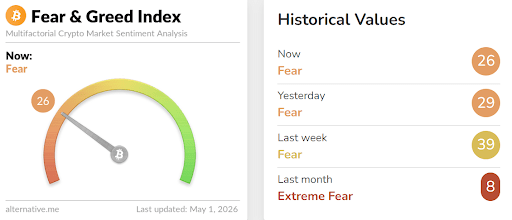
Fear And Greed Index. Source: Alternative.me
Sentiment improved gradually through the middle of the month, climbing into the 20s before briefly pushing into 46 and 67 on April 23 and April 27, respectively. Those two spikes were important because they showed that traders were beginning to respond to the rebound in prices when Bitcoin pushed above $78,000.
However, the index has now fallen back to 26, meaning the market failed to hold the stronger sentiment seen last week. A move from 8 to 26 shows that extreme panic has eased, but a fall from 39 last week to 26 now shows that the confidence is not strong yet.
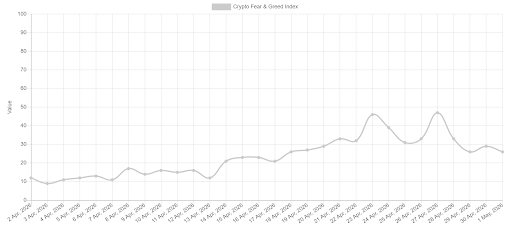
Crypto Fear And Greed Index. Source: Alternative.me
Can Bitcoin And Ethereum Recover?
Bitcoin posted a 12% gain across April, but the macro backdrop and profit-taking have prevented that momentum from translating into durable bullish sentiment. Nonetheless, Bitcoin has been the stronger side of recovery attempts in April.
At the time of writing, Bitcoin is trading around $77,000, and it recently came close to breaking above $80,000 on Monday, April 27 before losing momentum. That rejection explains why fear is still high. The market still needs proof that the rebound can survive beyond short-term relief buying. A clean move above $80,000 would likely change the tone of the sentiment, and the Fear and Greed Index could start to flip positive.
Ethereum’s position is more complicated. ETH is trading at $2,274, with CoinMarketCap data showing a 24-hour gain of about 1% at the time of writing. That shows some short-term recovery, but Ethereum is still not leading the market in the same way Bitcoin is.
Bitcoin has benefited from stronger ETF inflows, while Ethereum has been more uneven with fewer inflows. In order for Ethereum to recover properly, it likely needs Bitcoin to first stabilize above resistance at $2,300. From here, the leading altcoin could start to post price recoveries in May.