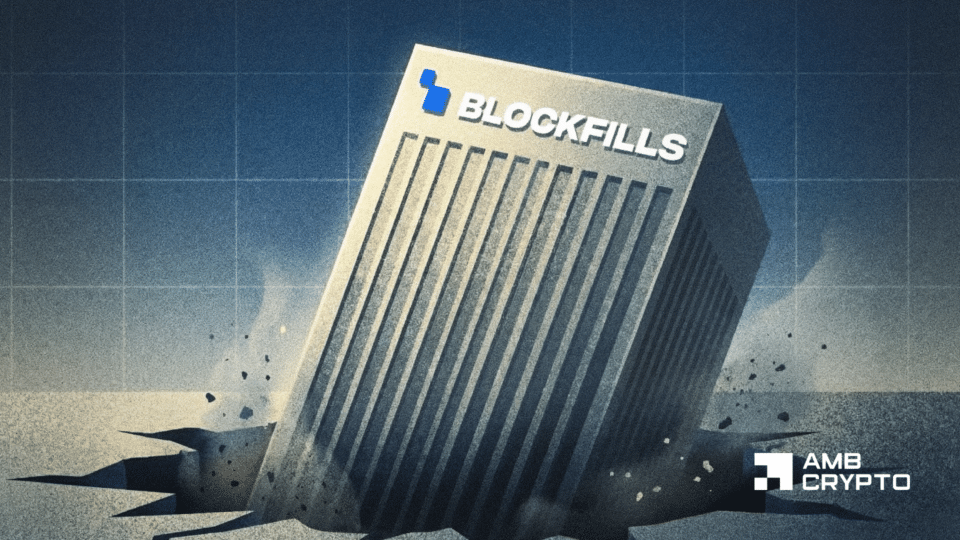
Crypto lender BlockFills files for bankruptcy: ‘Most responsible path forward’

ambcryptoPublicado em 2026-03-16Última atualização em 2026-03-16

Resumo

Crypto lending and trading firm BlockFills has filed for Chapter 11 bankruptcy protection. The company stated that this action represents the "most responsible path forward" to address its financial challenges. The filing aims to allow BlockFills to restructure its operations and manage its debts while continuing to serve its clients. This development reflects the ongoing volatility and difficulties within the cryptocurrency lending sector.

Perguntas relacionadas

QWhat is the name of the crypto lending company that has filed for bankruptcy?

ABlockFills

QWhat reason did BlockFills give for filing for bankruptcy?

AThey stated it as the 'most responsible path forward'.

QWhat type of financial service does BlockFills provide?

ACrypto lending.

QWhat is the main subject of the article based on its title?

AThe bankruptcy filing of BlockFills.

QDoes the article provide any specific details about the financial troubles leading to the bankruptcy?

ANo, the provided text does not include specific details about the financial troubles, only the announcement of the filing.


Leituras Relacionadas

Base Claims Its Distribution Advantage Can Outlast Robinhood Chain's Initial Surge

Base, a layer-2 blockchain, argues that its established distribution network will outlast Robinhood Chain's initial popularity surge. While Robinhood Chain quickly attracted 230,000 daily active users and over $9 billion in DEX volume (primarily from meme coins) shortly after launch, its core feature of tokenized stocks saw minimal use. Base acknowledged shortcomings in focusing on social blockchain products and lagging in areas like perpetual contracts, predictions markets, and on-chain tokenized stocks—a move Robinhood got right. In response, Base highlights its nearly three-year head start in building infrastructure. It emphasizes its x402 payment protocol, which has processed 187.8 million agent payments, its $3.9 billion in stablecoin deposits (mostly USDC), and its integration with partners like Visa, Shopify, and JPMorgan for institutional and merchant settlements. Base contends these capabilities for corporate payments and stablecoin liquidity represent a more durable and defensible ecosystem than Robinhood's retail trading metrics. Coinbase plans to launch its own on-chain, share-backed tokenized stocks on Base, which would directly challenge Robinhood's key differentiating feature. Base's strategy bets that its deep-rooted distribution and institutional partnerships will prove harder to overcome than Robinhood's early, meme-driven volume, which may fade after the initial launch hype.

cryptonews.ruHá 5m

Base Claims Its Distribution Advantage Can Outlast Robinhood Chain's Initial Surge

cryptonews.ruHá 5m

The Turning Point of the AI Bull Market: Leverage Blow-ups, Overcapacity in Compute, Why This Macro Analyst is Fully Bearish

AI Bull Market Reaches Inflection Point: Analyst Turns Bearish Due to Leverage, Chinese Competition, and Overcapacity Fidenza Macro analyst Geo Chen explains his decision to sell all AI semiconductor and infrastructure holdings in June, offering a comprehensive bearish thesis. He argues the AI-driven bull market has peaked, citing several key factors. First, unsustainable buying pressure: a massive influx of "low-quality" capital from Korean retail investors using highly leveraged ETFs on stocks like SK Hynix created a parabolic, fragile rally. Recent liquidations have wiped out billions and impacted over a million accounts, removing a key market driver. Second, a competitive threat: the rapid rise of powerful, cost-effective open-source AI models from China, such as MoonShot AI's Kimi K3 and Alibaba's Qwen 3.8, is commoditizing intelligence. This undermines the pricing power and high-valuation financing prospects of closed-source leaders like OpenAI and Anthropic, potentially creating a "single point of failure" for the ecosystem. Third, an impending capacity glut: while AI compute and components are currently in shortage, Chen warns this is typical of a cycle top. Massive, committed capex from cloud providers will likely lead to a supply overhang within 1-2 years. Data shows token spending has already peaked and declined since June, while bond spreads for data center companies are widening, signaling rising credit risk. Chen also highlights broader macro headwinds: the protracted Iran conflict acts as a persistent stagflationary force, and the Federal Reserve under Chair Kevin Warsh is losing credibility in its inflation fight. Long-term Treasury yields breaking above 5.2% present a new challenge for equities. In summary, Chen believes the convergence of speculative excesses, competitive disruption, looming overcapacity, and adverse macroeconomic conditions marks a significant turning point for the AI investment theme.

marsbitHá 20m

The Turning Point of the AI Bull Market: Leverage Blow-ups, Overcapacity in Compute, Why This Macro Analyst is Fully Bearish

marsbitHá 20m

Trading

Spot
活动图片