Crypto Industry Bands Together To Demand Clear Betting Market Laws

bitcoinistPublicado em 2026-02-18Última atualização em 2026-02-18

Resumo

A new advocacy effort led by The Digital Chamber’s Prediction Markets Working Group is pushing for clearer federal regulation of crypto prediction markets in the U.S. The group supports the CFTC’s stance that such markets should fall under federal oversight rather than state-level enforcement. Recent legal actions highlight the tension: state regulators, like in Nevada, are treating these platforms as unlicensed gambling operations, while companies like Polymarket and Kalshi argue they offer derivative-like contracts under federal jurisdiction. The conflict is moving through courts, with both sides preparing legal arguments, and future regulatory proposals may shape the outcome.

A new, organized push is under way to shape how crypto prediction markets are treated in the US. A blockchain advocacy group has launched a unit aimed at guiding policy, pressing regulators, and backing industry players through legal fights and public research.

Industry Sets Legal Strategy

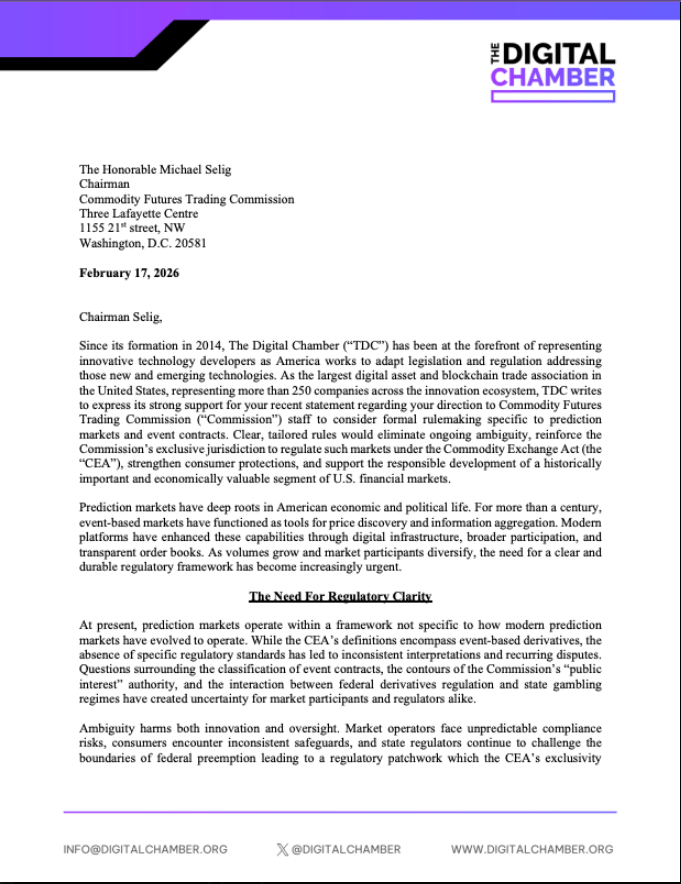
According to the group’s announcement, the first move was a letter praising the Commodity Futures Trading Commission and its chair for arguing that federal oversight should cover many event contracts.

The Prediction Markets Working Group, created by the blockchain advocacy group, The Digital Chamber, called for clearer rules and an end to what it described as enforcement-first regulation.

The group plans to meet with regulators, file policy ideas, publish studies and join court fights through friend-of-the-court briefs to press its view that a single federal regulator should be the lead voice on these crypto markets.

The regulator’s recent public comments were framed as support for that approach. CFTC Chairman Mike Selig has said the agency has overseen similar contracts for many years, and industry backers see that as a foundation for wider federal authority.

Tests On The Ground

Reports note that litigation and enforcement are already testing the theory. A major crypto US platform was hit with state action this week, accused of offering unlicensed wagering.

Kalshi faces a civil case brought by a state gaming regulator seeking to stop certain markets that the regulator calls gambling.

Rival platforms have felt the squeeze too; one has moved to federal court to try to head off state bans. Polymarket sued a state to argue federal oversight takes precedence.

The platforms argue their contracts behave like derivatives and should be treated as such, while state officials keep saying these products look a lot like bets.

As of today, the market cap of cryptocurrencies stood at $2.31 trillion. Chart: TradingView

States Push Back

That tension is clear along state lines. Nevada Gaming Control Board, which enforces strict gambling rules in its jurisdiction, has been among the most aggressive.

Reports say a governor in another state called these markets gambling that harms people, signaling political heat. Utah Governor Spencer Cox criticized federal arguments and framed the issue as one of public safety.

Meanwhile a platform chose to take its fight to the federal courts in a state that has been moving toward enforcement. Massachusetts figures into that legal push.
Image: Flowcarbon

What Comes Next

The next stretch will likely be shaped by filings and court rulings as much as by rulemaking. Industry lawyers are preparing to press federal primacy; state officials are planning to press their gambling statutes.

Legal briefs and amicus filings will try to persuade judges about what these crypto contracts really are. Regulators could also respond with formal rule proposals, and those would change the tone of the debate.

Featured image from The Center for Public Justice, chart from TradingView

Perguntas relacionadas

QWhat is the main goal of the newly formed Prediction Markets Working Group?

AThe main goal is to guide policy, press regulators, and back industry players through legal fights and public research to advocate for clearer rules and a single federal regulator for crypto prediction markets.

QWhich US regulatory body did the working group praise in its first move, and why?

AThe working group praised the Commodity Futures Trading Commission (CFTC) and its chair for arguing that federal oversight should cover many event contracts, seeing it as a foundation for wider federal authority.

QWhat legal action did the state of Nevada take against crypto prediction markets, according to the article?

AThe Nevada Gaming Control Board, which enforces strict gambling rules, has been among the most aggressive in taking action against these markets, with one major US platform facing a civil case from a state gaming regulator.

QHow are crypto prediction market platforms arguing their products should be classified and regulated?

AThe platforms argue that their contracts behave like derivatives and should be treated as such under federal oversight, rather than being classified as gambling and regulated by state laws.

QWhat is the current market capitalization of cryptocurrencies as mentioned in the article?

AAs of the date of the article, the market capitalization of cryptocurrencies stood at $2.31 trillion.

Leituras Relacionadas

From Return to Resignation: Chen Hang's 437 Days at DingTalk

The 437-Day Return and Departure of Chen Hang at DingTalk This article chronicles the 437-day period from March 31, 2025, to June 11, 2026, when Chen Hang (also known as "No Move") returned as CEO of DingTalk, the enterprise communication platform he originally founded, only to later step down. Chen Hang, the creator of DingTalk in 2015, was brought back by Alibaba in 2025 after the company acquired his subsequent startup, HHO. His return was driven by Alibaba's renewed focus on AI and DingTalk's strategic role as its key to-B AI application. However, his aggressive management style, marked by strict work policies like mandatory clock-ins and extended hours, quickly caused internal friction and was criticized as being at odds with Alibaba's culture. Despite the internal turmoil, Chen Hang drove significant product launches. In August 2025, he unveiled "AI DingTalk 1.0," featuring new products like the AI-native entry point "DingTalk ONE." By March 2026, he announced "Wukong," touted as the world's first enterprise-grade AI-native work platform, representing a fundamental rebuild of DingTalk's architecture. The turning point came in early June 2026. A detailed internal post criticizing DingTalk's work culture went viral, followed by a public critique from a former executive. This prompted an unprecedented public rebuke from the Alibaba Partners Committee, which stated such management was not aligned with company values. One day later, on June 11, Alibaba announced Chen Hang's departure. He was succeeded by Chen Yusen, a 32-year-old technical expert known for founding cybersecurity firm Changting Technology. While Chen Hang's tenure laid the technical foundation for DingTalk's AI transformation with "Wukong," his leadership style ultimately led to his replacement as the company seeks a new direction under younger leadership.

marsbitHá 12m

From Return to Resignation: Chen Hang's 437 Days at DingTalk

marsbitHá 12m

The 2026 Landscape of Decentralized AI: Why Blockchain is the Inevitable 'Antidote' for AI?

Decentralized AI 2026 Landscape: Why Blockchain is AI's Essential "Antidote" Centralized AI faces structural bottlenecks—expensive compute, concentrated control, unverifiable outputs, and difficult data access—that cannot be solved by capital or code alone. Blockchain offers a path to make intelligence open, verifiable, and economically accessible. The decentralized AI stack comprises: * **Infrastructure:** The foundation with compute, verifiable inference, distributed training, data/storage, and privacy/verification layers. Projects like Akash, Render, and Filecoin provide cheaper, decentralized alternatives for raw resources. * **Middleware:** The coordination layer for agent discovery, identity, and commerce. Key players include Bittensor (a network of specialized AI subnets), Virtuals (an agent economy OS), and frameworks providing agent identity and tooling. * **Applications & Services:** Dominated by Agentic Finance (AI agents executing on-chain actions based on natural language) and Agentic Payments (machine-to-machine transactions using blockchain as a settlement layer). Projects like Giza, Infinit Labs, and x402 are enabling these use cases. Key trends for 2026-2027 show AI demand outgrowing infrastructure, compute becoming an asset class, and tokenomics emerging as a structural advantage for coordinating capital, compute, and data. While still early—with adoption uneven and revenue often trailing token incentives—projects like Bittensor, NEAR, and Venice demonstrate decentralized AI is evolving from a narrative into a new model for coordinating intelligence.

Foresight NewsHá 32m

The 2026 Landscape of Decentralized AI: Why Blockchain is the Inevitable 'Antidote' for AI?

Foresight NewsHá 32m

Trading

Spot
Futuros

Artigos em Destaque

Como comprar PUSH

Bem-vindo à HTX.com!Tornámos a compra de Push Protocol (PUSH) simples e conveniente.Segue o nosso guia passo a passo para iniciar a tua jornada no mundo das criptos.Passo 1: cria a tua conta HTXUtiliza o teu e-mail ou número de telefone para te inscreveres numa conta gratuita na HTX.Desfruta de um processo de inscrição sem complicações e desbloqueia todas as funcionalidades.Obter a minha contaPasso 2: vai para Comprar Cripto e escolhe o teu método de pagamentoCartão de crédito/débito: usa o teu visa ou mastercard para comprar Push Protocol (PUSH) instantaneamente.Saldo: usa os fundos da tua conta HTX para transacionar sem problemas.Terceiros: adicionamos métodos de pagamento populares, como Google Pay e Apple Pay, para aumentar a conveniência.P2P: transaciona diretamente com outros utilizadores na HTX.Mercado de balcão (OTC): oferecemos serviços personalizados e taxas de câmbio competitivas para os traders.Passo 3: armazena teu Push Protocol (PUSH)Depois de comprar o teu Push Protocol (PUSH), armazena-o na tua conta HTX.Alternativamente, podes enviá-lo para outro lugar através de transferência blockchain ou usá-lo para transacionar outras criptomoedas.Passo 4: transaciona Push Protocol (PUSH)Transaciona facilmente Push Protocol (PUSH) no mercado à vista da HTX.Acede simplesmente à tua conta, seleciona o teu par de trading, executa as tuas transações e monitoriza em tempo real.Oferecemos uma experiência de fácil utilização tanto para principiantes como para traders experientes.

519 Visualizações TotaisPublicado em {updateTime}Atualizado em 2026.06.02

Como comprar PUSH

Discussões

Bem-vindo à Comunidade HTX. Aqui, pode manter-se informado sobre os mais recentes desenvolvimentos da plataforma e obter acesso a análises profissionais de mercado. As opiniões dos utilizadores sobre o preço de PUSH (PUSH) são apresentadas abaixo.

活动图片