Crypto Hedge Funds Retreat To Stablecoins Ahead of Rate Cut – Data Warns of a Familiar Pattern

bitcoinistPublicado em 2025-12-11Última atualização em 2025-12-11

Resumo

Bitcoin is holding above $92,000, but market sentiment remains bearish ahead of the December FOMC meeting. According to XWIN Research Japan, crypto hedge funds are shifting to a risk-off stance, reducing BTC exposure and increasing stablecoin reserves like USDT and USDC. This indicates defensive positioning and preparation for volatility rather than directional bets. Funding rate patterns mirror past FOMC events, where pre-meeting rallies often reverse post-announcement. The total crypto market cap is holding at $3.1 trillion, a key support level, but lacks bullish momentum. A break above $3.3T–$3.4T is needed for a sustained recovery; otherwise, the bounce may be short-lived. Risk management is crucial amid expected volatility.

Bitcoin is holding firm above the $92,000 level after rebounding from a brief dip to $90,000, but market sentiment remains decisively bearish. Despite the crypto market stabilization, confidence is fragile as traders brace for heightened volatility ahead of the December FOMC meeting. Bulls are attempting to regain momentum, yet the broader market continues to position defensively.

According to a detailed report by XWIN Research Japan, crypto hedge funds and large institutional players are shifting into clear risk-off mode. On-chain data reveals a notable divergence: BTC balances on centralized exchanges are falling, while USDT and USDC reserves are steadily climbing.

This behavior indicates that professional investors are reducing direct crypto market exposure and instead building up stablecoin liquidity on exchanges—capital that can be deployed rapidly depending on the FOMC outcome.

This rise in Stablecoin Exchange Reserves is a textbook sign of event-driven hedging. Institutions are preparing for volatility rather than betting outright on a directional move. Historically, such positioning emerges when markets expect meaningful policy decisions that could reshape short-term liquidity conditions.

Funding Rates Reveal the Market’s True Positioning

According to the XWIN Research Japan report, Funding Rates make the current crypto market structure even clearer. During the August–October 2025 period, funding surged as short-term traders aggressively loaded into long positions ahead of the FOMC decision, only to collapse sharply once the announcement was released.

Bitcoin’s price followed the same pattern: a strong pre-event rally driven by expectations, followed by a swift reversal as leveraged traders were forced to unwind. This fits the historical sequence of rate-cut expectations followed by a temporary rally, and a post-announcement deleveraging and decline.

The report highlights that today’s crypto market is showing similar behaviors. CME futures open interest has stalled, signaling that institutional traders are avoiding high-conviction directional bets. Whale spot holdings remain flat, suggesting that major players are positioned defensively rather than accumulating. At the same time, stablecoin inflows are accelerating, a hallmark of event-driven hedging as capital waits on the sidelines for clarity.
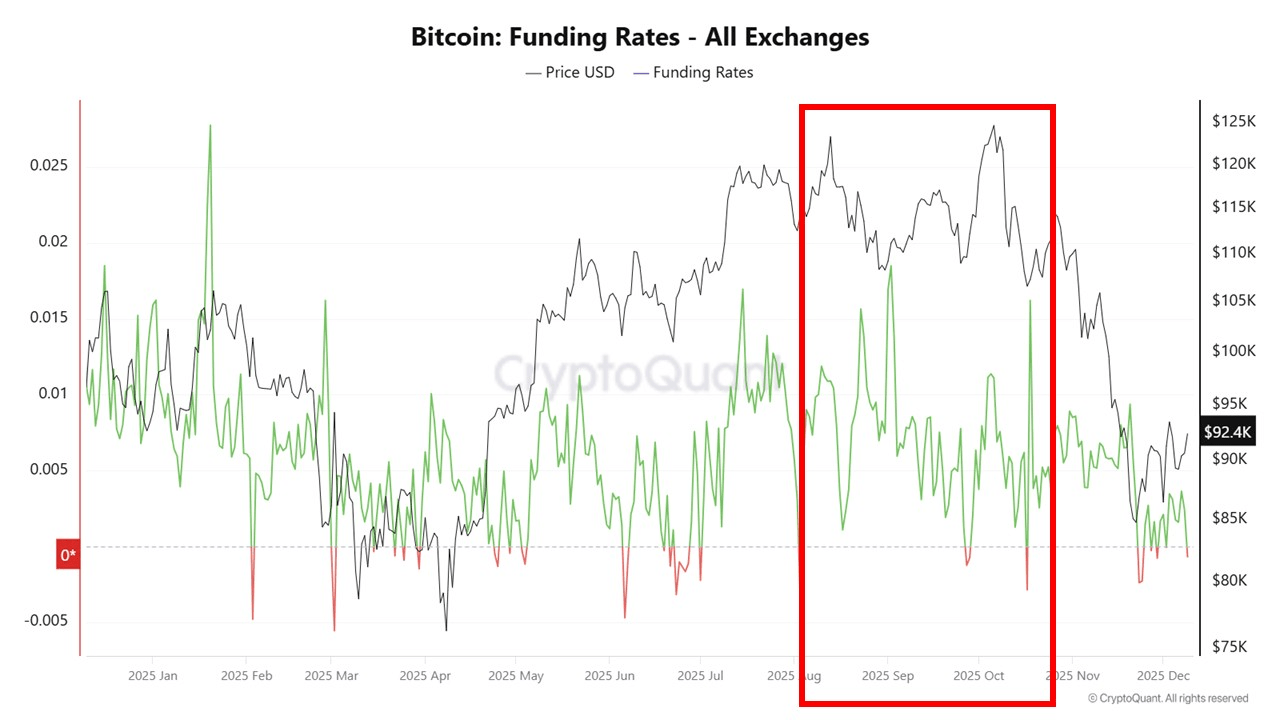
Bitcoin Funding Rates | Source: CryptoQuant

As XWIN Research Japan notes, whether the Fed cuts rates or not, one pattern remains consistent: volatility expands sharply during FOMC week. The danger lies in chasing the pre-meeting bounce without respecting the historical tendency for post-announcement shakeouts. In this environment, risk management—not prediction—is the winning strategy.

Total Crypto Market Cap Holds Key Support But Lacks Momentum

The Total Crypto Market Cap chart shows the market stabilizing around the $3.1 trillion level after a sharp multi-week decline. This area sits just above the 100-week moving average, a historically important dynamic support zone that often defines whether the broader cycle maintains bullish structure or shifts into deeper corrective territory. For now, buyers have stepped in to defend this region, preventing a breakdown that could have opened the door to a retest of the $2.7T–$2.8T area.
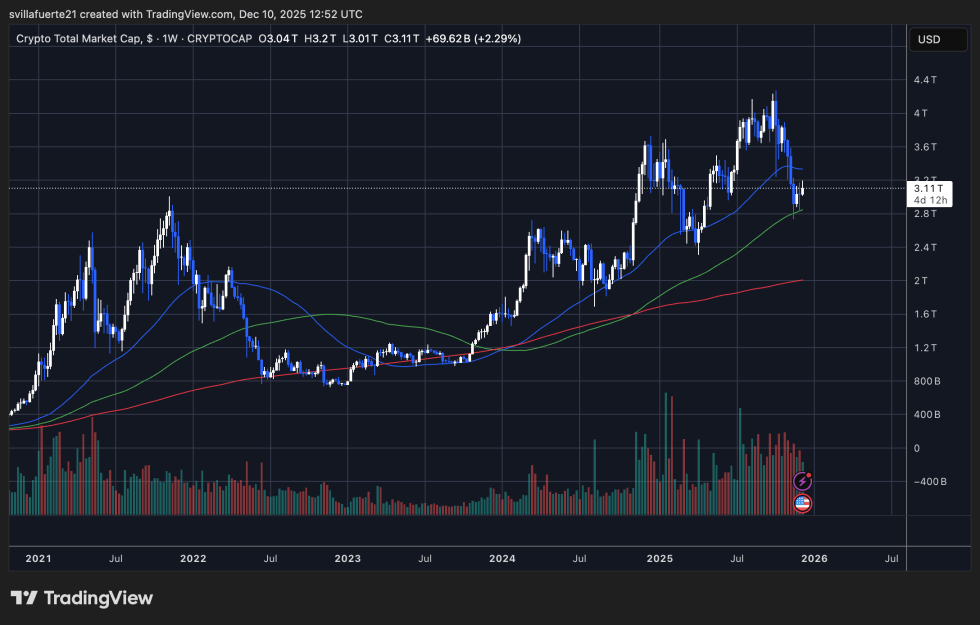
Crypto Total Market Cap | Source: TOTAL chart on TradingView

Despite the bounce, the structure remains fragile. The market is still trading below the 50-week moving average, which has now begun to bend downward—a sign that momentum has weakened across major assets like Bitcoin, Ethereum, and key altcoins. Volume has not shown a strong surge on the rebound either, suggesting that institutional conviction remains cautious ahead of the FOMC meeting and macro uncertainty.

A decisive reclaim of the $3.3T–$3.4T zone would shift momentum back in favor of bulls, opening room for a broader recovery. However, failure to break above this cluster of resistance could reinforce the idea that the recent bounce is only corrective. For now, the total market cap hovers at a crossroads, with macro events likely to determine the next major move.

Featured image from ChatGPT, chart from TradingView.com

Leituras Relacionadas

Fed's Internal Doves Flock to Hawkish Stance, Warsh's Debut "Between a Rock and a Hard Place"

U.S. Federal Reserve officials who previously advocated for rate cuts, including Governor Christopher Waller, have recently shifted their stance, with many now not ruling out the possibility of future rate hikes. This sets a challenging stage for new Fed Chair Kevin Warsh's first policy meeting. Appointed by President Trump based on his dovish views, Warsh now faces a committee where the debate has pivoted from "when to cut" to "whether to hike," driven by persistent inflation above 3%, a strong labor market, and supply-side pressures from AI infrastructure demands and geopolitical tensions. Key figures illustrate the shift. Governor Waller, once concerned about employment, now says data has pushed him toward considering rate increases. Even moderate voices like Governor Lisa Cook, while expecting inflation to ease, have indicated readiness to hike if it fails to do so. Long-time hawks such as regional Fed presidents Beth Hammack, Lorie Logan, and Neel Kashkari have grown more vocal, arguing that the real policy rate is effectively falling and that action may soon be needed. The upcoming Fed meeting is expected to keep rates steady but will likely remove the "easing bias" from its statement, signaling a neutral stance between cuts and hikes. The quarterly "dot plot" is anticipated to show most officials projecting no cuts this year, with some potentially indicating hikes. Chair Warsh, a critic of the Fed's reliance on forward guidance like the dot plot, must navigate communicating this pivot using tools he has questioned, all while steering policy in a direction counter to the preferences of the president who appointed him. The consensus suggests the Fed's next move could well be a rate increase.

marsbitHá 5m

Fed's Internal Doves Flock to Hawkish Stance, Warsh's Debut "Between a Rock and a Hard Place"

marsbitHá 5m

The Trillion-Yuan Market Cap 'Yi Zhong Tian': Who is the True Value King?

The article analyzes the three leading Chinese optical module companies, collectively nicknamed "Yi Zhong Tian": Xinyisheng, Zhongji Innolight, and TFC Optical Communication. It evaluates their "cost-performance" not by current stock price, but through three lenses: PEG ratio (growth vs. valuation), earnings quality, and premium/discount for certainty. Xinyisheng shows the most attractive PEG ratio and high profitability, but its valuation reflects discounts for risks like high customer concentration and reliance on overseas markets. Zhongji Innolight, the most expensive, commands a premium for its market leadership, dominant share in key products like 800G/1.6T modules, and higher earnings certainty, though it faces geopolitical risks. TFC Optical, as an upstream component supplier ("water seller"), has the highest gross margin and bets on the long-term CPO/NPO architecture trend, but trades at a high valuation with more stable, less explosive growth. The core argument is that while these companies dominate module assembly, the true profit pool and technological moat lie upstream in laser and switch chips, currently controlled by U.S. firms like Lumentum and Coherent. The long-term "cost-performance" for these Chinese leaders hinges on whether the domestic industry, exemplified by companies like Yuanjie Technology, can successfully move up the value chain into high-power laser chips. Otherwise, their high growth may remain confined to the lower-margin assembly segment.

marsbitHá 14m

The Trillion-Yuan Market Cap 'Yi Zhong Tian': Who is the True Value King?

marsbitHá 14m

Has the Crypto Market Bottomed? Here's What Institutions Think

The crypto market is in a period of significant debate, with leading institutions offering differing views on whether a bottom has been reached. Three prominent firms have published detailed analyses: * **Galaxy Digital** argues Bitcoin has **not yet bottomed**. Their analysis of 13 historical indicators across six dimensions (valuation, profit-taking, miner pressure, etc.) shows only four are fully met. They project a potential bottom range between $30k and $54k. * **NYDIG** states a bottom is **possible but not likely**. While metrics are close to historic bear market extremes, they note the absence of a classic panic-selling event. They also suggest increased institutional adoption may have structurally altered the market cycle, potentially leading to a shallower downturn. * **Standard Chartered Bank** asserts the **bottom has already occurred** at around $59k. They cite two key factors: potential US-Iran diplomatic progress and the anticipated SpaceX IPO, which they believe absorbed capital and caused ETF selling pressure that is now subsiding. They forecast a year-end price target of $100k. Despite the surface-level disagreement, the reports share critical common ground more valuable for long-term investors: 1. All three believe the market bottom will form **within this year**. 2. All agree the current price is **closer to the bottom than to previous highs**. 3. All maintain a **bullish long-term outlook** for Bitcoin and a new cycle. The core takeaway is that while the exact bottom price ($40k, $50k, or $60k) is debated, the consensus is that a bottom is imminent. For long-term holders, the primary focus should not be pinpointing the absolute low, but on the future potential for prices to reach $100k, $200k, or higher. The fundamental thesis for Bitcoin—sovereign debt accumulation, inflation, declining trust in centralized institutions, global digitization, and improved accessibility—remains intact and is arguably strengthening. The overall landscape is viewed as more favorable than in previous crypto winters.

marsbitHá 25m

Has the Crypto Market Bottomed? Here's What Institutions Think

marsbitHá 25m

The 'Chip' Challenge and Breakthroughs in China's Optical Industry Chain

China's Photonics Industry: Bottlenecks and Breakthroughs In the global AI race, computing chips dominate the narrative, but the underlying bottleneck increasingly defining the scale of AI clusters is light—or more specifically, optical connectivity. Optical modules, which translate electrical signals to light and vice versa, are crucial for connecting thousands of GPUs in AI data centers, preventing data congestion and ensuring efficient model training. High-speed modules (800G, 1.6T) are now standard, with performance hinging on advanced DSP (Digital Signal Processor) chips. This is where a critical dependency lies. Two US giants—Marvell and Broadcom—collectively dominate over 90% of the high-end DSP chip market. Chinese optical module leaders like Zhongji Innolight and Eoptolink rely on these chips to manufacture modules for overseas AI customers, primarily in North America. While this creates a supply chain vulnerability, complete decoupling is difficult. Marvell derives over half its revenue from Greater China, and the US firms depend on Chinese partners for chip packaging and optical components. The risk from laser chips (e.g., from Lumentum), another key component, is considered more manageable due to multiple global suppliers and faster progress in domestic alternatives from companies like YOFC and Accelink. To mitigate risks, China's industry is pursuing a multi-pronged strategy: diversifying supply chains and locking in long-term orders; fostering a domestic market ecosystem to adopt homegrown DSPs from firms like Huawei HiSilicon and CETC; accelerating R&D in high-speed DSPs and advanced packaging; and investing in next-gen technologies like silicon photonics and Co-Packaged Optics (CPO) to reduce reliance on discrete DSPs. The ultimate solution lies not in short-term博弈 but in persistent advancement of domestic high-end chip R&D and manufacturing. While challenges remain in performance, certification, and ecosystem building, China's vast domestic market and manufacturing base provide a crucial buffer, buying time for the industry to achieve greater technological independence.

marsbitHá 38m

The 'Chip' Challenge and Breakthroughs in China's Optical Industry Chain

marsbitHá 38m

Behind SpaceX's $2 Trillion Market Cap: Why Does Musk Always Have the Next Move Planned?

On June 12th, SpaceX debuted on the Nasdaq, reaching a valuation that briefly touched $2 trillion. This marked the culmination of a 24-year journey from its founding in 2002, driven by Elon Musk's frustration at the high cost of buying rockets. The company's path was defined by early failures, with its first three Falcon 1 launches ending in explosions before a successful 2008 flight opened the era of commercial spaceflight. Key to its model was a fixed-price NASA contract, incentivizing cost reduction. SpaceX mastered rocket reusability, first achieving a Falcon 9 landing in 2015, which drastically cut launch costs. This enabled its profitable Starlink satellite internet constellation, envisioned years before reusability was proven, to create an internal market for frequent launches. Similarly, the next-generation Starship rocket was in development long before its first flight, with its business case evolving from Mars colonization to supporting the emerging concept of in-orbit data centers for AI—a story now central to its valuation. The company's recent IPO, a reversal of its long-standing "no IPO" stance, is funding this ambitious "space-based compute" vision. While major tech players like Google, Blue Origin, and others are investing heavily, significant technical and cost hurdles remain. Ultimately, SpaceX's history is one of creating its own demand: first with Starlink and now with space-based AI compute, betting that its next rocket will enable its next giant market.

marsbitHá 41m

Behind SpaceX's $2 Trillion Market Cap: Why Does Musk Always Have the Next Move Planned?

marsbitHá 41m

Trading

Spot
Futuros

Artigos em Destaque

O que é ATWO

I. Introdução ao ProjetoArena Two é uma plataforma interativa descentralizada que permite aos fãs desempenhar um papel ativo e tokenizado nos resultados de eventos em tempo real. Ao contrário dos modelos tradicionais de transmissão que reduzem os fãs a espectadores passivos, a Arena Two utiliza a tecnologia blockchain para permitir que os fãs votem diretamente em tempo real e influenciem os resultados em campo.II. Informação sobre o TokenNome do token: ATWO(Arena Two)III. Links RelacionadosWebsite:https://arenatwo.com/Exploradores:https://basescan.org/token/0x499D35eBE6cEe9B2Ac35Fd003fcBbeeB9CFc7B32Twitter:https://x.com/arenatwoXNota: A introdução ao projeto provém dos materiais publicados ou fornecidos pela equipa oficial do projeto, que é apenas para referência e não constitui aconselhamento de investimento. A HTX não se responsabiliza por quaisquer perdas diretas ou indiretas resultantes.

259 Visualizações TotaisPublicado em {updateTime}Atualizado em 2026.06.02

O que é ATWO

Como comprar ATWO

Bem-vindo à HTX.com!Tornámos a compra de Arena Two (ATWO) simples e conveniente.Segue o nosso guia passo a passo para iniciar a tua jornada no mundo das criptos.Passo 1: cria a tua conta HTXUtiliza o teu e-mail ou número de telefone para te inscreveres numa conta gratuita na HTX.Desfruta de um processo de inscrição sem complicações e desbloqueia todas as funcionalidades.Obter a minha contaPasso 2: vai para Comprar Cripto e escolhe o teu método de pagamentoCartão de crédito/débito: usa o teu visa ou mastercard para comprar Arena Two (ATWO) instantaneamente.Saldo: usa os fundos da tua conta HTX para transacionar sem problemas.Terceiros: adicionamos métodos de pagamento populares, como Google Pay e Apple Pay, para aumentar a conveniência.P2P: transaciona diretamente com outros utilizadores na HTX.Mercado de balcão (OTC): oferecemos serviços personalizados e taxas de câmbio competitivas para os traders.Passo 3: armazena teu Arena Two (ATWO)Depois de comprar o teu Arena Two (ATWO), armazena-o na tua conta HTX.Alternativamente, podes enviá-lo para outro lugar através de transferência blockchain ou usá-lo para transacionar outras criptomoedas.Passo 4: transaciona Arena Two (ATWO)Transaciona facilmente Arena Two (ATWO) no mercado à vista da HTX.Acede simplesmente à tua conta, seleciona o teu par de trading, executa as tuas transações e monitoriza em tempo real.Oferecemos uma experiência de fácil utilização tanto para principiantes como para traders experientes.

141 Visualizações TotaisPublicado em {updateTime}Atualizado em 2026.06.02

Como comprar ATWO

O que é ZEST

I. Introdução ao Projeto1. O que é o Zest Protocol?O Zest Protocol é um protocolo de empréstimos nativo do Bitcoin construído na camada 2 do Stacks que permite aos utilizadores ganhar rendimento com BTC ou emprestar ativos colateralizando BTC. Os contratos inteligentes do protocolo são escritos na linguagem Clarity, operam totalmente em cadeia e são de código aberto, com um design inspirado no Aave v3. O Zest é atualmente o maior protocolo DeFi no Stacks, com mais de 800 BTC depositados e um pico de TVL superior a 100 milhões de dólares. Em maio de 2026, o protocolo introduziu ainda os Cofres de Colateral em Bitcoin, estendendo as capacidades de empréstimo do Stacks para a rede principal do Bitcoin. Isso permite que os utilizadores emprestem stablecoins sem mover BTC da rede Bitcoin, possibilitando empréstimos com custódia própria.2. Como funciona o Zest Protocol?O Zest Protocol consiste em dois mercados. O mercado do Stacks é construído sobre o Aave v3, permitindo que os utilizadores depositem ativos como sBTC, STX e USDC para ganhar rendimento ou contrair empréstimos sobre-colateralizados. O LTV máximo padrão é de 50% (70% para sBTC). O mercado do Bitcoin opera através dos recém-lançados Cofres de Colateral em Bitcoin. Os utilizadores emprestam stablecoins ao bloquear BTC em cofres de custódia própria na cadeia do Bitcoin. O colateral permanece na rede principal do Bitcoin durante todo o processo, e os utilizadores mantêm a custódia, a menos que a posição seja liquidada.3. Quem fundou o Zest Protocol?Tycho Onnasch (Co-Fundador): Formado na Universidade de Oxford. Envolvido em pesquisa e subsídios para a Stacks Open Internet Foundation. Antigo Gestor na Trust Machines e Fundador da Deedmob. Perfil do LinkedIn: https://www.linkedin.com/in/tychokoonnasch/.Fernando Foy (Co-Fundador): Trabalhou anteriormente em consultoria de TI na Objectif Emploi. Perfil do LinkedIn: https://www.linkedin.com/in/fernando-foy/.Emil E. (Co-Fundador): Possui um Mestrado em Física pela Universidade de Warwick. Antigo Partner de Engenharia na Trust Machines, Desenvolvedor Full-Stack para projetos Web3 e Cientista de Dados no HSBC. Perfil do LinkedIn: https://www.linkedin.com/in/emil-e-49771a145/.Detalhes de Financiamento: Em maio de 2024, o Zest Protocol anunciou a conclusão de uma ronda de financiamento inicial de 3,5 milhões de dólares liderada por Tim Draper, com a participação da Binance Labs, Flow Traders, Trust Machines, entre outros.4. Tokenomics do $ZEST$ZEST é o token nativo do Zest Protocol com um fornecimento total fixo de 1 mil milhões de tokens e sem mecanismo inflacionário.Comunidade (27,83%): Usado para airdrops e incentivos aos utilizadores;Desenvolvimento do Ecossistema (24,82%): Usado para liquidez, parcerias, marketing, listagens em bolsas, etc.;Investidores (22,35%): Apoio às partes investidoras que apoiaram o desenvolvimento inicial do Zest Protocol;Equipa (25%): Alocado para colaboradores principais.Calendário de Vesting: Os tokens da Equipa e dos Investidores estão sujeitos a um período de bloqueio de 1 ano, seguido de 3 anos de desbloqueio linear.5. Cronologia dos Principais Marcos2022: O Zest Protocol é oficialmente fundado.Março de 2024: Concluída a auditoria de segurança e lançado o mercado de empréstimos do Stacks na rede principal.Em fevereiro de 2026, é lançado o Stacks Market V2, introduzindo Grupos de Risco.Em maio de 2026, foram introduzidos os Cofres de Colateral em Bitcoin, e um protótipo operacional da rede principal está agora disponível. Isso permite que os utilizadores utilizem BTC com custódia própria na L1 do Bitcoin como colateral para emprestar stablecoins em cadeias EVM, encerrando a necessidade de bridging, wrapping e custódia de terceiros. Este lançamento é dividido em duas fases. Fase 1: Utiliza transações pré-assinadas para restringir o movimento de BTC; Fase 2: Utiliza BitVM para verificação. II. Informações sobre o TokenNome do token: ZEST (Zest Protocol)III. Links RelacionadosWebsite: https://www.zestprotocol.com/Exploradores: https://bscscan.com/token/0x5506599c722389a60580b5213ea1da60d64754a1Twitter: https://twitter.com/ZestProtocolNota: A introdução ao projeto provém dos materiais publicados ou fornecidos pela equipa oficial do projeto, que é apenas para referência e não constitui aconselhamento de investimento. A HTX não se responsabiliza por quaisquer perdas diretas ou indiretas resultantes.

208 Visualizações TotaisPublicado em {updateTime}Atualizado em 2026.06.02

O que é ZEST

Discussões

Bem-vindo à Comunidade HTX. Aqui, pode manter-se informado sobre os mais recentes desenvolvimentos da plataforma e obter acesso a análises profissionais de mercado. As opiniões dos utilizadores sobre o preço de A (A) são apresentadas abaixo.

活动图片