Crypto has everything needed for a bull market, so why is the market down?

cointelegraphPublicado em 2025-12-19Última atualização em 2025-12-19

Resumo

Despite numerous positive drivers such as increased liquidity, a pro-crypto U.S. government, ETF launches, and institutional buying, the crypto market is on track to end 2025 lower than it started. Analysts question why the market isn’t in a bull run, with some suggesting structural issues or excessive leverage are to blame. Selling pressure persists from long-term holders, technical traders, and cycle theorists. While some declare a bear market has already begun, others highlight strong fundamentals, including regulatory progress and institutional adoption, calling 2025 a foundational year for long-term growth.

Analysts and investors are questioning why crypto isn’t in a bull market, given the amount of positive drivers that have taken place this year.

“At some point, we need to admit that something is structurally broken in the crypto market,” CNBC crypto contributor Ran Neuner said on Tuesday.

He said that multiple favorable factors should be leading to crypto markets performing better, such as increased liquidity, a pro-crypto US government, various exchange-traded fund launches, major institutional and crypto treasury company buying, and strong performance in traditional markets such as gold, silver, and major stock indexes.

However, crypto markets are on track to end the year lower than when they began, with the total market capitalization falling more than 32% from its all-time high of $4.4 trillion in early October and almost 13% down from Jan. 1.
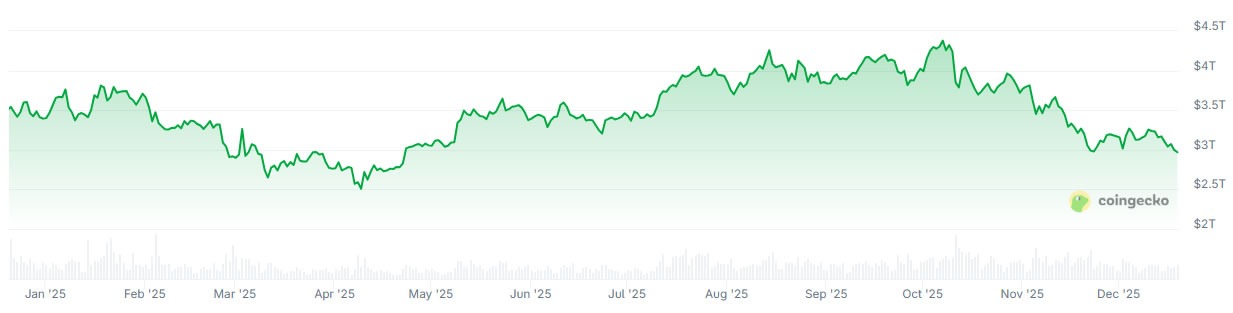
Crypto market cap is on track to end the year lower than it started. Source: CoinGecko

Two possible outcomes for crypto

Neuner said there were two possible outcomes for crypto: discovery of “what’s actually broken and who is selling” or the “mother of all catch-up trades because that’s how markets work.”

Economist Adam Kobeissi said that “one day, we will look back at the last 2 months of seemingly daily mass crypto liquidations and what’s happening will be crystal clear:”

“Crypto is experiencing a structural shift amid historic levels of leverage.”

Related: Most crypto sectors lagged Bitcoin over past 3 months: Glassnode

Analyst “PlanB” called it an “epic battle until sellers are out of ammo,” explaining that selling pressure is still coming from “OGs traumatized by 2021,” technical investors looking at relative strength index, and those who believe in the four-year cycle and that a bear market is due.

Crypto winter is already here

Meanwhile, some analysts are convinced that the bear market is already underway.

“Bitcoin entered a bear market in late October 2025, becoming the first major risk asset to price in a slowing economy,” 10x Research CEO Markus Thielen told Cointelegraph.

“Retail participation never meaningfully returned this cycle, and value creation remained narrowly concentrated in Bitcoin rather than broadening across risk assets. Winter isn’t approaching; it has already arrived.”

Things aren’t that bad, really

Despite the poor performance of spot markets, the industry’s fundamentals remain solid.

“While prices may have fallen short of expectations, this year delivered more structural progress than any in crypto’s history,” Erik Lowe, head of content at blockchain venture firm Pantera, said in a report on Tuesday.

Like Neuner, he listed several milestone achievements for the industry this year, including a shift in staff and stance at US financial regulators, the establishment of a US strategic Bitcoin reserve and digital asset stockpile, and increases in stablecoin supplies and onchain value of tokenized real-world assets.

“From that perspective, we believe there hasn’t been a more important year for the industry than 2025. This is the year we began laying the deep caissons to support durable, long-term growth.”

Magazine: Bitcoin’s critical level is $82.5K, Ethereum ‘not done yet’: Trade Secrets

Criptomoedas em alta

Perguntas relacionadas

QAccording to the article, what are some of the positive factors that should have led to a crypto bull market in 2025?

AThe positive factors include increased liquidity, a pro-crypto US government, various exchange-traded fund (ETF) launches, major institutional and crypto treasury company buying, and strong performance in traditional markets like gold, silver, and major stock indexes.

QWhat does analyst Ran Neuner suggest are the two possible outcomes for the crypto market?

ARan Neuner suggests the two possible outcomes are the discovery of 'what's actually broken and who is selling' or the mother of all catch-up trades because that's how markets work.

QWhat reason does 10x Research CEO Markus Thielen give for stating that a crypto bear market is already underway?

AMarkus Thielen states that Bitcoin entered a bear market in late October 2025, becoming the first major risk asset to price in a slowing economy. He adds that retail participation never meaningfully returned this cycle and value creation remained narrowly concentrated in Bitcoin.

QDespite the poor market performance, what does Erik Lowe from Pantera highlight as a positive for the crypto industry in 2025?

AErik Lowe highlights that 2025 delivered more structural progress than any year in crypto's history, citing milestone achievements like a shift in US financial regulators' stance, the establishment of a US strategic Bitcoin reserve, and increases in stablecoin supplies and onchain value of tokenized real-world assets.

QWhat does economist Adam Kobeissi identify as the core reason for the current crypto market conditions?

AAdam Kobeissi states that 'Crypto is experiencing a structural shift amid historic levels of leverage,' implying that excessive leverage is a fundamental cause of the current market downturn and liquidations.

Leituras Relacionadas

As Consensus Accelerates, What Are Young Investors Betting On?

Title: As Consensus Forms Faster, What Are Young Investors Betting On? In the rapid evolution of tech investment, a new generation of young investors is navigating a landscape where AI, robotics, commercial aerospace, and quantum computing are advancing simultaneously. Traditional investment logic based on financial models is giving way to a need for deep technical understanding and the ability to act before industry consensus forms. An analysis of trends from the "WAIC FUTURE TECH" list of young investment leaders reveals key shifts in focus. The first major trend is the movement of AI from the digital screen into the physical world. Investment is shifting from large language models and chatbots towards embodied AI, robotics, AI hardware, and edge computing. While demonstrations generate excitement, the real challenge lies in achieving scalable, reliable, and cost-effective delivery in complex real-world environments like factories and logistics. Success depends not just on algorithms but on the integration of sensors, actuators, and control systems. Second, the competitive focus for large models is moving beyond raw capability toward building an "intelligence flywheel." The goal is to create self-reinforcing systems where user interaction generates data, improving the model, which in turn enhances the user experience and attracts more engagement. Companies that successfully embed AI into workflows to create these closed-loop systems can build lasting value that isn't easily erased by the next model upgrade. Third, facing a potential bottleneck in high-quality human-generated data, investors are looking at new underlying technologies. Reinforcement learning and self-play, as demonstrated by AlphaGo Zero, offer paths for AI to generate its own experience. Scientific foundation models, which aim to build general AI capabilities for fields like life sciences and materials discovery, represent a non-consensus direction that could unlock new frontiers of knowledge and data. Finally, in deep-tech areas like quantum computing, commercial aerospace, and space-based infrastructure, patient capital is essential. These fields have long, uncertain development and validation cycles involving complex engineering, supply chains, and regulations. Investment here requires a long-term view, focusing on foundational team capabilities and the eventual emergence of market demand, even if commercial returns are distant. Collectively, these trends illustrate how young investors are adapting to a new era. They are learning to make earlier, technically-informed judgments, balance hype with real-world viability, and provide the patient capital needed to build the deep-tech foundations of the future.

marsbitHá 9m

As Consensus Accelerates, What Are Young Investors Betting On?

marsbitHá 9m

Can Japan Buy Growth with AI? Will the Bond Market Believe It?

Japan's cabinet has introduced the 2026 Basic Policy on Economic and Fiscal Management and Reform, shifting its primary fiscal target. The new framework moves away from the traditional annual primary balance goal and instead prioritizes a stable reduction of the debt-to-GDP ratio. This change is tied to a strategy of increased "responsible proactive fiscal" spending, aiming to boost long-term growth through investments in strategic sectors like AI, semiconductors, energy, and robotics. The government estimates total public and private investment in 62 key technologies could exceed 370 trillion yen by 2040. The market reaction has been mixed and cautious. While equity markets may respond to policy signals, bond markets are focused on fiscal credibility. Concerns center on whether the weakening of the clear primary balance anchor could lead to looser fiscal discipline. If investors doubt that these strategic investments will generate sufficient productivity gains, tax revenue, and nominal growth to outpace rising interest costs, they may demand higher yields on Japanese Government Bonds (JGBs). Recent volatility in the yen and JGB yields, with the 10-year yield briefly reaching 2.9%, reflects this skepticism. The success of this new framework hinges on two factors: whether Japan can achieve a nominal growth rate consistently higher than its long-term interest rates, and whether future budgets demonstrate disciplined control over bond issuance. The government's narrative is that strategic investment is essential to break Japan's cycle of low growth, aging, and labor shortages. However, the bond market will continuously assess the credibility of this plan, pricing the risk that it may represent fiscal expansion rather than a viable growth strategy.

marsbitHá 46m

Can Japan Buy Growth with AI? Will the Bond Market Believe It?

marsbitHá 46m

Misjudged A-Shares: Resilience, Expectations, and Confidence

China's A-share market recently faced selling pressure, especially in tech sectors, initially triggered by a global tech sell-off that began in South Korea. However, the article argues this is a case of "mistaken injury" and highlights the market's underlying resilience. This resilience stems from three main pillars: **1) Tech Sector Fundamentals:** Unlike Korea's market dominated by a few memory chip stocks, China's tech sector is diversified across computing, communications, electronics, and semiconductors, supported by dual narratives of global AI supply chains and domestic substitution. Core areas like optical modules and fiber optics continue to show strong earnings growth. **2) "National Team" Support:** State-backed institutions and large corporations have made significant market purchases and announced buybacks, providing liquidity and signaling confidence. This is seen as a stabilizing policy signal, often associated with market bottoms. **3) Broader Market Pillars:** Other major sectors are showing endogenous recovery momentum. Consumer stocks benefit from stabilizing CPI and signs of sector recovery (e.g., liquor price hikes). Cyclical sectors like aluminum have high earnings, potential price increases due to tight supply, and low valuations. The financial sector offers stable dividends and low valuations. The conclusion is that the sell-off was driven by external contagion, not a collapse in fundamentals. With strong policy support and recovering momentum across key sectors, the A-share market possesses the toughness to regain stability.

marsbitHá 1h

Misjudged A-Shares: Resilience, Expectations, and Confidence

marsbitHá 1h

Trading

Spot

Artigos em Destaque

Como comprar O

Bem-vindo à HTX.com!Tornámos a compra de O1 exchange (O) simples e conveniente.Segue o nosso guia passo a passo para iniciar a tua jornada no mundo das criptos.Passo 1: cria a tua conta HTXUtiliza o teu e-mail ou número de telefone para te inscreveres numa conta gratuita na HTX.Desfruta de um processo de inscrição sem complicações e desbloqueia todas as funcionalidades.Obter a minha contaPasso 2: vai para Comprar Cripto e escolhe o teu método de pagamentoCartão de crédito/débito: usa o teu visa ou mastercard para comprar O1 exchange (O) instantaneamente.Saldo: usa os fundos da tua conta HTX para transacionar sem problemas.Terceiros: adicionamos métodos de pagamento populares, como Google Pay e Apple Pay, para aumentar a conveniência.P2P: transaciona diretamente com outros utilizadores na HTX.Mercado de balcão (OTC): oferecemos serviços personalizados e taxas de câmbio competitivas para os traders.Passo 3: armazena teu O1 exchange (O)Depois de comprar o teu O1 exchange (O), armazena-o na tua conta HTX.Alternativamente, podes enviá-lo para outro lugar através de transferência blockchain ou usá-lo para transacionar outras criptomoedas.Passo 4: transaciona O1 exchange (O)Transaciona facilmente O1 exchange (O) no mercado à vista da HTX.Acede simplesmente à tua conta, seleciona o teu par de trading, executa as tuas transações e monitoriza em tempo real.Oferecemos uma experiência de fácil utilização tanto para principiantes como para traders experientes.

167 Visualizações TotaisPublicado em {updateTime}Atualizado em 2026.06.29

Como comprar O

Como comprar PROS

Bem-vindo à HTX.com!Tornámos a compra de Pharos (PROS) simples e conveniente.Segue o nosso guia passo a passo para iniciar a tua jornada no mundo das criptos.Passo 1: cria a tua conta HTXUtiliza o teu e-mail ou número de telefone para te inscreveres numa conta gratuita na HTX.Desfruta de um processo de inscrição sem complicações e desbloqueia todas as funcionalidades.Obter a minha contaPasso 2: vai para Comprar Cripto e escolhe o teu método de pagamentoCartão de crédito/débito: usa o teu visa ou mastercard para comprar Pharos (PROS) instantaneamente.Saldo: usa os fundos da tua conta HTX para transacionar sem problemas.Terceiros: adicionamos métodos de pagamento populares, como Google Pay e Apple Pay, para aumentar a conveniência.P2P: transaciona diretamente com outros utilizadores na HTX.Mercado de balcão (OTC): oferecemos serviços personalizados e taxas de câmbio competitivas para os traders.Passo 3: armazena teu Pharos (PROS)Depois de comprar o teu Pharos (PROS), armazena-o na tua conta HTX.Alternativamente, podes enviá-lo para outro lugar através de transferência blockchain ou usá-lo para transacionar outras criptomoedas.Passo 4: transaciona Pharos (PROS)Transaciona facilmente Pharos (PROS) no mercado à vista da HTX.Acede simplesmente à tua conta, seleciona o teu par de trading, executa as tuas transações e monitoriza em tempo real.Oferecemos uma experiência de fácil utilização tanto para principiantes como para traders experientes.

160 Visualizações TotaisPublicado em {updateTime}Atualizado em 2026.06.29

Como comprar PROS

O que é VERONA

I. Introdução ao Projeto VERONA é uma blockchain construída para todos, em todo o lado, através da abstração da cadeia. Utilizando a sua camada de Abstração Generalizada, a VERONA distingue-se por integrar funcionalidades complexas de blockchain, como contas, assinaturas e interoperabilidade, diretamente ao nível do protocolo. Esta abordagem permite a interação com aplicações de blockchain sem a necessidade de compreender as tecnologias subjacentes.1) Informação Básica Nome: VERONA (VERONA)III. Links Relacionados Link do site oficial: https://xion.burnt.com/ Whitepaper: https://xion.burnt.com/whitepaper.pdf Exploradores: https://explorer.burnt.com/ Mídias Sociais: https://x.com/burnt_xion Nota: A introdução ao projeto provém dos materiais publicados ou fornecidos pela equipa oficial do projeto, que é apenas para referência e não constitui aconselhamento de investimento. A HTX não se responsabiliza por quaisquer perdas diretas ou indiretas resultantes.

778 Visualizações TotaisPublicado em {updateTime}Atualizado em 2026.06.22

O que é VERONA

Discussões

Bem-vindo à Comunidade HTX. Aqui, pode manter-se informado sobre os mais recentes desenvolvimentos da plataforma e obter acesso a análises profissionais de mercado. As opiniões dos utilizadores sobre o preço de A (A) são apresentadas abaixo.

活动图片














