Crypto hacks return: Is $35M in exploits the start of another DeFi FUD cycle?

ambcryptoPublicado em 2026-07-24Última atualização em 2026-07-24

Resumo

A wave of crypto hacks targeting cross-chain bridges has resulted in $35.55 million in losses across three DeFi protocols in a single day, sparking concerns of a renewed DeFi FUD cycle. The largest exploit saw $24.2 million stolen from the AFX Arbitrum bridge. These incidents coincide with the hacker behind the massive $285 million Drift Protocol exploit from earlier this year resuming movement of stolen funds through Tornado Cash. This comes just as DeFi TVL had shown strong recovery, increasing by over $10 billion in July. The simultaneous bridge attacks and the reactivation of a major past exploit have injected fresh uncertainty into the market, potentially shifting focus back to security risks and threatening the sector's recent momentum.

Is another wave of DeFi FUD building beneath the surface?

Flashback to the Q1-Q2 cycle, the crypto market went through one of its biggest DeFi security scares after three back-to-back hacks wiped out over $600 million. The result was a sharp liquidity outflow, with DeFi TVL dropping to Q2 2024 levels at just over $65 billion.

The selling pressure quickly spread across major protocols, with Ethereum alone losing more than $10 billion in TVL in less than 48 hours.

Now, the same narrative is starting to resurface.

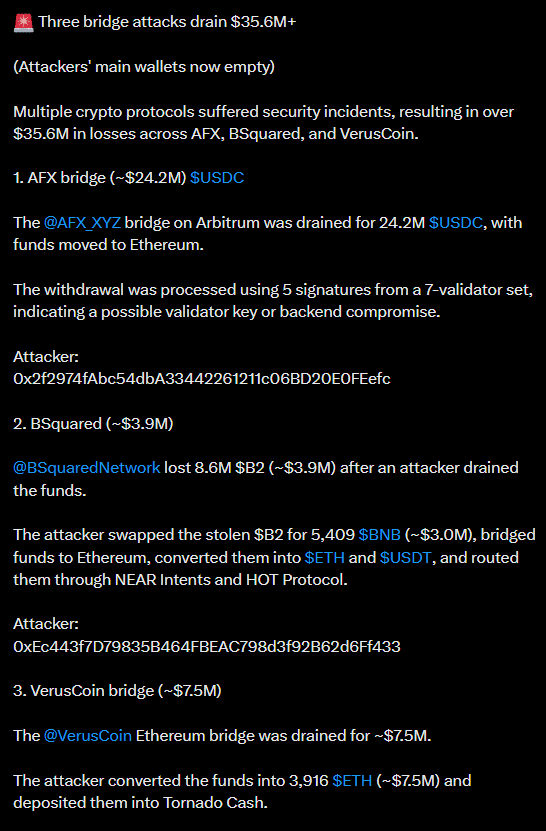
At press time, three DeFi exploits have already resulted in $35.55 million in losses. While the amount is much smaller than the Q1-Q2 hacks, the market is already calling it the worst day for DeFi in months, bringing back memories of the earlier hack-driven selloff.
Source: X

Notably, AFX suffered the biggest loss after attackers stole $24.2 million in USDC from its Arbitrum bridge and moved the funds to Ethereum.

BSquared Network was the second-largest victim, losing around $3.9 million after an attacker drained 8.6 million B2 tokens. VerusCoin also suffered a bridge exploit worth roughly $7.5 million, pushing the combined losses across the three protocols to $35.55 million.

Interestingly, all three attacks targeted the same part of the DeFi stack: Cross-chain bridges.

Put simply, even though the protocols operate in different ecosystems, the attack vector was identical.

That once again puts the spotlight on bridge infrastructure, which continues to be one of DeFi’s biggest security risks. The timing is also what makes this more interesting.

These exploits come as another key development is unfolding, adding fresh uncertainty to the market.

Crypto hacks put DeFi under pressure as the Drift exploit resurfaces

The $35 million exploit wave couldn’t have come at a worse time for DeFi.

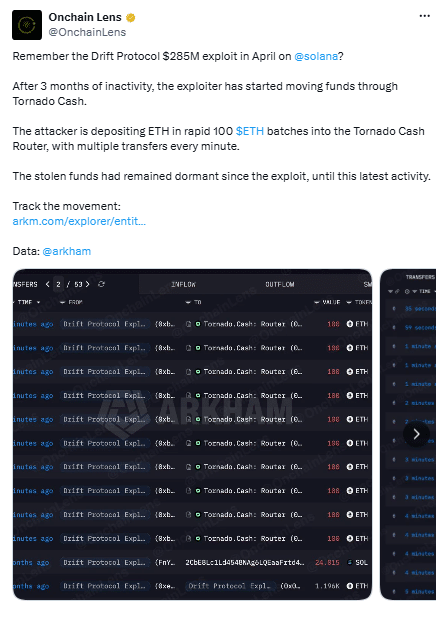
Just as three cross-chain bridges were hacked in a single day, the hacker behind the Drift exploit has started moving stolen funds again.

Earlier this year, Drift Protocol suffered one of the largest DeFi exploits after attackers drained $285 million, triggering a sharp wave of risk-off sentiment across the sector.

Now, the stolen funds are on the move again.

According to Onchain Lens, the attacker is funneling ETH through the Tornado Cash Router in repeated 100 ETH batches, with multiple transactions being executed every minute.

While the transfers don’t necessarily signal an immediate selloff, they have brought the Drift hack back into focus at a time when DeFi is already dealing with a fresh wave of bridge exploits.
Source: X

Notably, this is where the timing starts to stand out.

According to DeFiLlama data, DeFi had finally started to regain momentum, with TVL climbing by more than $10 billion in July, marking the strongest monthly increase since the Q1-Q2 hack wave.

However, the latest $35 million in crypto hacks has injected fresh uncertainty into that recovery. If more exploits follow, the market could once again shift its focus from capital inflows to protocol security, reviving the same DeFi FUD that dominated earlier this year.


Final Summary

  • Three bridge hacks wiped out $35.55 million in one day, while the hacker behind the $285 million Drift exploit started moving stolen funds again.
  • After DeFi TVL recovered by over $10 billion in July, fresh crypto hacks could bring DeFi FUD back into the market.


Perguntas relacionadas

QAccording to the article, how much money was lost in the recent wave of DeFi bridge exploits, and which protocol suffered the largest loss?

AThe recent wave of DeFi bridge exploits resulted in a combined loss of $35.55 million. The protocol that suffered the largest loss was AFX, which had $24.2 million in USDC stolen from its Arbitrum bridge.

QWhat common vulnerability was exploited in the three recent hacks mentioned in the article?

AAll three recent hacks exploited the same part of the DeFi stack: cross-chain bridges.

QWhy is the timing of these new exploits and the Drift Protocol fund movements considered significant for DeFi?

AThe timing is significant because these events occur just as DeFi TVL was showing a strong recovery, having increased by over $10 billion in July. The fresh exploits and the movement of funds from the massive Drift hack reintroduce uncertainty and could shift market focus back to security risks, potentially reviving the DeFi FUD (Fear, Uncertainty, Doubt) seen earlier in the year.

QWhat was the estimated total loss from the major DeFi security scares in Q1-Q2 of this cycle, and what was its impact on DeFi TVL?

AThe major DeFi security scares in the Q1-Q2 cycle wiped out over $600 million. This led to a sharp liquidity outflow, causing the total value locked (TVL) in DeFi to drop to just over $65 billion, which was a level last seen in Q2 2024.

QAccording to on-chain data, how is the hacker behind the Drift exploit currently moving the stolen funds?

AAccording to Onchain Lens, the hacker behind the Drift exploit is moving the stolen funds by funneling ETH through the Tornado Cash Router in repeated batches of 100 ETH, with multiple transactions being executed every minute.

Leituras Relacionadas

The Verdict in Choi Tae-won's Divorce Case: Revealing the Inheritance Undercurrent Behind SK Hynix's Trillion-Won Empire

SK Group Chairman Chey Tae-won's high-profile divorce case, involving a record 1.38 trillion won settlement, has drawn attention to the succession plans for Korea's second-largest conglomerate, especially its crown jewel, SK hynix. Unlike traditional chaebol scripts centered on the eldest son, Chey's three children from his marriage to former President Roh Tae-woo's daughter, Roh Soh-yeong, are carving distinct, non-traditional paths. Eldest daughter Chey Yun-jung (b. 1989) is seen as the most evident successor. With a scientific and consulting background, she holds executive roles at SK bioscience and SK Inc.'s growth support department, focusing on future strategy and biopharma. Her marriage is to an AI infrastructure entrepreneur, not a traditional business alliance. Second daughter Chey Min-jung (b. 1991) took a unique route, voluntarily serving as a South Korean naval officer, including an anti-piracy deployment. She later worked on policy and strategy for SK hynix in Washington D.C. before co-founding an AI-driven healthcare startup. She married a former U.S. Marine Corps officer, connecting her to U.S. defense and policy circles—networks crucial for a global semiconductor giant. The only son, Chey In-geun (b. 1995), who studied physics like his father, worked briefly at SK E&S before joining McKinsey. Despite fitting the traditional "heir" profile as the eldest son, he remains silent and holds no public position or shares in SK, suggesting the old succession playbook is obsolete. As SK hynix's valuation soars, becoming a geopolitical asset in the AI era, the heirs' legitimacy is no longer automatic. They must prove themselves in fields like AI biotech, global policy, and strategic consulting. Their marriages also reflect new elite networks in tech and defense, not old political alliances. Their inheritance is the complex challenge of navigating a globalized, tech-driven world, not just a corporate throne.

marsbitHá 7h

The Verdict in Choi Tae-won's Divorce Case: Revealing the Inheritance Undercurrent Behind SK Hynix's Trillion-Won Empire

marsbitHá 7h

From OpenSea to OpenRouter: Is Alex Atallah Repeating His 'Exit at the Peak' Playbook?

From OpenSea to OpenRouter: Is Alex Atallah Repeating His "Exit at the Peak" Playbook? According to the Wall Street Journal, payments giant Stripe is in talks to acquire the AI model aggregation platform OpenRouter in a potential deal valuing the company near $100 billion. This would mark founder Alex Atallah's second creation of a company reaching a $100 billion valuation, following his co-founding of NFT marketplace OpenSea. OpenRouter, founded just over three years ago, has grown rapidly by acting as a unified gateway for developers to access over 400 AI models. It currently has about 10 million users and processes over 200 trillion tokens monthly. While the platform's annualized revenue is around $50 million, its valuation has skyrocketed from $1.3 billion in March 2026. The potential acquisition by Stripe, a company OpenRouter's founder once likened it to, represents a major expansion into AI infrastructure for the payments leader. This move echoes Atallah's previous timing with OpenSea, where he departed before the NFT market's significant downturn. For OpenRouter, selling now may be strategic. Despite its scale, its business model—charging a 5-5.5% fee on AI inference calls—faces pressure from competition, open-source models, and potential price wars among model providers, limiting its profitability narrative for an IPO. A key asset for potential acquirers like Stripe is OpenRouter's vast repository of real-world AI usage data, which offers unique insights into model performance and developer preferences that are difficult to replicate. Whether this potential deal signifies a new valuation benchmark for AI infrastructure or another market peak signal remains to be seen.

链捕手Há 7h

From OpenSea to OpenRouter: Is Alex Atallah Repeating His 'Exit at the Peak' Playbook?

链捕手Há 7h

Trading

Spot
活动图片




