Crypto hack counts fall but supply chain attacks reshape threat landscape

cointelegraphPublicado em 2025-12-23Última atualização em 2025-12-23

Resumo

New data from CertiK reveals that while crypto hackers stole $3.3 billion in 2025, the number of attacks fell sharply. Losses were concentrated in fewer, more damaging supply-chain attacks, which accounted for $1.45 billion across just two incidents, including the $1.4 billion Bybit hack. This shift indicates attackers are moving away from simple code vulnerabilities toward more sophisticated infrastructure-level exploits. The number of security incidents decreased by 162 year-over-year, suggesting improved protocol-level security. The median loss per hack fell 35.75% to $103,966, though the average loss rose to $5.3 million due to high-value outliers. Phishing scams were the second-largest threat, costing $722 million across 248 incidents. A significant subset was "pig butchering" romance scams, which used prolonged emotional manipulation and cost the industry $5.5 billion in 2024.

Crypto hackers stole $3.3 billion in 2025, but the number of attacks fell sharply as losses became concentrated in fewer, more sophisticated supply-chain exploits, according to new data from blockchain security firm CertiK shared with Cointelegraph.

While total losses remained elevated, the decline in incident counts and a drop in median theft sizes suggest that protocol-level security is improving, pushing attackers away from simple code vulnerabilities and toward phishing and infrastructure-level attacks.

CertiK said supply-chain breaches emerged as the most damaging threat, accounting for $1.45 billion in losses across just two incidents, including the $1.4 billion Bybit hack in February.

"The Bybit exploit signals that well-capitalized, well-coordinated threat actors are becoming more active across the ecosystem," the report said, predicting a rise in the “sophistication” of supply chain attacks as attackers target more infrastructure providers.
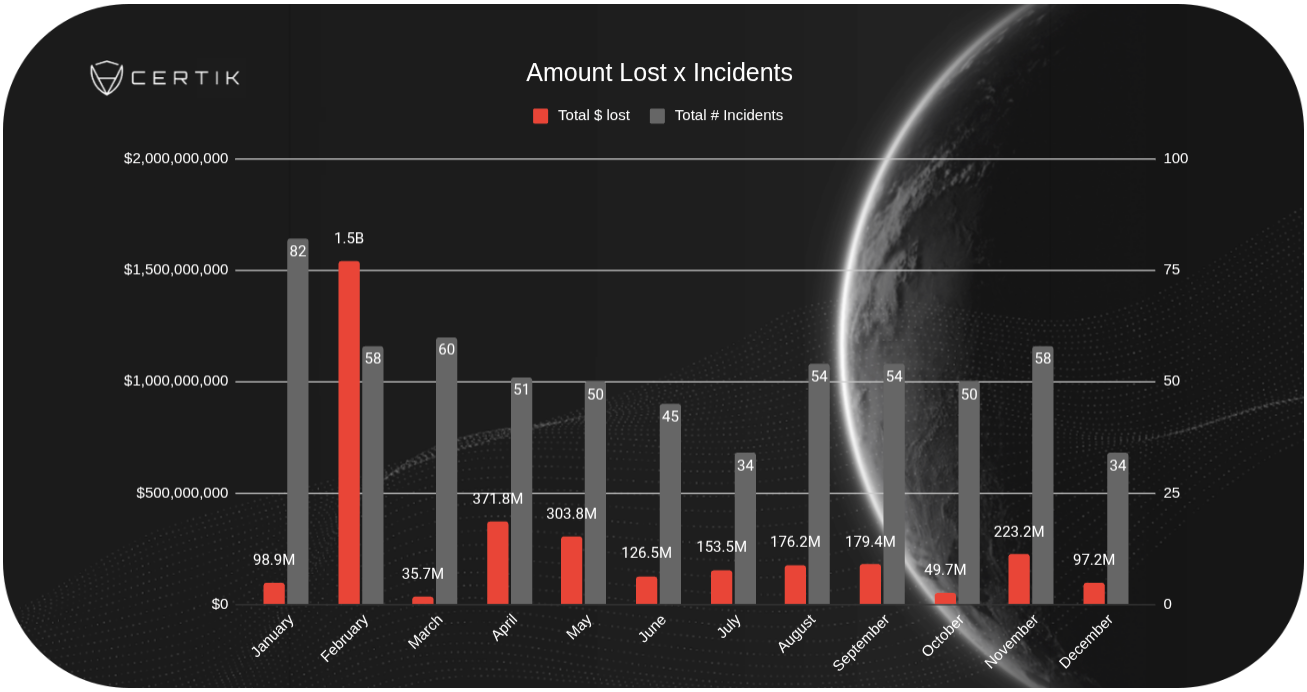
Crypto hacks by amount and incident, yearly chart. Source: CertiK

Related: Soulja Boy token sparks backlash after Base co-founder posts purchase receipt

The number of security incidents decreased by 162 counts year-over-year, indicating that blockchain cybersecurity measures are improving despite hackers aiming for larger targets.

The average amount lost per hack stood at $5.3 million, a 66% increase from the previous year. However, the median loss — a measure less influenced by outlier incidents — fell to $103,966, down 35.75% over the same period.
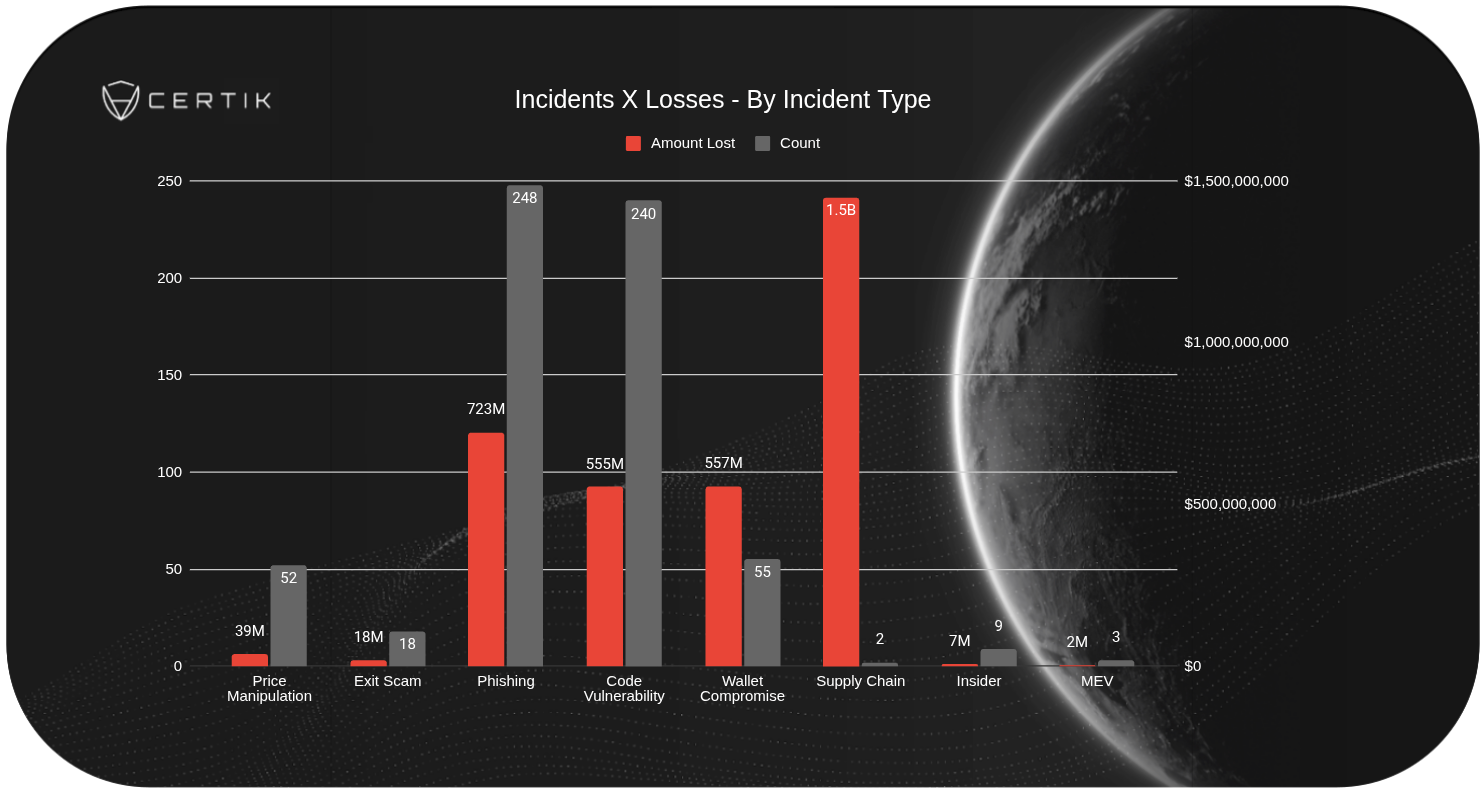
Cryptop hacks by incident type and amount of losses, one-year chart. Source: CertiK

Related: Solana AI token Ava hit by launch sniping tied to deployer: Bubblemaps

Code vulnerabilities fade as “pig butchering” scams threaten crypto savings

Phishing scams became the second-largest threat, costing crypto investors a cumulative $722 million across 248 incidents.

Recently, an investor lost their entire Bitcoin (BTC) retirement fund in an artificial intelligence-fueled romance scam, also known as a "pig butchering" scam, where the con artists used prolonged emotional manipulation to convince the investors to transfer their funds.
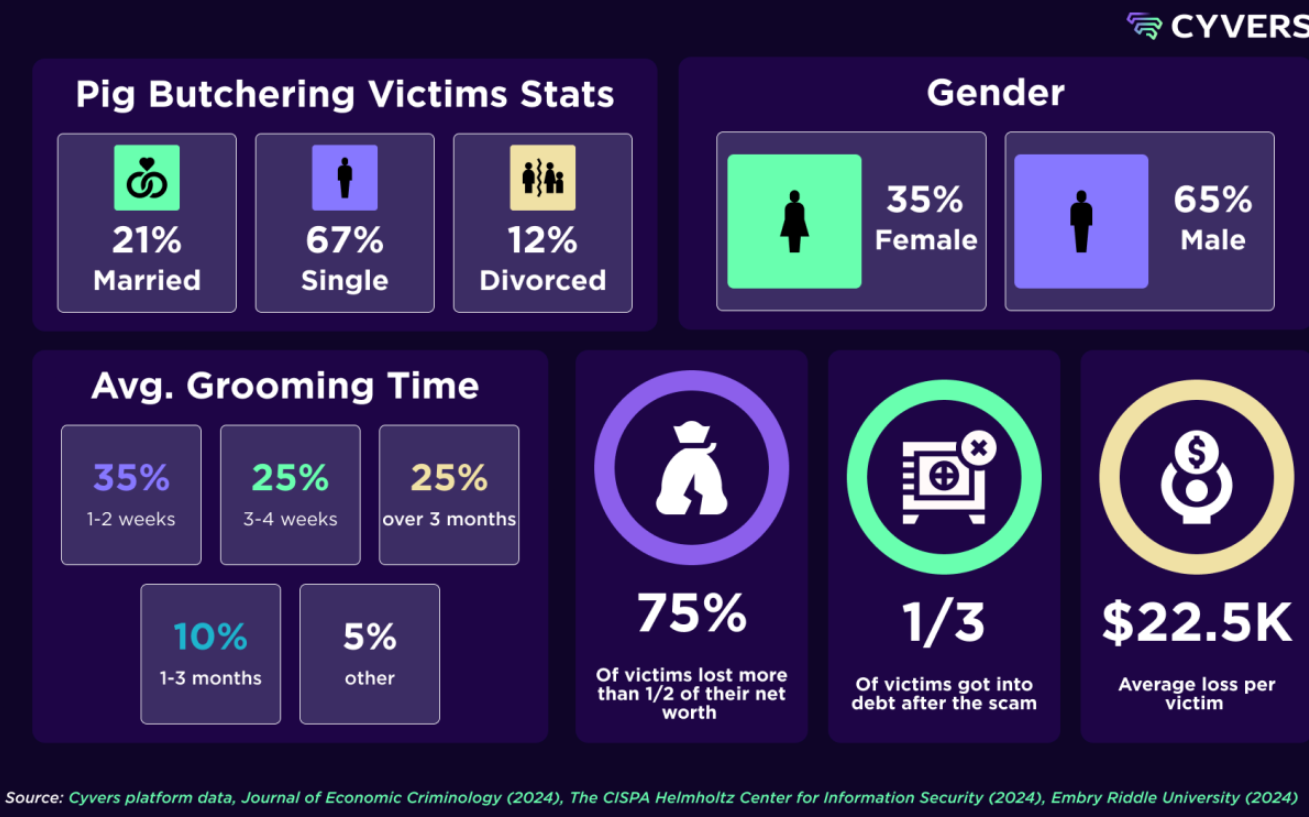
Pig butchering victim stats, grooming time. Source: Cyvers

Pig butchering scams are a subset of phishing scams that cost the industry a collective $5.5 billion in 2024, across 200,000 individual cases.

Notably, the average grooming period for victims is between one and two weeks in 35% of cases, while 10% of scams involve grooming periods of up to three months, according to blockchain security platform Cyvers.

In June, the US Department of Justice announced the seizure of over $225 million in crypto linked to pig butchering scams.

Magazine: Coinbase hack shows the law probably won’t protect you — Here’s why

Perguntas relacionadas

QAccording to CertiK's data, what was the total amount stolen by crypto hackers in 2025 and what was the most damaging type of attack?

ACrypto hackers stole a total of $3.3 billion in 2025. The most damaging type of attack was supply-chain breaches, which accounted for $1.45 billion in losses.

QWhat does the report suggest about the trend in protocol-level security based on the decline in incident counts and median theft sizes?

AThe decline in incident counts and the drop in median theft sizes suggest that protocol-level security is improving. This is pushing attackers away from simple code vulnerabilities and toward more sophisticated methods like phishing and infrastructure-level attacks.

QWhat was the average amount lost per hack and how much did it change from the previous year?

AThe average amount lost per hack stood at $5.3 million, which was a 66% increase from the previous year.

QWhat are 'pig butchering' scams and how much did they cost the industry in 2024?

A'Pig butchering' scams are a subset of phishing scams that involve prolonged emotional manipulation to convince victims to transfer their funds. They cost the industry a collective $5.5 billion in 2024 across 200,000 individual cases.

QWhat significant action did the US Department of Justice take regarding pig butchering scams in June?

AIn June, the US Department of Justice announced the seizure of over $225 million in cryptocurrency that was linked to pig butchering scams.

Leituras Relacionadas

Anthropic's IPO Launch: Commercial Miracle or Valuation Bubble?

Anthropic has confidentially filed for an IPO, led by Morgan Stanley and Goldman Sachs, potentially going public by October. Following its latest $650 billion funding round, its pre-IPO valuation stands at $965 billion, with projections reaching up to $2 trillion at listing, which would make it the highest-valued private company ever. The article, written by Fu Sheng, addresses skepticism that this represents an AI bubble akin to the 2000 dot-com crash. It argues the current situation differs fundamentally. Unlike the internet bubble era, which relied on speculative narratives with little revenue, Anthropic's valuation is backed by unprecedented, measurable financial performance. Key data points include: * **Revenue Growth:** ARR skyrocketed from $10 billion in early 2025 to $470 billion by May 2026, targeting $100 billion by year-end—a growth curve unmatched in business history. * **Profitability:** It achieved operating profitability in Q2 2026 with an estimated $5.6 billion profit. * **Efficiency:** With ~3,000 employees and ~$470 billion ARR, its revenue per employee exceeds $10 million. Products like Claude Code, launched less than a year ago, already generate $25 billion in annualized revenue. * **Enterprise Adoption:** It boasts a strong enterprise client base, with 8 of the Fortune 10 and over 1,000 large firms spending over $1 million annually on Claude. The valuation is framed using a traditional SaaS model (e.g., a 10x Price-to-Sales multiple on $100 billion revenue). The author contends the core question for analysts has shifted from "How big could this be?" to "How much is it earning and will earn next quarter?" The discussion extends beyond Anthropic to a broader paradigm shift: the transition from a "carbon-based" to a "silicon-based" economy. Companies are increasingly prioritizing investment in compute and AI capabilities over human resources, as these directly scale productivity and competitive advantage. Anthropic's IPO is thus positioned not just as a corporate milestone, but as a price anchor for this new economic era.

链捕手Há 4h

Anthropic's IPO Launch: Commercial Miracle or Valuation Bubble?

链捕手Há 4h

Trading

Spot
Futuros
活动图片





