Crypto Funds See Six Consecutive Weeks of Net Inflows, CLARITY Act Drives $858 Million Influx

marsbitPublicado em 2026-05-11Última atualização em 2026-05-11

Resumo

Global cryptocurrency investment products recorded a net inflow of $857.9 million last week, marking the sixth consecutive week of positive flows and the largest single-week inflow since April 24, according to CoinShares' latest report. The primary catalyst was legislative progress on the U.S. CLARITY Act, specifically the final compromise text for stablecoin yield provisions, alongside Bitcoin's price breaking above $80,000. U.S.-listed products dominated with $776.6 million in inflows, a significant jump from the prior week's $47.5 million. European markets also saw increased participation. Bitcoin products led with $706.1 million in inflows, while short-Bitcoin products experienced their largest weekly outflow of 2026, indicating unwinding bearish positions. Major altcoins like Ethereum, Solana, and XRP all saw renewed positive flows, with Ethereum reversing its prior week's outflow to attract $77.1 million. Total assets under management (AUM) climbed to $160 billion.

Author: James Butterfill (Head of Research, CoinShares)

Compiled by: Deep Tide TechFlow

Deep Tide Introduction: The latest weekly report from CoinShares shows that global crypto investment products recorded net inflows of $857.9 million last week, marking the sixth consecutive week of positive flows and the highest single-week inflow since April 24. The direct catalysts were the release of the compromise text for the stablecoin yield provisions in the CLARITY Act and Bitcoin's return above $80,000. Funds from the US market surged to $776.6 million from $47.5 million the previous week. Altcoin participation also expanded simultaneously, with ETH, SOL, and XRP all recording net inflows.

Progress on CLARITY Act Was the Core Variable Driving Fund Flows This Week

Global crypto investment products saw net inflows of $857.9 million last week, marking six consecutive weeks of positive flows and the largest single-week inflow since April 24. James Butterfill, Head of Research at CoinShares, directly attributed this acceleration to legislative progress on the CLARITY Act.

The timeline is clear: On May 1, Senators Tillis and Alsobrooks released the final compromise text for the stablecoin yield provisions; on May 4, the two lawmakers resisted lobbying pressure from the banking industry and maintained the compromise unchanged. A formal markup by the Senate Banking Committee is expected this week.

Bitcoin broke above $80,000 on Monday, reaching a new high since the February pullback. Total Assets Under Management (AUM) rose to $160 billion.
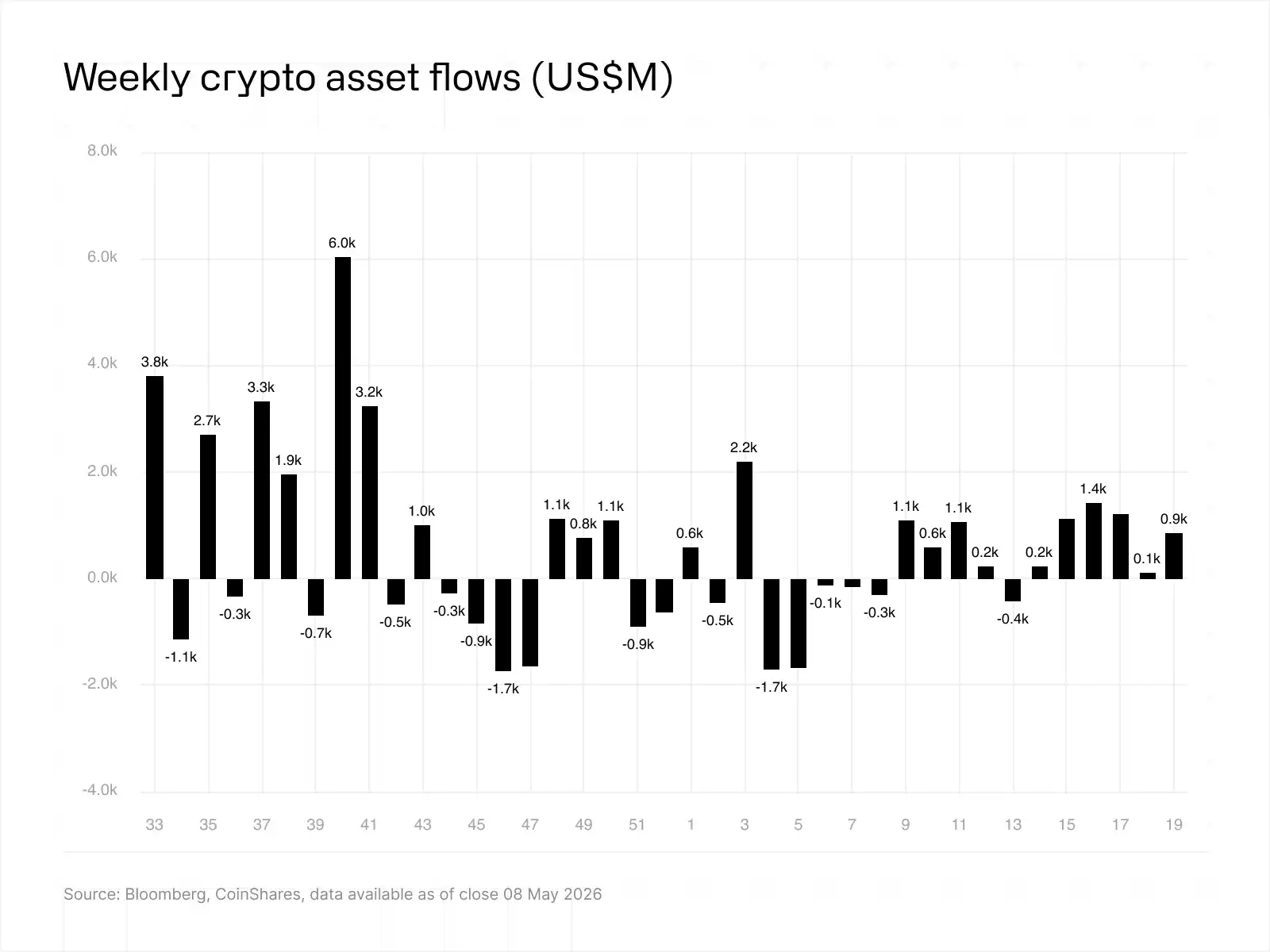
Caption: Weekly Global Crypto Asset Fund Flows, Source: CoinShares

US Fund Rebound Far Exceeds Previous Week

In terms of regional distribution, the United States dominated with net inflows of $776.6 million, showing a sharp rebound compared to the $47.5 million from the previous week.

Europe also showed improvement. Germany recorded $50.6 million, slightly higher than the previous week; Switzerland saw $21.1 million, and the Netherlands $5 million. Butterfill believes this indicates that while the buying momentum has returned to the US, there is also broader participation emerging in Europe.
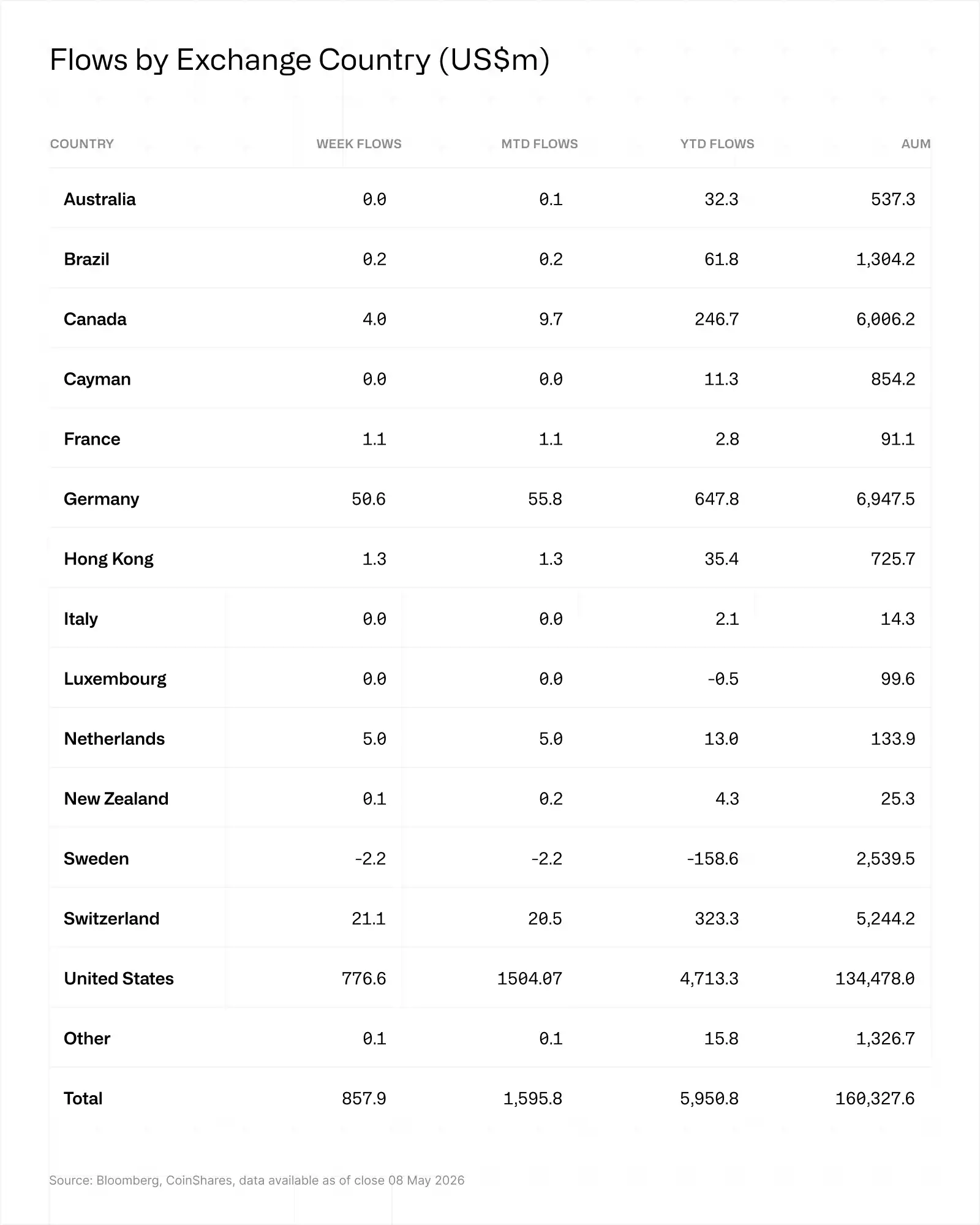
Caption: Fund Flows by Listing Country, Source: CoinShares

BTC Leads, Short Positions Accelerate Unwinding

Bitcoin products absorbed $706.1 million last week, bringing year-to-date cumulative inflows to $4.9 billion.

A noteworthy signal to unpack: Short-bitcoin products saw net outflows of $14.4 million last week, the largest single-week outflow in 2026. This suggests hedge positions are being unwound, indicating growing institutional confidence in the rebound.

Altcoins Rebound Across the Board, ETH Reverses Previous Week's Outflow

Ethereum products saw net inflows of $77.1 million, completely reversing the net outflow of $81.6 million from the previous week. Solana recorded $47.6 million, and XRP saw $39.6 million, both showing a significant acceleration compared to recent activity levels.

The only category with noticeable outflows was multi-asset products, with a net outflow of $5.5 million.
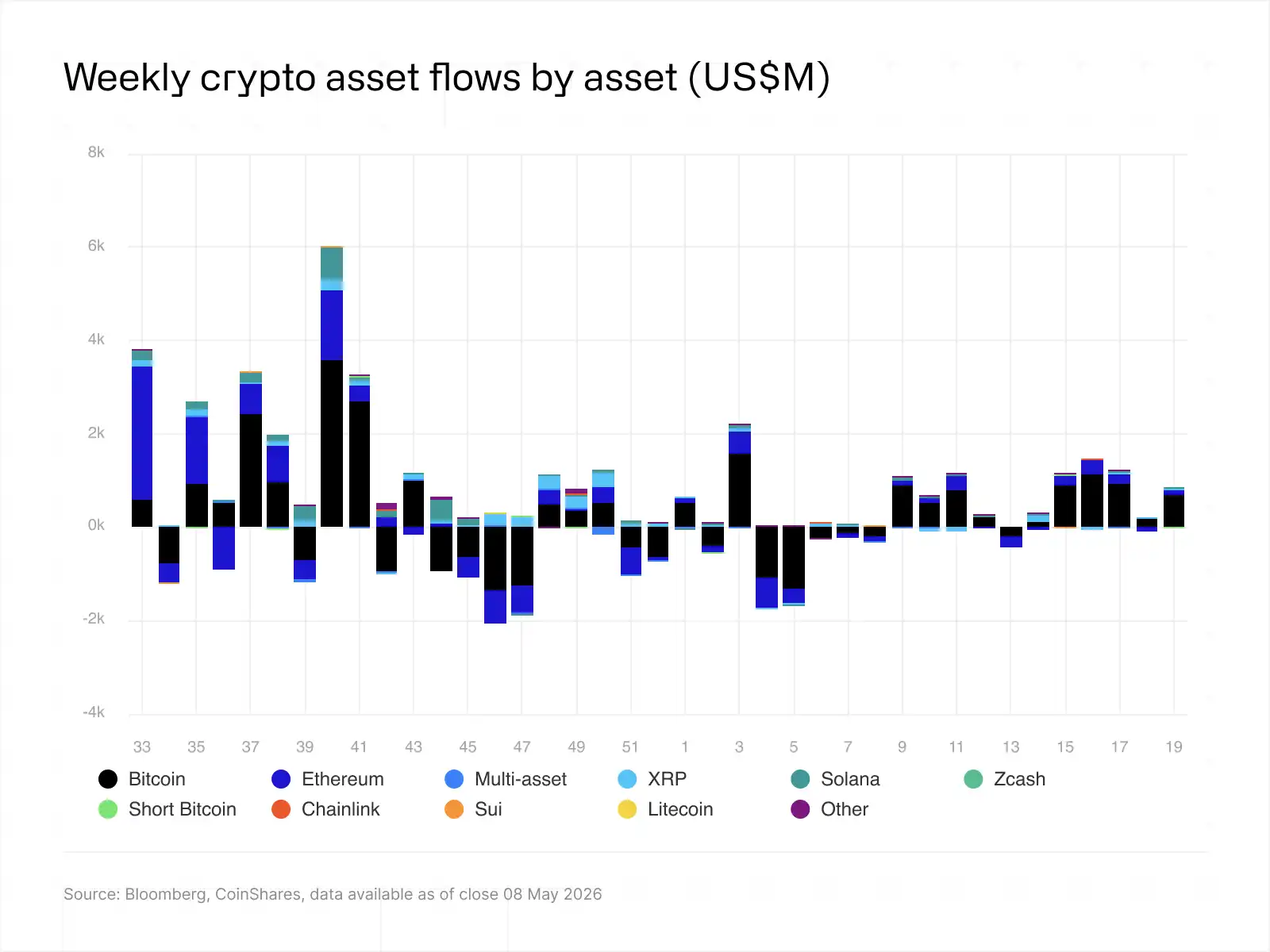
Caption: Weekly Fund Flows by Asset Class, Source: CoinShares
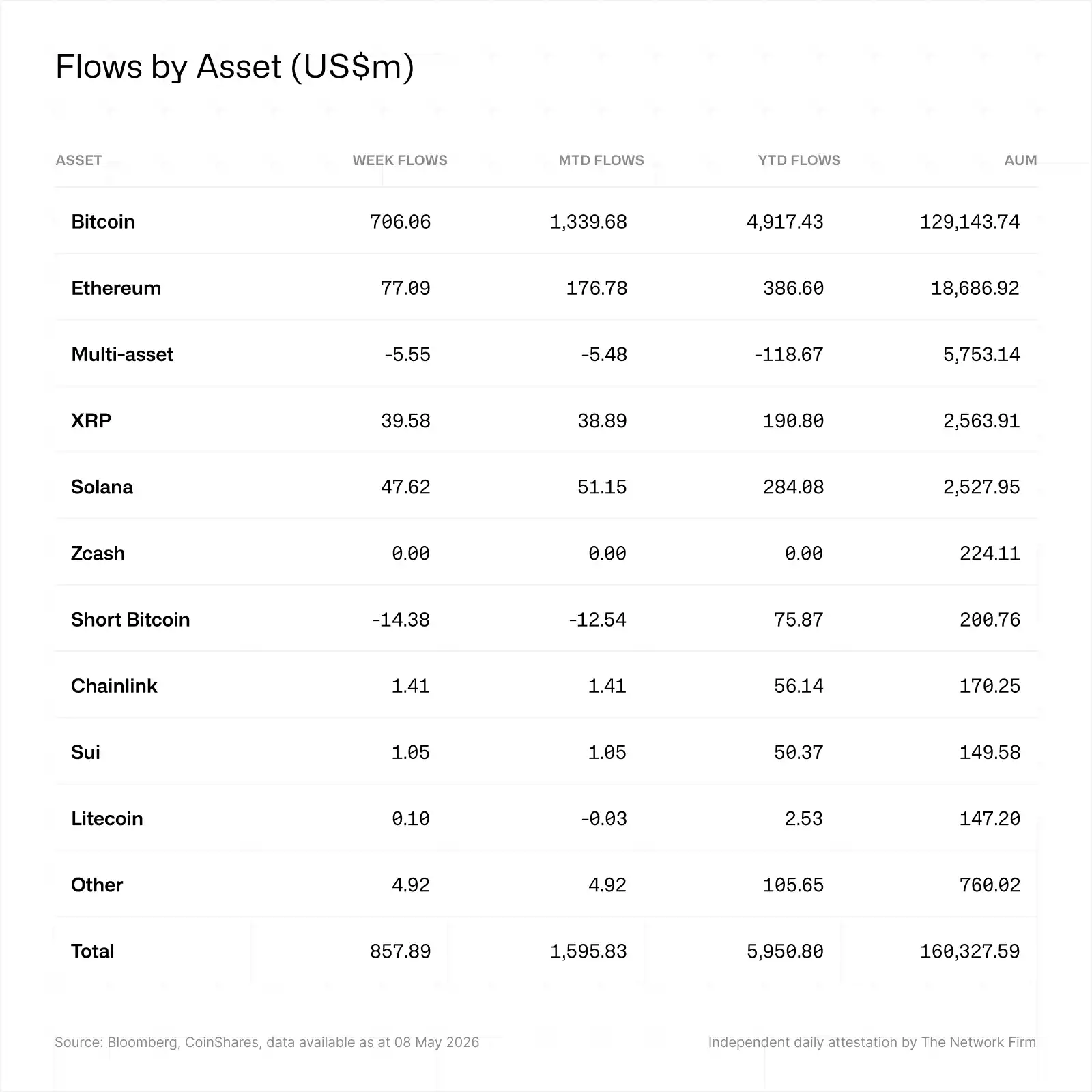
Caption: Detailed Fund Flows by Asset, Source: CoinShares
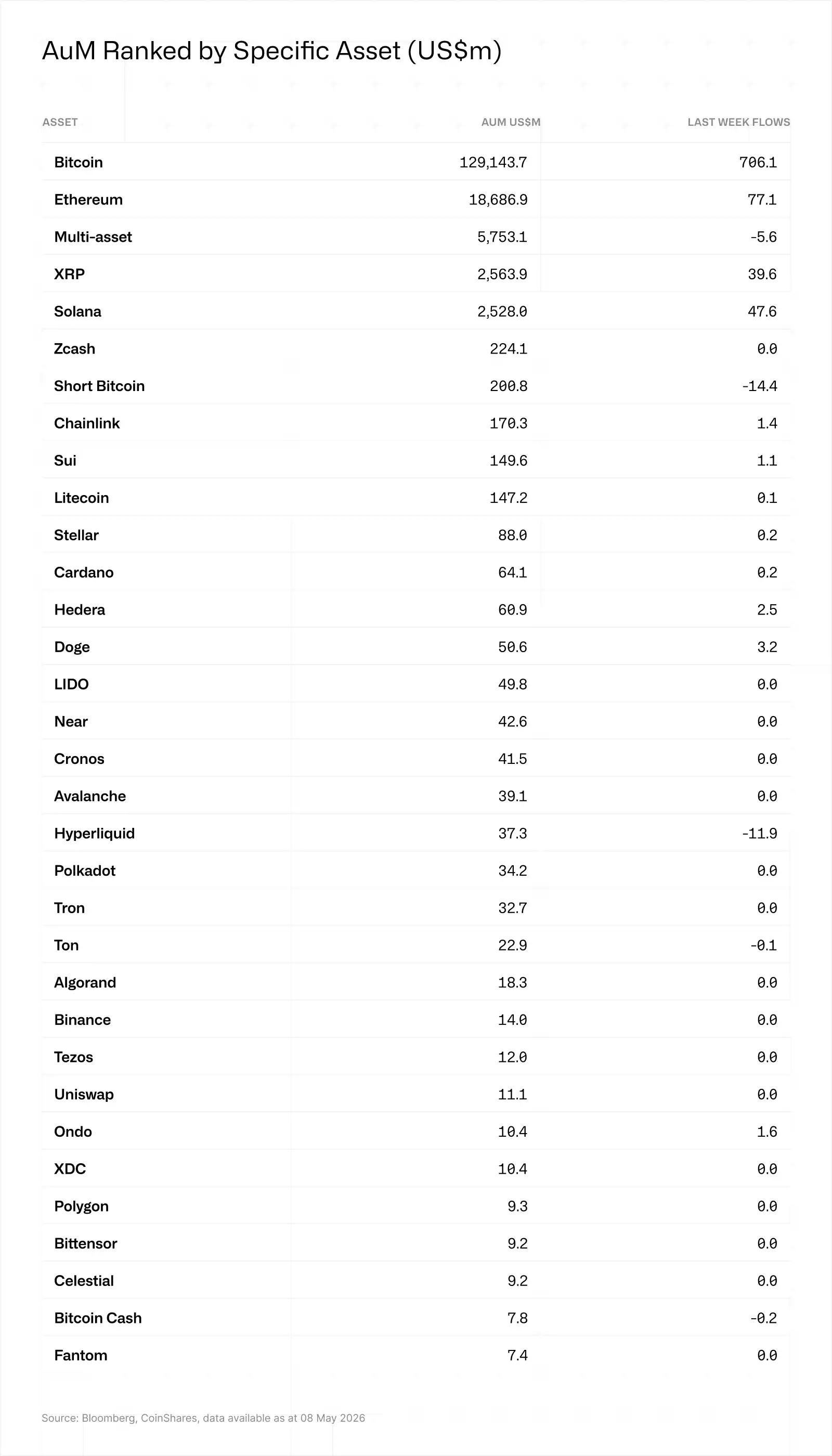
Caption: Assets Under Management Ranked by Specific Asset, Source: CoinShares


Perguntas relacionadas

QWhat was the main catalyst behind the record $857.9 million weekly inflow into crypto investment products, according to CoinShares?

AThe main catalyst was legislative progress on the CLARITY Act, specifically the release of a final compromise text for the stablecoin yield provision on May 1 and the sponsors' resistance to banking lobbying pressure to keep the compromise intact.

QWhich region saw the most significant week-over-week increase in net inflows for crypto investment products, and by how much?

AThe United States saw the most significant increase, with net inflows surging from $47.5 million the previous week to $776.6 million.

QWhat does the $14.4 million net outflow from short-bitcoin products signal about market sentiment, according to the article?

AThe largest weekly outflow for short-bitcoin products in 2026 signals that hedge positions are being unwound, indicating growing institutional confidence in the market's rebound.

QWhich three altcoin investment products saw notable net inflows alongside Bitcoin?

AEthereum (ETH), Solana (SOL), and XRP investment products all saw notable net inflows of $77.1 million, $47.6 million, and $39.6 million, respectively.

QWhat was the total Assets Under Management (AUM) for global crypto investment products mentioned in the report, and what was Bitcoin's price milestone?

AThe total Assets Under Management (AUM) reached $160 billion, while Bitcoin's price broke above $80,000, marking a new high since its correction in February.

Leituras Relacionadas

STRC Breaks Below $95: Why Does It Continue to Depeg? Is There Default Risk?

"STRC Falls Below $95: Why the Persistent Depegging and Is There Default Risk?" The article discusses the recent decline in the price of STRC, a perpetual preferred stock issued by Strategy (MSTR) designed to trade around a $100 par value. As of publication, STRC traded at $94.65, raising market concerns. STRC is described as a high-yield cash flow product, offering an 11.50% annual dividend paid monthly. Its "preferred" status grants it priority over common stock for dividends and in liquidation. Key reasons cited for the price depegging include: 1. **Bitcoin's Price Drop:** MSTR's assets are heavily tied to Bitcoin (BTC), which fell over 21% from its recent high, pressuring all Strategy-related products. 2. **Competitive Pressure:** Rival Strive Asset Management's similar product, SATA, offers daily dividends and has maintained its $100 par value with a ~13% yield. In response, Strategy has proposed changing STRC's dividend frequency from monthly to bi-weekly, pending shareholder vote. 3. **Technical Selling:** A break below $100 may have triggered algorithmic selling and stop-losses, exacerbating the decline. Regarding default risk, the analysis suggests it is currently low. Strategy founder Michael Saylor confirmed the June 2026 dividend rate remains at 11.50% with no cuts or suspensions. The company's massive reserve of 843,706 BTC provides a significant backstop for its obligations. Industry opinions are mixed. Some analysts view the BTC holdings as reliable support for dividends, while critics like Peter Schiff warn of potential dividend cuts leading to price crashes and lawsuits. Others highlight inflation risk and the company's ability to reduce dividends without a formal default. In summary, STRC's drop is attributed to BTC volatility, competition, and technical factors. While immediate default risk appears contained, the product faces challenges from market conditions and competitive dynamics.

marsbitHá 1h

STRC Breaks Below $95: Why Does It Continue to Depeg? Is There Default Risk?

marsbitHá 1h

AI Trading Cools, South Korean Stocks Plunge 1.8%, Spot Gold Rises 1%, Bitcoin Dives

A sell-off in AI-related stocks, triggered by Broadcom's disappointing earnings forecast, sent shockwaves through global markets. South Korea's KOSPI led Asia's decline, plunging 1.8% as the risks from concentrated chip stock gains and surging leveraged investments came to the fore. The tech-heavy Nasdaq 100 futures fell 0.5% following Broadcom's 14% after-hours plunge, which signaled a slower-than-expected transition to AI clients. This pullback extended Wall Street's weakness, halting the S&P 500's nine-day rally amid hawkish Fed signals and renewed Middle East tensions. South Korean authorities convened an emergency meeting, pledging "immediate measures" against market volatility and warning of record-high stock margin debt. The adjustment rippled across assets: Bitcoin fell to around $64,000, its lowest since February, while safe-haven gold rose 1% on bargain hunting. Oil prices dipped on Middle East ceasefire news. Market analysts noted the sell-off was driven by profit-taking after massive gains, particularly in chip stocks like Samsung and SK Hynix, which now dominate the KOSPI. Wall Street banks are divided on Korea's outlook, with Goldman Sachs raising its target while Citigroup and others warn of overvaluation and a potential bubble. Bridgewater's Ray Dalio noted that great technological shifts often create bubbles. Meanwhile, Fed officials' hints at potential future rate hikes added to the cautious mood ahead of key U.S. jobs data.

华尔街日报Há 1h

AI Trading Cools, South Korean Stocks Plunge 1.8%, Spot Gold Rises 1%, Bitcoin Dives

华尔街日报Há 1h

Trading

Spot
Futuros
活动图片