Crypto Funds See Record Exodus: $1.7 Billion Leaves Market

bitcoinistPublicado em 2026-01-27Última atualização em 2026-01-27

Resumo

Crypto investment products experienced a record weekly outflow of $1.73 billion, the largest since November 2025. The outflows were driven by fading hopes for interest rate cuts, weak price momentum, and crypto's failure to act as a reliable inflation hedge. Major issuers like BlackRock and Fidelity saw significant withdrawals, with the U.S. market accounting for nearly $2 billion of the movement. Bitcoin and Ether funds led the outflows, losing $630 million and $1.10 billion respectively, while some altcoins like Solana saw modest inflows. Despite the sell-off, market confidence appears unsettled rather than broken, with investors shifting strategies rather than fully exiting the market.

Crypto investment vehicles dumped cash last week in a move that startled many market watchers. According to CoinShares, crypto exchange-traded products saw about $1.73 billion of outflows — the largest weekly withdrawal since mid-November 2025.

The pullback came after a recent stretch of inflows, which left some investors caught between hope and caution. Reports say fading hopes for quick interest rate cuts, weak price momentum, and a sense that crypto has not yet played the inflation hedge role many expected helped drive the exit.

Flows Reverse Sharply

Big names felt the hit. BlackRock’s iShares led issuers with roughly $950 million leaving its coffers. Fidelity lost close to $470 million, and Grayscale saw withdrawals near $270 million.

In the regional front, the US accounted for the bulk of the movement, with nearly $2 billion exiting from that market alone.
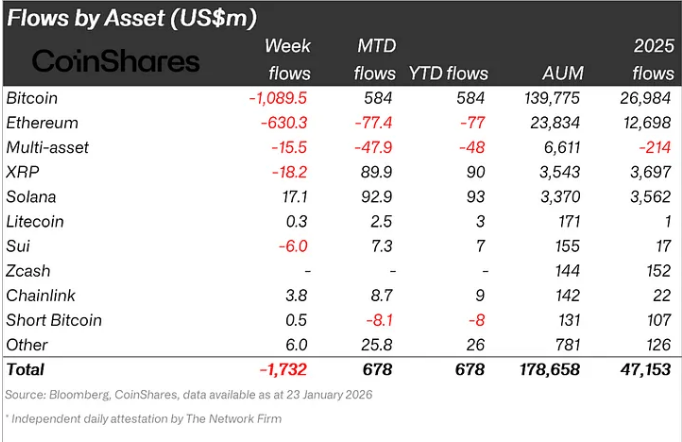
Weekly crypto ETP flows by asset in millions of USD. Source: CoinShares

Some managers did attract fresh capital — groups focused on volatility or niche strategies posted modest gains — showing that investors are shifting tactics rather than abandoning the sector entirely.

Who Pulled Money Out

Bitcoin and Ether were the largest contributors to the outflows. Combined, they comprise most of the $1.73 billion. Based on reports, Ether funds lost roughly $1.10 billion while Bitcoin-focused products shed about $630 million.

Total crypto market cap currently at $2,95 trillion. Chart: TradingView

That split shows a renewed skepticism about large-cap tokens even as traders weigh macro signals. Smaller tokens told a mixed story: Solana drew about $17 million in inflows, while XRP and SUI saw withdrawals of a little over $18 million and $6 million, respectively.

Bitcoin Price Action

Meanwhile, price moves matched the money flow. Bitcoin traded in a choppy range and slipped below $90,000 at one point as risk appetite evaporated. But it did not cave in.

Periodic buying returned, and shorts were put under stress when prices bounced back. Traders are watching macro cues; weakness in sentiment has been paired with bouts of institutional interest, creating a seesaw battle that keeps volatility up.

What This Means For Traders

Market behavior suggests that confidence is unsettled, not totally evaporated. Reports note that investors are recalibrating timeframes and tools. Some are rotating into altcoins that look cheap to them, while others beef up hedges or step back from leveraged positions.

Featured image from Unsplash, chart from TradingView

Perguntas relacionadas

QWhat was the total amount of outflows from crypto exchange-traded products last week, and why was it significant?

AThe total outflows were approximately $1.73 billion. This was significant because it marked the largest weekly withdrawal since mid-November 2025.

QWhich three major issuers saw the largest outflows, and how much did each lose?

ABlackRock’s iShares led with about $950 million in outflows, Fidelity lost close to $470 million, and Grayscale saw withdrawals of nearly $270 million.

QAccording to the article, what were the three main factors that helped drive the massive exit from crypto funds?

AThe three main factors were fading hopes for quick interest rate cuts, weak price momentum, and a sense that crypto has not yet played the inflation hedge role many expected.

QWhich two cryptocurrencies were the largest contributors to the outflows, and what were the respective amounts?

ABitcoin and Ether were the largest contributors. Ether funds lost roughly $1.10 billion, while Bitcoin-focused products shed about $630 million.

QDespite the record outflows, what does the market behavior suggest about overall investor confidence?

AThe market behavior suggests that confidence is unsettled but not totally evaporated, as investors are shifting tactics and some are rotating into altcoins or adjusting their strategies rather than abandoning the sector entirely.

Leituras Relacionadas

OpenAI's 'Blueprint for the Future': Making AI Beneficial for Every Person on the Planet

A new transformative technology emerges every few generations. OpenAI draws a parallel with the advent of electricity in the 1920s, which initially brought convenience but ultimately enabled unprecedented progress in medicine, engineering, and living standards by empowering people to create new possibilities. AI is poised to recreate this phenomenon. Its true significance lies not in the technology itself, but in what people can achieve with it—from understanding a medical bill or starting a business to aiding scientific discovery. OpenAI believes AI should be universally accessible, allowing everyone to use it according to their own needs. This future, however, is not guaranteed. While transformative tech can centralize power, OpenAI's philosophy is that AI must serve humanity, augmenting human capabilities and broadly distributing its benefits. The company's first commitment is to build AI for human service, aiming to empower the many rather than concentrate power in a few. Safety, alignment with human intent, and oversight are paramount. OpenAI is optimistic about AI's potential to expand human welfare but remains clear-eyed about risks. The goal is to help people achieve more, not to replace them. Full automation is not the desired future; human judgment, values, and direction will become even more critical. OpenAI outlines three core goals: 1. Build automated AI researchers to accelerate and increasingly automate the research process itself, maintaining close human collaboration. The internal projection is that by March 2028, a significant portion of their research will be conducted by AI systems working alongside human researchers. 2. Accelerate economic development by advancing science, boosting productivity, and fostering growth, while ensuring the fruits are widely shared. 3. Provide a personal AGI for everyone on Earth, allowing individuals to benefit from this transformative technology in their own way. The company is entering its third phase, moving from foundational AGI research (Phase 1) to product deployment and learning from real-world use (Phase 2). The current challenge is making advanced AI abundant, affordable, safe, practical, and usable for all individuals and organizations. OpenAI concludes that a widely distributed power structure leads to a more resilient, adaptable, and free society. A positive AI future should not be controlled by a handful of entities but built, benefited from, and owned by many. If realized correctly, AI can become a cornerstone for enhancing global productivity, creativity, scientific advancement, and economic opportunity, fulfilling the mission to ensure AGI benefits all of humanity.

marsbitHá 20m

OpenAI's 'Blueprint for the Future': Making AI Beneficial for Every Person on the Planet

marsbitHá 20m

Arthur Hayes' New Article: AI Bubble Nears Bursting, Crypto Market Faces Short-Term Pressure

In a new essay, Arthur Hayes argues that the AI market bubble is approaching a rupture, which will place significant short-term pressure on crypto assets. He identifies rising oil prices, a trio of massive tech IPOs (SpaceX, Anthropic, OpenAI), and potential anti-AI political rhetoric from Trump as the three key catalysts for a correction. Hayes posits that the prolonged blockage of the Strait of Hormuz will drive energy prices higher, increasing operational costs for data centers and squeezing AI company profits. Simultaneously, the market may struggle to absorb the upcoming wave of multi-trillion dollar tech IPOs. Furthermore, with high inflation hurting his election chances, Trump could pivot to attacking the AI sector with proposals for heavy taxation and regulation to win over voters, spooking the market. Hayes notes that nearly all new dollar liquidity since 2022 has flowed into the AI sector, leaving little for Bitcoin, explaining its recent underperformance. He believes an AI stock crash would trigger a broad risk-off sentiment and credit contraction, dragging down crypto in the near term. Consequently, his fund, Maelstrom, has sold all AI-related stocks and non-core cryptocurrencies, retaining only Bitcoin and Ethereum while building positions in traditional energy stocks. He anticipates Bitcoin will bottom and resume its bull run only after the AI bubble pops and a new monetary easing cycle begins.

marsbitHá 23m

Arthur Hayes' New Article: AI Bubble Nears Bursting, Crypto Market Faces Short-Term Pressure

marsbitHá 23m

Trading

Spot
Futuros

Artigos em Destaque

Como comprar MOVE

Bem-vindo à HTX.com!Tornámos a compra de Movement (MOVE) simples e conveniente.Segue o nosso guia passo a passo para iniciar a tua jornada no mundo das criptos.Passo 1: cria a tua conta HTXUtiliza o teu e-mail ou número de telefone para te inscreveres numa conta gratuita na HTX.Desfruta de um processo de inscrição sem complicações e desbloqueia todas as funcionalidades.Obter a minha contaPasso 2: vai para Comprar Cripto e escolhe o teu método de pagamentoCartão de crédito/débito: usa o teu visa ou mastercard para comprar Movement (MOVE) instantaneamente.Saldo: usa os fundos da tua conta HTX para transacionar sem problemas.Terceiros: adicionamos métodos de pagamento populares, como Google Pay e Apple Pay, para aumentar a conveniência.P2P: transaciona diretamente com outros utilizadores na HTX.Mercado de balcão (OTC): oferecemos serviços personalizados e taxas de câmbio competitivas para os traders.Passo 3: armazena teu Movement (MOVE)Depois de comprar o teu Movement (MOVE), armazena-o na tua conta HTX.Alternativamente, podes enviá-lo para outro lugar através de transferência blockchain ou usá-lo para transacionar outras criptomoedas.Passo 4: transaciona Movement (MOVE)Transaciona facilmente Movement (MOVE) no mercado à vista da HTX.Acede simplesmente à tua conta, seleciona o teu par de trading, executa as tuas transações e monitoriza em tempo real.Oferecemos uma experiência de fácil utilização tanto para principiantes como para traders experientes.

308 Visualizações TotaisPublicado em {updateTime}Atualizado em 2026.06.02

Como comprar MOVE

Discussões

Bem-vindo à Comunidade HTX. Aqui, pode manter-se informado sobre os mais recentes desenvolvimentos da plataforma e obter acesso a análises profissionais de mercado. As opiniões dos utilizadores sobre o preço de MOVE (MOVE) são apresentadas abaixo.

活动图片













