Crypto funds log second week of inflows after massive $5.5B selloff

cointelegraphPublicado em 2025-12-08Última atualização em 2025-12-08

Resumo

Cryptocurrency investment products recorded their second consecutive week of inflows, attracting $716 million, following a previous week of $1 billion in gains. This marks a recovery after a significant $5.5 billion selloff over four weeks, bringing total assets under management to over $180 billion—an 8% rebound from November lows, though still below the all-time high of $264 billion. Bitcoin led inflows with $352 million, followed by XRP with $244 million. Chainlink saw a record inflow of $52.8 million, representing 54% of its AUM. Ether had minor inflows of $39 million, while short Bitcoin products saw outflows, suggesting reduced negative sentiment. Among issuers, ProShares led with $210 million in inflows, while BlackRock experienced $105 million in outflows. Geographically, the U.S., Germany, and Canada saw the highest inflows, whereas Sweden continued to record outflows.

Cryptocurrency investment products maintained upward momentum last week, logging two consecutive weeks of gains following substantial outflows.

Crypto exchange-traded products (ETPs) attracted $716 million in inflows last week, adding to the previous week’s gains of $1 billion, European crypto asset manager CoinShares reported Monday.

“Daily data highlighted minor outflows on Thursday and Friday in what we believe was a response to macroeconomic data in the US alluding to ongoing inflationary pressures,” CoinShares’ head of research, James Butterfill, said in the update.

The new inflows pushed total assets under management (AUM) above $180 billion, marking an 8% rebound from November lows following $5.5 billion of four-week outflows. However, AUM remains well below its all-time high of $264 billion, Butterfill noted.

Bitcoin leads inflows, Chainlink posts record inflow

Bitcoin (BTC) led crypto ETP gains last week, attracting $352 million in inflows, followed by XRP (XRP) funds with $244 million.

Chainlink (LINK) stood out with a record inflow of $52.8 million, which represented 54% of its AUM.
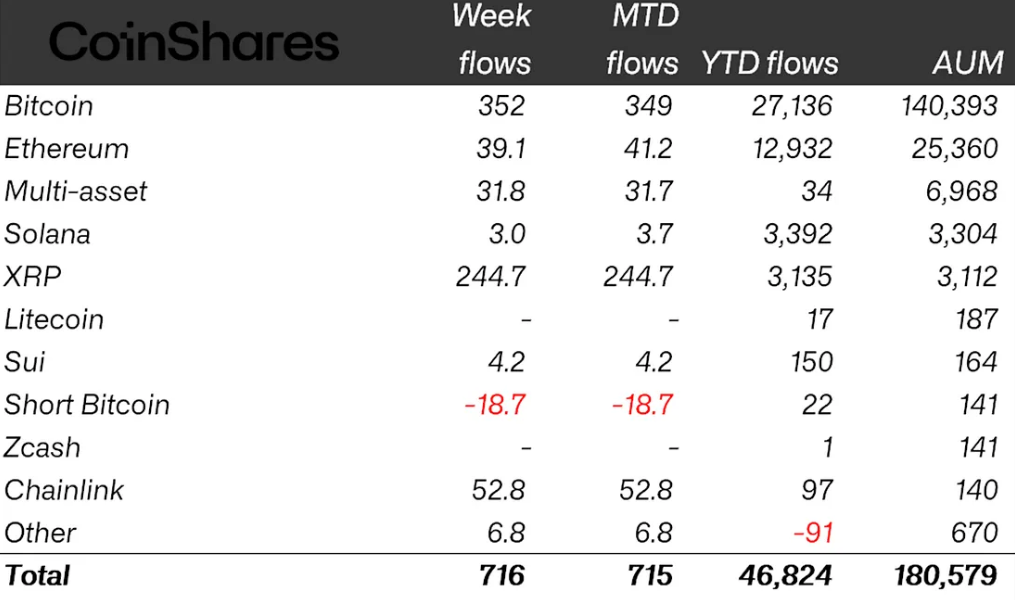
Weekly crypto ETP flows by asset as of Friday (in millions of US dollars). Source: CoinShares

On the other hand, Ether (ETH) funds saw minor inflows of $39 million, while short Bitcoin ETPs posted around $19 million in outflows, potentially indicating a lessening of negative sentiment.

ProShares tops inflows, while BlackRock’s iShares bleeds

Among issuers, ProShares led inflows with $210 million, while BlackRock — the largest issuer by AUM — experienced $105 million in outflows.

Cathie Wood’s ARK and Grayscale Investments also saw outflows, recording $78 million and $7 million, respectively, last week.
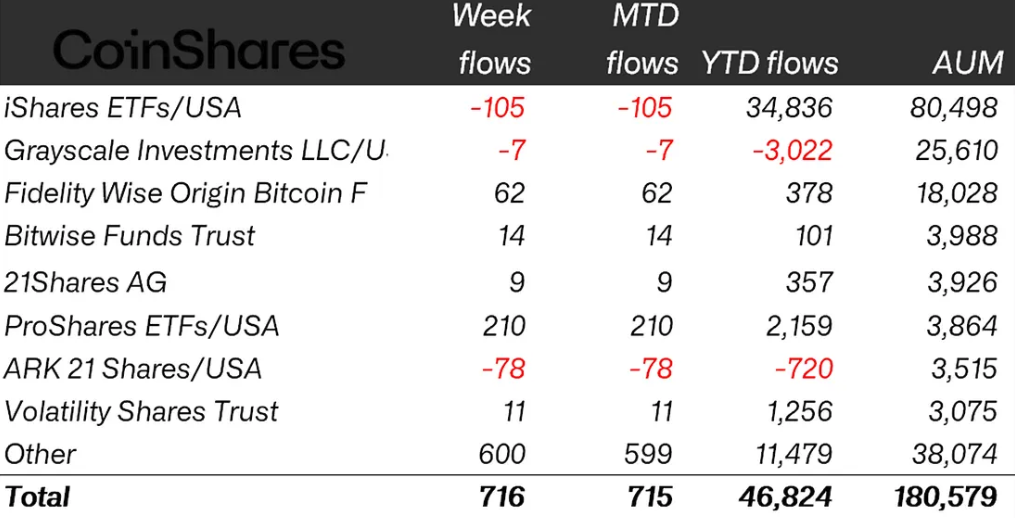
Weekly crypto ETP flows by issuer as of Friday (in millions of US dollars). Source: CoinShares

Geographically, almost all regions globally saw inflows, with the most notable being the US, Germany and Canada, with inflows of $483 million, $97 million and $80.7 million, respectively.

Related: Sweden eyes entering the Bitcoin ‘digital arms race’

On the other hand, Sweden saw $5.6 million in outflows last week, pushing its year-to-date outflows to $836 million, topping global outflows.

Magazine: Koreans ‘pump’ alts after Upbit hack, China BTC mining surge: Asia Express


Perguntas relacionadas

QWhat was the total amount of inflows into crypto ETPs for the week reported by CoinShares?

ACrypto ETPs attracted $716 million in inflows for the week.

QWhich cryptocurrency fund led the inflows, and how much did it attract?

ABitcoin (BTC) funds led the inflows, attracting $352 million.

QWhich asset manager experienced the largest outflows among the issuers mentioned?

ABlackRock, the largest issuer by AUM, experienced the largest outflows at $105 million.

QWhat record did Chainlink (LINK) funds set according to the report?

AChainlink (LINK) funds posted a record inflow of $52.8 million, which represented 54% of its Assets Under Management (AUM).

QWhat was the primary reason suggested for the minor outflows on Thursday and Friday?

AThe minor outflows were suggested to be a response to US macroeconomic data alluding to ongoing inflationary pressures.

Leituras Relacionadas

With Two Consecutive Quarters of Losses, Coinbase Must Rely on Paths Beyond Trading

Coinbase posted its second consecutive quarterly net loss of $359 million on $1.22 billion in revenue for Q2, highlighting its vulnerability to crypto market cycles where weaker prices and lower volatility reduce user trading. However, the report also reveals a strategic shift in its business model. Despite a 25% quarter-over-quarter decline in global spot trading volume, Coinbase increased its market share to a company-record 10.3%. This suggests its position as a compliant U.S. on-ramp is strengthening even in a cooler market. A key development is the diversification of revenue streams. Transaction revenue fell to $599 million, nearly equaling subscription and services revenue of $555 million. Stablecoin services, generating $292 million, are becoming a crucial revenue "floor." This income, derived from interest on the $20 billion average USDC balance held on its platform, is less tied to daily trading activity. Furthermore, while spot trading volume dropped significantly, derivatives volume held steady at $1.03 trillion. Coinbase is pushing to integrate spot, stablecoin, and derivatives liquidity to create a more interconnected and sticky ecosystem for users. The GAAP net loss includes non-cash expenses like stock-based compensation and crypto asset valuation changes. Its adjusted EBITDA remained positive at $208 million for the 14th straight quarter, indicating core operations can cover ongoing costs. The company is also reducing expenses to manage the downturn. The central question moving forward is whether Coinbase's growing market share, stablecoin revenues, and expanding product integration can sufficiently offset the inherent cyclicality of its core trading business during future market contractions.

marsbitHá 12m

With Two Consecutive Quarters of Losses, Coinbase Must Rely on Paths Beyond Trading

marsbitHá 12m

In the Age of Artificial Intelligence, We Need 'Magicians,' Not 'Managers'

In the AI era, leadership must shift from management to magic. As knowledge rapidly expires, value shifts from what leaders know to what they can facilitate. Traditional "inside-out" management, driven by internal experience, is giving way to "outside-in" thinking focused on external opportunities, customer needs, and disruptive change. The core challenge is fostering new ideas that may invalidate existing knowledge. While technologies like steam, electricity, and AI provide the "skeleton" for innovation, it is human vision—connecting technology to customer dreams—that creates magic. Historical figures like Richard Arkwright and Eldridge R. Johnson succeeded not by inventing core technologies, but by reimagining work and business models from the outside in. Leaders must transition from controllers to "architects of flourishing." Their role is to design environments where empowerment, creativity, and adaptive learning thrive. This involves granting autonomy, fostering partnerships, and building resilient systems that scale innovation. Critical leadership qualities now include judgment, creativity, and the ability to learn continuously rather than relying on static expertise. Therefore, cultivating future leaders requires a focus on timeless fundamentals, humanities for broader perspective, and social acuity, rather than over-specialization in quickly outdated technical skills. The future rewards those who respond to the unseen and create conditions for better answers to emerge. Leadership in the AI age is less about having all the answers and more about enabling others to discover them—creating organizations where people explore, imagine, and thrive.

marsbitHá 47m

In the Age of Artificial Intelligence, We Need 'Magicians,' Not 'Managers'

marsbitHá 47m

Trading

Spot
活动图片