Crypto Exchange Backpack Targets Token Launch Soon, as BMIC Fires Up Quantum Defense

bitcoinistPublicado em 2026-02-10Última atualização em 2026-02-10

Resumo

Crypto exchange Backpack is signaling an imminent token launch, leveraging growing activity and trading on the Solana ecosystem. The platform, known for its points-based rewards system, is positioning itself as a regulated "super app" combining a non-custodial wallet with exchange services. Meanwhile, a growing security threat is emerging: the risk posed by quantum computing to current encryption standards. Hackers are already using a "Harvest Now, Decrypt Later" strategy, collecting encrypted blockchain data to decrypt later when quantum computers become powerful enough. In response, BMIC is developing a quantum-secure financial infrastructure, featuring a wallet with post-quantum cryptography that avoids public-key exposure and integrates AI-driven threat detection. Its ongoing presale has raised over $445K, reflecting investor interest in long-term security solutions. The trend highlights a market split between short-term speculative trading on platforms like Backpack and long-term investments in infrastructure aimed at mitigating future technological risks.

Trusted Editorial content, reviewed by leading industry experts and seasoned editors. Ad Disclosure

Quick Facts:

  • ➡️ Backpack exchange is signaling an imminent token launch, capitalizing on increased Solana ecosystem activity and trading volume.
  • ➡️ The ‘Harvest Now, Decrypt Later’ strategy by hackers necessitates an urgent upgrade to blockchain encryption standards before quantum computing matures.
  • ➡️ BMIC provides a necessary solution with its quantum-secure wallet and AI-driven threat detection, aiming to protect assets from future decryption threats.
  • ➡️ The industry is seeing a bifurcated trend: immediate speculative trading on exchanges versus long-term infrastructure hedging against existential tech risks.

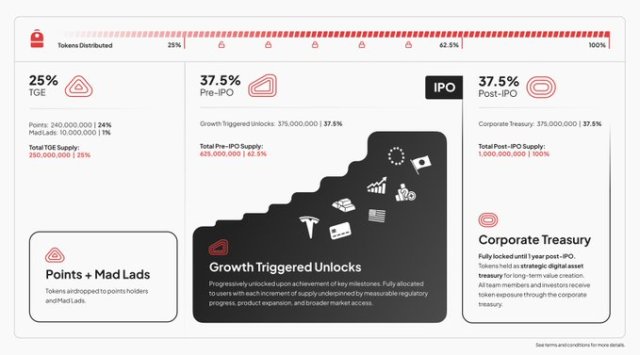
The Solana ecosystem is bracing for another liquidity injection as the highly anticipated Backpack exchange token launch moves closer to reality. For months, the platform, founded by the creators of the Mad Lads NFT collection, has run a points program rewarding volume.

Traders know the drill: points usually mean a native token generation event (TGE) is just around the corner. It’s a strategy that has successfully siphoned volume from established giants, positioning Backpack not just as a centralized exchange (CEX), but as a regulated ‘super app’ blending a non-custodial wallet with a trading venue.

The timing is impeccable. With Bitcoin hovering near all-time highs and liquidity rotating back into high-performance chains like Solana, the appetite for infrastructure plays is peaking. Smart money isn’t just chasing speculative fervor anymore; it’s positioning itself in protocols with tangible utility.

Backpack’s potential launch represents a shift toward platforms that actually blend a compliant user experience with a decentralized ethos.
But while capital floods into these next-gen exchanges, the security architecture supporting them faces a quieter, darker threat. The looming arrival of quantum computing poses a severe risk to the standard encryption protecting nearly every digital asset in circulation.

While traders focus on the immediate upside of a Backpack airdrop, forward-thinking investors are asking a harder question: what protects those gains five years from now? This search for longevity has directed significant attention toward BMIC ($BMIC), a project engineering the first quantum-secure financial stack designed to survive the post-quantum era.

Learn more about BMIC here.

Post-Quantum Cryptography Redefines Wallet Security

The crypto industry faces a ‘Harvest Now, Decrypt Later’ threat vector that most retail participants overlook. Nation-states and malicious actors are currently scraping encrypted blockchain data, which is immutable and public, to store it until quantum computers are powerful enough to break the RSA and Elliptic Curve Cryptography (ECC) standards securing Bitcoin and Ethereum.

BMIC addresses this inevitability by deploying a quantum-secure wallet infrastructure utilizing post-quantum cryptography (PQC). Unlike legacy wallets that leave public keys exposed after transactions, this protocol ensures zero public-key exposure.

And it doesn’t stop at encryption. The project integrates an AI-enhanced threat detection system directly into its Quantum Meta-Cloud.

This creates a dual-layer defense: cryptographic hardness against brute force attacks and active, algorithmic monitoring for anomalous transaction patterns. For enterprises and high-net-worth holders, this distinction is critical. Current security solutions focus on phishing and seed phrase management, but they remain fundamentally vulnerable to the mathematical breakthroughs quantum computing will bring.

This project’s approach to ERC-4337 Smart Accounts further modernizes the user experience, allowing for abstracting gas fees and social recovery without compromising the quantum-proof shield.

$BMIC is available here.

Early Investors Target BMIC Presale for Future-Proof Gains

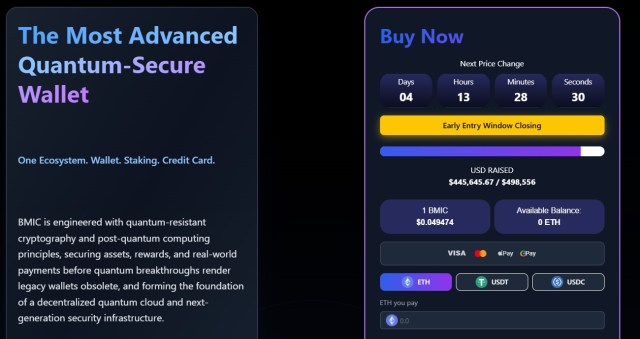
As the narrative shifts from speed to security, capital is beginning to flow into the BMIC presale, which has already raised $445K+. The project is currently offering tokens at $0.049474, a price point reflecting an early-stage valuation for infrastructure that aims to become an industry standard.
The utility of the token extends beyond simple governance; it functions as ecosystem fuel for the entire stack, including the ‘Burn-to-Compute’ mechanism and access to quantum-secure payment layers.

The robust raise indicates the market is waking up to the necessity of PQC. While exchanges like Backpack capture the current trading zeitgeist, infrastructure protocols like this are hedging against the technological obsolescence of current blockchain security.

The integration of staking and governance within a quantum-secure environment solves the dilemma of having to choose between earning yield and maintaining maximum security. With the presale ongoing, participants are effectively betting that the transition to quantum-resistant ledgers isn’t a matter of ‘if,’ but ‘when.’

Buy your $BMIC here.

Disclaimer: The information provided in this article is for educational purposes only and does not constitute financial advice. Cryptocurrency investments carry high risk, including the potential loss of all invested capital. Always conduct independent research.

Editorial Process for bitcoinist is centered on delivering thoroughly researched, accurate, and unbiased content. We uphold strict sourcing standards, and each page undergoes diligent review by our team of top technology experts and seasoned editors. This process ensures the integrity, relevance, and value of our content for our readers.

patrubogdan

Follow

Full Profile

Related Posts

US Debt Spiral Eyes $39T: Why Bitcoin Hyper ($HYPER) Is The Hedge to Watch

Ethereum Foundation Backs SEAL Initiative as LiquidChain L3 Protocol Gains Traction

Vitalik Buterin Outlines Ethereum’s AI Future, While SUBBD Token Targets the Creator Economy

Binance Dominates Trump’s USD1 Supply as Bitcoin Hyper Breaks Records

Cathie Wood’s Ark Invest Buys More Bullish Assets Just Days After Last Purchase, While LiquidChain Turns Heads

Polymarket Sues Massachusetts Over Prediction Market Regulation – SUBBD Token Takes Advantage

Perguntas relacionadas

QWhat is the main purpose of the Backpack exchange's points program, and what event does it typically signal?

AThe Backpack exchange's points program rewards trading volume and typically signals an imminent native token generation event (TGE).

QWhat is the 'Harvest Now, Decrypt Later' threat mentioned in the article, and why is it a concern for blockchain security?

AThe 'Harvest Now, Decrypt Later' threat is a strategy where hackers scrape and store encrypted blockchain data now, with the intention of decrypting it later when quantum computers become powerful enough to break current encryption standards like RSA and Elliptic Curve Cryptography (ECC).

QHow does the BMIC project propose to protect digital assets from the threat of quantum computing?

ABMIC proposes a quantum-secure wallet infrastructure that utilizes post-quantum cryptography (PQC) to ensure zero public-key exposure, and an AI-enhanced threat detection system within its Quantum Meta-Cloud for a dual-layer defense.

QWhat are the two distinct investment trends the article identifies in the current crypto market?

AThe article identifies a bifurcated trend: immediate speculative trading on exchanges (e.g., anticipating a Backpack token) versus long-term infrastructure investments hedging against existential technological risks (e.g., investing in quantum-secure protocols like BMIC).

QWhat is the current status of the BMIC token presale and its price, according to the article?

AThe BMIC token presale has raised over $445,000 and is currently offering tokens at a price of $0.049474.

Leituras Relacionadas

Korean Youth, Making a 'Last Stand' in an Epic Bull Market

South Korea is experiencing an unprecedented stock market boom in the first half of 2026, with the KOSPI index doubling in six months, driven primarily by tech giants Samsung Electronics and SK Hynix. This "epic bull run," tied to the semiconductor cycle, has sparked a nationwide frenzy for stock trading. The country, with a population of just over 50 million, now has over 105 million securities accounts. The article, from the perspective of a Chinese national living in Seoul, explores how this speculative fever reflects deeper societal anxieties among Korean youth. Facing stagnant wages, high costs of living, housing pressures, and rigid social stratification, many young people see the volatile market as a "last chance" to alter their predetermined life trajectories and escape financial precarity. Stories include a young office worker investing her meager savings, a couple delaying marriage due to financial pressures, and a seasoned trader navigating exclusive social circles where market information is currency. However, the boom also exposes and exacerbates existing inequalities. While some achieve windfalls, others face devastating losses, with borrowing to invest reaching record highs. The narrative contrasts the illusion of equal opportunity with the harsh reality that the ability to absorb risk is unevenly distributed. Ultimately, the market frenzy is portrayed not as a solution, but as a symptom of a generation's struggle against a system offering limited upward mobility, where daily life is a precarious balance of bills, debts, and societal expectations.

marsbitHá 26m

Korean Youth, Making a 'Last Stand' in an Epic Bull Market

marsbitHá 26m

Young South Koreans, Making a 'Last-Ditch Effort' in an Epic Bull Market

This article explores how an unprecedented stock market boom in South Korea during the first half of 2026, driven by the semiconductor industry, is transforming the lives of ordinary people, particularly the youth. The KOSPI index doubled in six months, fueled by giants Samsung and SK Hynix, leading to a frenzy of retail investing. With over 105 million stock accounts in a population of just over 50 million, a sense of "FOMO" (fear of missing out) is pervasive. Through the perspective of Li Yuning, a Chinese woman living in Seoul, the piece follows several young Koreans who see the market as a last chance to escape stifling economic pressures, high housing costs, and narrow social mobility. Individuals like Minji, a low-paid office worker, and Junho, saving for marriage, invest their limited savings, while experienced traders like Suhu navigate exclusive social circles. The narrative reveals that this speculative fever stems less from greed and more from deep-seated anxiety about being left behind in a society with growing wealth inequality and rigid class structures. However, the boom also exposes stark social divides. It exacerbates wealth gaps, as those with family support or existing capital fare better. The pressure to succeed is immense, with stories of devastating losses leading to personal tragedy. Ultimately, the article suggests the牛市 acts as a pressure valve and a temporary illusion of opportunity in a system where traditional paths to advancement seem increasingly closed, leaving young people to gamble on the market as a final, desperate bid for a better future.

链捕手Há 32m

Young South Koreans, Making a 'Last-Ditch Effort' in an Epic Bull Market

链捕手Há 32m

Doubao Charges More than GPT, While DeepSeek Slashes Prices Dramatically: Who Will Win?

The article discusses the divergent pricing strategies of two major Chinese AI companies. In May, Doubao (by ByteDance) began testing fees, with its professional tier priced higher than ChatGPT Plus. Meanwhile, DeepSeek permanently cut prices for its V4-Pro API to a quarter of the original, setting new global lows. Doubao, with high user traffic from ByteDance apps like TikTok, leads in monthly active users but faces massive compute costs from its free model. Its move to a freemium model targets heavy users, aiming to balance scale and monetization amid substantial investments. DeepSeek's price cut is attributed to architectural innovations that slash inference costs, adaptation to domestic hardware reducing dependency, and engineering optimizations. It focuses on the enterprise (B2B) market, aiming to become a leading model base. Both companies are currently unprofitable. The article contrasts their approaches with Anthropic, which is profitable by primarily serving enterprises with high-value use cases like coding and agents. It argues that sustainable AI business models require integrating AI into real workflows to deliver tangible ROI, rather than just offering chat services. DeepSeek's recent $7 billion funding round, including investments from Tencent, is noted to bolster its B2B position. The ultimate winner will be the player that successfully transforms AI into measurable returns, whether through consumer productivity ecosystems or enterprise platforms.

marsbitHá 41m

Doubao Charges More than GPT, While DeepSeek Slashes Prices Dramatically: Who Will Win?

marsbitHá 41m

Promised Year of Crypto IPOs? Only One Went Public in Six Months, Down 70%

The much-anticipated wave of crypto IPOs in 2026 has failed to materialize, with market conditions worsening dramatically. While SpaceX prepares for the largest IPO in history, raising $75 billion at a $1.75 trillion valuation, the crypto sector faces a frozen pipeline. The sole crypto IPO success this year, BitGo, serves as a cautionary tale. After launching on the NYSE in January at $18, its stock has plummeted approximately 70%. Other major contenders have stalled or delayed. Kraken, which secretly filed in late 2025, has put its plans on ice, seeing its valuation drop 33% to $13.3 billion. Consensys has postponed its filing until autumn at the earliest, and Bitpanda is poised to miss its self-imposed H1 deadline for a Frankfurt listing. This widespread retreat is driven by a severe liquidity crunch. Bitcoin has fallen below $60,000, with capital being diverted to AI stocks and the massive SpaceX offering. The poor performance of earlier crypto listings like Gemini and the stagnant price of Coinbase further dampen investor appetite. A key underlying pressure is the impending US midterm elections in November, which could alter the currently favorable regulatory landscape. Companies had hoped to go public during this window of policy certainty, but challenging market dynamics have overridden those plans. The transparency that comes with being a public company is now seen as a potential liability rather than a benefit in a down market. The industry's fate now hinges on a few critical watchpoints: whether Kraken restarts its process in H2, if Consensys files in the fall, and if SpaceX's debut can revitalize market liquidity. Otherwise, the promised "crypto IPO year" will likely be pushed beyond the election.

marsbitHá 56m

Promised Year of Crypto IPOs? Only One Went Public in Six Months, Down 70%

marsbitHá 56m

Trading

Spot
Futuros
活动图片