Crypto Entrepreneurs, VCs Have Become Immune to 'Storytelling'

比推Publicado em 2026-01-27Última atualização em 2026-01-27

Resumo

Cryptocurrency funding surged to $50.6 billion in 2025, a 200% increase from 2024, but the growth was largely driven by mergers and acquisitions (M&A), which accounted for over 40% of total funding—up from just 9% the previous year. While venture capital (VC) investments still grew by 70%, their share of overall funding dropped significantly. VCs shifted focus toward later-stage rounds (Series B and C), which more than doubled, while early-stage funding (Pre-Seed, Seed, and Series A) declined. This indicates a market preference for lower-risk, proven ventures with existing traction, such as robust user bases and distribution networks, rather than speculative early ideas. Major acquisitions, like Coinbase’s purchase of Deribit and Naver’s acquisition of Dunamu, highlight this trend toward consolidation and leveraging established "flywheels." The data suggests that in 2026, capital concentration will continue, with investors prioritizing clear metrics, regulatory resilience, and sustainable business models over narrative-driven pitches. Early-stage founders must adapt by focusing on tangible growth indicators and distribution strategies to attract funding in a more cautious investment landscape.

Author: Prathik Desai

Source: The Token Dispatch

Compiled and Edited: BitpushNews


Preface

Money has a fascinating way of narrating. Through its flow in the global markets, it silently reveals its perspective on the world.

In a confident market, money behaves like a 'talent scout.' It dares to take risks, willing to pay for a business plan, a prototype, or a future vision that seems far-fetched today. It expresses its belief by signing investment checks.

However, in an anxious market, money behaves more like a 'cautious auditor.' It gravitates towards what has already proven successful. Think of businesses with stable cash flows, large user bases, distribution channels, or strong teams.

There is a third scenario, somewhere in between. In this case, funds begin to 'recycle' existing ideas and jump between different hands. This happens when we see changes in business ownership through mergers and acquisitions (M&A), business unit restructuring, etc. In these scenarios, although funds are flowing, they are not creating new liquidity.

This is why anyone interpreting capital flows and financing data should be cautious. Large financing figures may signal fresh risk-taking, or they may merely mean that funds are 'changing hands' among existing businesses.

The '2025 Cryptocurrency Financing Report' disclosed such a number: In 2025, $50.6 billion was raised through 1,409 rounds of financing, an increase of over 200% compared to $15.5 billion in 2024. It sounds like a狂欢, but only by breaking down this number can we see the real picture.

This article will delve into this data and explain what last year's capital flows tell us about the direction of the crypto market.

Farewell to Storytelling: Giants Only Pay for 'Ready-Made Flywheels'

A significant portion of so-called 'fundraising' is not necessarily new money flowing into the crypto market. The financing report divides the total funds raised into several categories: venture capital (VC)/private equity, mergers and acquisitions (M&A), and public offerings/IPOs.

Last year, over 40% of the funds raised came from M&A, compared to only 9% in 2024. Although the total financing amount more than doubled from the previous year, 2025 was more a year of consolidation for the cryptocurrency industry.
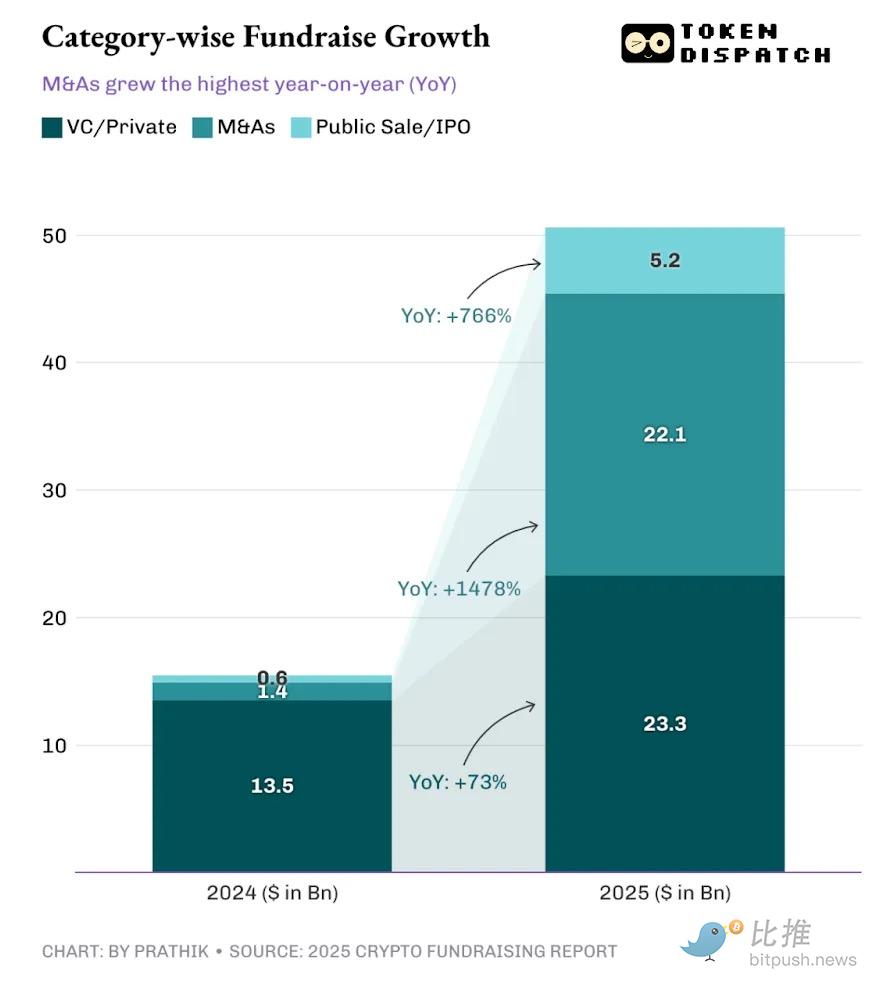
The report interprets these numbers as 'moderate growth' in venture capital activity and an 'explosive growth' in M&A transactions. However, I believe there is more hidden behind these numbers.

In a relatively nascent industry like cryptocurrency, business consolidation may signify maturity and progress. But if accompanied by capital withdrawal from other channels, it may tell a completely different story.

In 2025, funds were not just shifting from funding new projects to acquiring existing ones. Although the total financing amount increased by $35 billion year-on-year, M&A and public offerings/IPOs accounted for $27 billion of this increase.

Venture capital (VC) activity still grew by over 70% year-on-year last year, although its share in the overall financing categories declined.

In 2024, VC accounted for over 85% of total financing, but by 2025, this proportion dropped to 46%. This, combined with how VC allocated funds to different stages of crypto projects last year, is precisely what worries the new generation of crypto developers and founders: In 2025, VCs signed far fewer checks, but for much larger amounts, aiming to fund existing projects in the later stages of their life cycle, rather than funding newer early-stage projects.
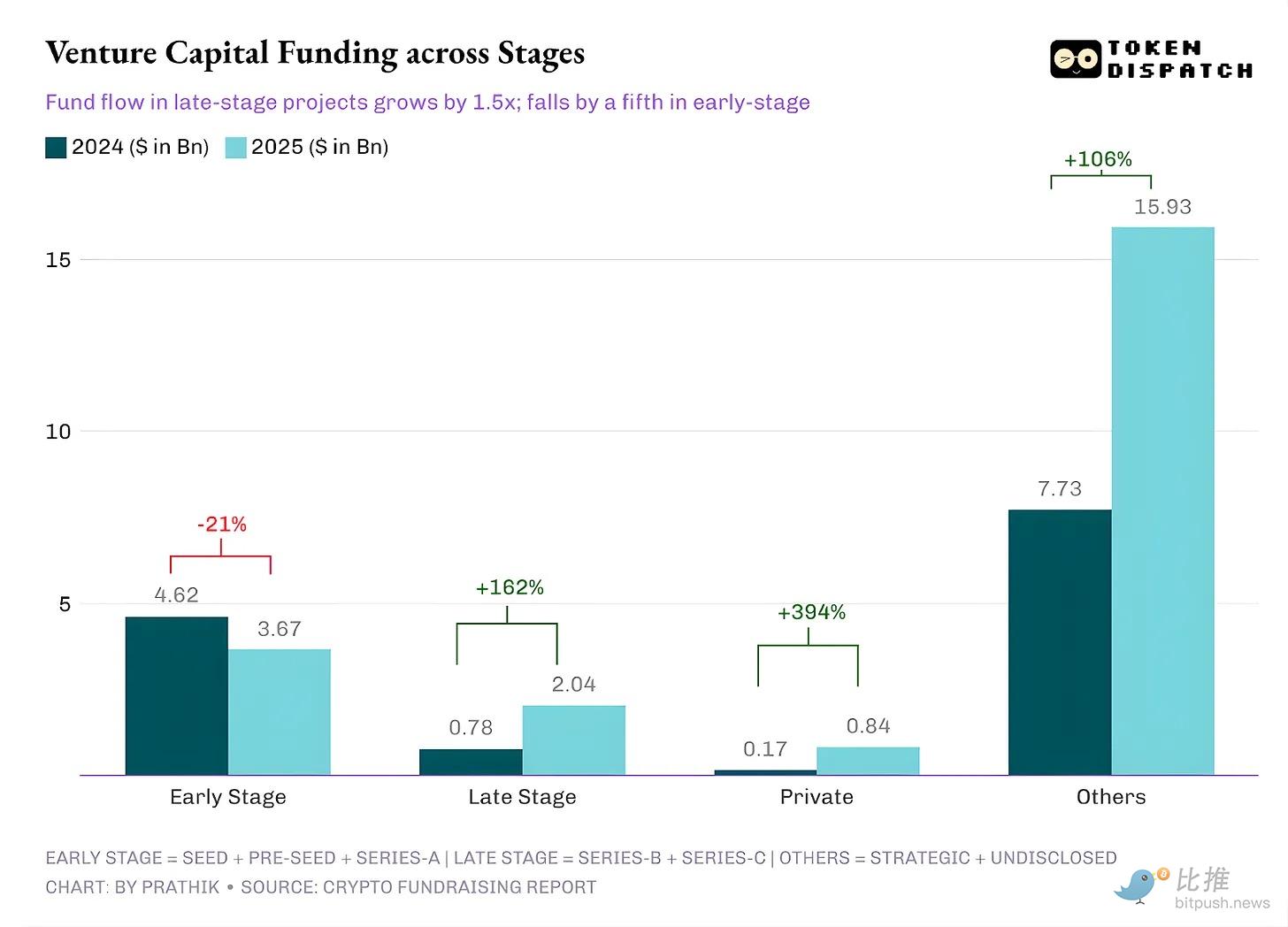
The data shows that Pre-Seed, Seed, and Series A financing decreased year-on-year, while Series B and Series C financing more than doubled in 2025. This behavior is also confirmed when looking at the number of checks signed across all financing stages.
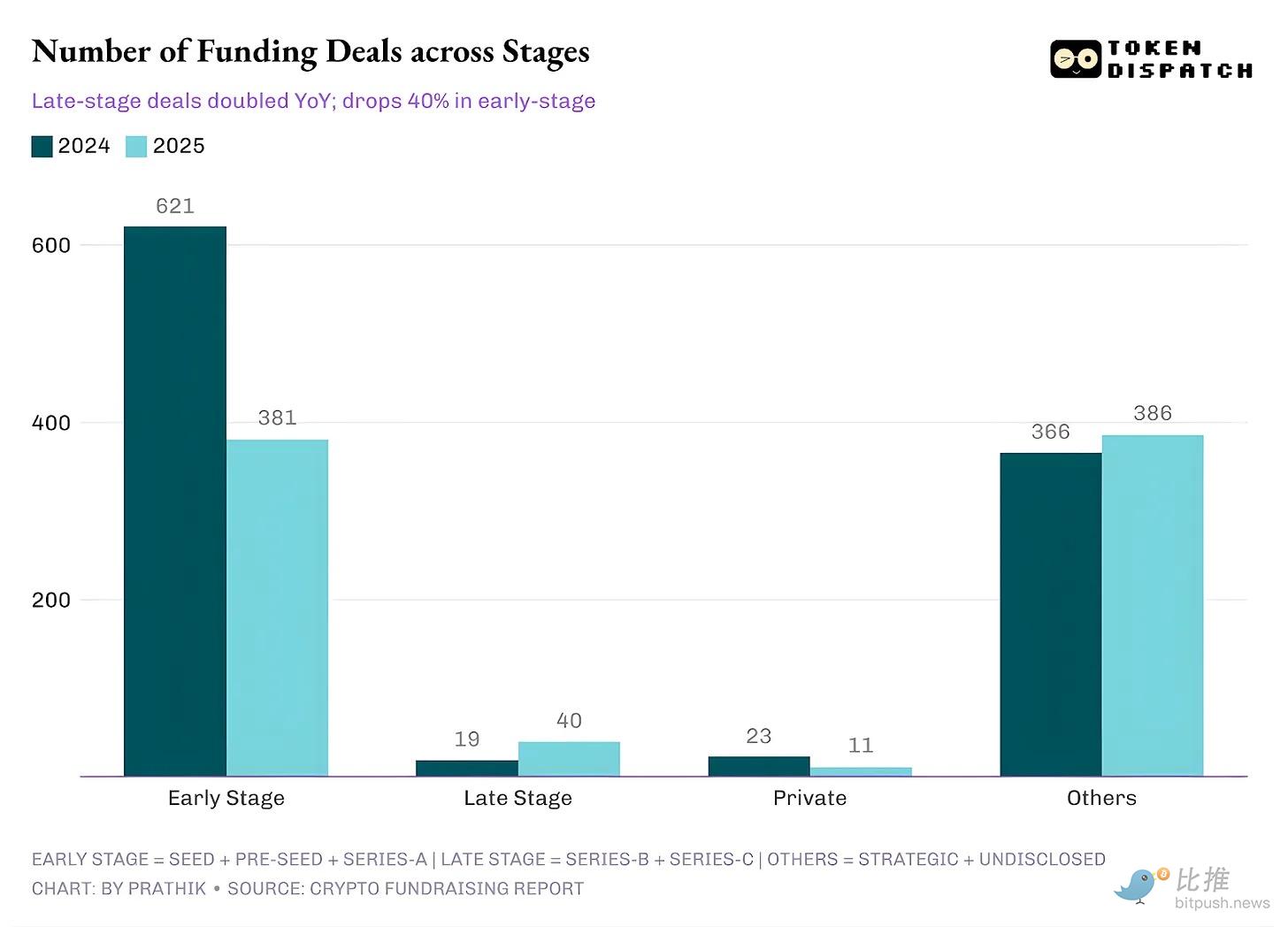
The two charts above together tell us: "Yes, capital has increased. But it has increased in places with lower uncertainty. Founders' fundraising pitches are no longer about 'the future of money,' but about 'here are some ready-made metrics worth betting on.'"

According to Equal Ventures' 'State of the Venture Economy Report,' while this portends fierce competition for early-stage founders, it may signal a value investment opportunity for investors seeking to inject funds into Series A and Series B projects.

This is because the competition to raise funds at the Seed and Pre-Seed stages has driven up valuation premiums. High valuation premiums mean investors are paying growth-stage valuation multiples for seed-stage risk profiles.

This shift prompts rational capital allocators to reallocate funds to lower-risk opportunities, such as Series A and B projects, which demand lower valuation premiums than Seed, Pre-Seed, Series C, and D+ rounds.
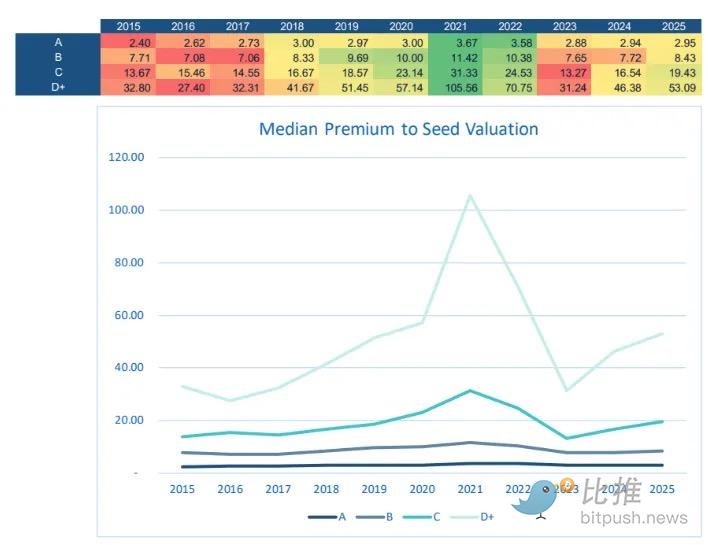
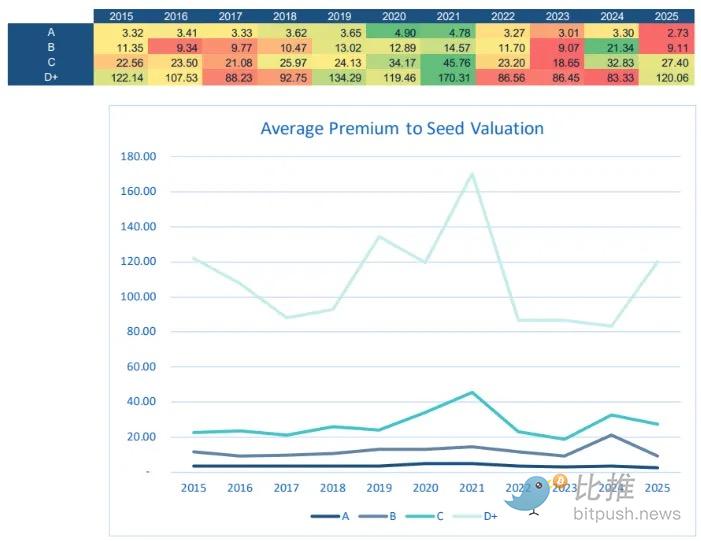
This, combined with the explosive growth in M&A transactions, shows how risk appetite has shifted across stages. On one hand, M&A accounted for over 40% of all 'funds raised,' which is inherently different from new funds injected through VC rounds. On the other hand, later-stage financing is favored because it appears easier to underwrite risk, offering greater certainty and higher potential return on investment (ROI).

When capital converges on specific tracks, two things naturally happen.

First, decision-making logic tends to focus. Entrepreneurs begin preparing for a more precise audience—a group focuses on similar metrics, shares industry insights with each other, and gradually forms a common evaluation language.

Second, the definition of a 'quality project' begins to converge. In the crypto field, this may mean extensive distribution networks, compliance resilience, enterprise-grade product readiness, and a business model that can operate independently without relying on bull or bear narratives.

This is why I am skeptical of the data in the '2025 Crypto Financing Report.' Although the amount of funds has increased, it is crucial to understand the drivers behind the explosive growth in M&A. Although cryptocurrency is a relatively new market, the technology stack has become very crowded, making it difficult to expand distribution channels.

In such times, it becomes a matter of course for existing giants to choose to buy and expand mature products rather than persuade users to adopt a new one. This was evident in last year's deals.
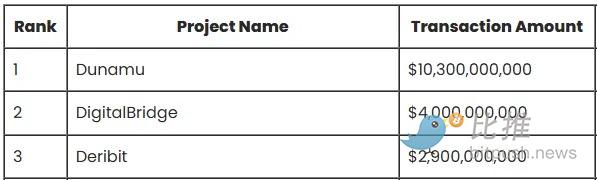
Take the top three M&A transactions listed in the report as examples: Dunamu, DigitalBridge, and Deribit. Their total value reached $17.2 billion, accounting for about 81% of the report's total M&A value.

Coinbase's acquisition of Deribit was not a bet on innovation or experimentation. This move was to leverage the flywheel Deribit had already built. Deribit provides a platform with ready-made liquidity, user habits, and options and derivatives products. Once the market matures, it can become the default trading venue for seasoned traders.Coinbase spotted the signal and prepared in advance.

South Korean internet giant Naver had a similar strategy when it decided to acquire Dunamu (operator of South Korea's largest cryptocurrency exchange Upbit) in an all-stock transaction worth $1.03 billion.This deal combines a massive consumer-grade distribution platform (an internet finance giant) with a regulated high-frequency financial product (an exchange).

What Does This Mean for 2026?

I expect the phenomenon of capital concentration to continue until we see clear exit paths. My only reservation regarding the report's 'consolidation' viewpoint is: Maturity does not necessarily have to mean the end of innovation. If too much capital is invested in rearranging ownership or doubling down on existing ideas, it could lead to stagnation and reduce breakthrough innovation.

If we fail to see successful IPOs and the reopening of large liquidity listing channels, expect later-stage investors to continue acting like strict underwriters, while early-stage founders will face a scarcity of attention.

But I don't think crypto seed rounds are dead.

2025 provided valuable lessons and clarity for early-stage founders. In 2026, they need to streamline their storytelling pitch decks and focus on the metrics the market values most. For example: how to have a distribution wedge, how to deliver products quickly while maintaining regulatory compliance, and how the product can survive robustly without the support of a bull market.


Twitter:https://twitter.com/BitpushNewsCN

Bitpush TG Discussion Group:https://t.me/BitPushCommunity

Bitpush TG Subscription: https://t.me/bitpush

Original link:https://www.bitpush.news/articles/7606417

Perguntas relacionadas

QWhat does the 40% increase in M&A activity in 2025's crypto funding report primarily indicate about the market?

AIt indicates a significant year of consolidation, where a large portion of the 'raised funds' was not new capital entering the crypto market but rather money changing hands between existing companies through acquisitions.

QHow did the behavior of Venture Capital (VC) funding change from 2024 to 2025 according to the article?

AVC activity shifted from funding newer, early-stage projects to writing fewer but larger checks for later-stage, existing projects (B and C rounds), reducing its share of total funding from over 85% to 46%.

QWhat two natural consequences occur when capital concentrates in specific sectors, as described in the article?

AFirst, decision-making logic becomes more focused as entrepreneurs tailor pitches to a specific audience. Second, the definition of a 'quality project' converges, emphasizing metrics like distribution networks, regulatory resilience, and independent business models.

QWhy does the author express skepticism about the massive funding numbers in the 2025 report?

AThe author is skeptical because the large increase was heavily driven by M&A and later-stage funding, which represents a recycling of existing ideas and capital rather than fresh risk-taking and investment in genuine innovation.

QWhat key lessons from 2025 should early-stage founders apply to their strategies in 2026?

AThey should streamline their pitches to focus on metrics the market values most, such as having a distribution wedge, ensuring regulatory compliance, rapid product delivery, and building a product that can survive independently without relying on a bull market.

Leituras Relacionadas

The Value Distribution of Stablecoins

**Summary: The Value Distribution of Stablecoins** The article argues that stablecoins are evolving from mere trading tools into broader channels for dollar access. It divides the stablecoin ecosystem into four layers to analyze how value is distributed: 1. **Issuance Layer:** Mints stablecoins, holds reserve assets, and captures the spread between reserve yield and user costs (e.g., Tether, Circle). This layer currently earns the largest profit margin. 2. **Infrastructure Layer:** Connects stablecoins to the traditional financial system, handling fiat on/off-ramps, banking integration, compliance (KYC/AML), and asset management (e.g., Bridge, BVNK). This is the "unglamorous" but critical work, building the essential bridges between crypto and real-world finance. 3. **Acquiring/Distribution Layer:** Integrates stablecoins into merchant systems, manages payment flows, and provides enterprise financial software (e.g., Stripe, Coinbase). They act as the access point for businesses. 4. **Application Layer:** The end-users and businesses that ultimately use stablecoins for payments, settlements, or as a store of value. They benefit from convenience but have little pricing power. The core thesis is that while the issuance layer currently dominates profits, the often-overlooked **infrastructure layer holds significant long-term potential**. The real challenge and barrier to mass adoption is not the on-chain transfer of stablecoins (which is simple), but the complex "last mile" integration into existing business workflows, banking systems, and regulatory frameworks across different countries. Companies in this layer are currently in a "land grab" phase, investing heavily to build networks, secure bank partnerships, and establish compliance pathways. While their position is currently pressured by the profitable issuers above and distribution platforms below, the article suggests that if stablecoins become a default financial rail for businesses, the infrastructure providers who have done the hard work of integration will ultimately gain strong pricing power and become entrenched, essential players.

marsbitHá 3h

The Value Distribution of Stablecoins

marsbitHá 3h

The Value Distribution of Stablecoins

The Value Distribution of Stablecoins The article argues that stablecoins are evolving from a mere trading tool into a broad "dollar channel." It analyzes the industry's value chain through four layers: 1. **Issuance Layer (e.g., Tether, Circle):** The top layer that mints stablecoins, holds reserve assets, and captures the thickest interest rate spread. 2. **Infrastructure Layer (e.g., Bridge, BVNK):** Connects stablecoins to the traditional financial system, handling critical but complex "dirty work" like fiat on/off-ramps, banking integration, compliance (KYC/AML), and cross-border settlement. 3. **Acquiring/Distribution Layer (e.g., Stripe, Coinbase):** Embeds stablecoins into merchant systems, manages payment flows, and integrates with enterprise software. 4. **Application Layer:** End-users and businesses that ultimately use stablecoins for payments, settlement, or storing value. The author posits that while the issuance layer currently captures the most profit, the most overlooked and potentially critical layer is infrastructure. The core challenge for stablecoin adoption isn't the on-chain transfer (which is simple), but bridging the gap between blockchain and the real-world financial system. This involves solving practical problems for businesses: fiat conversion, reconciliation, tax handling, and user onboarding. Infrastructure companies are currently in a difficult "land-grab" phase—building networks, securing banking relationships, and achieving compliance country-by-country. They face pressure from both the profitable issuance layer above and distribution platforms below. However, the author suggests this layer is building a crucial moat. Once stablecoins become a default business rail, the infrastructure players who have done the hard work of integration may gain significant, durable value and pricing power.

链捕手Há 3h

The Value Distribution of Stablecoins

链捕手Há 3h

How to Do Research Well: Deliberately Practice the Real Skills That Matter

No one truly teaches you how to do research. You're often given a desk, a pre-selected problem, and vague instructions to "create something new." Consequently, many people reverse-engineer the job based on visible outputs—papers, posts, announcements—learning only how to *appear* like a researcher rather than how to *become* one. True research capability is built from stacking small, trainable skills, nearly all of which can be developed through deliberate practice. **Pick Your Own Problem:** Most researchers absorb problems from advisors or trends, lacking the underlying reasoning. Choosing a problem you genuinely care about, as John Schulman advises, leads to original work. Develop "taste" like a muscle: predict experiment outcomes, guess paper results from methods, and track which findings remain important over time. **Upgrade Your Inputs:** Relying on shared reading lists (arXiv hot lists, filtered group chats) leads to unoriginal conclusions. Undervalued old literature often holds crucial insights (e.g., MoE, LSTM, backpropagation). Richard Sutton's "The Bitter Lesson" or Claude Shannon's 1952 talk on creative thinking are more predictive than lengthy modern surveys. Breadth matters as much as depth: draw from neuroscience, mechanism design, hardware knowledge, and honest statistics. Read papers directly, especially appendices and limitations sections. **Write Everything Down:** As Paul Graham noted, writing exposes flaws in seemingly mature ideas. Writing is the cheapest defense against self-deception. Following Feynman's principle, Darwin programmatically wrote down facts contradicting his theory to combat memory bias. Maintain a detailed log of hypotheses, setups, predictions, results, and updated understandings. Reviewing past logs fosters essential humility.

marsbitHá 6h

How to Do Research Well: Deliberately Practice the Real Skills That Matter

marsbitHá 6h

Trading

Spot
Futuros
活动图片