Crypto Enters Extreme Fear Zone as Global Trade Tensions and Policy Shifts Weigh on Prices

bitcoinistPublicado em 2026-02-24Última atualização em 2026-02-24

Resumo

Cryptocurrency markets plunged into extreme fear, with BTC briefly falling below $65,000, erasing weekend gains. The sell-off was driven by heightened geopolitical risks, new U.S. tariff policies, and concerns over persistent inflation and slower global growth. Total market cap dropped 3–5%, approaching $2.2 trillion. Over $460 million in leveraged positions were liquidated, with long traders bearing the brunt. Rising whale selling and thin liquidity exacerbated the decline. Investors are now closely watching upcoming economic data and Fed policy decisions for direction, though short-term volatility is expected to persist amid macroeconomic uncertainty.

The market tumbled sharply on Monday, with BTC briefly slipping below $65,000, as traders reacted to a mix of U.S. trade policy shifts, geopolitical risks, and looming economic data. The sudden losses erased weekend gains and pushed the market deeper into extreme fear, currently at 5.

Total crypto market capitalization fell roughly 3–5% within a day, sliding toward the $2.2 trillion mark. The downturn coincided with rising geopolitical risks and sweeping tariff measures announced by U.S. President Donald Trump, which unsettled broader financial markets and reduced appetite for risk assets.
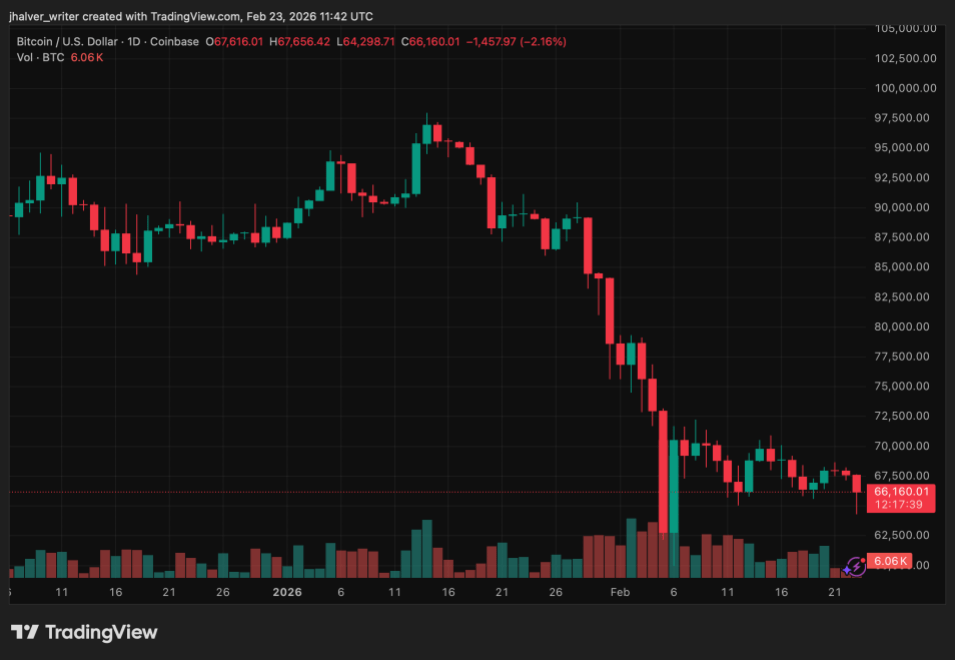
BTC's price trends to the downside on the daily chart. Source: BTCUSD on Tradingview

Trade Tensions and Macro Risks Drive Sell-Off

Market volatility intensified after the Supreme Court of the United States ruled that parts of earlier tariff programs exceeded presidential authority. Shortly after, Trump introduced new global tariffs of up to 15% under separate trade powers, raising concerns about slower global growth and persistent inflation.

Escalating tensions between the United States and Iran added another layer of uncertainty, pushing investors toward traditional safe-haven assets such as gold. Crypto assets, which had previously benefited from a “digital gold” narrative, instead behaved more like high-risk investments during the latest market stress.

Large-holder selling also contributed to downside pressure, with increased transfers from whale wallets to exchanges signaling potential liquidation activity. Analysts noted that thin liquidity and weak conviction among buyers amplified price swings.

Economic Data And Policy Decisions in Focus

Investors are now watching upcoming economic indicators closely. Consumer confidence data, jobless claims, and producer price inflation figures are expected to shape expectations around interest rates. Recent inflation readings above forecasts have reduced hopes for near-term monetary easing by the Federal Reserve.

Meanwhile, the central bank is scheduled to inject roughly $14.6 billion into financial markets, a move some analysts believe could provide temporary support for speculative assets, though not equivalent to full stimulus measures.

Technology earnings are also on the radar, particularly results from Nvidia, whose performance often influences sentiment across both tech equities and crypto markets.

Liquidations Rise as Fear Dominates Sentiment

Market data shows more than $460 million in leveraged positions were wiped out during the latest decline, with long traders accounting for the majority of losses. Institutional flows have weakened as well, with exchange-traded crypto funds recording notable outflows.

Additional supply pressure emerged after mining firm Bitdeer sold its entire weekly production, while public commentary from industry figures, including Michael Saylor, suggested long-term optimism remains despite short-term weakness.

The Crypto Fear and Greed Index has dropped into extreme fear territory, reflecting cautious positioning across the market. Until macroeconomic clarity improves, analysts expect volatility to remain elevated as traders weigh policy risks against longer-term adoption trends.

Cover image from ChatGPT, BTCUSD chart from Tradingview

Perguntas relacionadas

QWhat caused the crypto market to tumble sharply on Monday, pushing it into extreme fear?

AThe market decline was driven by a combination of U.S. trade policy shifts, including new global tariffs announced by former President Trump, rising geopolitical risks such as tensions with Iran, and looming economic data that reduced risk appetite.

QHow much did the total crypto market capitalization fall within a day, and what level did it approaching?

ATotal crypto market capitalization fell roughly 3–5% within a day, sliding toward the $2.2 trillion mark.

QWhat role did large-holder selling play in the market downturn?

ALarge-holder selling contributed to downside pressure, with increased transfers from whale wallets to exchanges signaling potential liquidation activity, which amplified price swings due to thin liquidity and weak buyer conviction.

QWhich upcoming economic indicators are investors closely watching to shape interest rate expectations?

AInvestors are closely watching consumer confidence data, jobless claims, and producer price inflation figures to shape expectations around interest rates.

QHow much in leveraged positions were wiped out during the market decline, and what was the primary type of trader affected?

AMore than $460 million in leveraged positions were wiped out, with long traders accounting for the majority of the losses.

Leituras Relacionadas

Why Bitcoin Holds Above $64,000 After Fed's Hard Pause

**Bitcoin Stabilizes Near $64,000 Following Hawkish Fed Pause** The cryptocurrency market, led by Bitcoin, remained stable around $64,000 despite a volatile reaction to the latest U.S. Federal Reserve meeting. The Fed paused interest rates but signaled a hawkish stance, with three committee members voting for an increase—the highest dissent since 2016. This limits risk appetite but hasn't triggered panic selling. Key market highlights include Bitcoin ETFs seeing a net inflow of $32.1 million, breaking a streak of outflows, while Ethereum ETFs experienced outflows of $18.65 million. Liquidations affected about 90,000 traders. Technically, Bitcoin finds support around $63,000-$63,500, with major resistance near $66,000. While its price is about 49% below its all-time high, institutional demand via ETFs and the absence of mass capitulation support a potential recovery scenario in the second half of the year. Major altcoins showed mixed movements, with Solana attracting capital while Ethereum faced selling pressure despite strong on-chain metrics like a growing staking queue. Regulatory news took a pause as the U.S. Senate delayed the CLARITY Act vote until at least autumn. For the final trading day of July, U.S. inflation and consumer spending data will be crucial. Bitcoin's key levels to watch are $63,000 support and $66,000 resistance. Sustained ETF inflows and Bitcoin holding above $63,000 are seen as positive signs for a potential market recovery later in the year.

cryptonews.ruHá 3h

Why Bitcoin Holds Above $64,000 After Fed's Hard Pause

cryptonews.ruHá 3h

Trading

Spot
活动图片





