Crypto drops alongside equities as risk-off sentiment spreads across markets

ambcryptoPublicado em 2026-03-26Última atualização em 2026-03-26

Resumo

Cryptocurrencies experienced a broad sell-off alongside U.S. equities, signaling a market-wide shift toward risk-off sentiment rather than crypto-specific weakness. Major digital assets declined, with Ethereum falling 4.1% and Solana dropping over 5%, while Bitcoin saw a more modest 2.1% decrease. Losses extended across altcoins and large-cap tokens like BNB and XRP, with stablecoins remaining stable as investors sought safety. Similarly, tech stocks such as Meta and Nvidia fell sharply, highlighting a retreat from high-risk assets. The synchronized decline underscores continued correlation between crypto and equities during periods of market stress, reflecting their increased sensitivity to macro sentiment and institutional flows.

A broad sell-off across digital assets mirrored declines in U.S. equities, signaling a coordinated pullback in risk assets rather than an isolated crypto move.

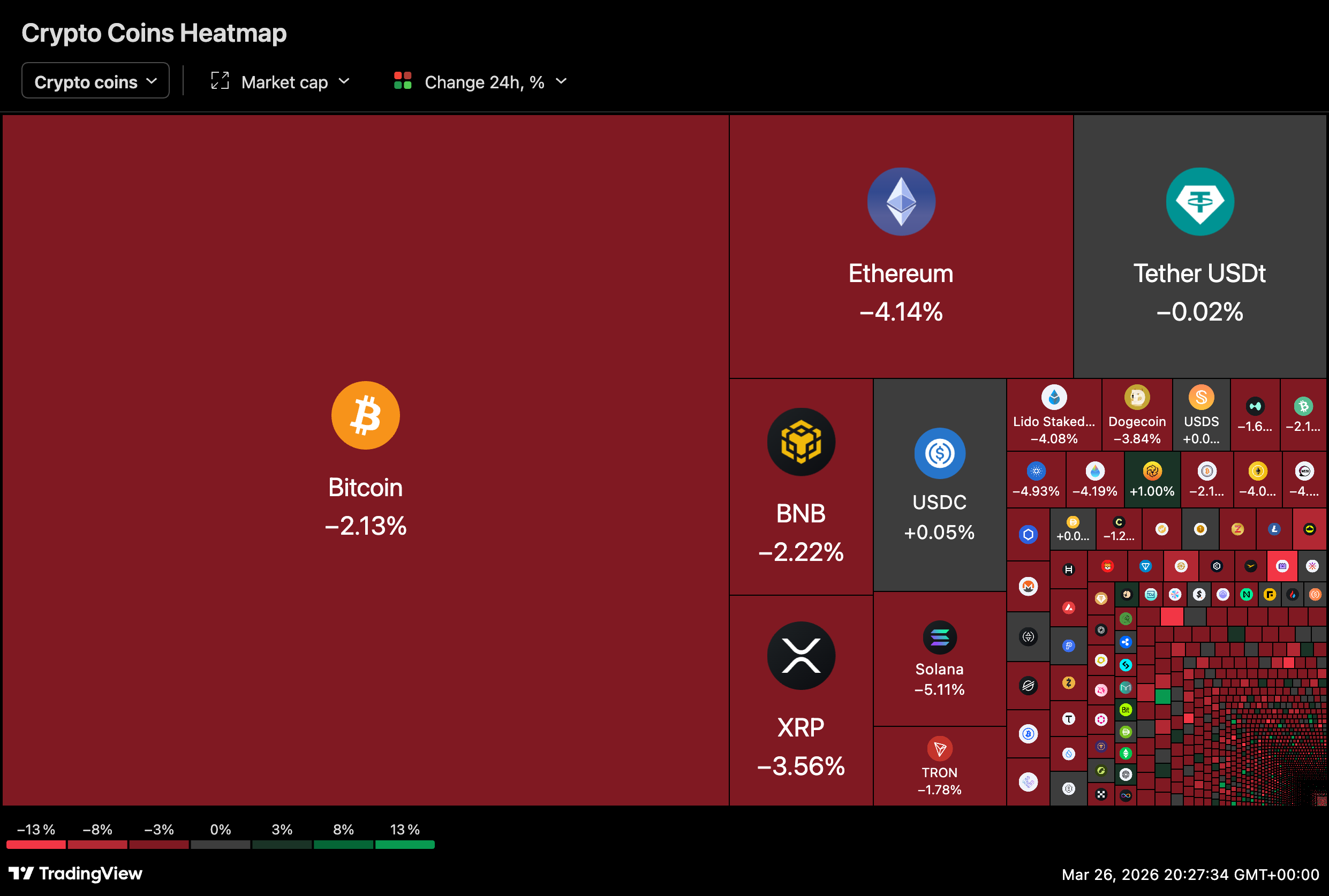
Market heatmaps showed widespread losses across major cryptocurrencies, with Ethereum down 4.1% and Solana falling over 5%. Bitcoin, the largest asset by market cap, posted a more modest 2.1% decline but remained firmly in negative territory.

The weakness extended across altcoins, with few sectors showing resilience, pointing to a broad-based shift in sentiment rather than token-specific developments.

Crypto market sees broad sell-off led by ETH and SOL

The decline was led by higher-beta assets, a common pattern during periods of market stress. Ethereum and Solana both underperformed Bitcoin, suggesting reduced risk appetite among traders.

Large-cap tokens, including BNB and XRP, also moved lower, reinforcing the market-wide nature of the sell-off. Stablecoins such as USDC and Tether remained largely unchanged, reflecting a shift toward capital preservation.
Source: TradingView

The absence of a clear catalyst suggests the move may be tied to broader macro positioning rather than crypto-specific developments.

Equities mirror the move with tech stocks under pressure

A similar pattern was visible in equity markets, particularly within the technology sector.

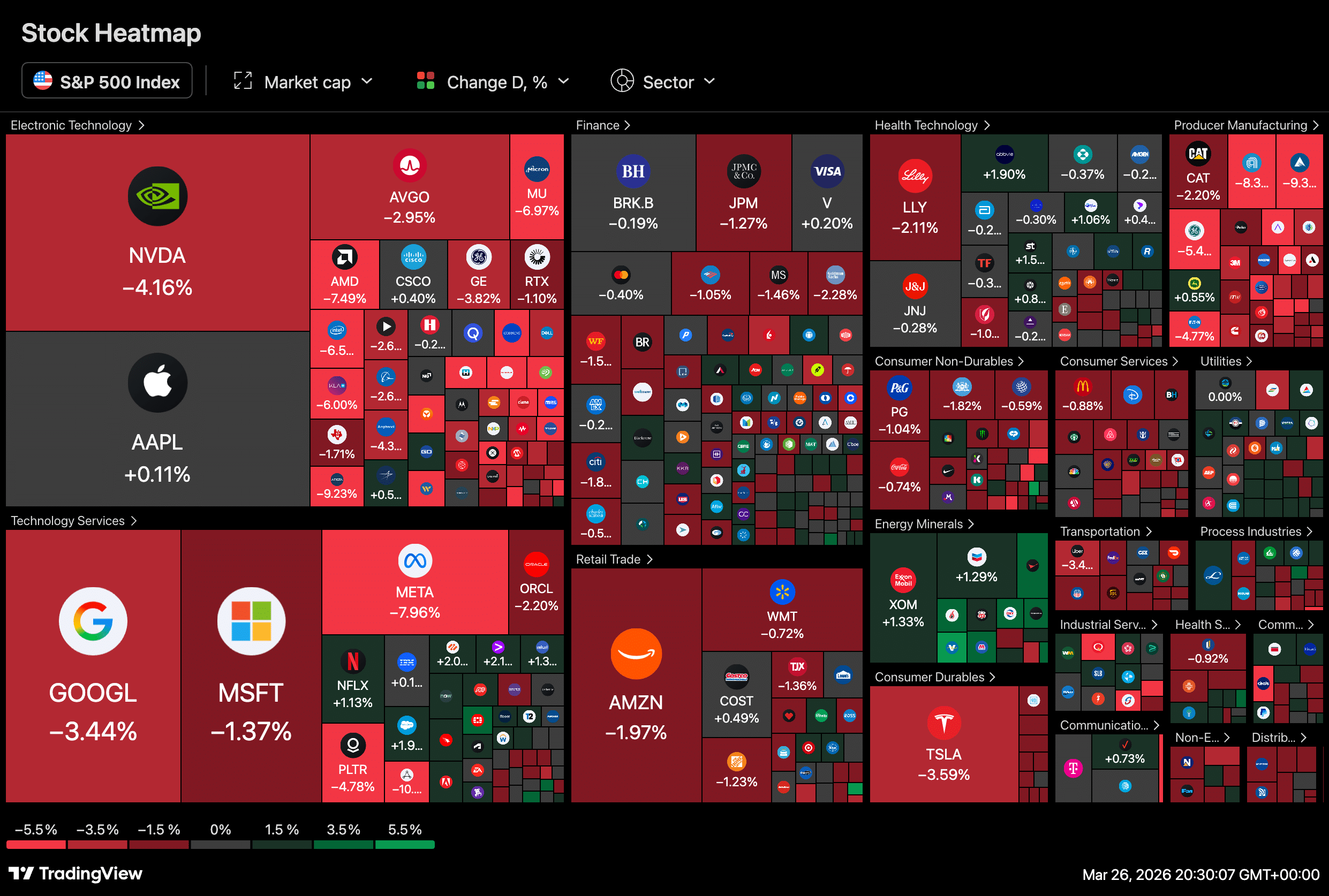
Major stocks such as NVIDIA and Meta Platforms fell sharply, with Meta dropping nearly 8% and Nvidia declining over 4%. Alphabet Inc. and Amazon also posted losses, contributing to a broader decline across the S&P 500.
Source: TradingView

The concentration of losses in growth and tech names highlights a retreat from higher-risk segments of the market.

Correlation highlights risk-off sentiment across markets

The synchronized decline across crypto and equities points to a continued correlation between the two asset classes, particularly during periods of uncertainty.

Rather than acting as a hedge, crypto is trading in line with broader risk sentiment, moving alongside equities when investors reduce exposure to volatile assets.

This alignment has become more pronounced in recent years as institutional participation in digital assets has increased, linking crypto performance more closely to macro-driven market flows.


Final Summary

  • Crypto and equities declined simultaneously, reflecting a broader risk-off move rather than isolated weakness.
  • Continued correlation suggests digital assets remain tied to macro sentiment, especially during periods of market stress.


Perguntas relacionadas

QWhat was the main reason for the simultaneous decline in both cryptocurrency and equity markets according to the article?

AThe decline was due to a broad risk-off sentiment spreading across markets, rather than isolated crypto-specific factors, indicating a coordinated pullback in risk assets.

QWhich two major cryptocurrencies led the sell-off in the crypto market and by how much did they decline?

AEthereum led with a 4.1% decline, and Solana fell over 5%.

QHow did Bitcoin's performance compare to other major cryptocurrencies during this market downturn?

ABitcoin posted a more modest decline of 2.1%, underperforming compared to Ethereum and Solana but still in negative territory.

QWhich technology stocks were mentioned as declining sharply in the equity market, and what were their approximate losses?

AMeta Platforms dropped nearly 8%, and Nvidia declined over 4%. Alphabet and Amazon also posted losses.

QWhat does the synchronized decline between crypto and equities suggest about their correlation according to the article?

AIt suggests that crypto is trading in line with broader risk sentiment and moving alongside equities during periods of uncertainty, rather than acting as a hedge, due to increased institutional participation linking crypto to macro-driven market flows.

Leituras Relacionadas

In Jinjiang, Fujian, a Storage Super Unicorn Lies Quiet

In Fujian's Jinjiang, a city known for sportswear, lies a quiet semiconductor giant: Fujian Jinhua Integrated Circuit Co. (JHICC). Once a promising domestic DRAM manufacturer alongside Yangtze Memory and ChangXin Memory Technologies (CXMT), its journey was derailed in 2018 when the U.S. placed it on an Entity List and filed criminal charges for alleged trade secret theft. This halted production for years. A turning point came in February 2024 when a U.S. federal court found JHICC not guilty. However, it had lost crucial time. While CXMT soared to become a top-valued A-share company in 2024, JHICC, with an estimated valuation of 80 billion RMB, was just restarting. Its current output is primarily customized DDR4 chips, not the advanced DDR5/HBM demanded for AI, but it still benefits from the broader memory chip upcycle. JHICC's story is tied to Chen Zhengkun, a veteran engineer who left Micron to lead the venture. Founded in 2016 with state-backed funding, JHICC partnered with Taiwan's UMC to develop DRAM technology. Rapid progress was cut short by the U.S. actions, which Micron initiated, partly due to its heavy reliance on the Chinese market. Post-sanctions, Chen's team worked to rebuild the production line with reduced reliance on U.S. technology. According to its records, JHICC achieved small-scale production and revenue growth under immense pressure. It now focuses on the stable "niche" DRAM market (e.g., TVs, routers) with a monthly capacity of ~40,000 wafers, aiming for 60,000 by 2026. It holds over 1,000 patents but remains on the Entity List. For Jinjiang, investing in JHICC was a bold industrial leap. The local government provided unwavering financial and logistical support during the crisis, helping the company survive. JHICC has become the anchor for a growing local semiconductor cluster. Though its scale lags behind domestic peers, JHICC's persistence symbolizes a hard-won foothold in a global market long dominated by Samsung, SK Hynix, and Micron. Having missed one boom, it seeks a place in the new AI-driven memory supercycle.

marsbitHá 1h

In Jinjiang, Fujian, a Storage Super Unicorn Lies Quiet

marsbitHá 1h

Trading

Spot
活动图片




