Crypto Downturn Slams Galaxy Digital With $241 Million Annual Loss

bitcoinistPublicado em 2026-02-05Última atualização em 2026-02-05

Resumo

Galaxy Digital reported a significant annual loss of $241 million, driven by a sharp downturn in crypto markets. The fourth quarter alone saw a net loss of $482 million due to declining digital asset valuations and reduced trading volumes. These results fell well below Wall Street expectations. The company also incurred one-time charges related to mining infrastructure and reorganization. Despite the losses, Galaxy strengthened its liquidity, ending the year with $2.6 billion in cash and stablecoins. It is expanding into data centers and cloud partnerships to create more stable revenue streams. Market reaction was negative, with shares declining as analysts remain divided on the company’s near-term prospects.

Galaxy Digital posted a heavy loss for the year as the crypto slump bit into its holdings and trading business. The numbers show a company that weathered big markdowns on digital assets while trying to bulk up its cash and new revenue streams.

Losses And Liquidity

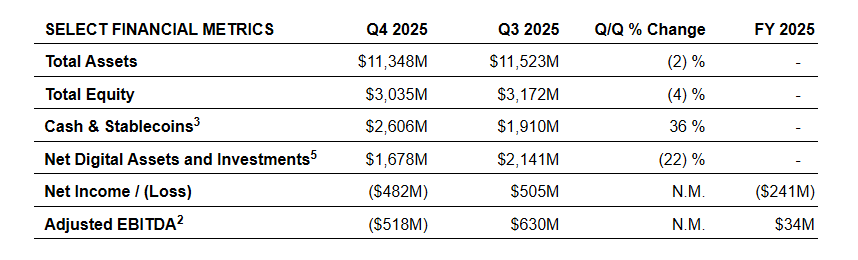
Reports say Galaxy recorded a GAAP net loss of $241 million for the full year, and a much larger hit in the fourth quarter alone: a $482 million net loss.

The quarterly shortfall came after a steep drop in the value of the firm’s crypto holdings and lower trading volumes, which together pushed reported results well below Wall Street expectations.

The Downturn Behind The Numbers

According to the company’s results, the value of its digital assets and investments fell sharply late in the year, producing most of the headline losses.

Trading activity cooled, and that reduced fees and transaction income. At the same time, one-time charges tied to mining infrastructure and a corporate reorganization added to the drag on annual results.
Source: Galaxy Digital

Data Center And New Business

Galaxy has not only been a crypto trading and asset management shop. It has been building out a large data-center footprint in Texas, including the Helios campus with approvals to scale power capacity to over 1.6 GW.

The company says that infrastructure work and deals with cloud partners could produce steadier revenue streams over time, even if crypto markets stay weak in the near term.

BTCUSD currently trading at $75,736. Chart: TradingView

Cash Cushion And Balance-Sheet Moves

Reports note that Galaxy finished the year with roughly $2.6 billion in cash and stablecoins, a position management highlights as a buffer against further market volatility.

The firm also raised capital and tapped debt markets late in the year, steps meant to preserve optionality while trading revenues slump.

At the same time, some asset management lines reported record activity, which helped offset a part of the losses when measured on an adjusted basis.

Market Reaction And Outlook

The market reacted quickly. Shares slid in premarket trading after the release and then fell further as investors digested the scale of the write-downs.

Analysts are split: some see the data-center push as a sensible hedge against volatile crypto returns, while others point out that near-term earnings will remain pressured until trading volumes and asset prices recover.

Featured image from Unsplash, chart from TradingView

Perguntas relacionadas

QWhat was the total GAAP net loss reported by Galaxy Digital for the full year?

AGalaxy Digital reported a GAAP net loss of $241 million for the full year.

QWhat were the two main factors that contributed to the company's large net loss in the fourth quarter?

AThe quarterly net loss of $482 million was primarily due to a steep drop in the value of the firm’s crypto holdings and lower trading volumes.

QBesides trading losses, what other one-time charges added to the drag on the company's annual results?

AOne-time charges tied to mining infrastructure and a corporate reorganization also added to the drag on the annual results.

QWhat new business initiative is Galaxy Digital building in Texas to create steadier revenue streams?

AThe company is building out a large data-center footprint in Texas, including the Helios campus, which is approved to scale power capacity to over 1.6 GW.

QHow much cash and stablecoins did Galaxy Digital have at the end of the year to act as a buffer against market volatility?

AGalaxy Digital finished the year with roughly $2.6 billion in cash and stablecoins.

Leituras Relacionadas

Annual Salary of Millions Competing for Electricians, Meta Rushes to Open Its Own Technical School

The AI boom is facing an unexpected bottleneck: a severe shortage of skilled construction workers and electricians. As tech giants like Meta, OpenAI, and Alphabet race to build massive data centers—such as OpenAI's $16 billion "Stargate" project—they are hitting a critical labor wall. The U.S. needs an estimated 130,000 more electricians, 240,000 construction workers, and 150,000 supervisors by 2030 for AI infrastructure alone, but tens of thousands of electrician jobs go unfilled each year. While AI companies offer high premiums, with electricians earning up to $280,000 annually, worker scarcity still causes massive losses—delays on a single project can cost $14.2 million per month. The complexity of building AI data centers, which require immense power (equivalent to powering hundreds of thousands of homes), sophisticated electrical systems, and advanced liquid cooling solutions, demands highly skilled technicians who are in short supply. To combat this, companies are investing heavily in training. Meta has committed $115 million to a free training school offering tuition, housing, and stipends, targeting 5,000 new workers. OpenAI is partnering with unions to secure skilled labor. These efforts are paying off, with a significant rise in Gen Z interest in trade schools over college. However, the power demands are staggering. AI data centers are driving a rapid surge in electricity consumption, projected to account for up to 12% of U.S. power use by 2028 and raising costs for consumers. Furthermore, the construction boom is project-based, leading to a potential future glut of trained workers once building peaks, which could depress wages industry-wide. The race for AI supremacy now depends as much on skilled hands as on advanced chips.

marsbitHá 1h

Annual Salary of Millions Competing for Electricians, Meta Rushes to Open Its Own Technical School

marsbitHá 1h

OpenAI No Longer Sells Its Most Expensive Model for Profit

OpenAI is shifting its business strategy away from promoting its most expensive, flagship models for every task. Recent price cuts—80% for GPT-5.6 Luna and 20% for Terra—signal a deeper change: the company now actively advises users that many tasks don't require the most powerful model. Instead, OpenAI recommends a tiered approach: use the high-end GPT-5.6 Sol for complex planning and analysis, then delegate execution to cheaper models like Luna. This mirrors moves by Anthropic, which recently launched Claude Opus 5 at half the price of its top model, Fable 5. Both companies are de-emphasizing flagship models as primary revenue drivers, using them instead for brand prestige and technological showcases. The industry is entering a "mass-market" phase, similar to automotive, where high-volume, cost-effective models handle daily operations and drive scale. OpenAI's price reductions are partly enabled by AI models themselves optimizing underlying code and infrastructure, creating a self-reinforcing cycle of efficiency gains and cost reduction. Competition is shifting from "who is smartest" to "who offers the best value." The goal is no longer selling individual models but fostering widespread API adoption and ecosystem lock-in. By making AI calls cheap and ubiquitous, companies like OpenAI aim to become the indispensable, utility-like infrastructure powering automated workflows—the "water and electricity" of software, quietly embedded everywhere.

marsbitHá 1h

OpenAI No Longer Sells Its Most Expensive Model for Profit

marsbitHá 1h

Trading

Spot
活动图片





