Crypto Criminals In Crosshairs As Chainalysis Partners With South Korean Police

bitcoinistPublicado em 2026-06-11Última atualização em 2026-06-11

Resumo

South Korea's national police have partnered with blockchain analytics firm Chainalysis to strengthen their investigative capabilities against crypto-related crimes. The agreement, formalized through a memorandum of understanding, provides Korean investigators with access to specialized training and certification programs. This collaboration aims to build institutional expertise for tackling a broad spectrum of virtual asset crimes, including money laundering and state-sponsored hacking. The move follows the recent creation of a dedicated multi-agency task force to eradicate crypto-based money laundering. While North Korea-linked crypto theft, which saw massive losses in 2025, is a significant concern, officials emphasize the partnership is designed to enhance overall investigative capacity for handling complex, cross-border crypto crime cases.

South Korea’s national police launched a special multi-agency task force just weeks ago to go after crypto-based money laundering. Now they have a new partner in that fight.

Building Investigative Muscle

Blockchain analytics firm Chainalysis signed a memorandum of understanding with the Korean National Police Agency on Wednesday, a deal aimed at strengthening the KNPA’s ability to investigate virtual asset crimes.

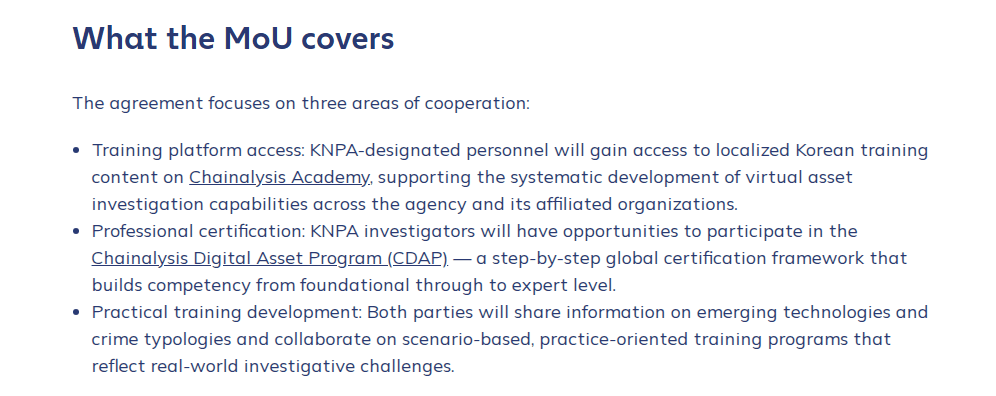
The agreement will give South Korean investigators access to personalized training content, professional certification programs, and hands-on practical instruction developed by Chainalysis.

The partnership comes at a time when North Korea-linked crypto theft has been surging. Data shows that in 2025, hackers tied to the DPRK were responsible for $2 billion in crypto losses — a 51% jump from the year before, according to research from CrowdStrike.

By April of this year, theft attributed to North Korea had already reached close to $580 million, with attacks on Kelp DAO and the Drift Protocol among the largest incidents.

South Korea’s police have been described as being at the forefront of confronting those state-level threats. But Chainalysis country director Ryan Kwon said the MoU is built around a wider purpose than targeting any single adversary.

A Wider Mandate

“While North Korean-driven attacks are understandably a national security focus, this partnership isn’t designed around a single threat,” Kwon said. “It’s fundamentally about building institutional capability.”

Chainalysis has worked alongside South Korean law enforcement before. In September last year, police in Seoul dismantled an international hacking ring that had stolen roughly $30 million.
Source: Chainalysis

The investigation started in South Korea and eventually led authorities to Thailand, with Chainalysis playing a supporting role throughout.

The newly signed agreement builds on that existing relationship. According to Chainalysis, Korean investigators need global visibility into how illicit funds move across blockchains to handle these cases effectively — and that cross-border reach is part of what the training is designed to provide.

BTCUSD trading at $62,044 on the 24-hour chart: TradingView

Casting The Net On Crypto Crime

The MoU follows the May launch of the Money Laundering Eradication Task Force, a multi-agency unit under South Korea’s Economic Crime Investigation Division created specifically to go after crypto-based financial crimes.

The back-to-back moves suggest a deliberate push by South Korean authorities to sharpen their tools against a growing range of threats — from state-sponsored hackers to scams targeting ordinary investors.

Chainalysis said the goal is not just to chase individual cases but to leave the KNPA better equipped long after any single investigation wraps up.

Featured image from Getty Images, chart from TradingView

Perguntas relacionadas

QWhat is the main purpose of the Memorandum of Understanding signed between Chainalysis and the Korean National Police Agency?

AThe main purpose is to strengthen the KNPA's ability to investigate virtual asset crimes by providing personalized training content, professional certification programs, and hands-on practical instruction developed by Chainalysis.

QAccording to the article, what was the estimated value of crypto losses attributed to North Korea-linked hackers in 2025?

AAccording to research from CrowdStrike, North Korea-linked hackers were responsible for an estimated $2 billion in crypto losses in 2025.

QWhat recent initiative by South Korean authorities does the Chainalysis MoU follow, and what is its focus?

AThe MoU follows the May launch of the Money Laundering Eradication Task Force, a multi-agency unit created specifically to go after crypto-based financial crimes.

QWhat does Chainalysis country director Ryan Kwon say is the fundamental goal of the partnership with the KNPA?

ARyan Kwon states that the partnership is fundamentally about building institutional capability within the KNPA, rather than being designed solely around targeting a single threat like North Korean-driven attacks.

QHow did Chainalysis previously assist South Korean law enforcement, as mentioned in the article?

AChainalysis played a supporting role in an investigation where Seoul police dismantled an international hacking ring that had stolen roughly $30 million, with the investigation starting in South Korea and leading to Thailand.

Leituras Relacionadas

In Conversation with Ray Dalio: We Are Currently in an AI Bubble, with 1% of My Portfolio in Bitcoin

Ray Dalio, founder of Bridgewater Associates, warns in an interview that the current AI boom shows classic bubble characteristics, which could lead to significant economic downturns as seen in past cycles like 1929 or 2000. He explains that speculative enthusiasm, fueled by debt and overvaluation, often precedes a crash when rising rates or taxation force asset sales, causing widespread losses and recession. Dalio also outlines his "Big Cycle" theory, describing an approximate 80-year pattern where widening wealth gaps, massive government deficits, and shifting geopolitical power (like China's rise) create internal conflict and global instability. He emphasizes that we are in a late-cycle, transitional phase where traditional powers like the US and UK face decline. For personal wealth protection, Dalio advises diversification beyond cash into assets like stocks, bonds, real estate, and particularly gold, which he prefers over Bitcoin. While he holds about 1% of his portfolio in Bitcoin as a non-printable hard asset, he views gold as more secure from technological or governmental threats. Regarding AI's impact, Dalio believes it will disproportionately benefit capital owners, worsening inequality by replacing both physical and cognitive labor. He suggests that human intuition and emotional intelligence, combined with AI, will be key for future workers. On taxation, Dalio argues that wealth taxes are impractical and risk triggering asset sell-offs, reducing productive investment. He points to the UK as a cautionary example of debt, low productivity, and political strife. Geopolitically, Dalio foresees a more regionalized world, with the US showing weakness in prolonged conflicts like with Iran, akin to past imperial declines. The ideal outcome, he suggests, is coexisting powerful blocs (e.g., Americas, China-Asia Pacific) without major war.

marsbitHá 1h

In Conversation with Ray Dalio: We Are Currently in an AI Bubble, with 1% of My Portfolio in Bitcoin

marsbitHá 1h

Daily 7.2 Trillion KRW: Foreign Capital's Record Net Buying on Friday! Wall Street Says Headwinds for Korean Stock Fund Flows Have Subsided

South Korean stock market sees a dramatic shift in fund flows. On July 31, foreign investors made a record net purchase of approximately KRW 7.2 trillion in KOSPI stocks, marking a fundamental reversal from the persistent large-scale net outflows seen in previous months. This contributed to a significant narrowing of foreign net selling in July to KRW 9.8 trillion, down sharply from KRW 48.4 trillion in June and KRW 44.5 trillion in May. Simultaneously, domestic institutional pressure eased. South Korean pension funds and asset managers turned to a net buying position in July, purchasing KRW 1.0 trillion worth of KOSPI shares, contrasting with net sales in May and June. Market volatility is expected to be dampened by new financial regulations. Effective July 31, the Financial Services Commission tightened access for retail investors to single-stock leveraged ETFs by raising the minimum cash deposit requirement. Trading volumes for these products subsequently dropped to about 50% of their monthly average. Citigroup Research maintains its year-end KOSPI target of 10,000 points. The firm cites several supportive factors: the substantial easing of headwinds from capital outflows, a robust fundamental outlook for the semiconductor sector, historically low market valuations, strong economic fundamentals, and the potential for policy support from financial authorities if needed.

marsbitHá 1h

Daily 7.2 Trillion KRW: Foreign Capital's Record Net Buying on Friday! Wall Street Says Headwinds for Korean Stock Fund Flows Have Subsided

marsbitHá 1h

Thanks to Dice Rolls, Bitcoin Keys Are Stored Offline, But Not Everyone Will Do It

The article discusses using dice rolls to generate secure Bitcoin wallet seeds, providing entropy independent of potentially flawed hardware random number generators. It explains that each fair dice roll offers about 2.585 bits of entropy, with around 50 rolls needed for a standard 12-word seed phrase and 99+ recommended for higher security. This method gained attention after a vulnerability was revealed in some Coldcard hardware wallets, where a faulty firmware RNG (dating back to 2021) compromised generated keys. The analysis notes that while a dice-generated main seed was safe from this specific flaw, other Coldcard functions (like creating paper wallets, backup keys, or passwords) could still be vulnerable if they used the defective RNG. The piece argues that while dice-based entropy is technically robust, the manual process is error-prone, tedious, and unrealistic for most new users, who might make mistakes in recording or inputting rolls. It concludes that while manual entropy generation should remain an option for advanced users, the long-term goal is to develop reliable, user-friendly hardware and software that securely generates randomness without requiring specialized knowledge. Coldcard users are advised to check their firmware version and replace any secondary secrets (like paper wallet keys) created with vulnerable devices, while also considering multi-signature setups with devices from different manufacturers for added security.

cryptonews.ruHá 7h

Thanks to Dice Rolls, Bitcoin Keys Are Stored Offline, But Not Everyone Will Do It

cryptonews.ruHá 7h

Trading

Spot
活动图片





