Crypto Crackdown Intensifies: Canada Revokes 47 Licenses

bitcoinistPublicado em 2026-03-20Última atualização em 2026-03-20

Resumo

Canada's financial regulator FINTRAC has intensified its crackdown on the crypto sector, revoking 47 money services business licenses from crypto-related firms in 2026 alone. This follows earlier major penalties, including a $126 million fine for Cryptomus and a $14 million penalty for KuCoin. Finance Minister François-Philippe Champagne signaled continued strict enforcement, specifically highlighting risks associated with crypto ATMs and money laundering. The move represents a significant shift in Canada's regulatory approach, with FINTRAC strengthening enforcement and using its actions as a public deterrent. The broader context notes that while illicit crypto transactions are estimated at under 1%, the sector faces stricter scrutiny than traditional finance.

Canada’s financial watchdog fined crypto platform Cryptomus $126 million last October after the company allegedly failed to flag suspicious transactions on 1,068 separate occasions in a single month.

A month before that, crypto exchange KuCoin was handed a $14 million penalty for operating in Canada without registering as a foreign money services business.

Those two cases now look like early warnings of what was coming.

In the months since, the Financial Transactions and Reports Analysis Centre — better known as FINTRAC — has revoked 50 money services business registrations in 2026 alone.

Forty-seven of those belonged to crypto-related firms. The latest round, announced Monday, cut 23 registrations in one move.

Finance Minister Signals More Actions On The Way

Finance Minister François-Philippe Champagne called the pace of enforcement “significantly increased” and said the government has no plans to slow down.

“Our government will continue to monitor and pursue new measures to address risks posed by virtual currency businesses, such as cryptocurrency MSBs and crypto ATMs, which can be used to facilitate money laundering and fraud,” he said in a statement Tuesday.
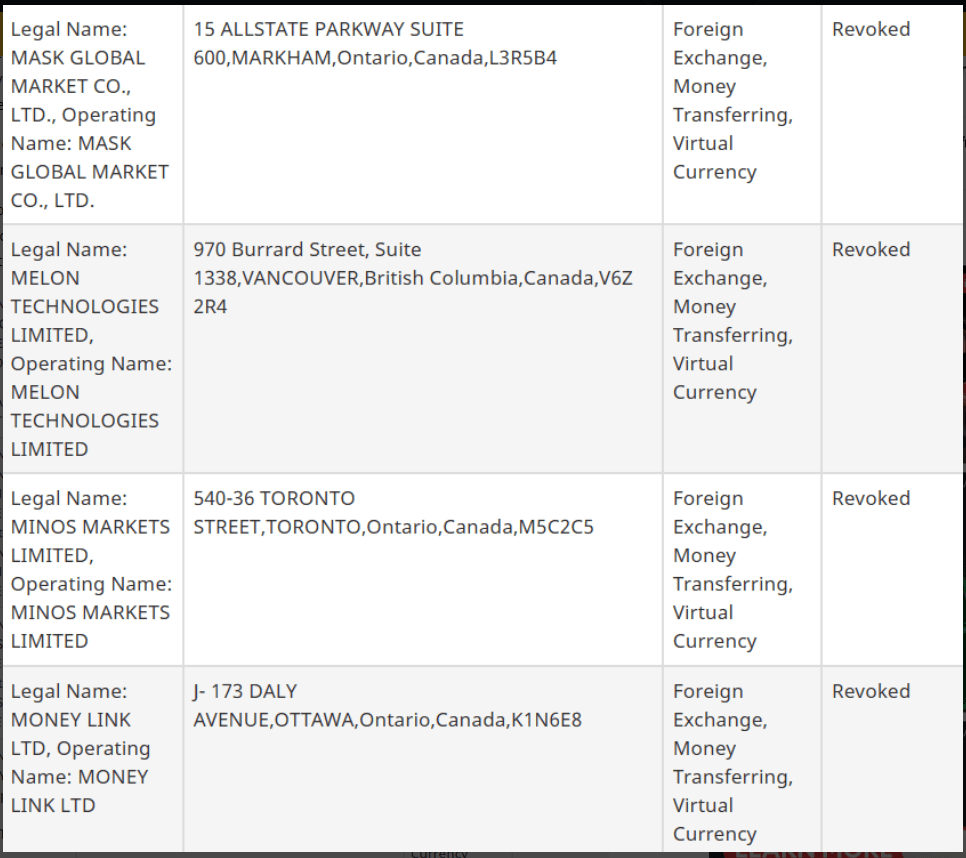
FINTRAC canceled 23 MSB registrations on Monday, according to the agency.

Any business that loses its registration has 30 days to request a review. Some may get reinstated. But the scale of the sweep — nearly 50 revocations in under three months — signals a shift in how Canada is policing the crypto sector.

FINTRAC also said it is strengthening enforcement and increasing transparency around compliance actions, a move that suggests the agency wants its actions to serve as a public deterrent, not just a regulatory cleanup.

Total crypto market cap currently at $2.38 trillion. Chart: TradingView

What The Numbers Say About Crypto And Crime

Canada’s crackdown comes at a time when the relationship between cryptocurrency and illicit finance is still hotly debated.

The Financial Action Task Force estimates that between 2% and 5% of global GDP moves through illegal channels each year — almost entirely through traditional banking systems.

Blockchain analytics firm Chainalysis puts the share of crypto transactions tied to illicit activity at under 1%.

Those figures don’t mean crypto is clean. But they do raise questions about whether the sector is being held to a stricter standard than older financial industries.

For now, Canada appears committed to its current direction. Officials have specifically called out crypto ATMs as a concern, suggesting future enforcement could extend beyond online platforms to physical kiosks scattered across the country.

Businesses that aren’t in full compliance with registration and reporting rules have reason to take that warning seriously.

Featured image from Unsplash, chart from TradingView

Perguntas relacionadas

QWhat was the total number of money services business registrations revoked by FINTRAC in 2026 alone, and how many of these were crypto-related firms?

AFINTRAC revoked 50 money services business registrations in 2026 alone, and 47 of those belonged to crypto-related firms.

QWhat were the two major enforcement actions taken by Canadian regulators against crypto platforms prior to the recent wave of license revocations?

ACanada's financial watchdog fined crypto platform Cryptomus $126 million for failing to flag suspicious transactions, and crypto exchange KuCoin was handed a $14 million penalty for operating without registering as a foreign money services business.

QAccording to the article, what is the estimated percentage of global GDP that moves through illegal channels each year, and what is the estimated share of crypto transactions tied to illicit activity?

AThe Financial Action Task Force estimates that between 2% and 5% of global GDP moves through illegal channels each year, while blockchain analytics firm Chainalysis puts the share of crypto transactions tied to illicit activity at under 1%.

QWhat did Finance Minister François-Philippe Champagne say about the government's future plans regarding virtual currency businesses?

AFinance Minister François-Philippe Champagne stated that the government will continue to monitor and pursue new measures to address risks posed by virtual currency businesses, such as cryptocurrency MSBs and crypto ATMs, which can be used to facilitate money laundering and fraud.

QWhat specific physical infrastructure, beyond online platforms, did Canadian officials call out as a concern for future enforcement actions?

ACanadian officials specifically called out crypto ATMs as a concern, suggesting future enforcement could extend to these physical kiosks scattered across the country.

Leituras Relacionadas

Within Strategy's Framework, STRC's Dividend Yield Remains at 12% as Share Price Stays Below Par Value

Michael Saylor, Executive Chairman of Strategy (MSTR), confirmed that the dividend rate for its STRC perpetual preferred shares will remain at 12.00% through August 2026. The rate has increased from 9% at its July 2025 launch to the current high via a "ratchet" mechanism, which permanently raises the rate by 0.5% whenever the share price falls below $95. This mechanism is intended to push the price back toward its $100 par value and support Strategy's "at-the-market" (ATM) program for issuing new shares to fund Bitcoin purchases. However, the mechanism has not worked as intended. STRC shares closed at $89.46 on July 31, remaining about 10-11% below par value despite the record-high dividend. Competition from rival Strive's higher-yielding SATA securities has pressured demand. The persistent discount has forced Strategy to suspend new STRC issuances via its ATM program, limiting this funding channel for Bitcoin acquisitions. STRC's struggles reflect Bitcoin's own volatility, as the preferred shares historically move in tandem. Analysts have warned the ratchet structure carries long-term, one-way risk. A law firm is investigating Strategy's ability to maintain dividend payments if Bitcoin's price stays low. Retail investors own roughly 83% of outstanding STRC shares, a group seen as prone to panic selling during downturns. In response, Strategy has established financial reserves, including a liquidity cushion covering about 26 months of dividend/interest obligations, and a $2 billion share buyback program alongside a Bitcoin monetization framework, though the company emphasized it is not obligated to sell any Bitcoin.

cryptonews.ruHá 39m

Within Strategy's Framework, STRC's Dividend Yield Remains at 12% as Share Price Stays Below Par Value

cryptonews.ruHá 39m

Analyst: Bitcoin's Price Will Drop to $60k in August, Then Rebound to $70k

Financial analyst Andrey Poroshin has provided a new forecast for Bitcoin's price dynamics in August. Poroshin, an analyst at the Bitbanker exchange, expects the cryptocurrency market to experience a downturn this month, with prices retesting the $60,000 level due to a lack of supportive macroeconomic catalysts. He noted that the recent US Federal Reserve decision to hold interest rates did not significantly impact the market, while inflation remains above the 2% target. Poroshin stated that Bitcoin is ending July under pressure from moderate volatility and a lack of new macroeconomic stimuli, leading to continued market caution. According to his base scenario, Bitcoin will drop to a range of $60,000 to $62,000 before recovering to $70,000. He pointed out that even $70,000 remains below the cost of mining in the US, which has prompted some miners to shift towards AI data center operations. Poroshin cited the winding down of BitMEX's operations as a potential catalyst for a price rebound, suggesting the exit of weaker players often coincides with market reversals and reduced short-term selling pressure. He believes Bitcoin is currently less susceptible to geopolitical shocks, such as the Iran-US conflict, and does not expect significant market changes in August related to the pending CLARITY Act. Looking ahead, Poroshin forecasts that September will bring more active price fluctuations driven by potential Fed rate decisions and possible discussions or approval of the CLARITY Act.

cryptonews.ruHá 40m

Analyst: Bitcoin's Price Will Drop to $60k in August, Then Rebound to $70k

cryptonews.ruHá 40m

Trading

Spot
活动图片





