Crypto could rally in Q2: But tensions rise, as do real-world risks

ambcryptoPublicado em 2026-03-20Última atualização em 2026-03-20

Resumo

Based on historical trends, there is potential for a bullish Q2 in the crypto market, as seen in 2025 when the total market cap surged 23.4% and Bitcoin gained 30% following a Q1 correction. This year's 20% Q1 drop has already been exceeded, indicating the market's ability to rebound quickly. However, currently down 18%, faces rising real-world risks. Geopolitical tensions, such as the West Asia crisis, and hotter-than-expected inflation data have triggered risk-off sentiment, causing significant sell-offs. Additionally, political uncertainty, including a high probability of a U.S. presidential impeachment, reflects broader economic weaknesses. These macro factors are increasingly influencing crypto, making a strong Q2 rally far less certain than before.

Is it still too early to project a bullish Q2 for the crypto market?

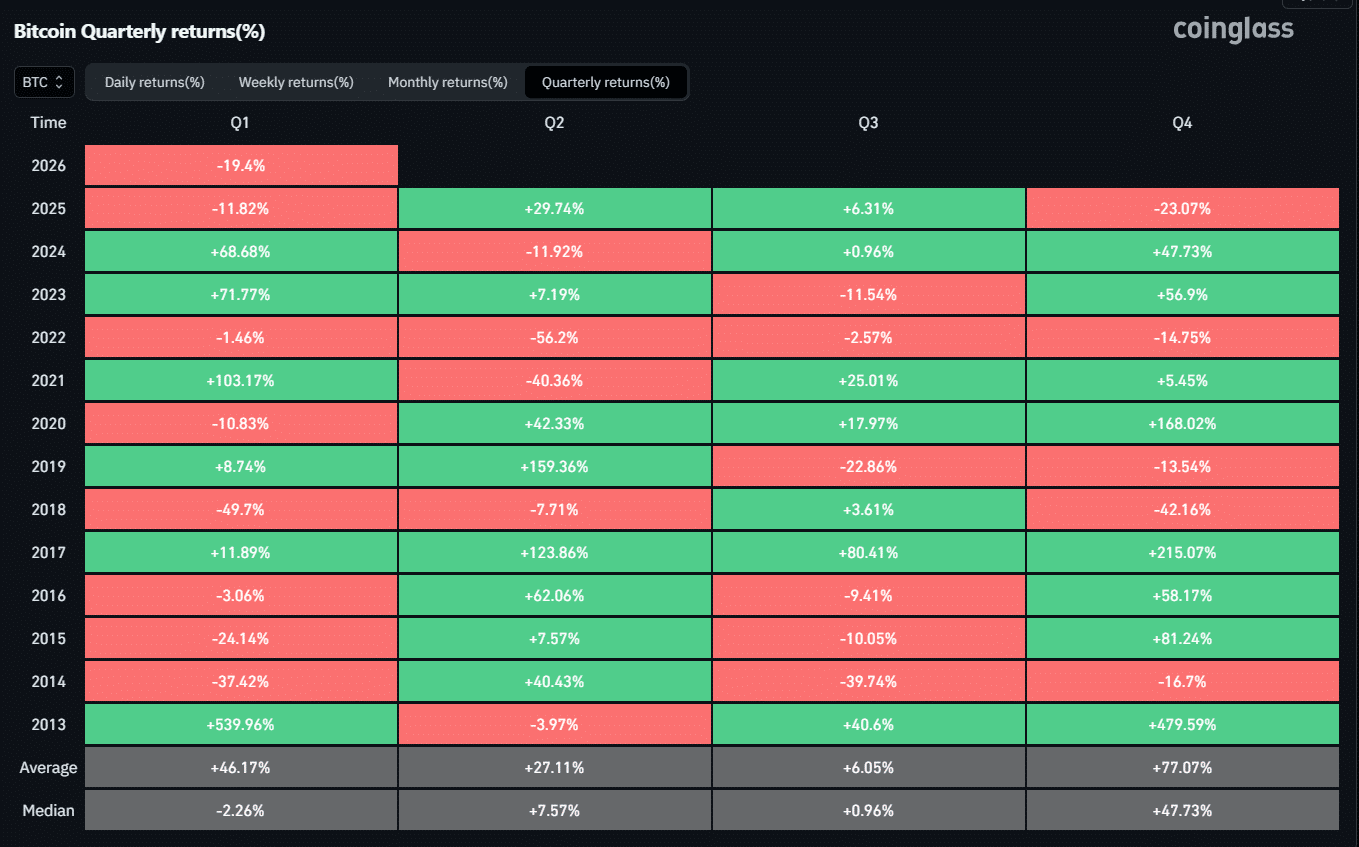
The discussion is certainly worth exploring, especially when we consider historical trends. Looking back at the 2025 cycle, Q2 clearly emerged as the most bullish quarter of the year.

During this period, the total crypto market cap increased by 23.4%, which translated into roughly $640 billion in fresh inflows.

Bitcoin [BTC] mirrored this momentum, closing the quarter up 30% and achieving the highest ROI of the year.

However, the main takeaway? This surge followed BTC’s roughly 12% correction in Q1, and the market has already outpaced that pullback with this year’s roughly 20% drop so far, showing how quickly it can rebound and adapt.
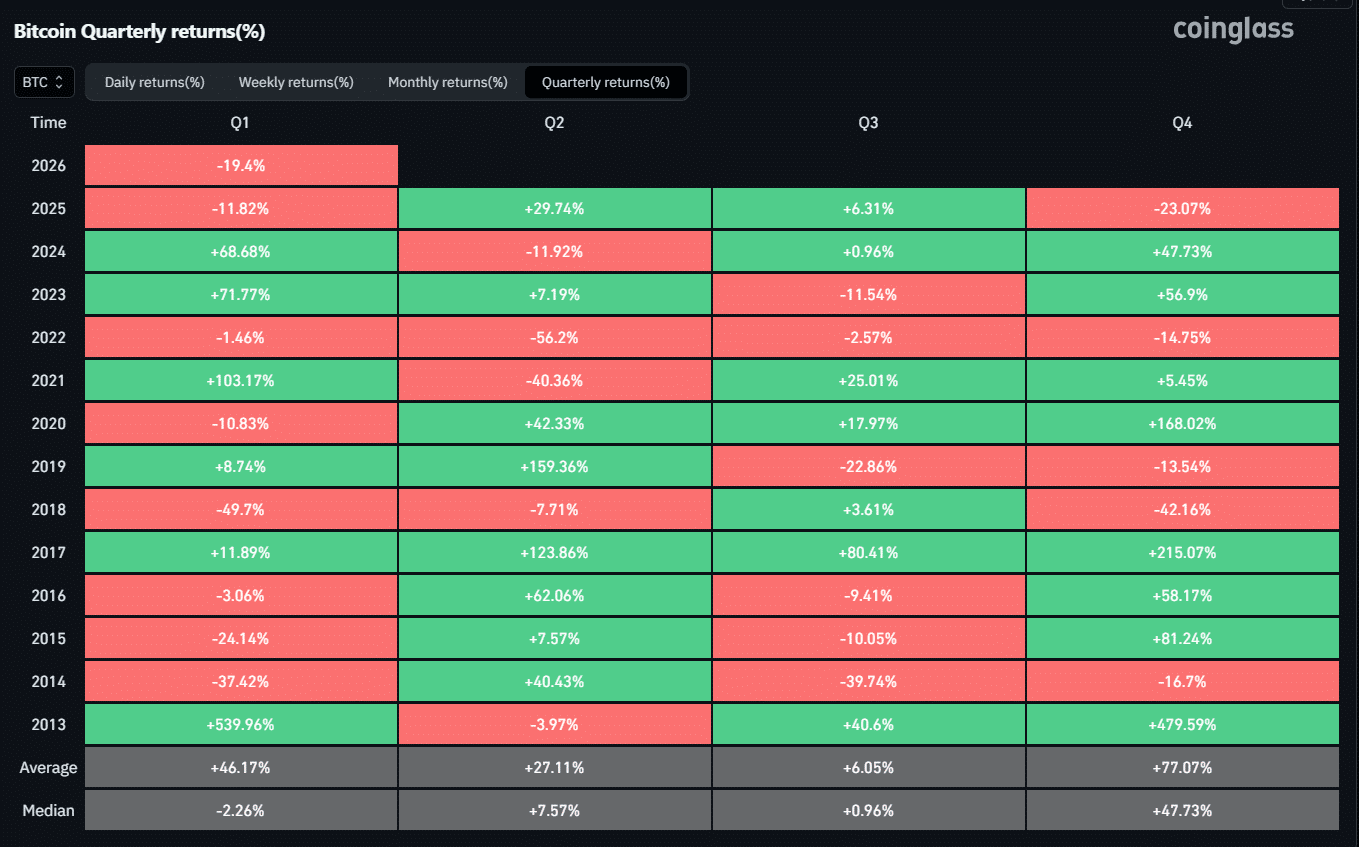
Source: CoinGlass

Against this backdrop, we cannot dismiss the possibility of a repeat run for crypto as overly optimistic.

In fact, it becomes even more compelling when we consider how the market has so far shrugged off the FUD stemming from the West Asia crisis, despite surging oil prices. Meanwhile, traditional safe havens have been under pressure, with gold posting nearly twice the weekly losses of Bitcoin.

Taken together, this suggests that the crypto market could be setting the stage for another strong rally. However, when we step back and look at the bigger picture, the total crypto market cap is still down roughly 18%, a stark contrast to the S&P 500’s 3.23% quarterly decline.

Naturally, the key question becomes: Can crypto’s relative strength hold up against a double-digit pullback and still power a bullish Q2?

The crypto market faces a real-world test

The crypto market stumbled on fresh macro data, sparking another wave of risk-off activity.

As AMBCrypto flagged, the latest PPI report came in hotter than expected, showing that inflation concerns continue to keep the Federal Reserve hawkish on interest rates. Still, the market had mostly priced this in, with nearly 99% expecting rates to remain unchanged.

And yet, crypto closed the session down 3.24%, reminding investors that even priced-in data can shake sentiment.

This naturally puts the spotlight on recent prediction market data, which highlights that the probability of U.S. President Donald Trump being impeached before 2028 has risen to 72%, trending steadily higher over the past few months.
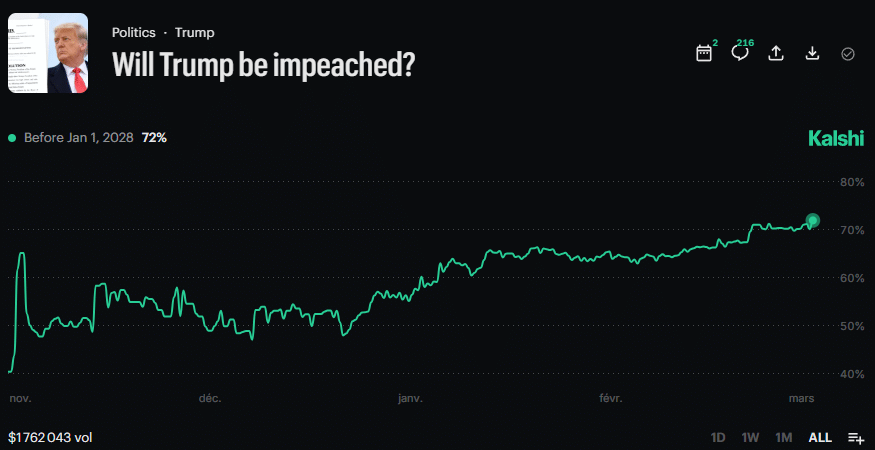
Source: Kalshi

Most importantly, this isn’t a one-off signal. The data also reflects a weakening U.S. economy across multiple sectors, from unemployment to GDP, underscoring that the impeachment prediction is supported by broader economic trends.

In this context, the recent PPI report represents just one piece of a much larger picture, highlighting ongoing inflation pressures and the challenges policymakers face. Against this backdrop, it’s no surprise that the market reacted.

After Israel struck Iran’s critical energy infrastructure, crypto lost billions, with Bitcoin falling more than 2%. This shows that real-world events are starting to feed into investor sentiment, testing the crypto market’s recent resilience.

This in turn makes the odds of a bullish Q2 highly unlikely, as macro FUD now plays a larger role in shaping investor expectations than it did earlier this year.


Final Summary

  • Historical trends suggest Q2 could be bullish, as BTC and the overall crypto market have rebounded strongly after Q1 pullbacks.
  • Macro and geopolitical risks are beginning to influence investor sentiment, making a repeat Q2 rally far from guaranteed.

Leituras Relacionadas

The Entire Internet Hails Noam's Joining, But OpenAI's Loss Bill Just Got Thicker

While the AI community celebrates Noam Shazeer, co-author of the "Attention Is All You Need" paper, joining OpenAI as Head of Architectural Research, the company's audited financials reveal a starkly different reality. In 2025, OpenAI reported $13.07 billion in revenue but a massive $20.92 billion operating loss. Even excluding a one-time accounting charge, the cash burn is severe, with $3.7 billion consumed in Q1 2026 alone. This high-profile hiring occurs against a backdrop of significant internal research talent drain, with key founders and researchers departing as the company's focus shifts from exploratory research to product iteration. Meanwhile, OpenAI's fundamental business model faces a deep crisis. It paid Microsoft $10.59 billion for compute in 2025, while its vast user base of 9 billion weekly actives includes only 50 million paying customers, making growth a direct driver of escalating costs. The article argues Shazeer's recruitment is less about technical necessity and more about crafting a compelling narrative for OpenAI's upcoming IPO, aiming to justify a rumored $1 trillion valuation to future public market investors. It contrasts OpenAI's strategy with Anthropic's reported path to profitability, which relies on a strong enterprise customer base and cost control, rather than star-powered narratives. Ultimately, the piece concludes that while Shazeer's architectural work may take 1-2 years to materialize, OpenAI's financial clock is ticking much faster, with its massive losses undercutting the celebratory headlines.

marsbitHá 1h

The Entire Internet Hails Noam's Joining, But OpenAI's Loss Bill Just Got Thicker

marsbitHá 1h

Market Trend (June 19): US-Iran Deal Drives Out Geopolitical Premium; Chip Stocks Soar to New Highs; Energy Sector Leads Declines

U.S. Market Trends (June 19): U.S.-Iran Deal Eases Tensions, Chip Stocks Soar, Energy Sector Leads Declines. U.S. stocks rallied on Thursday as the signing of a temporary U.S.-Iran deal in Geneva de-escalated Middle East tensions, with Saudi oil tankers transiting the Strait of Hormuz. This geopolitical relief helped markets recover from recent Fed-driven volatility. The S&P 500 rose over 1%, the Nasdaq gained nearly 2%, and the Dow Jones Industrial Average closed at another record high. The Philadelphia Semiconductor Index surged over 6% to a historic peak. Chip stocks were the standout performers. Reports of an Apple-Intel design and foundry deal for certain products, alongside mentions of potential Nvidia and SpaceX collaborations with Intel, propelled the sector. Intel surged ~10.5%, while memory chip makers like Micron also saw significant gains, highlighting sustained confidence in long-term AI capital expenditure. In contrast, the energy sector was the day's sole loser, with the S&P 500 energy sub-index declining as WTI crude fell ~2% to around $74.29/barrel. The reopening of key shipping routes erased prior geopolitical risk premiums. SpaceX extended losses for a second day on news of a potential large bond offering. Market volatility (VIX) dropped sharply, indicating a swift reversal of post-Fed jitters. Treasury yields dipped slightly but remained elevated. The focus now shifts to upcoming economic data, including next week's PCE inflation report and Micron's earnings, which will serve as a key test for the AI trade's durability.

marsbitHá 2h

Market Trend (June 19): US-Iran Deal Drives Out Geopolitical Premium; Chip Stocks Soar to New Highs; Energy Sector Leads Declines

marsbitHá 2h

Trading

Spot
Futuros
活动图片