Crypto Continues to Expand in Asia as Thailand Clears Path for Digital Asset Derivatives

bitcoinistPublicado em 2026-02-13Última atualização em 2026-02-13

Resumo

Thailand's Cabinet has approved amendments to the Derivatives Act, allowing digital assets like Bitcoin to serve as underlying instruments for regulated derivatives contracts. The Securities and Exchange Commission (SEC) will update licensing and supervision rules to enable crypto-linked futures and options on platforms such as the Thailand Futures Exchange. This move aims to enhance crypto's recognition as an investable asset class, expand investor access, and improve risk management tools. The reform aligns with Thailand's growing crypto market, valued at $3.19 billion as of August 2025, and supports plans for future crypto ETFs. The SEC will implement safeguards to address volatility and protect investors.

Thailand has taken a further step toward integrating crypto into its mainstream financial system, after the Cabinet approved changes that allow digital assets to underpin regulated derivatives contracts. The move positions the country among a growing number of Asian markets adapting crypto-linked financial products.

On Feb. 10, Thailand’s Cabinet endorsed a Finance Ministry proposal to expand the scope of assets permitted under the Derivatives Act B.E. 2546 (2003). The amendment enables digital assets, including cryptos such as Bitcoin, to serve as underlying instruments for futures and options traded on regulated platforms.

The Securities and Exchange Commission (SEC) will now amend the Derivatives Act and draft supporting regulations to govern participation, licensing, and supervision.
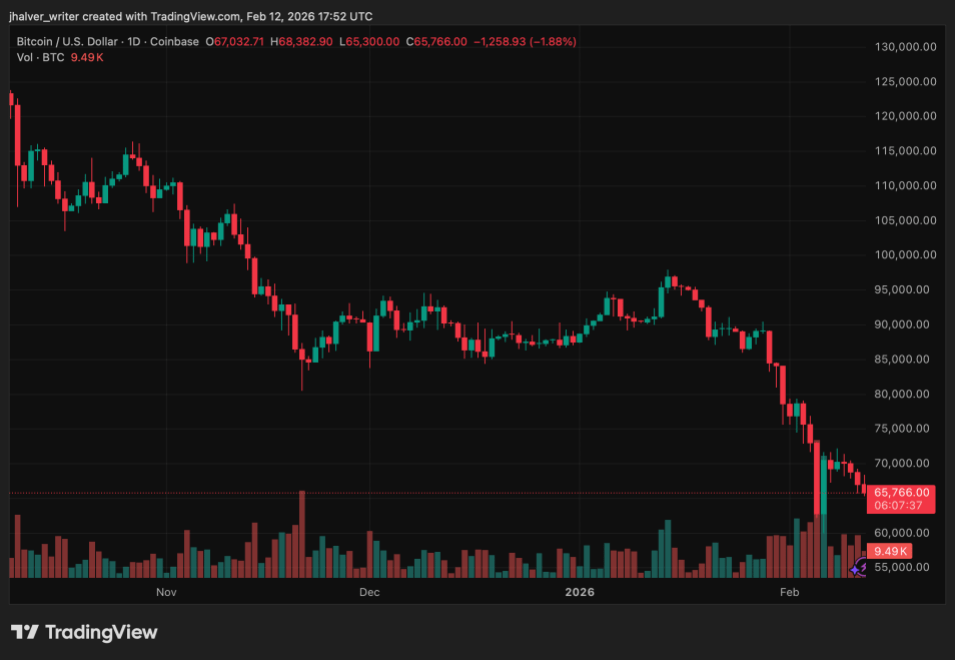
BTC's price trends to the downside on the daily chart. Source: BTCUSD on Tradingview

Thailand Integrates Crypto Into Regulated Derivatives Market

Under the revised framework, digital assets will be recognized as permissible underlying assets for derivatives products listed on exchanges such as the Thailand Futures Exchange (TFEX).

The SEC said it will revise derivatives business licenses to allow digital asset operators to offer crypto-linked contracts and will review supervisory standards for exchanges and clearinghouses.

SEC Secretary-General Pornanong Budsaratragoon said the expansion is intended to strengthen the recognition of cryptocurrencies as an investment asset class, broaden investor access, and enhance risk management tools.

The regulator will also work with TFEX to determine contract specifications that account for the volatility and risk characteristics of digital assets. Officials indicated that supervisory safeguards and investor protection measures will remain central as the market evolves.

In addition to cryptocurrencies, the amendment reclassifies carbon credits, enabling the introduction of physically delivered futures contracts alongside cash-settled products. The measure aligns with Thailand’s draft Climate Change Act and its broader carbon-neutrality objectives.

Growing Institutional Focus and Market Expansion

Thailand’s latest reform builds on a regulatory framework introduced in 2018, when the country enacted rules governing digital asset businesses. Oversight has since expanded to include stricter operational requirements and investor protection measures, while crypto payments remain prohibited by the central bank.

The SEC’s broader 2026 capital markets roadmap includes plans to introduce crypto exchange-traded funds (ETFs), subject to legal amendments. Officials have indicated that crypto ETFs could launch later this year.

Thailand’s domestic crypto market has also grown steadily. As of August 2025, the SEC valued the market at approximately $3.19 billion, with average daily trading volumes near $95 million. Active accounts rose to 230,000, reflecting increased participation from retail investors, foreign entities, and domestic institutions.

Industry participants say integrating crypto into the derivatives market could improve liquidity and provide hedging tools, but some have cautioned that capital requirements and disclosure standards must keep pace to manage systemic risk.

Cover image from ChatGPT, BTCUSD chart from Tradingview

Perguntas relacionadas

QWhat recent regulatory change did Thailand's Cabinet approve regarding digital assets?

AThailand's Cabinet approved changes to the Derivatives Act to allow digital assets, including cryptocurrencies like Bitcoin, to serve as underlying instruments for regulated futures and options contracts.

QWhich regulatory body is responsible for amending the Derivatives Act and drafting supporting regulations for this new framework?

AThe Securities and Exchange Commission (SEC) is responsible for amending the Derivatives Act and drafting the supporting regulations to govern participation, licensing, and supervision.

QWhat are the stated goals of integrating crypto into the derivatives market, according to SEC Secretary-General Pornanong Budsaratragoon?

AThe goals are to strengthen the recognition of cryptocurrencies as an investment asset class, broaden investor access, and enhance risk management tools.

QBesides cryptocurrencies, what other asset was reclassified by this amendment, and for what purpose?

ACarbon credits were also reclassified to enable the introduction of physically delivered futures contracts, aligning with Thailand's climate change and carbon-neutrality objectives.

QWhat is the estimated value of Thailand's domestic crypto market as of August 2025, according to the SEC?

AAs of August 2025, the SEC valued Thailand's domestic crypto market at approximately $3.19 billion.

Leituras Relacionadas

How Many Tokens Away Is Yang Zhilin from the 'Moon Chasing the Light'?

The article explores the intense competition between two leading Chinese AI companies, DeepSeek and Kimi (Moon Dark Side), and the mounting pressure on Yang Zhilin, the founder of Kimi. While DeepSeek re-emerged after 15 months of silence with its powerful V4 model—boasting 1.6 trillion parameters and low-cost, long-context capabilities—Kimi has been focusing on long-context processing and multi-agent systems with its K2.6 model. Yang faces a threefold challenge: technological rivalry, commercialization pressure, and investor expectations. Despite Kimi’s high valuation (reaching $18 billion), its revenue heavily relies on a single product with low paid conversion rates, while DeepSeek’s strategic silence and open-source influence have strengthened its market position and valuation prospects, now targeting over $20 billion. Both companies reflect broader trends in China’s AI ecosystem: Kimi aims for global influence through open-source contributions and agent-based advancements, while DeepSeek prioritizes foundational innovation and hardware independence, notably shifting to Huawei’s chips. Their competition is seen as vital for China’s AI progress, with the gap between top Chinese and U.S. models narrowing to just 2.7% on the Elo rating scale. Ultimately, the article argues that this rivalry, though anxiety-inducing for leaders like Zhilin, is essential for driving innovation and solidifying China’s role in the global AI landscape.

marsbitHá 1h

How Many Tokens Away Is Yang Zhilin from the 'Moon Chasing the Light'?

marsbitHá 1h

TechFlow Intelligence Bureau: ChatGPT Helps Amateur Mathematician Crack 60-Year-Old Problem, CFTC Sues New York Regulator Over Coinbase and Gemini

An amateur mathematician, with the assistance of ChatGPT, has solved a combinatorial mathematics puzzle originally proposed by Hungarian mathematician Paul Erdős in the 1960s. This marks another milestone in AI-aided mathematical research, demonstrating the evolving capabilities of large language models in formal reasoning. In other AI developments, OpenAI introduced a new privacy filter tool for enterprise API usage, automatically screening sensitive data. Meanwhile, the Qwen3.6-27B model achieved 100 tokens per second on a single RTX 5090 GPU using quantization, significantly lowering the cost barrier for local AI deployment. In crypto and Web3, the U.S. CFTC sued New York’s financial regulator, challenging its oversight of Coinbase and Gemini—a first-of-its-kind federal-state regulatory clash. Following a vulnerability, KelpDAO and major DeFi protocols established a recovery fund. Tether froze $344 million in assets linked to Iran’s central bank upon U.S. Treasury request, highlighting the centralized control risks in stablecoins. Separately, Litecoin underwent a 3-hour chain reorganization to undo a privacy-layer exploit. In the U.S., former President Trump invoked the Defense Production Act to address power grid bottlenecks affecting AI data centers and dismissed the entire National Science Board, raising concerns over research independence. A retail trader gained 250% on a $600k Intel options bet amid AI-related speculation. Xiaomi announced its first performance electric vehicle, targeting rivals like Tesla. Meanwhile, iPhone users reported devices automatically reinstalling a hidden app daily, suspected to be MDM-related. A Chinese securities report noted that A-share institutional crowding has reached its second-longest streak since 2007, signaling high valuations and potential style rotation. The day’s developments reflect a dual narrative: AI is enabling unprecedented individual breakthroughs, while centralized power structures—whether governmental or corporate—are becoming more assertive, underscoring that decentralization is as much a political-economic challenge as a technical one.

marsbitHá 2h

TechFlow Intelligence Bureau: ChatGPT Helps Amateur Mathematician Crack 60-Year-Old Problem, CFTC Sues New York Regulator Over Coinbase and Gemini

marsbitHá 2h

Trading

Spot
Futuros
活动图片