Crypto Bets On Argentina Inflation Stoke Fears Of Insider Trading On Polymarket

bitcoinistPublicado em 2026-03-17Última atualização em 2026-03-17

Resumo

Argentinian authorities have ordered a nationwide blockade of the crypto prediction platform Polymarket, enforced by regulators and internet providers, following a court ruling that deemed it an unlicensed gambling operation. The move comes after allegations of insider trading emerged when suspicious betting activity occurred just before the release of official inflation data in February. Argentina follows Colombia as the second Latin American country to ban the platform, reflecting a broader global trend of regulators treating prediction markets as gambling rather than financial tools. This could fragment liquidity and push users into less regulated markets.

Argentinian authorities have ordered a full national blockade of Polymarket after it predicted inflation data.

An Authoritarian Crypto Ban?

Argentinian outlets reported this Monday that a court ruling in Buenos Aires ordered a nationwide blockade of Polymarket, one of the largest crypto prediction market platforms globally. The blockade will be enforced via the Ente Nacional de Comunicaciones (ENACOM) and local internet service providers (ISPs), in addition to its removal from Apple and Google app stores. The restriction goes as far as affecting already signed up Polymarket users, another local outlet claims.

Buenos Aires Lottery Regulators (Lotería de la Ciudad de Buenos Aires and the Cámara Argentina de Casinos y Bingos) argue that Polymarket is operating as an unlicensed online gambling platform, not just a neutral "prediction market". This led to a case being brought by the City's Special Prosecutor's Office for Gambling (FEJA) and presided over by Judge Susana Parada.

The Public Prosecutor's Office explained that despite the blocking order having already been issued, the implementation depends on ENACOM notifying all ISP's so the companies can cut off access. Therefore, the full and final implementation will most likely be gradual.

A "Degen Casino" That Played With The Country's Inflation

This drastic ruling follows a suspicious trading scandal in the inflation market back in February, where odds moved around fifteen minutes before INDEC released official CPI data, raising allegations of insider trading by politically connected actors.

The local media has echoed the "degen casino" narrative, arguing that these markets let users place peso‐linked wagers on macro data, elections and high‐profile political outcomes without any Argentine license or KYC/age checks. Clarín claims that, in Polymarket, "it all comes down to betting money on a question that can be answered with a yes or a no":

Polymarket presents itself as a prediction market, but in practice it's a way to bet on almost anything that emerged during the pandemic and gained popularity during the election campaign between Donald Trump and Kamala Harris, when the tycoon began promoting these markets because they gave him better results than the polls: 55.5% were literally betting on him.

A Global Trend

Despite some claims that place Argentina as the first country in the region to implement such measures, the truth is that last year Colombia became the first country in Latin America to ban Polymarket. Coljuegos, Colombian gambling regulators, declared the platform ilegal in September 2025 and, similarly to the Argentinian ban, instructed their ISPs to block access to it.

It its worth noting that prediction markets had become a popular way for global crypto traders to price political risk, inflation paths and macro events in real time, often anticipating official data. In line with this, this is not the first clash between Polymarket's and regulatory entities. Besides Colombia, other earlier blocks or investigations have been registered in France, Taiwan and Singapore, in addition to the US regulatory pressure over unregistered derivatives and gambling concerns.

Argentina's move reinforces a growing trend of regulators increasingly treating crypto prediction platforms as gambling first and market infrastructure second, which could fragment liquidity and push activity into friendlier jurisdictions or darker venues.
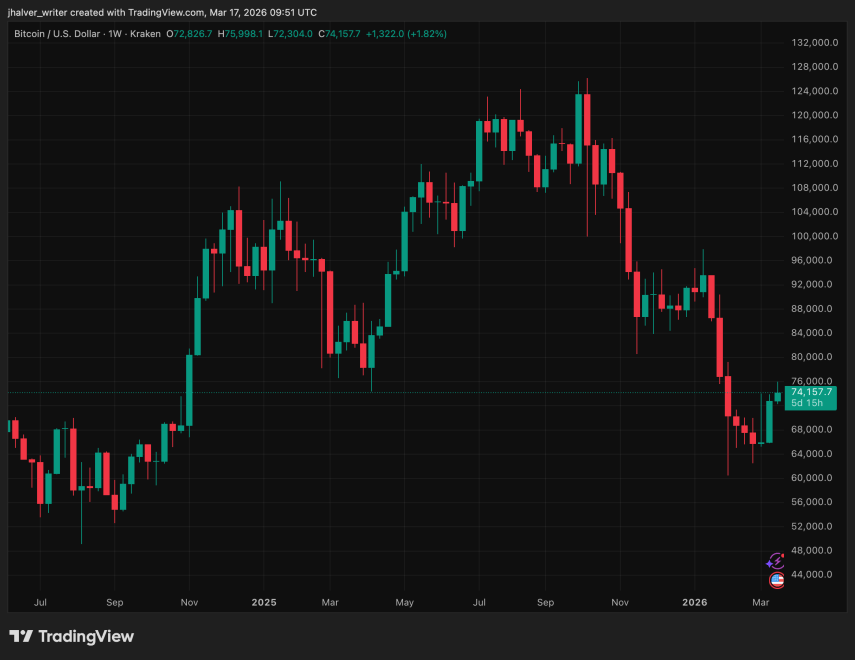
BTC's price trends reaches $74K on the daily chart, the highest since January. Source: BTCUSD on Tradingview

Cover image from Perplexity, BTCUSD chart from Tradingview

Perguntas relacionadas

QWhy did Argentinian authorities order a national blockade of Polymarket?

AArgentinian authorities ordered a national blockade of Polymarket because they argue it is an unlicensed online gambling platform, not just a neutral prediction market, following a suspicious trading scandal involving inflation data.

QWhat was the suspicious trading activity on Polymarket related to in Argentina?

AThe suspicious trading activity was related to Argentina's inflation data, where odds moved around fifteen minutes before the official CPI data was released by INDEC, raising allegations of insider trading.

QWhich other Latin American country banned Polymarket before Argentina?

AColombia became the first country in Latin America to ban Polymarket, declaring the platform illegal in September 2025 and instructing ISPs to block access.

QHow does Polymarket present itself versus how it is viewed by regulators?

APolymarket presents itself as a prediction market, but regulators view it as an unlicensed online gambling platform that allows users to place wagers on events without proper licensing or KYC/age checks.

QWhat global trend does Argentina's move against Polymarket reinforce?

AArgentina's move reinforces a growing trend of regulators treating crypto prediction platforms as gambling first and market infrastructure second, which could fragment liquidity and push activity into friendlier jurisdictions.

Leituras Relacionadas

$30 Billion DeFi Capital Exodus: LayerZero Stumbles, Chainlink Feasts

Following the major DeFi security incident involving Kelp DAO, a significant migration of funds is underway from the cross-chain protocol LayerZero to Chainlink's CCIP (Cross-Chain Interoperability Protocol). Over $30 billion in Total Value Locked (TVL) from protocols like Kelp DAO, Solv Protocol, Re, and Tydro has moved to Chainlink in the past week, driven by security concerns. LayerZero is facing a severe trust crisis after the attack. Initially denying responsibility, LayerZero Labs has now issued a public apology, acknowledging management oversights. These include a vulnerable "1/1" single-node configuration for its Decentralized Verification Network (DVN) and past misuse of a multi-signature wallet by a team member. The protocol's weekly bridge volume has slumped to near-historic lows of around $470 million. In contrast, Chainlink is experiencing a surge in adoption and activity. Its independent active addresses recently hit multi-month highs, and whales have been accumulating LINK tokens. Beyond DeFi, Chainlink is securing partnerships with traditional finance giants like DTCC, European stock exchange operator SIX Group, and asset manager Amundi. While LayerZero has announced security upgrades—such as migrating to stronger multi-signature configurations and developing a second DVN client—and contributed to a rescue fund, the event underscores that security is becoming a decisive competitive factor as DeFi matures.

marsbitHá 33m

$30 Billion DeFi Capital Exodus: LayerZero Stumbles, Chainlink Feasts

marsbitHá 33m

The $13 Trillion Repo Market Is Quietly Being Rewritten by Blockchain

The $13 trillion repurchase agreement (repo) market, a crucial artery for global short-term funding, is experiencing a significant transformation through blockchain technology. After years of limited impact in finance, blockchain is finding substantial adoption in repo transactions. Major institutions like JPMorgan Chase, HSBC, and Broadridge are deploying tokenized repo platforms, with daily volumes already reaching tens of billions of dollars. Traditional repo markets operate with fixed hours, rely on intermediaries, and involve manual, time-consuming processes. Tokenized repos, by contrast, use blockchain to create digital tokens representing cash and securities collateral. This enables near-instantaneous settlement, 24/7 trading, automated execution, and enhanced auditability. The key drivers for adoption include maturing technology, more receptive regulators, and growing client recognition of tangible benefits like reduced operational friction and capital efficiency. Analyses, such as one from Broadridge, indicate that moving a portion of repo activity onto blockchain can significantly reduce a bank's required liquidity buffers, potentially freeing up billions in capital. The infrastructure is also seen as foundational for a future of round-the-clock trading for traditional assets. Challenges remain, including the existence of fragmented blockchain networks, the need for stress testing under extreme market conditions, and the loss of operational flexibility compared to manual processes. However, the industry consensus is that these are implementation hurdles. Tokenized repo has moved beyond pilot stages to become one of blockchain's most concrete and impactful applications in traditional finance, marking a pivotal shift in how a core market functions.

marsbitHá 34m

The $13 Trillion Repo Market Is Quietly Being Rewritten by Blockchain

marsbitHá 34m

From Gas Limit to 'Keyed Nonces', How to Understand the Next Step in Ethereum Scalability?

Ethereum’s scalability efforts are shifting toward a user-centric approach—focusing not only on higher TPS, but on translating technical upgrades into lower costs, smoother operations, and better wallet experiences. Two recent developments highlight this direction: - **Raising the Gas Limit to 200 million**: Following the Fusaka upgrade that increased it to 60 million, a consensus has formed around a potential future increase to 200 million. This would boost Ethereum’s execution capacity, but it is planned alongside other upgrades—such as ePBS, Block-Level Access Lists (BAL), and EIP-8037—to manage state growth and keep node operation viable for average participants. - **Keyed Nonces (EIP-8250)**: This proposal aims to improve how transactions are queued. Instead of a single linear nonce per account, it introduces multiple independent nonce domains. This prevents different types of transactions—such as private payments, session keys, or batch operations—from blocking each other. Vitalik Buterin views this as a foundational step toward better privacy support and more flexible state scalability. Together, these upgrades are part of a broader move to push complexity from wallets, DApps, and relays back into the protocol layer. For everyday users, this means future Ethereum interactions could become less congested, more intuitive, and safer—especially as core improvements in account abstraction, cross-L2 interoperability, and node decentralization continue to progress. Ultimately, Ethereum is evolving to handle not just more transactions, but more varied and complex on-chain use cases while preserving its decentralized foundation.

marsbitHá 57m

From Gas Limit to 'Keyed Nonces', How to Understand the Next Step in Ethereum Scalability?

marsbitHá 57m

Trading

Spot
Futuros
活动图片





