Crypto-Backed Super PAC Launches Midterm Election Endorsements Push

bitcoinistPublicado em 2026-04-15Última atualização em 2026-04-15

Resumo

A crypto-aligned super PAC named Fellowship PAC, chaired by Tether's head of government affairs Jesse Spiro, has launched its 2026 midterm election push with over $100 million to spend. Its first action was a $300,000 ad buy supporting a Republican candidate in a Georgia congressional race. The PAC has also endorsed several other Republican candidates in key Senate and gubernatorial races across five states. This strategy mirrors previous crypto-backed efforts, like the Fairshake PAC, which spent heavily in the 2024 cycle. Meanwhile, major crypto legislation, the CLARITY Act, remains stalled in the Senate.

Tether’s top government affairs official is now running one of the most well-funded political operations in the crypto world. Jesse Spiro, who serves as head of government affairs for the stablecoin giant, was named chair of Fellowship PAC earlier this month — a crypto-aligned super PAC that says it has more than $100 million ready to spend on the 2026 US midterm elections.

First Spending On Record

The group’s opening move was a $300,000 ad buy backing Clay Fuller, a Republican who won a special election to fill the Georgia 14th Congressional District seat left open after Marjorie Taylor Greene stepped down. That spending was formally reported to the Federal Election Commission and disbursed this week, roughly a month before Georgia’s Republican primary on May 19.

Fellowship did not stop there. The PAC posted a list of endorsements to its account on X, backing Republican candidates in five states. The list includes Alan Wilson for South Carolina governor, Blake Miguez for Louisiana’s 5th Congressional District, Mike Collins for a Georgia Senate seat, Julia Letlow for a Louisiana Senate seat, Pete Ricketts for Nebraska’s Senate race, and Nate Morris in Kentucky’s Senate contest.
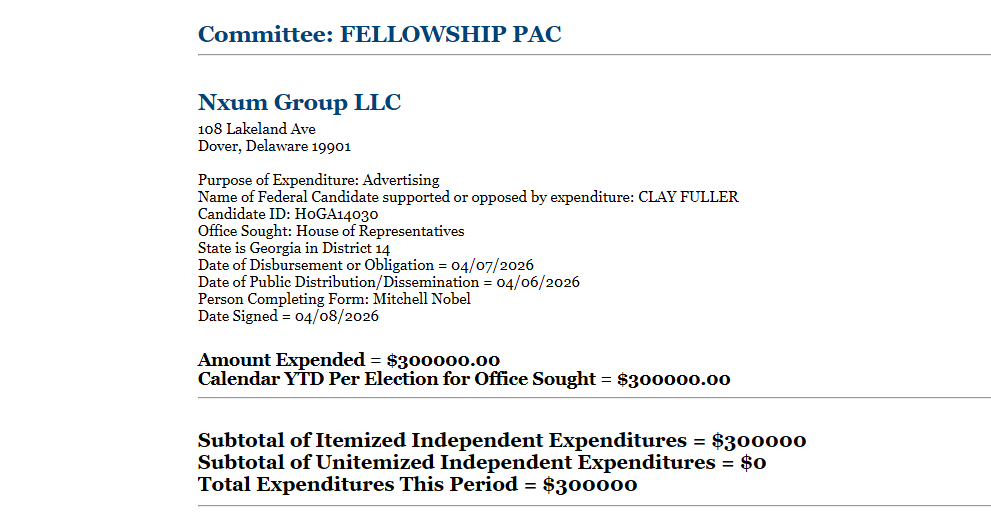
Source: Federal Election Commission

A Familiar Playbook

The crypto industry has done this before. During the 2024 election cycle, Fairshake PAC — another crypto-backed group — poured more than $130 million into congressional races across the country.

Reports indicate the spending may have shaped outcomes in battleground contests, including the Ohio Senate race. Fellowship appears to be following a similar strategy heading into 2026.

Bitcoin is now trading at $74,345. Chart: TradingView

Super PACs are allowed by federal law to accept unlimited donations from individuals, corporations, labor unions, and other PACs, as long as the spending remains independent from any candidate’s official campaign.

Fellowship filed its statement of organization in 2025. Its financial backers have not been publicly identified — a legal but notable feature of how these groups operate.

Legislation Still Waiting

While money flows into midterm races, a major crypto bill sits unresolved in the Senate. The CLARITY Act, passed by the House of Representatives last July, was designed to be one of the most far-reaching pieces of legislation affecting the crypto and banking sectors.

It has since run into resistance over questions involving ethics provisions, stablecoin yield rules, and tokenized equities.

Reports say the Senate Banking Committee was considering a review session on the bill, but no date had been placed on the committee’s official calendar as of Monday.

A second Senate panel would also need to clear the legislation before it could advance to a full chamber vote. For now, the bill’s path forward remains uncertain — and the midterms may determine whether it ever gets one.

Featured image from Ivan Marc/Shutterstock, chart from TradingView

Perguntas relacionadas

QWho is running the crypto-aligned super PAC Fellowship PAC and what is their role at Tether?

AJesse Spiro, who serves as head of government affairs for Tether, is running the crypto-aligned super PAC Fellowship PAC as its chair.

QWhat was Fellowship PAC's first reported political expenditure and for which candidate?

AFellowship PAC's first reported expenditure was a $300,000 ad buy backing Clay Fuller, a Republican candidate in a special election for Georgia's 14th Congressional District.

QWhat is the name of the major crypto bill that is currently unresolved in the Senate?

AThe major crypto bill that is currently unresolved in the Senate is called the CLARITY Act.

QAccording to the article, what was the total amount a similar crypto-backed group spent during the 2024 election cycle?

ADuring the 2024 election cycle, the crypto-backed group Fairshake PAC spent more than $130 million on congressional races.

QWhat is a key feature of how super PACs like Fellowship operate regarding their financial backers?

AA key feature is that the financial backers of super PACs like Fellowship have not been publicly identified, which is a legal but notable aspect of their operation.

Leituras Relacionadas

WeChat Agent Issues a 'Heroic Summons,' Half of the Internet Responds

WeChat AI Agent is on the horizon. The WeChat Open Platform has issued a guide for developers, offering them ways to integrate into the WeChat AI ecosystem. This will enable mini-programs to be discovered and invoked by the AI. Meituan has already announced its integration, allowing users to access services like food delivery through WeChat AI. Other platforms like Ctrip and Tongcheng have followed suit. Furthermore, WeChat is collaborating with major smartphone manufacturers to enable their native AI assistants to perform actions within WeChat, such as initiating calls or sending messages, through a controlled protocol called Agent-to-Agent (A2A). Reports indicate the WeChat AI Agent will be accessible by swiping right on the main interface. It aims to understand user intent within the rich context of chats, groups, and past interactions, then automatically call upon relevant mini-programs to complete tasks like ordering coffee or booking restaurants. This positions it as a potential "super app" with direct access to WeChat's vast ecosystem of services, social connections, and payment systems. Technically, this is a complex endeavor. It requires advanced natural language understanding, a "world model" to predict interactions within mini-programs (UI-Oceanus), multi-model orchestration for cost efficiency, and careful coordination with millions of third-party service providers. Tencent's development follows a "Co-Design" approach, where product teams and the Hunyuan model team collaborate closely, allowing capabilities honed in other AI products (like Yuanbao for chat, ima for search, WorkBuddy for office tasks) to be transferred to the WeChat Agent. Tencent is strategically opting for the A2A protocol over GUI-based automation (which it has blocked in the past), maintaining control over its ecosystem. To manage the immense scale and cost of serving 1.4 billion monthly active users, Tencent is deepening its ties with DeepSeek, known for its cost-effective training, to secure a low-cost inference backbone. The ultimate goal is to solve practical, everyday problems for users within the WeChat ecosystem, moving beyond technical benchmarks to deliver real utility, which Tencent sees as the key to winning in the long-term AI game.

marsbitHá 4m

WeChat Agent Issues a 'Heroic Summons,' Half of the Internet Responds

marsbitHá 4m

Humanity Loses $31 Million in Attack, Token Price Plummets 90% Due to a Single Private Key

On June 9th, the digital identity project Humanity Protocol suffered a major security breach resulting in over $31 million in losses. According to on-chain analyst Specter, hundreds of wallets holding the project's H token were drained. The attack was confirmed by founder Terence Kwok to be caused by the compromise of a foundation member's private key. As a precaution, users are advised to avoid interacting with Humanity's cross-chain bridge or liquidity pools. The incident caused the H token price to crash over 90%, from around $0.70 to a low of $0.052, wiping its market cap from $2 billion to approximately $35.7 million. The attacker allegedly minted 100 million new H tokens and is selling them for BNB. This breach adds to existing controversies surrounding Humanity Protocol. Founded in 2024, it aimed to verify human users via palm-print biometrics and zero-knowledge proofs. However, a leaked conversation in 2025 revealed that only about 1 million of its 9 million claimed Human IDs had completed biometric verification, suggesting 88% might be bots. Furthermore, the project has faced allegations of being a repackaged product from a Chinese access control vendor, raising privacy and authenticity concerns. Founder Terence Kwok's previous venture, Tink Labs, a hotel smartphone startup that raised $170 million, failed and entered bankruptcy in 2020 after burning through its funding. The current attack highlights the persistent critical issue of private key management in crypto. Unlike smart contract exploits, a private key compromise bypasses all on-chain security mechanisms. With no user compensation plan announced yet, this $31 million breach may be a final blow to the project's credibility, already weakened by previous controversies and a heavily depreciated token.

marsbitHá 38m

Humanity Loses $31 Million in Attack, Token Price Plummets 90% Due to a Single Private Key

marsbitHá 38m

MicroStrategy Will Not Die in This Downturn: Reflexivity, STRC Anchoring Back to Par, and the Self-Rescue Logic of "Sell Stock, Not Bitcoin"

This article analyzes the recent sharp decline in Bitcoin and MicroStrategy (MSTR), framing it as a targeted "reflexivity" attack. The trigger was MSTR using its cash reserves to buy back convertible notes, raising market concerns about a liquidity crisis. The playbook follows George Soros's principle: market expectations can shape reality. Fears that MSTR might be forced to sell BTC caused panic selling, lowering BTC's price and worsening MSTR's financial ratios, thus reinforcing the negative narrative. The author argues that MSTR's Structured Convertible (STRC), while falling in price, is a floating-rate security that will eventually return to par value (100). The price drop reflects the market demanding a higher yield due to perceived risk, but as a floating-rate instrument, its coupon can adjust, naturally pulling the price back to par over time. This is crucial for MSTR's continued ability to raise funds. The core thesis is that MSTR's best move to counter the attack is to **issue new equity (sell shares)**, not sell its Bitcoin holdings. While selling BTC would solve the immediate cash crunch, it would destroy the company's core investment thesis and premium. It would dilute the BTC per share, likely erase the market premium over its net asset value (mNAV > 1), and worsen its debt-to-asset ratio. Issuing shares while mNAV is high (e.g., 1.25x) allows MSTR to raise cash for reserves without harming shareholder value or the "perpetual accumulation" narrative. It improves the debt ratio and reassures STRC holders, breaking the negative reflexivity cycle. In conclusion, while MSTR could survive this episode even by selling BTC, doing so would fundamentally alter its investment proposition and weaken it for future cycles. The optimal, value-preserving strategy is to sell equity to rebuild reserves and maintain the long-term growth flywheel.

marsbitHá 39m

MicroStrategy Will Not Die in This Downturn: Reflexivity, STRC Anchoring Back to Par, and the Self-Rescue Logic of "Sell Stock, Not Bitcoin"

marsbitHá 39m

Humanity Loses $31 Million, a Private Key Causes Token Price to Plunge 90%

On June 9th, the digital identity project Humanity Protocol suffered a major security breach resulting in over $31 million stolen from hundreds of wallets holding its H token. The attack was caused by the compromise of a private key belonging to a foundation member, leading the team to advise users against interacting with its bridge or liquidity pools. Following the incident, the price of the H token plummeted by over 90%, from around $0.70 to a low of $0.052, wiping out a significant portion of its market capitalization. The attacker allegedly minted 100 million new H tokens and began selling them for BNB. Humanity Protocol, founded in 2024, aimed to verify human users through palm-print biometrics and zero-knowledge proofs on Polygon CDK. Despite raising $50 million across two funding rounds and achieving a unicorn valuation, the project faced prior controversies. Shortly after its June 2025 token launch, reports emerged that only about 1 million of its 9 million registered IDs had completed biometric verification, suggesting 88% might be bots. Furthermore, allegations surfaced that the project might be a rebranded "shell" of a Chinese access control company, raising concerns about data privacy and authenticity. The project's founder, Terence Kwok, has a controversial business history. His previous venture, Tink Labs, burned through $170 million in funding before collapsing in 2020. The breach highlights the persistent critical risk of private key management in crypto. With no user compensation plan detailed in the initial response, the incident deals a severe blow to trust in a project already struggling with credibility issues.

Foresight NewsHá 1h

Humanity Loses $31 Million, a Private Key Causes Token Price to Plunge 90%

Foresight NewsHá 1h

Trading

Spot
Futuros

Artigos em Destaque

Como comprar PUSH

Bem-vindo à HTX.com!Tornámos a compra de Push Protocol (PUSH) simples e conveniente.Segue o nosso guia passo a passo para iniciar a tua jornada no mundo das criptos.Passo 1: cria a tua conta HTXUtiliza o teu e-mail ou número de telefone para te inscreveres numa conta gratuita na HTX.Desfruta de um processo de inscrição sem complicações e desbloqueia todas as funcionalidades.Obter a minha contaPasso 2: vai para Comprar Cripto e escolhe o teu método de pagamentoCartão de crédito/débito: usa o teu visa ou mastercard para comprar Push Protocol (PUSH) instantaneamente.Saldo: usa os fundos da tua conta HTX para transacionar sem problemas.Terceiros: adicionamos métodos de pagamento populares, como Google Pay e Apple Pay, para aumentar a conveniência.P2P: transaciona diretamente com outros utilizadores na HTX.Mercado de balcão (OTC): oferecemos serviços personalizados e taxas de câmbio competitivas para os traders.Passo 3: armazena teu Push Protocol (PUSH)Depois de comprar o teu Push Protocol (PUSH), armazena-o na tua conta HTX.Alternativamente, podes enviá-lo para outro lugar através de transferência blockchain ou usá-lo para transacionar outras criptomoedas.Passo 4: transaciona Push Protocol (PUSH)Transaciona facilmente Push Protocol (PUSH) no mercado à vista da HTX.Acede simplesmente à tua conta, seleciona o teu par de trading, executa as tuas transações e monitoriza em tempo real.Oferecemos uma experiência de fácil utilização tanto para principiantes como para traders experientes.

518 Visualizações TotaisPublicado em {updateTime}Atualizado em 2026.06.02

Como comprar PUSH

Discussões

Bem-vindo à Comunidade HTX. Aqui, pode manter-se informado sobre os mais recentes desenvolvimentos da plataforma e obter acesso a análises profissionais de mercado. As opiniões dos utilizadores sobre o preço de PUSH (PUSH) são apresentadas abaixo.

活动图片