Crypto ATMs face 60-day removal order in U.S. city – Report

ambcryptoPublicado em 2026-04-01Última atualização em 2026-04-01

Resumo

Haverhill, Massachusetts, has proposed a ban on all cryptocurrency ATMs, citing risks of financial fraud, money laundering, and lack of consumer protection. Mayor Melinda E. Barrett's ordinance, which received strong council support, requires removal of all machines within 60 days or a $300 daily fine per machine. The city has about 415 crypto ATMs. Bitcoin Depot, the largest operator, faces particular scrutiny after revenue losses, a CEO change, and a lawsuit from the state Attorney General. Similar actions are occurring in other cities like South Hadley, Waltham, and Gloucester, while New Hampshire has passed legislation to reimburse scam victims.

Haverhill, a city in Massachusetts, United States, is moving ahead with a plan to ban cryptocurrency ATMs entirely.

Melinda E. Barrett, the mayor of Haverhill, has proposed an ordinance to the City Council adding a new chapter to the Massachusetts city’s legal code.
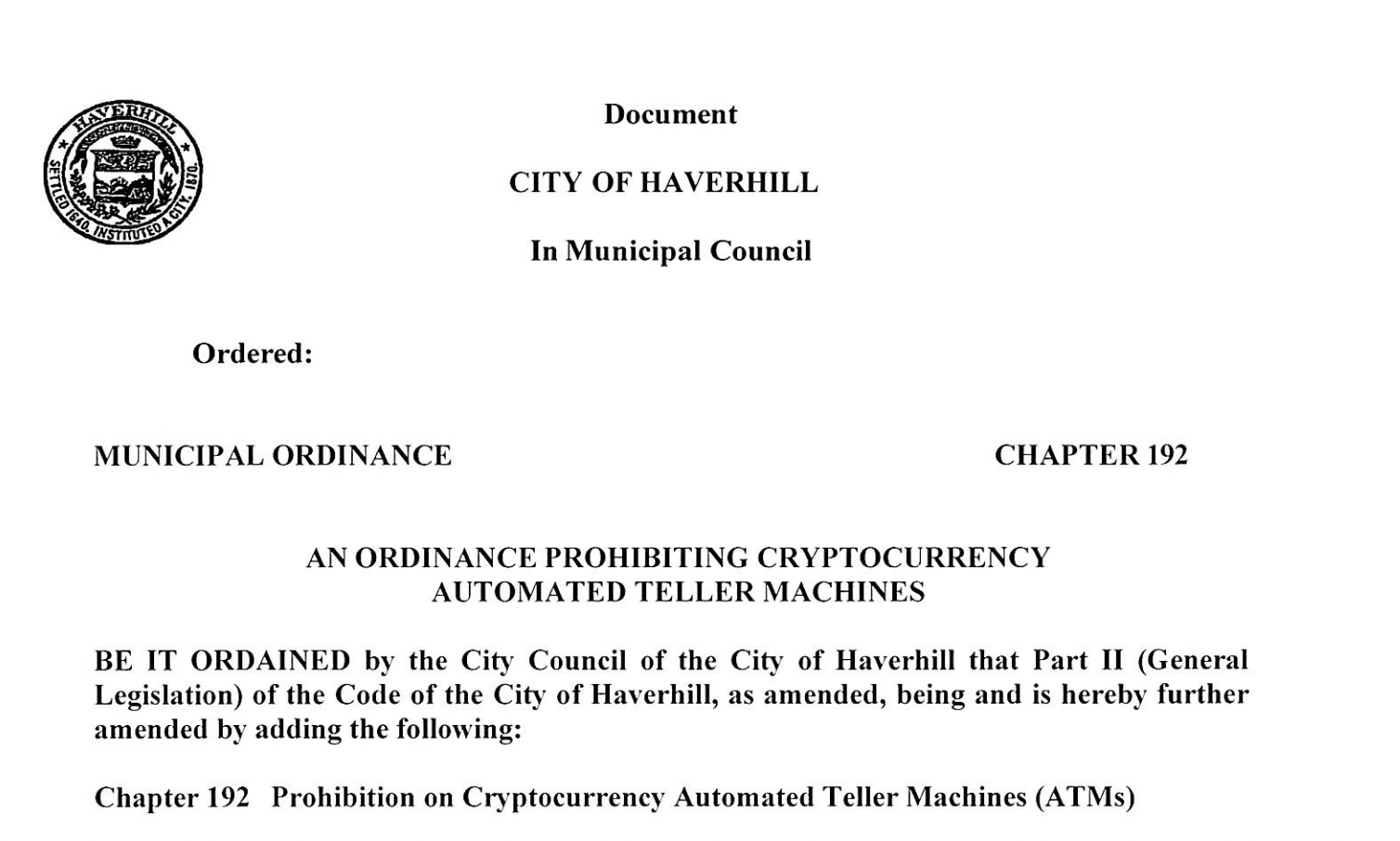
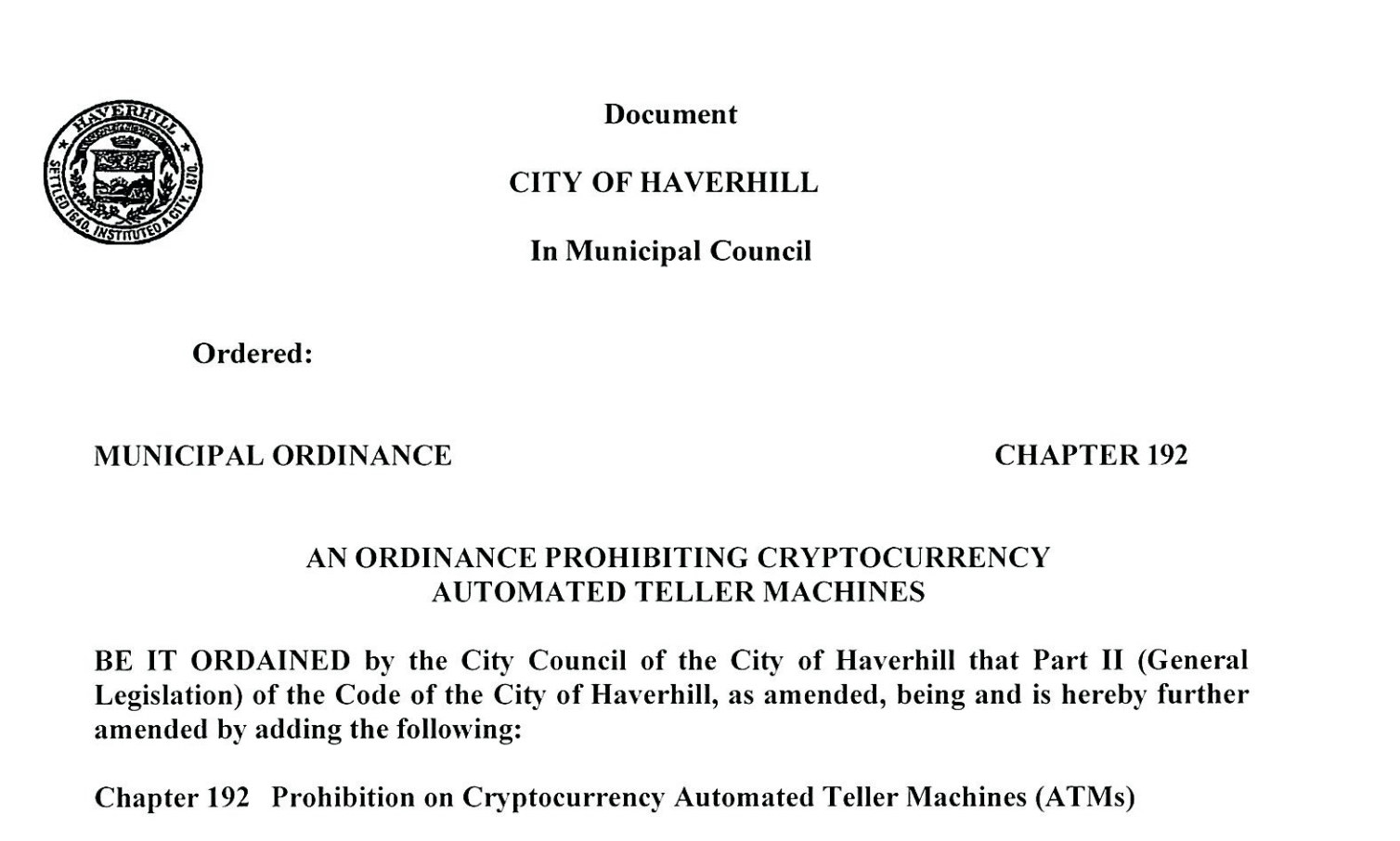
Source: events.haverhillma.gov

Massachusetts city to ban crypto ATMs

Proposed on the 17th of March, the ordinance has already received 11 votes in favour, showing widespread agreement on the matter.

Indeed, citing the reasons behind this ban, the mayor argued,

Unregulated Cryptocurrency ATMs pose risks to consumers, including financial fraud, money laundering, and lack of recourse for users.

This has resulted in the elderly and gullible tech users losing money to scams and fraud. Additionally, the lack of “federal and state consumer protection and regulatory oversight” has prompted the mayor to propose this law.

As per the law, all existing machines within the city must be removed and completely shut down within 60 days. If not, then a fine of $300 per day per machine will be imposed on the violators.

With about 415 crypto ATMs in and around Haverhill, according to CoinATMRadar, this move is crucial for residents’ protection from fraudsters.

Why is Bitcoin Depot being targeted the most?

Needless to say, Bitcoin [BTC] Depot leads the Crypto ATM space as the biggest operator. This makes the ATM most exposed to crypto scams due to high transaction volume and usage.

In fact, according to its quarterly report, Bitcoin Depot has seen a streak of revenue losses since the end of Q3 in 2025.

Amidst these concerning numbers, Scott Buchanan stepped down as the CEO. Following this, Alex Holmes, a former CEO of MoneyGram, was appointed the new CEO of Bitcoin Depot.

Additionally, in February 2026, Massachusetts Attorney General Andrea Joy Campbell sued Bitcoin Depot. She alleged that scammers used the company’s ATM to defraud residents.

Yet, despite such developments, Bitcoin Depot’s stock surged by 7.39% in the last trading session to reach $2.18. However, the bigger concern remains as the stock has seen a drop of over 91% in the past 6 months.

Haverhill – Not the only boat in the sea of crypto scams

Now, as these crypto ATM scams continue to operate, New Hampshire has passed bipartisan legislation to protect the victims. According to the law, victims of crypto ATM scams will recive reimbursed, provided they report the fraud within 14 days.

This coincided with a massive incident that took place in October 2025. As reported by the Police, a South Hadley business owner had rented out a crypto ATM for $200 per month.

During this time, a scammer impersonated him and targeted his employees.

This, in turn, resulted in a loss of over $11,000.

Following this incident, South Hadley officials stepped in. They imposed a complete ban on crypto ATMs – a similar approach was made by Waltham and Gloucester.


Final Summary

  • Crypto ATMs, once seen as a tool to bring crypto to everyday use, are now acting as a source of scams and fraud.
  • Haverhill is not the only one to take this step: South Hadley, New Hampshire, Waltham, Gloucester, and many more cities are going ahead with this.


Criptomoedas em alta

Perguntas relacionadas

QWhich U.S. city is moving to ban cryptocurrency ATMs and what is the deadline for removal?

AHaverhill, Massachusetts is moving to ban cryptocurrency ATMs, and all existing machines must be removed within 60 days.

QWhat are the primary reasons cited by Haverhill's mayor for proposing the ban on crypto ATMs?

AMayor Melinda E. Barrett cited risks to consumers, including financial fraud, money laundering, and a lack of recourse for users, as well as the absence of federal and state consumer protection and regulatory oversight.

QWhich company is the largest crypto ATM and has been specifically targeted by legal action in Massachusetts?

ABitcoin Depot is the largest crypto ATM operator and was sued by Massachusetts Attorney General Andrea Joy Campbell in February 2026 over allegations that scammers used its ATMs to defraud residents.

QWhat financial penalty will violators face if they do not remove their crypto ATMs in Haverhill?

AViolators who do not remove their crypto ATMs within 60-day deadline will be fined $300 per day per machine.

QBesides Haverhill, name at least two other Massachusetts cities that have imposed a complete ban on crypto ATMs.

ABesides Haverhill, the cities of South Hadley, Waltham, and Gloucester have also imposed a complete ban on crypto ATMs.

Leituras Relacionadas

Investors Begin 'Switching Tables'

Investors Begin to “Change Tables” A notable shift is occurring in China's venture capital landscape. While the hard tech sector, especially AI, experiences a funding frenzy with record-breaking investment rounds, many investors are opting to leave traditional investment firms to join portfolio companies. This movement, termed "changing tables," marks a departure from past downturns where such moves were often a last resort. Currently, the trend is driven by proactive choice. Seasoned investors, including partners and managing directors, are being lured by attractive salaries, equity incentives, and core roles like VP, General Manager, or even co-founder at fast-growing startups in hot sectors like AI, embodied intelligence, and aerospace. This "going ashore" to companies is seen as a strategic career move. The shift is a two-way street. Booming fundraising and feverish investment activity have created intense competition among VCs for a narrow set of "star projects." Simultaneously, these high-flying tech companies, engaged in rapid, multi-round financing, urgently need talent with deep capital market expertise and institutional connections to manage their complex funding needs. Companies like Zhiyuan Robot, MoonDark AI, and MiniMax are actively recruiting from investment firms. For investors, the move also reflects concerns about the sustainability of the current market. Risks like valuation inversion between primary and secondary markets, high IPO破发 rates, increased regulatory scrutiny, and the uncertainty of eventual exits are prompting a reevaluation of the traditional VC path. While this transition offers new opportunities, it is not without challenges. Success requires adapting from evaluating companies to operating within one, focusing on execution over analysis. Nevertheless, this trend underscores the expanding career boundaries and fluidity within China's innovation ecosystem.

marsbitHá 21m

Investors Begin 'Switching Tables'

marsbitHá 21m

Ethereum Community in Uproar! Whose Cake is EIP-8363 Cutting Into?

**Ethereum Community Debates Controversial Staking Proposal EIP-8363** A new Ethereum proposal, EIP-8363, dubbed "Tapered Issuance Burn," has ignited heated debate within the community. The core idea is to reduce and eventually eliminate new issuance rewards for validators as the total amount of staked ETH approaches 50% of the total supply (around 60.25 million ETH). The authors, including EthCC founder Jérôme de Tychey and Ethereum Foundation researcher Justin Drake, argue the current system perpetually incentivizes more staking, potentially leading to centralization as stake flows to large custodians and liquid staking tokens (LSTs). They also aim to reduce dilution pressure on non-staking ETH holders. Under the proposal, validator rewards from consensus-layer issuance would be partially burned based on a formula tied to the total staked amount. Net rewards would gradually approach zero as staking nears the 50% threshold. Notably, execution-layer rewards (tips, MEV) are unaffected. A proposed 18-month transition period would soften the initial impact. The community reaction has been predominantly critical. Key concerns include: * **Centralization Risk:** Critics like Obol's Oisín Kyne argue very low rewards could drive out solo stakers and smaller operators, leaving only large, cost-insensitive institutions, thus increasing validator centralization. * **Ecosystem Impact:** Aave's Stani Kulechov warns it could hurt ETH's predictable yield appeal for institutions and compress yields for LST-based DeFi strategies (e.g., recursive lending). * **Process & Timing:** Some, like ether.fi's Mike Silagadze, criticize the proposal's late submission ahead of a key upgrade deadline, limiting discussion time. Supporters believe the change is necessary to maintain ETH as a neutral reserve asset and avoid excessive security costs and holder dilution. If implemented, solo stakers would face higher relative operational costs and longer recovery times from penalties. LST yields would converge with native ETH, challenging their value proposition. The entire DeFi interest rate ecosystem, built around staking yield, could be pressured. While all ETH holders would benefit from reduced dilution, the net effect on ETH's price and adoption remains uncertain due to potential demand-side impacts from lower yields. The proposal is currently an early-stage draft and has not been officially slated for inclusion in any upcoming network upgrade.

marsbitHá 51m

Ethereum Community in Uproar! Whose Cake is EIP-8363 Cutting Into?

marsbitHá 51m

Trading

Spot

Artigos em Destaque

Como comprar ORDER

Bem-vindo à HTX.com!Tornámos a compra de Orderly (ORDER) simples e conveniente.Segue o nosso guia passo a passo para iniciar a tua jornada no mundo das criptos.Passo 1: cria a tua conta HTXUtiliza o teu e-mail ou número de telefone para te inscreveres numa conta gratuita na HTX.Desfruta de um processo de inscrição sem complicações e desbloqueia todas as funcionalidades.Obter a minha contaPasso 2: vai para Comprar Cripto e escolhe o teu método de pagamentoCartão de crédito/débito: usa o teu visa ou mastercard para comprar Orderly (ORDER) instantaneamente.Saldo: usa os fundos da tua conta HTX para transacionar sem problemas.Terceiros: adicionamos métodos de pagamento populares, como Google Pay e Apple Pay, para aumentar a conveniência.P2P: transaciona diretamente com outros utilizadores na HTX.Mercado de balcão (OTC): oferecemos serviços personalizados e taxas de câmbio competitivas para os traders.Passo 3: armazena teu Orderly (ORDER)Depois de comprar o teu Orderly (ORDER), armazena-o na tua conta HTX.Alternativamente, podes enviá-lo para outro lugar através de transferência blockchain ou usá-lo para transacionar outras criptomoedas.Passo 4: transaciona Orderly (ORDER)Transaciona facilmente Orderly (ORDER) no mercado à vista da HTX.Acede simplesmente à tua conta, seleciona o teu par de trading, executa as tuas transações e monitoriza em tempo real.Oferecemos uma experiência de fácil utilização tanto para principiantes como para traders experientes.

298 Visualizações TotaisPublicado em {updateTime}Atualizado em 2026.06.02

Como comprar ORDER

Discussões

Bem-vindo à Comunidade HTX. Aqui, pode manter-se informado sobre os mais recentes desenvolvimentos da plataforma e obter acesso a análises profissionais de mercado. As opiniões dos utilizadores sobre o preço de ORDER (ORDER) são apresentadas abaixo.

活动图片