Crypto, AI Investments Surface In Fed Chair Nominee’s Financial Disclosure

bitcoinistPublicado em 2026-04-15Última atualização em 2026-04-15

Resumo

Amidst key regulatory vacancies at the SEC and CFTC, Federal Reserve Chair nominee Kevin Warsh disclosed over $100 million in assets, including investments in crypto firms (Compound, Dapper Labs, Kinetic) and AI companies (Delphi, Conversion, among others). His largest holding is the $50+ million Juggernaut Fund. The disclosure did not value his crypto/AI holdings, raising questions about potential conflicts of interest as the Fed’s rate decisions directly impact these sectors. With Jerome Powell’s term ending May 15, Warsh’s Senate confirmation process is advancing rapidly.

Two of the most closely watched regulatory bodies in American finance are operating with skeleton crews. The Securities and Exchange Commission has three of its five commissioner seats filled — all by Republicans.

The Commodity Futures Trading Commission has just one sitting commissioner. Both vacancies come at a moment when the agencies are expected to take center stage in shaping the rules around digital assets, should a crypto market structure bill that has been stalled in the Senate since July 2025 finally pass.

A Nominee With Stakes In The Industry

Against that backdrop, Kevin Warsh — US President Donald Trump’s pick to replace Federal Reserve Chair Jerome Powell — filed a financial disclosure last week that revealed personal investments in crypto and artificial intelligence companies.

Based on reports, Warsh’s filing with the US Office of Government Ethics lists holdings in Compound, Dapper Labs, and Kinetic on the crypto side, alongside AI firms including Delphi, Conversion, Factory, and Glue, among others.

Source: US Office of Government Ethics
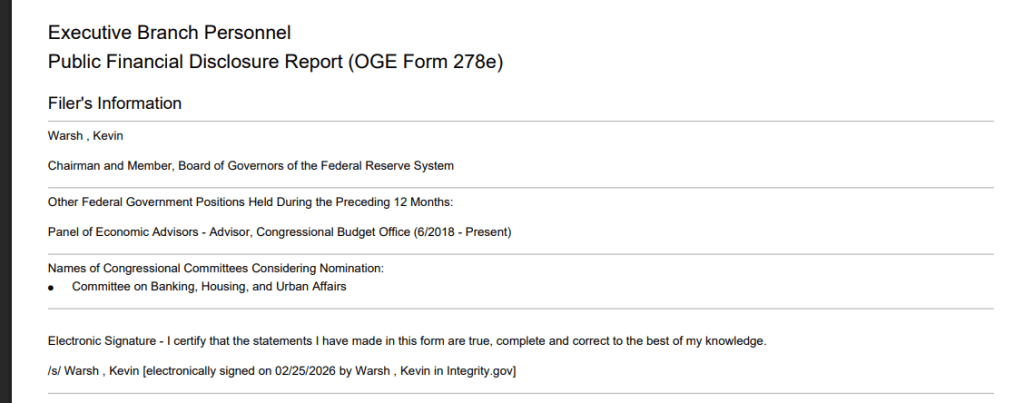
His total disclosed assets top $100 million. The largest single entry is more than $50 million in something called the Juggernaut Fund. Another major line item: more than $10 million in consulting fees from the Duquesne Family Office, the investment firm run by billionaire Stanley Druckenmiller.

None of his crypto and AI investments included a value range in the disclosure. It is unclear why. The ethics office’s rules do not require reporting assets valued under $1,000, which may explain the omission — though the gap leaves open questions about the full scope of his exposure to sectors the Fed’s interest rate decisions directly affect.

BTCUSD trading at $73,929 on the 24-hour chart: TradingView

Powell’s Clock Is Running Out

Time is short. Powell’s second four-year term ends May 15. Trump first floated Warsh’s name in January, then formally sent his nomination to the Senate in March, following months of public pressure on Powell to cut interest rates. As of Tuesday, the Senate Banking Committee had not announced a hearing date, but reports indicated a vote could come as early as next week.

Whoever takes the Fed chair position wields enormous influence over US financial policy — most visibly through decisions on federal interest rates, which ripple through every corner of the economy, including the crypto and AI sectors where Warsh holds investments.

Featured image from Real Estate News, chart from TradingView

Perguntas relacionadas

QWho is Kevin Warsh and what role has he been nominated for?

AKevin Warsh is US President Donald Trump's nominee to replace Jerome Powell as the Chair of the Federal Reserve.

QWhich crypto and AI companies were listed in Kevin Warsh's financial disclosure?

AHis disclosure listed holdings in crypto companies Compound, Dapper Labs, and Kinetic, and AI firms including Delphi, Conversion, Factory, and Glue.

QWhat is the significance of the SEC and CFTC operating with vacancies according to the article?

AThe vacancies are significant because these agencies are expected to be central in shaping the rules around digital assets if a stalled crypto market structure bill passes.

QWhat was the largest single asset disclosed in Kevin Warsh's filing?

AThe largest single disclosed asset was over $50 million in something called the Juggernaut Fund.

QWhen does Jerome Powell's term as Federal Reserve Chair end, creating the vacancy?

AJerome Powell's second four-year term as Federal Reserve Chair ends on May 15.

Leituras Relacionadas

Bitcoin Withdrawals Continue: 8 Years of Storage in a Coldcard Cold Wallet Ended in Zero

Coldcard Hardware Wallet Hacked: Losses Mount Due to Vulnerable Seed Generation A critical vulnerability in Coldcard hardware wallets has led to a continued wave of fund thefts. According to Galaxy Research, the total stolen has reached 1,367.05 BTC (approx. $88.6 million) from 4,585 addresses, a significant increase from the initial 594.5 BTC reported on July 30, 2026. Most of the stolen funds remain on the attackers' addresses. The issue is not with the current firmware, which Coinkite has updated, but with seed phrases generated on vulnerable devices between March 2021 and the release of fixed firmware versions. Due to a programmer error, devices switched from using a hardware random number generator to the software-based Yasmarang generator, which was initialized with publicly accessible data like the chip's serial number. This made the seed phrases predictable through offline brute-force attacks, meaning wallets remain at risk until funds are moved to a new wallet generated with the patched firmware. Affected devices include Mk2/Mk3 with firmware 4.0.1–4.1.9 (and up to 5.0.3), Mk4/Mk5 up to version 5.6.0, and Q models up to 1.5.0Q. The only exceptions are seeds created with a high-entropy method like at least 50 independent dice rolls or a strong unique BIP-39 passphrase. All other owners must generate a new seed on the fixed firmware and transfer their assets. A case highlighting the human impact involves a 39-year-old long-term investor who lost 2 BTC (approx. $130,000) in minutes. He had accumulated the Bitcoin over eight years through physical labor, viewing it as a financial lifeline and a retirement plan in a country suffering from hyperinflation. His story underscores that even conservative "buy and hold in cold storage" strategies can be compromised by such underlying technical flaws. From a technical perspective, this incident echoes historical failures where weak random number generators undermined cryptographic security, challenging the assumption that offline storage is automatically foolproof.

cryptonews.ruHá 11m

Bitcoin Withdrawals Continue: 8 Years of Storage in a Coldcard Cold Wallet Ended in Zero

cryptonews.ruHá 11m

Trading

Spot
活动图片





