Crypto, AI Investments Surface In Fed Chair Nominee’s Financial Disclosure

bitcoinistPublicado em 2026-04-15Última atualização em 2026-04-15

Resumo

Amidst key regulatory vacancies at the SEC and CFTC, Federal Reserve Chair nominee Kevin Warsh disclosed over $100 million in assets, including investments in crypto firms (Compound, Dapper Labs, Kinetic) and AI companies (Delphi, Conversion, among others). His largest holding is the $50+ million Juggernaut Fund. The disclosure did not value his crypto/AI holdings, raising questions about potential conflicts of interest as the Fed’s rate decisions directly impact these sectors. With Jerome Powell’s term ending May 15, Warsh’s Senate confirmation process is advancing rapidly.

Two of the most closely watched regulatory bodies in American finance are operating with skeleton crews. The Securities and Exchange Commission has three of its five commissioner seats filled — all by Republicans.

The Commodity Futures Trading Commission has just one sitting commissioner. Both vacancies come at a moment when the agencies are expected to take center stage in shaping the rules around digital assets, should a crypto market structure bill that has been stalled in the Senate since July 2025 finally pass.

A Nominee With Stakes In The Industry

Against that backdrop, Kevin Warsh — US President Donald Trump’s pick to replace Federal Reserve Chair Jerome Powell — filed a financial disclosure last week that revealed personal investments in crypto and artificial intelligence companies.

Based on reports, Warsh’s filing with the US Office of Government Ethics lists holdings in Compound, Dapper Labs, and Kinetic on the crypto side, alongside AI firms including Delphi, Conversion, Factory, and Glue, among others.

Source: US Office of Government Ethics
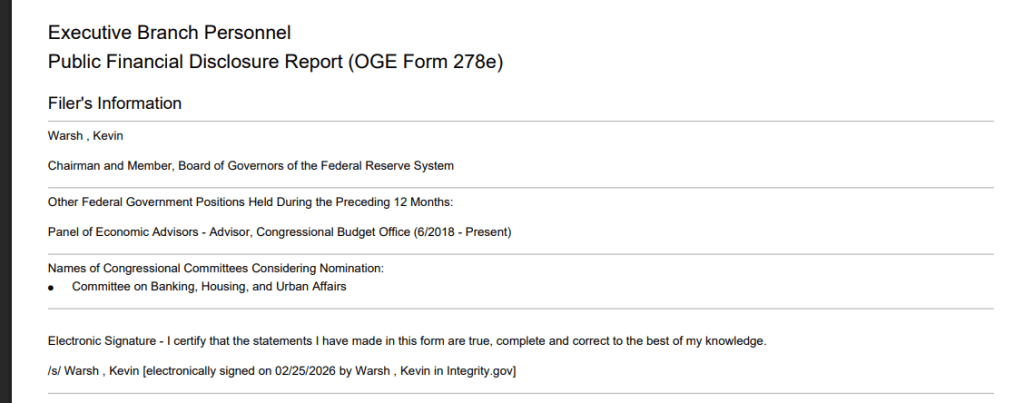
His total disclosed assets top $100 million. The largest single entry is more than $50 million in something called the Juggernaut Fund. Another major line item: more than $10 million in consulting fees from the Duquesne Family Office, the investment firm run by billionaire Stanley Druckenmiller.

None of his crypto and AI investments included a value range in the disclosure. It is unclear why. The ethics office’s rules do not require reporting assets valued under $1,000, which may explain the omission — though the gap leaves open questions about the full scope of his exposure to sectors the Fed’s interest rate decisions directly affect.

BTCUSD trading at $73,929 on the 24-hour chart: TradingView

Powell’s Clock Is Running Out

Time is short. Powell’s second four-year term ends May 15. Trump first floated Warsh’s name in January, then formally sent his nomination to the Senate in March, following months of public pressure on Powell to cut interest rates. As of Tuesday, the Senate Banking Committee had not announced a hearing date, but reports indicated a vote could come as early as next week.

Whoever takes the Fed chair position wields enormous influence over US financial policy — most visibly through decisions on federal interest rates, which ripple through every corner of the economy, including the crypto and AI sectors where Warsh holds investments.

Featured image from Real Estate News, chart from TradingView

Perguntas relacionadas

QWho is Kevin Warsh and what role has he been nominated for?

AKevin Warsh is US President Donald Trump's nominee to replace Jerome Powell as the Chair of the Federal Reserve.

QWhich crypto and AI companies were listed in Kevin Warsh's financial disclosure?

AHis disclosure listed holdings in crypto companies Compound, Dapper Labs, and Kinetic, and AI firms including Delphi, Conversion, Factory, and Glue.

QWhat is the significance of the SEC and CFTC operating with vacancies according to the article?

AThe vacancies are significant because these agencies are expected to be central in shaping the rules around digital assets if a stalled crypto market structure bill passes.

QWhat was the largest single asset disclosed in Kevin Warsh's filing?

AThe largest single disclosed asset was over $50 million in something called the Juggernaut Fund.

QWhen does Jerome Powell's term as Federal Reserve Chair end, creating the vacancy?

AJerome Powell's second four-year term as Federal Reserve Chair ends on May 15.

Leituras Relacionadas

Qualcomm: AI Hype Subsides, When Will Smartphones Emerge from the Gloom?

Qualcomm reported its Q3 FY2026 results (ending June 2026), with revenue of $9.95B, down 4% YoY but above expectations. Gross margin declined to 53.1%, pressured by rising costs across manufacturing and memory. Key business segments showed mixed performance: Handset revenue fell 19.6% YoY to $5.09B, dragged by an 11% decline in non-Apple Android shipments and weaker high-end mix. Conversely, Automotive revenue surged 61% to $1.59B, and IoT grew 9% to $1.83B. Core operating profit dropped 41% YoY due to margin compression and higher expenses. Management's Q4 FY2026 guidance projects revenue of $9.7B-$10.5B, in line with consensus, but Non-GAAP EPS guidance of $2.05-$2.25 fell short of expectations. Amidst persistent weakness in its core handset market, Qualcomm is pursuing growth in AI, focusing on Edge AI (smartphones, PCs, automotive) and Data Center AI. Its data center strategy includes four pillars: AI accelerators (e.g., AI200), commercial CPUs (Dragonfly C1000), custom silicon, and connectivity solutions. While these initiatives initially boosted its stock, concerns over AI capital expenditure sustainability have since erased those gains. The company targets $5B in data center revenue for FY2027 and $15B for FY2029. The report concludes that with the traditional handset business still under pressure, the data center opportunity is currently viewed as a longer-term option, and a more conservative valuation based on core operations may be warranted until AI contributions materialize.

marsbitHá 4m

Qualcomm: AI Hype Subsides, When Will Smartphones Emerge from the Gloom?

marsbitHá 4m

From TPU to Self-Evolving Agents: How Jeff Dean Predicts the Next Step in AI

At the 2026 YC Startup School, Jeff Dean outlined his vision for AI's next phase, shifting focus from simply scaling models to building intelligent, autonomous systems. He believes AI's progress is no longer just about creating smarter models, but about integrating them into systems capable of long-term, iterative work, automated experimentation, and continuous learning. This evolution moves the competition from "who has the bigger model" to "who can best organize intelligence." Dean suggests AI capabilities are now comparable to a junior engineer, enabling the automation of complex workflows. However, the true challenge and opportunity lie in managing these AI "workers" at scale. He emphasizes the importance of **context engineering**—structuring tools, memory, and feedback loops—over raw model power. For startups, this means building deep expertise in niche domains where general models currently fail (near 0-1% success rates), leveraging proprietary data, specialized tools, and domain-specific evaluators. A recurring theme is re-examining fundamental constraints. Dean's past work, like moving Google's search index to memory or creating the TPU, stemmed from questioning outdated assumptions about hardware and cost. He sees similar inflection points today, particularly in **specialized inference hardware** to drastically reduce latency and energy consumption for real-time Agent operation. Notably, he points out that in modern AI systems, the dominant cost is often not computation but **data movement**. Reliable, long-running Agents require robust system design, borrowing concepts from distributed computing like checkpointing, state management, and parallel exploration to handle failures and maintain progress over days or weeks. As AI automates execution, the scarcest human skills will shift to **defining clear specifications**, **judging what problems are worth solving** (taste), and designing effective feedback loops. Ultimately, Dean's framework prioritizes understanding the problem deeply, identifying the true bottlenecks, and systematically building closed-loop systems where AI can not only perform tasks but also improve AI itself.

marsbitHá 4m

From TPU to Self-Evolving Agents: How Jeff Dean Predicts the Next Step in AI

marsbitHá 4m

Trading

Spot
活动图片





