Crypto Accumulation Narrative Builds After Record Binance COMP Withdrawal

bitcoinistPublicado em 2026-02-16Última atualização em 2026-02-16

Resumo

The crypto market faces ongoing challenges with recovery, hindered by capital outflows and selling pressure. However, on-chain analysis from CryptoQuant indicates a notable shift in investor behavior, particularly for Compound (COMP) on Binance. The weekly Netflow for COMP turned sharply negative, reaching approximately -$1.8 million—the largest outflow since October. This suggests significant withdrawals from the exchange, often interpreted as reduced immediate selling intent, as assets move toward long-term storage or DeFi deployment. While not signaling an imminent market reversal, this pattern may reflect early accumulation behavior, potentially supporting future price stabilization if sustained.

The crypto market continues to struggle with recovery as sustained capital outflows and persistent selling pressure weigh on sentiment. After months of volatility and declining liquidity, attempts to stabilize prices have repeatedly faced resistance, leaving investors cautious and positioning defensively. While corrective phases are common following strong rallies, recent price action reflects a more prolonged adjustment period, with both retail and institutional participants reassessing exposure amid uncertain macro and market conditions.

However, recent on-chain analysis from CryptoQuant highlights a potentially important shift in investor behavior within specific segments of the market. Data focused on Compound (COMP) activity on Binance shows a pronounced change in exchange flows. The weekly Netflow chart has turned sharply negative, indicating that significant amounts of COMP are being withdrawn from the exchange rather than deposited.

Such movements are often interpreted as a reduction in immediate selling intent, as assets transferred off exchanges typically move toward long-term storage, DeFi deployment, or strategic repositioning. While this development does not necessarily signal an imminent market reversal, it suggests evolving sentiment beneath the broader market weakness.

Record COMP Outflows Suggest Accumulation Trend

The CryptoQuant report adds further context by highlighting the scale of recent capital movements involving Compound (COMP). Over the past week, the Netflow indicator dropped to roughly -$1.8 million, marking the largest negative weekly reading since October. This sharp decline signals a substantial withdrawal of COMP from Binance, indicating a notable shift in crypto investor positioning. Large exchange outflows often reflect reduced immediate selling intent, particularly when they occur during periods of broader market uncertainty.
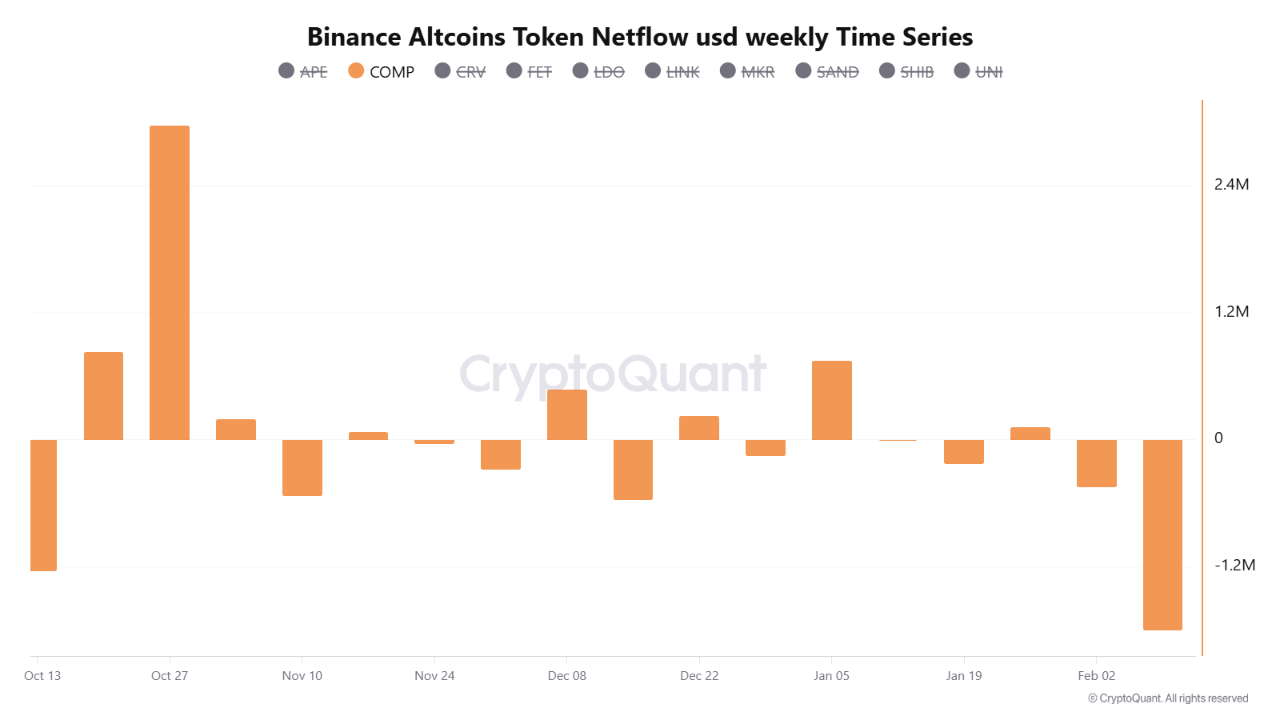
Binance Altcoins Token Netflow USD Weekly Time Series | Source: CryptoQuant

This development contrasts sharply with the situation observed in late October, when the Netflow chart recorded a strong positive spike driven by heavy inflows to Binance. Such crypto inflows typically precede elevated selling pressure as traders position assets on exchanges for potential liquidation. The current pattern, however, suggests the opposite dynamic. A significant outflow of approximately $1.8 million implies that holders may be opting for longer-term custody, whether through cold storage solutions or deployment within decentralized finance protocols.

From a structural standpoint, record exchange outflows can act as a supply-side constraint, reducing available liquidity for immediate sales. While not a definitive bullish signal on its own, this behavior often aligns with early accumulation phases. If sustained, it could support price stabilization or eventual recovery across segments of the broader crypto market.


Perguntas relacionadas

QWhat does a negative Netflow reading on an exchange like Binance typically indicate for a cryptocurrency like COMP?

AA negative Netflow reading indicates that significant amounts of the cryptocurrency are being withdrawn from the exchange. This is often interpreted as a reduction in immediate selling intent, as assets are moved toward long-term storage, DeFi deployment, or strategic repositioning.

QAccording to the CryptoQuant report, what was the value of the recent weekly Netflow drop for COMP on Binance?

AThe weekly Netflow indicator dropped to roughly -$1.8 million, marking the largest negative weekly reading since October.

QHow does the current pattern of COMP outflows from Binance contrast with the activity seen in late October?

AThe current pattern shows a sharp negative outflow, whereas in late October, the Netflow chart recorded a strong positive spike driven by heavy inflows to Binance. Inflows typically precede selling pressure, while outflows suggest accumulation.

QWhat are the potential implications of sustained, large exchange outflows for a cryptocurrency's price?

ASustained large outflows can act as a supply-side constraint by reducing the available liquidity for immediate sales. This behavior often aligns with early accumulation phases and could support price stabilization or eventual recovery.

QBeyond the specific case of COMP, what broader market condition is the crypto market currently facing according to the article?

AThe broader crypto market continues to struggle with recovery due to sustained capital outflows, persistent selling pressure, declining liquidity, and uncertain macro and market conditions, leading to a prolonged adjustment period.

Leituras Relacionadas

Bitcoin's 'Rally Ends,' Officially Entering the Later Stage of a Bear Market?

Bitcoin prices declined 13% this week, reversing the recent rebound and signaling a likely transition into the later stages of a bear market. Key on-chain metrics deteriorated, with the short-term holder cost basis falling below the Realized Price—a pattern last seen in early 2022, characteristic of bear market maturity. The rally to ~$82k proved to be a bear market bounce, as evidenced by the 90-day realized profit/loss ratio failing to sustain above the bullish threshold of 2. Daily realized losses surged to $1.35B, including significant selling from long-term holders who accumulated near cycle tops, indicating ongoing supply redistribution. Price was rejected almost precisely at the aggregate US spot ETF cost basis of ~$83k, turning that level into resistance and leaving the average ETF investor underwater again. Spot market selling pressure intensified, with the 7-day volume delta turning significantly negative to its weakest level since February. While a major long liquidation event cleared over $400M in leverage, spot demand has not yet stepped in to absorb the resulting supply. Options markets continue pricing in higher future volatility (elevated volatility risk premium) and maintain a skew toward put options, reflecting persistent demand for downside protection, though not yet panic. Overall, market structure remains fragile. Sustained recovery likely requires a reclaim of the ETF cost basis, a shift back to positive spot demand, and a slowdown in realized loss-taking. Until then, the market risks further downside or extended consolidation within the broader bear trend.

Foresight NewsHá 38m

Bitcoin's 'Rally Ends,' Officially Entering the Later Stage of a Bear Market?

Foresight NewsHá 38m

How Risky is the "Death Spiral" of MSTR and STRC?

Summary: This article explores the perceived "death spiral" risk between MicroStrategy (MSTR), its Bitcoin holdings, and its perpetual preferred stock (STRC), drawing comparisons to the LUNA-UST collapse. While both systems feature price anchors, high yields for holders, and potential feedback loops, their core mechanisms differ fundamentally. The MSTR-STRC structure relies on continuous financing to sustain its high dividend payouts, primarily through stock ATM offerings. A negative feedback cycle could occur: falling MSTR stock price makes raising equity capital harder, increasing pressure to sell Bitcoin, which undermines STRC confidence and further depresses MSTR. However, unlike LUNA-UST's automated, direct linkage, the MSTR-STRC loop is weaker and has brakes: STRC dividends can be deferred or rates lowered, and STRC holders have a $100/share liquidation preference in bankruptcy, providing a price floor. The company's sustainability hinges on its ability to continue financing. Its current ~$900 million USD reserves cover only about 6.3 months of its ~$1.71 billion annual interest/dividend burden. The next six months are critical, aligning with both the potential bottom in Bitcoin's four-year cycle and the depletion timeline of its reserves. While a LUNA-style catastrophic collapse is deemed highly unlikely due to structural differences, the key question is whether MicroStrategy can navigate this period through healthy deleveraging to restart its capital engine.

Foresight NewsHá 56m

How Risky is the "Death Spiral" of MSTR and STRC?

Foresight NewsHá 56m

How Much Debt Does Strategy Really Have? Is There a Risk of Implosion?

MicroStrategy's Debt Risk: A Turning Point in the "Never Sell" Strategy As of June 3, 2026, MicroStrategy holds 843,706 bitcoins (valued at ~$53.1B) but faces significant financial obligations. Its capital structure includes $6.75B in convertible notes and $15.48B in perpetual preferred stock (led by the $8.5B STRC series), creating an annual payout burden of ~$1.71B. With software revenue at only ~$500M, interest and dividend obligations far exceed operating income. A critical shift occurred in late May 2026 when the company sold 32 bitcoins for ~$2.5M to cover dividends, breaking CEO Michael Saylor's long-standing "never sell" pledge. This symbolic move triggered a sharp decline in both Bitcoin's price and MSTR stock, reflecting market fears about cash flow sustainability. The core of the strain is the STRC perpetual preferred stock, designed as a "permanent loan" with no maturity date but requiring high monthly dividends (currently 11.5%). Its business model relies on a three-part cycle: issuing new STRC shares, using proceeds to buy more Bitcoin and fund a USD reserve, and using that reserve to pay dividends. This cycle depends on continuous investor demand for STRC and Bitcoin's price appreciation. Analysis shows Bitcoin needs to appreciate at least 2.3% annually to cover the $1.71B in yearly obligations at current holdings. With Bitcoin price down ~22% from March 2026 highs, this pressure has intensified. The company's $900M USD reserve can only cover about 7 months of payments if STRC issuance stalls. Key risks are not immediate bankruptcy or forced Bitcoin liquidation (as BTC is not collateral), but rather: 1) The erosion of MSTR's premium to its Bitcoin holdings (mNAV), which would cripple its ability to raise cheap capital; 2) A vicious cycle where stagnant Bitcoin prices reduce STRC demand, draining the USD reserve and forcing BTC sales, further depressing prices. The period from February 2027 to September 2028 is a crucial test, with over $5.9B in convertible notes facing put options or maturity. In essence, MicroStrategy has evolved from a simple Bitcoin holder into a complex financial entity acting like a "private Bitcoin bank," leveraging its BTC holdings to create layered financial products. Its survival depends on maintaining Bitcoin's price trend, its stock premium, and market appetite for its preferred shares. The recent token sale marks not a betrayal of its Bitcoin thesis, but an admission that the leveraged strategy must eventually be paid for.

marsbitHá 1h

How Much Debt Does Strategy Really Have? Is There a Risk of Implosion?

marsbitHá 1h

Trading

Spot
Futuros

Artigos em Destaque

Como comprar COMP

Bem-vindo à HTX.com!Tornámos a compra de Compound (COMP) simples e conveniente.Segue o nosso guia passo a passo para iniciar a tua jornada no mundo das criptos.Passo 1: cria a tua conta HTXUtiliza o teu e-mail ou número de telefone para te inscreveres numa conta gratuita na HTX.Desfruta de um processo de inscrição sem complicações e desbloqueia todas as funcionalidades.Obter a minha contaPasso 2: vai para Comprar Cripto e escolhe o teu método de pagamentoCartão de crédito/débito: usa o teu visa ou mastercard para comprar Compound (COMP) instantaneamente.Saldo: usa os fundos da tua conta HTX para transacionar sem problemas.Terceiros: adicionamos métodos de pagamento populares, como Google Pay e Apple Pay, para aumentar a conveniência.P2P: transaciona diretamente com outros utilizadores na HTX.Mercado de balcão (OTC): oferecemos serviços personalizados e taxas de câmbio competitivas para os traders.Passo 3: armazena teu Compound (COMP)Depois de comprar o teu Compound (COMP), armazena-o na tua conta HTX.Alternativamente, podes enviá-lo para outro lugar através de transferência blockchain ou usá-lo para transacionar outras criptomoedas.Passo 4: transaciona Compound (COMP)Transaciona facilmente Compound (COMP) no mercado à vista da HTX.Acede simplesmente à tua conta, seleciona o teu par de trading, executa as tuas transações e monitoriza em tempo real.Oferecemos uma experiência de fácil utilização tanto para principiantes como para traders experientes.

263 Visualizações TotaisPublicado em {updateTime}Atualizado em 2026.06.02

Como comprar COMP

Discussões

Bem-vindo à Comunidade HTX. Aqui, pode manter-se informado sobre os mais recentes desenvolvimentos da plataforma e obter acesso a análises profissionais de mercado. As opiniões dos utilizadores sobre o preço de COMP (COMP) são apresentadas abaixo.

活动图片