CoreWeave plans $2B note offering to scale AI business while managing dilution

cointelegraphPublicado em 2025-12-08Última atualização em 2025-12-08

Resumo

CoreWeave plans to raise $2 billion through a private offering of convertible notes due 2031, with an option for an additional $300 million. Proceeds will be used for general corporate purposes and capped-call transactions to reduce potential shareholder dilution. The notes can be settled in cash, shares, or a combination. Founded as a crypto miner in 2017, the company pivoted to AI infrastructure in 2019 and now operates over 33 data centers. The stock fell 9.2% on the news. Separately, CoreWeave's recent $9 billion bid to acquire Bitcoin miner Core Scientific failed after shareholders rejected it. The company stated the acquisition was primarily aimed at securing power capacity for future AI expansion, not a return to crypto.

AI infrastructure provider CoreWeave (CRWV) plans to raise $2 billion through a private offering of convertible senior notes due 2031, with proceeds earmarked for general corporate purposes and for capped-call transactions that could reduce potential future shareholder dilution.

The notes include an option for purchasers to buy an additional $300 million, the company said Monday. They can be settled in cash, shares or a combination of both at CoreWeave’s discretion.

To limit dilution if the notes are ultimately converted into equity, CoreWeave is entering into capped-call transactions. This hedge increases the effective conversion price and provides a degree of protection for existing shareholders while preserving financial flexibility.

CoreWeave was founded in 2017 as Atlantic Crypto, a company that used GPUs to mine Ether (ETH). As the crypto market weakened, it pivoted in 2019 into cloud and high-performance computing services, eventually refocusing its GPU infrastructure on AI workloads.

The company now operates a network of data centers built specifically for AI, and as of this year, reported running more than 33 facilities. It has not said whether proceeds from its latest fundraising will go toward further expanding that footprint.
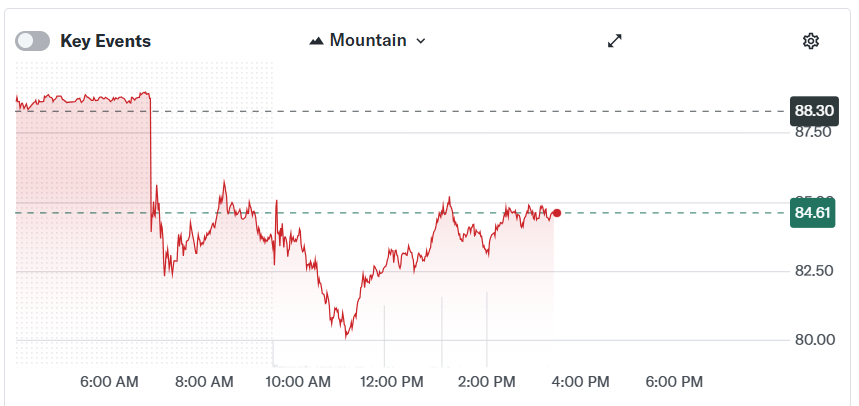
CoreWeave stock reacted negatively to the private note offering, falling as much as 9.2% on Monday. Source: Yahoo Finance

Related: TeraWulf looks to raise $500M as it bets big that AI is new Bitcoin

CoreWeave’s failed takeover bid of Core Scientific

Despite shifting its focus away from digital asset mining as its primary business, CoreWeave recently pursued a $9 billion acquisition of Core Scientific, one of the largest Bitcoin (BTC) mining operators. However, the deal fell through after Core Scientific’s shareholders voted against the proposal.

The attempted takeover fueled speculation about a return to crypto, but CoreWeave has characterized the effort differently.

The company stated that the acquisition aimed to secure access to approximately 1.3 gigawatts of power capacity across Core Scientific’s sites, which could be leveraged for future expansion in AI, cloud computing or other GPU-intensive workloads.

CoreWeave had spent more than a year pursuing Core Scientific, beginning with an initial offer in June 2024 that the miner rejected. As Core Scientific’s stock rose, the price needed to secure a deal also increased, ultimately contributing to the failure of the final proposal when shareholders voted it down.

Related: Crypto Biz: Mining weakness tests Bitcoin’s market cycle

Leituras Relacionadas

Crypto Market Prices the Verdict: $1.8 Billion Bet on Do Kwon's Sentencing Outcome

The cryptocurrency market is witnessing an extraordinary $1.8 billion in futures trading volume for LUNA and LUNA2 tokens, despite their lack of fundamental value. This surge in speculative activity is directly tied to the upcoming sentencing hearing of Terraform Labs co-founder Do Kwon in a New York federal court on December 11th. Prosecutors are seeking a 12-year prison sentence for Kwon’s role in the $40 billion Terra-LUNA collapse, while his defense team is arguing for a 5-year term. This 7-year discrepancy has created a high-stakes betting environment. The market is characterized by extreme divergence, with a high volume of short positions (indicated by negative funding rates) and a powerful counter-force of buyers attempting to squeeze those shorts. The article argues that the current LUNA traders are not the original victims of the crash but are now primarily event-driven speculators, quantitative funds, and opportunistic traders. For them, LUNA has been transformed from a failed project into a pure "legal derivative," a volatile instrument whose price is entirely driven by the legal outcome of Kwon's case, devoid of any fundamental anchor. The author concludes that regardless of the sentencing outcome—whether a harsh or light sentence—the event's conclusion will likely cause LUNA's price to collapse. A harsh sentence would reaffirm its zero fundamental value, while a light sentence would trigger a "sell the news" event. This situation exemplifies the crypto market's cold, hyper-efficient ability to price and monetize anything, including justice and a person's freedom, reducing moral judgment to mere noise against the pursuit of volatility and profit.

比推Há 52m

Crypto Market Prices the Verdict: $1.8 Billion Bet on Do Kwon's Sentencing Outcome

比推Há 52m

Trading

Spot
Futuros
活动图片