Consumer Technology Association Urges Senate to Vote for CLARITY Act Bill

cryptonews.ruPublicado em 2026-07-31Última atualização em 2026-07-31

Resumo

The Consumer Technology Association (CTA), representing over 1,300 tech companies, is urging the U.S. Senate to pass the CLARITY Act to establish clear federal rules for digital assets. CTA argues regulatory certainty will spur investment, enhance consumer protection, and bolster U.S. leadership in blockchain innovation. The House already approved the bill with bipartisan support in 2025. In the Senate, negotiations are ongoing, with debates centered on ethics rules and market oversight. Senator Cynthia Lummis released an updated bill text, but critics like Senator Elizabeth Warren warn it leaves conflicts of interest unresolved. Political pressure is mounting ahead of a potential vote, with former officials expressing confidence in its eventual passage. A key final debate involves stablecoins, as banking executives warn against allowing payment stablecoins to function like interest-bearing accounts, fearing deposit losses could impact community lending. Advocacy groups are also pledging to score senators' votes on the bill, increasing election-year pressure.

The Consumer Technology Association (CTA), representing over 1,300 technology companies, is urging the Senate to advance the CLARITY Act bill and establish clear federal rules for digital assets. This influential industry association is celebrating its 100th anniversary in 2024.

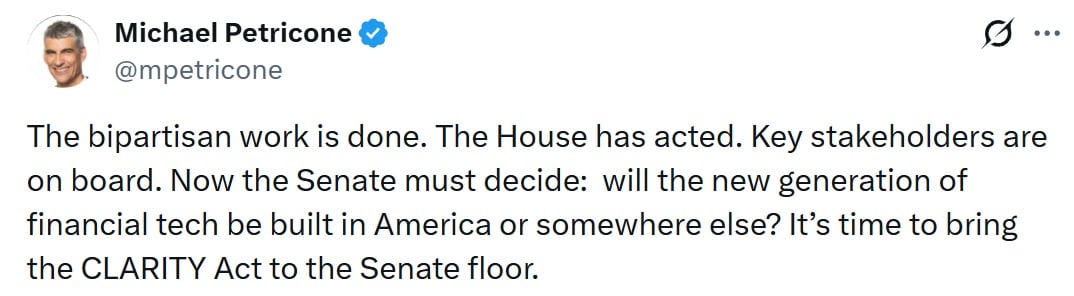
Michael Petricone, Senior Vice President of Global Public Affairs at CTA, stated on July 28 on X that the House of Representatives has completed its work, industry stakeholders support the bill, and now the Senate must determine whether financial technology innovation will develop in the United States or abroad.

CTA emphasized that regulatory certainty will stimulate investment, enhance consumer protection, expand innovation, and strengthen U.S. leadership in blockchain technology. The organization also noted that businesses need clear federal rules governing digital assets before they invest long-term capital and develop new financial products.
This call is based on a June 17 letter from CTA in which the organization expressed support for the bill's passage by the Senate. In 2025, the House of Representatives approved the bill with broad bipartisan support, shifting responsibility for the next crucial step to the Senate.

Senate Negotiations Focus on Ethics Rules

U.S. Senator Cynthia Lummis (R-WY) has released an updated text of the CLARITY Act, merging the results of work from the Senate Banking and Agriculture Committees. The introduced amendments address market oversight, consumer protection, and the allocation of regulatory authority for digital assets.

The proposal still faces opposition on ethics and enforcement issues. U.S. Senator Elizabeth Warren (D-MA), a senior member of the Senate Banking Committee, stated that the revised wording leaves significant conflicts of interest unresolved.

These disagreements are currently determining the bill's path to a vote. Supporters view this measure as a solid foundation for investment and competition, while critics demand stronger safeguards before Congress establishes new rules for the cryptocurrency market.

Political Pressure Mounts Ahead of Senate Vote

The CLARITY Act remains stalled in the Senate as legislators negotiate unresolved provisions. A White House agreement on ethics was aimed at easing one point of contention, while former House Financial Services Committee Chairman Patrick McHenry described the bill's passage as a matter of not "if" but "when."

Securities and Exchange Commission (SEC) Chairman Paul Atkins also supported Congressional action, arguing that legislation would provide more durable rules than regulation led primarily by federal agencies.

Stablecoin Debate Defines Course of Final Debates

Advocacy groups have promised to score senators' votes on the CLARITY Act bill, intensifying political pressure ahead of the November midterm elections.

Banks are focused on a narrower dispute concerning stablecoin rewards. Over 130 bank executives have urged lawmakers not to allow payment stablecoins to function as interest-bearing accounts, warning that deposit losses could affect funding for mortgages, farms, small businesses, and local communities.


Criptomoedas em alta

Perguntas relacionadas

QWhat is the Consumer Technology Association (CTA) urging the U.S. Senate to do, and what is the name of the bill?

AThe Consumer Technology Association (CTA) is urging the U.S. Senate to advance and vote for the CLARITY Act, a bill aimed at establishing clear federal regulations for digital assets.

QAccording to the CTA, what are the expected benefits of regulatory clarity for digital assets?

AAccording to the CTA, regulatory clarity for digital assets will drive investment, enhance consumer protection, foster innovation, and strengthen U.S. leadership in blockchain technology. It will also give businesses the certainty needed to invest long-term capital and develop new financial products.

QWhat is a major point of contention regarding the CLARITY Act in the Senate, as highlighted by Senator Elizabeth Warren?

AA major point of contention in the Senate regarding the CLARITY Act involves ethics and enforcement. Senator Elizabeth Warren has criticized the revised bill language, stating it leaves serious conflicts of interest unresolved.

QWhat specific concern have banks raised regarding stablecoins in the final debates over the CLARITY Act?

ABanks have raised concerns that payment stablecoins could function like interest-bearing accounts. They warn that allowing this could lead to deposit losses, which could negatively impact funding for mortgages, farms, small businesses, and local communities.

QWhat was the legislative status of the CLARITY Act in the House of Representatives, and what is the current status in the Senate?

AThe CLARITY Act was passed by the House of Representatives in 2025 with broad bipartisan support. Currently, the bill is stalled in the Senate as legislators negotiate unresolved provisions, primarily concerning ethics, enforcement, and stablecoin regulations.

Leituras Relacionadas

Bank of Korea Reveals Results of Tokenized Deposit Testing

The Bank of Korea has announced the results of its pilot test for tokenized deposits. Involving 28 central banks and international financial organizations, the project saw participation from major South Korean banks including KB Kookmin Bank, NH NongHyup Bank, Shinhan Bank, Woori Bank, and Hana Bank. Transactions, from payment orders to final settlement, were completed in real time, averaging just 80 seconds. The test involved 30 transactions across 17 different scenarios—such as corporate and interbank transfers—and was conducted in six currencies, including the Korean won, US dollar, and euro, with a total transaction value reaching approximately $995,000. The central bank reported that the platform operated stably throughout, despite being only partially connected to the existing banking infrastructure. Settlements using tokenized deposits were executed seamlessly, quickly, and transparently. An internal transfer of 20 million won (about $13,890) between NH NongHyup Bank and Shinhan Bank was also successfully processed via the Project Agora platform, which involved connecting to the Bank of Korea's CBDC test platform, Project Hangang. Additionally, KB Kookmin Bank and Japan's MUFG Bank tested cross-border payments using these deposit tokens—digital certificates issued by commercial banks within the pilot, not directly by the central bank. The Bank of Korea plans to continue testing payments with tokenized deposits. This follows last year's pledge by South Korean authorities to tighten regulations for won-based stablecoins, which will require approval from both the central bank and the Financial Services Commission.

cryptonews.ruHá 22m

Bank of Korea Reveals Results of Tokenized Deposit Testing

cryptonews.ruHá 22m

Trading

Spot

Artigos em Destaque

Como comprar BILL

Bem-vindo à HTX.com!Tornámos a compra de Billions Network (BILL) simples e conveniente.Segue o nosso guia passo a passo para iniciar a tua jornada no mundo das criptos.Passo 1: cria a tua conta HTXUtiliza o teu e-mail ou número de telefone para te inscreveres numa conta gratuita na HTX.Desfruta de um processo de inscrição sem complicações e desbloqueia todas as funcionalidades.Obter a minha contaPasso 2: vai para Comprar Cripto e escolhe o teu método de pagamentoCartão de crédito/débito: usa o teu visa ou mastercard para comprar Billions Network (BILL) instantaneamente.Saldo: usa os fundos da tua conta HTX para transacionar sem problemas.Terceiros: adicionamos métodos de pagamento populares, como Google Pay e Apple Pay, para aumentar a conveniência.P2P: transaciona diretamente com outros utilizadores na HTX.Mercado de balcão (OTC): oferecemos serviços personalizados e taxas de câmbio competitivas para os traders.Passo 3: armazena teu Billions Network (BILL)Depois de comprar o teu Billions Network (BILL), armazena-o na tua conta HTX.Alternativamente, podes enviá-lo para outro lugar através de transferência blockchain ou usá-lo para transacionar outras criptomoedas.Passo 4: transaciona Billions Network (BILL)Transaciona facilmente Billions Network (BILL) no mercado à vista da HTX.Acede simplesmente à tua conta, seleciona o teu par de trading, executa as tuas transações e monitoriza em tempo real.Oferecemos uma experiência de fácil utilização tanto para principiantes como para traders experientes.

407 Visualizações TotaisPublicado em {updateTime}Atualizado em 2026.06.02

Como comprar BILL

Discussões

Bem-vindo à Comunidade HTX. Aqui, pode manter-se informado sobre os mais recentes desenvolvimentos da plataforma e obter acesso a análises profissionais de mercado. As opiniões dos utilizadores sobre o preço de BILL (BILL) são apresentadas abaixo.

活动图片