Confirmed: GPT-5.5 "Brain Drain" Exposed, OpenAI's Own Documentation Admits It

marsbitPublicado em 2026-05-27Última atualização em 2026-05-27

Resumo

Summary: Evidence emerges that OpenAI's GPT-5.5 may be "silently" switching to a less capable model during use. Users report that after roughly two hours, the GPT-5.5 Extended Thinking model begins responding instantly with significantly degraded output quality, while the interface continues to display the premium model's label. Complaints on developer forums describe a loss of instruction-following ability and poor code quality, with even the highest "xhigh" tier affected. This is corroborated by an OpenAI help document stating that after Plus users exceed 160 messages per 3 hours, the system "silently" switches to a "mini" model without any user notification. Pro users also report "heavy thinking" modes being throttled during high server loads. Trace commands from earlier incidents have shown users requesting GPT-5.3 Codex but receiving GPT-5.2 outputs. OpenAI acknowledged performance degradation in mid-May, marking it resolved, but user reports surged again in late May. The pattern mirrors past controversies with GPT-5, 5.2, 5.3, and 5.4 releases, where each update was followed by user complaints of reduced capability. The article suggests cost-cutting on compute may be a factor, noting that while GPT-5.5 users struggle, GPT-5.6 is already being tested internally.

[Introduction] GPT-5.5 exposed for "fake thinking," secretly switched to 'mini' after two hours of use. $200 monthly fee buys you a "Schrödinger's brain." Trace command provides concrete evidence, official documentation personally acknowledges. Users are flocking to complain: OpenAI, who are you trying to fool?

ChatGPT has been caught "dumbing down" again!

Just in the last couple of days, it blew up on X first.

User Lisan al Gaib discovered that after using GPT-5.5 for an hour or two, it suddenly became stupid, with every request answered instantly and quality plummeting off a cliff.

Yet the interface still displayed "GPT-5.5 Extended Thinking."

In other words, the thinking label was still there, but the thinking itself had vanished.
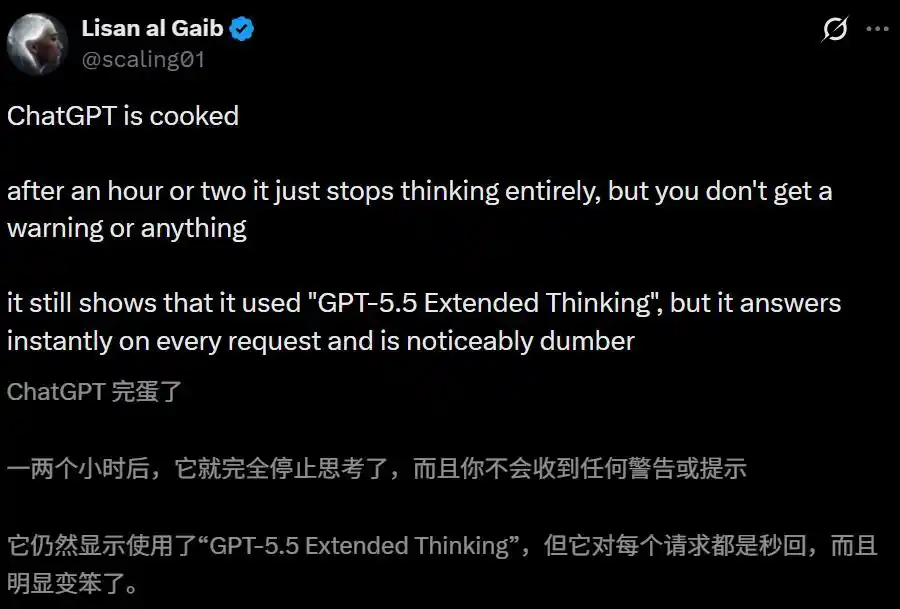
$200/month for a "Schrödinger's Model"

On the OpenAI developer forum, a complaint post blew up simultaneously.

Agentify.sh stated that GPT-5.5 would suddenly lose its ability to follow instructions during use.

Watching it excitedly announce it was "fixed," only to produce code so poor it triggered a mass rollback.

UI tasks that the previous 5.5-med could handle easily now couldn't even manage the simplest changes.

Upgrading to 5.5-high didn't work. Upgrading again to xhigh, still no luck.

And xhigh, which used to run for several hours, now clearly lasted a shorter time.
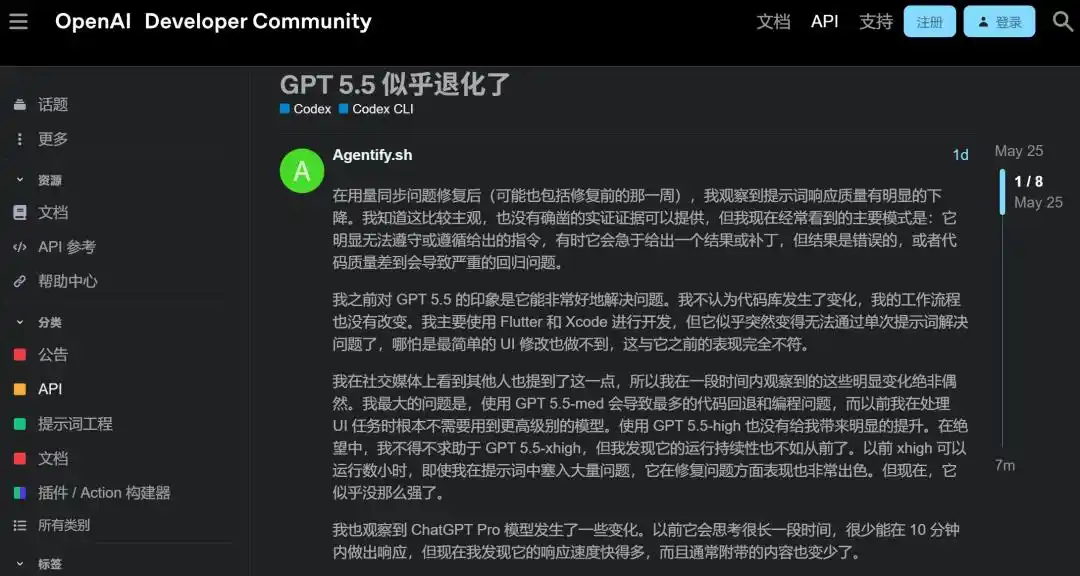
As soon as the post went up, the replies exploded.

Some directly reverted to 5.4.

One used the highest tier, xhigh, but found it "clearly worse than last week, frequent errors on long tasks, not following the workflow at all."

One reported an even more bizarre situation: "Simple queries also take ages to process, and if you interrupt to correct its direction, it completely ignores you and continues with its previous incorrect plan."

That's right, everyone was describing the same phenomenon—GPT's brain had been swapped out at some unknown point.

GPT-5.5's current performance is on par with 5.3, no exaggeration. It was amazing the first few days, but now you can't find a trace of that original model.
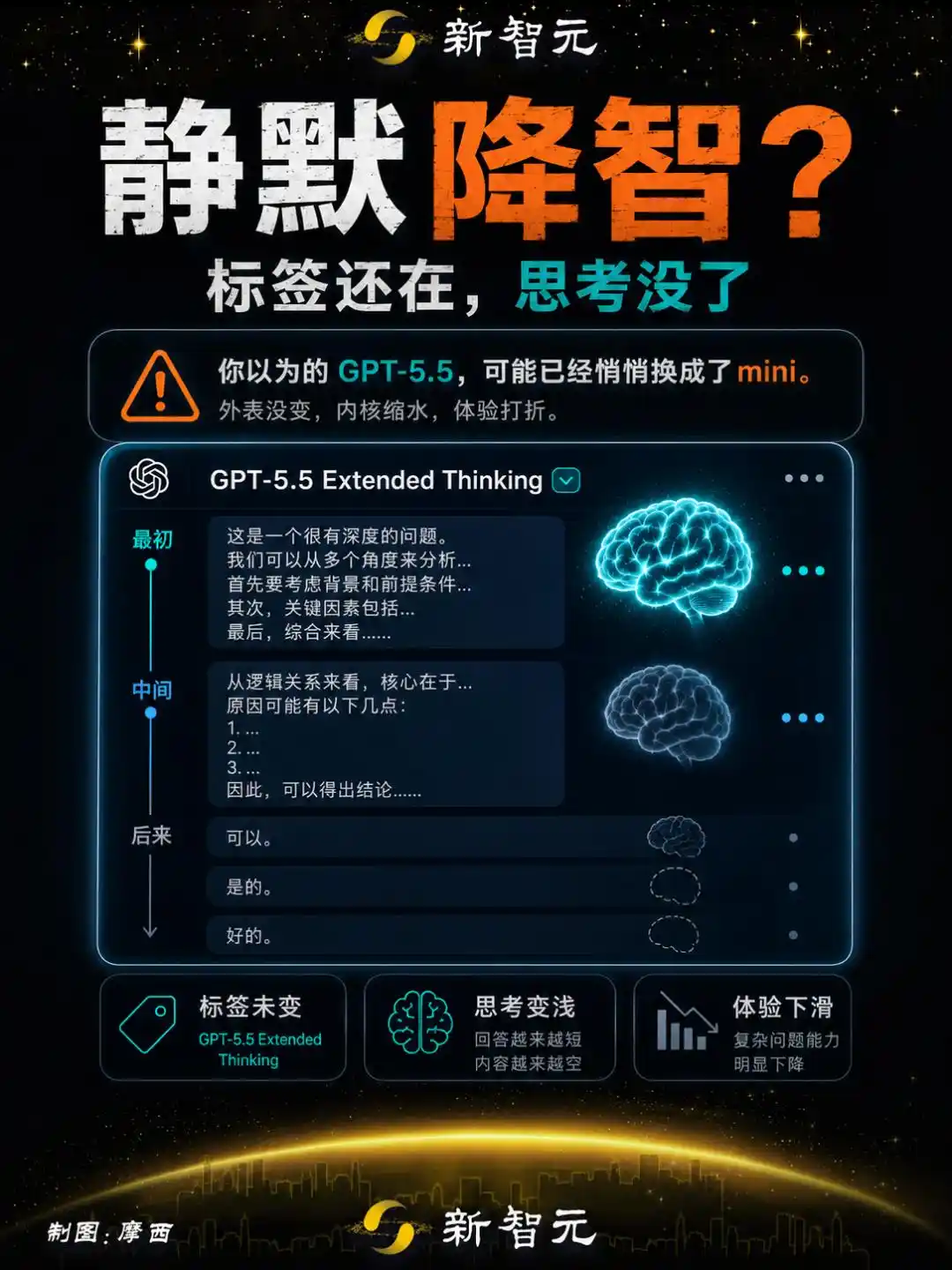
Not an illusion, OpenAI spells it out in black and white

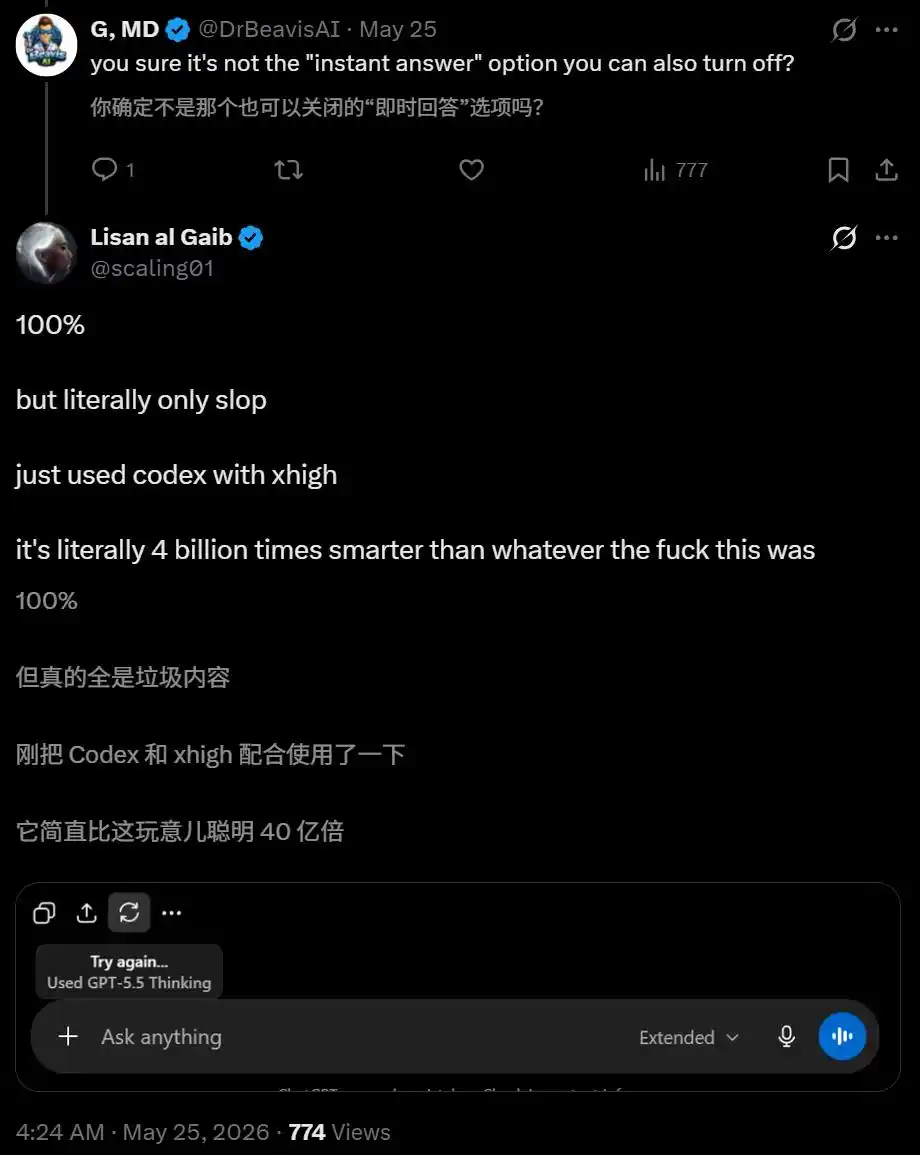
To verify, Lisan al Gaib conducted a comparative test.

Same account, Extended Thinking on the ChatGPT side produced garbage, but switching to xhigh on the Codex side immediately restored normal performance.

In his own words, Codex was "literally 4 billion times smarter than this thing."
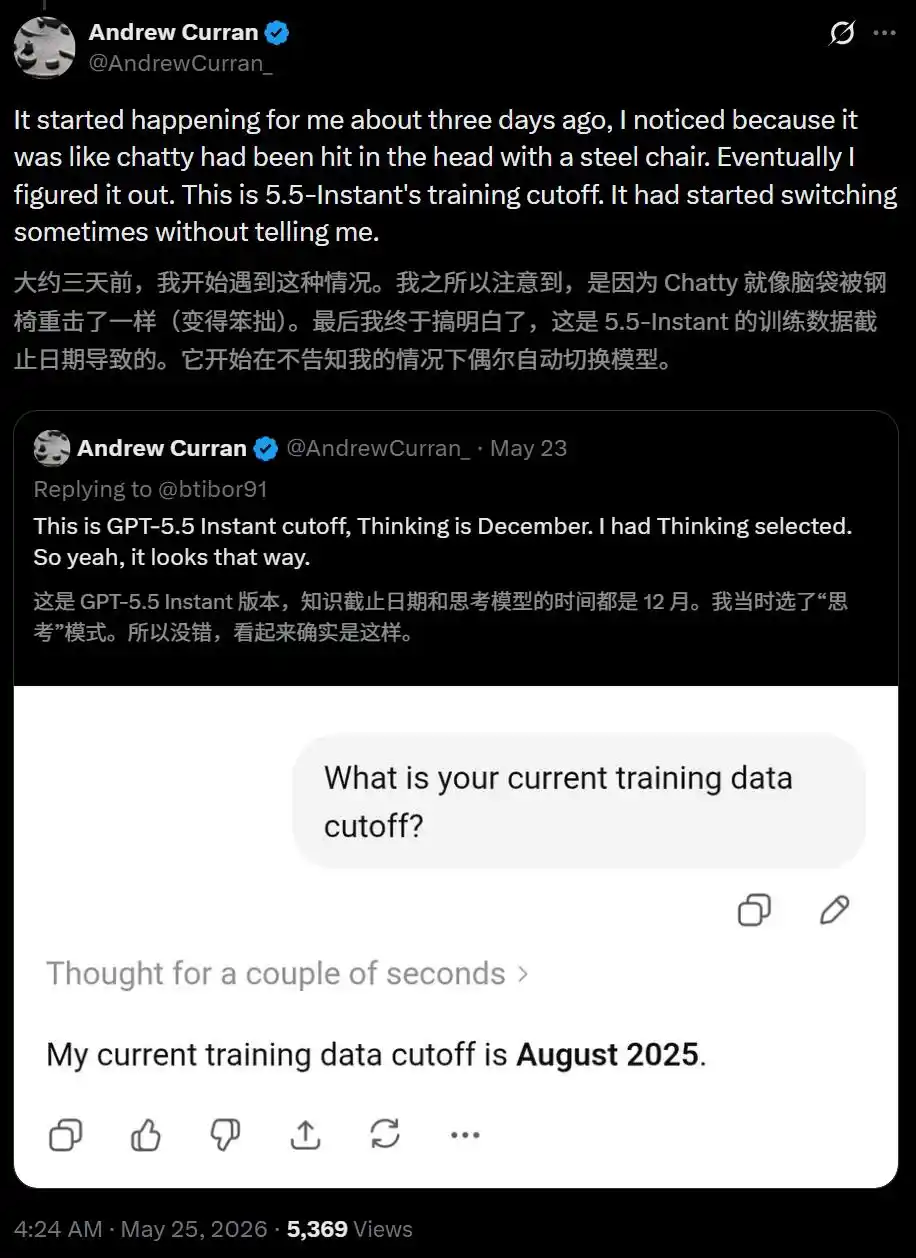
Developer Andrew Curran came up with a clever trick—directly asking the model, "What is the cutoff date for your training data?"

The model answered: August 2025.

The problem? The cutoff date for GPT-5.5 Thinking is December. August is the cutoff date for the Instant version!

In other words, he selected Thinking, but the system actually ran Instant for him.

Not a single word of the model label on the interface changed, but the model behind it had been secretly swapped......
The funny thing is, this time OpenAI itself nailed the coffin shut for users in its own help documentation.

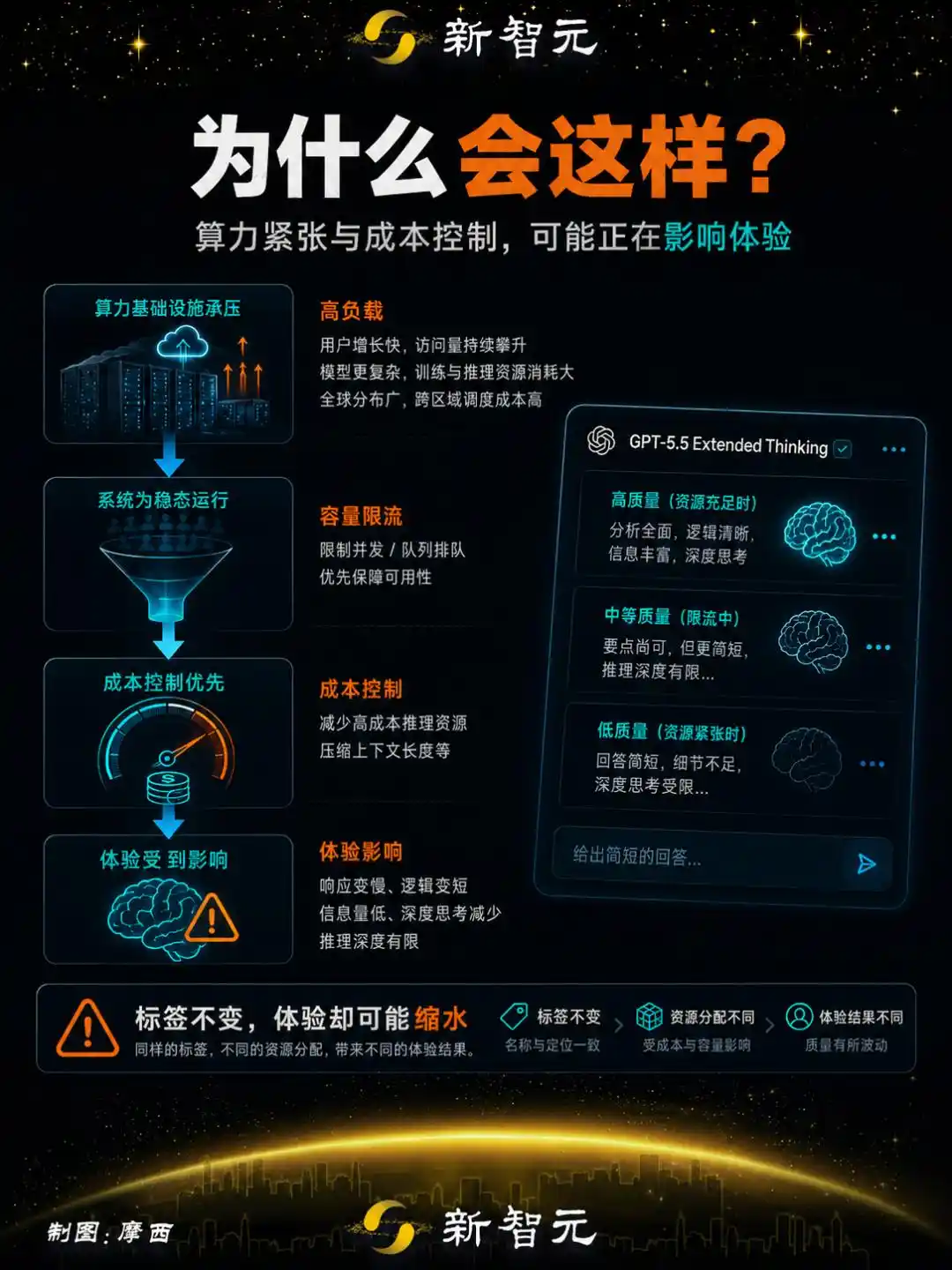
According to the official explanation in the OpenAI Help Center, Plus users can send a maximum of 160 GPT-5.5 messages every 3 hours.

After that quota is used up, the system will silently switch to the mini model until the quota resets.
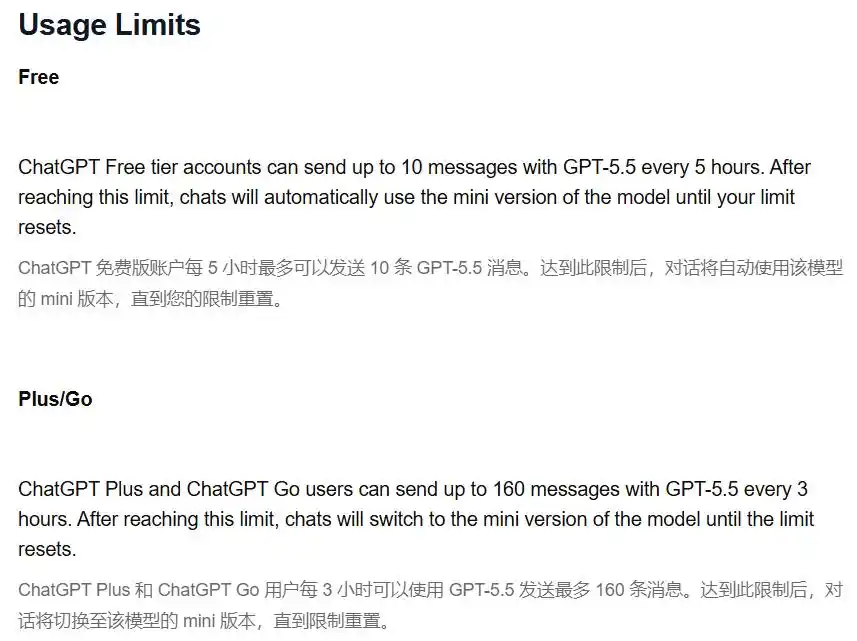
Note the word "silently."

No pop-up notification, no change in the model label, no visual feedback whatsoever.

You still think you're using the flagship model, while on the other end it has quietly been replaced with mini.

Pro users, don't celebrate too soon either.

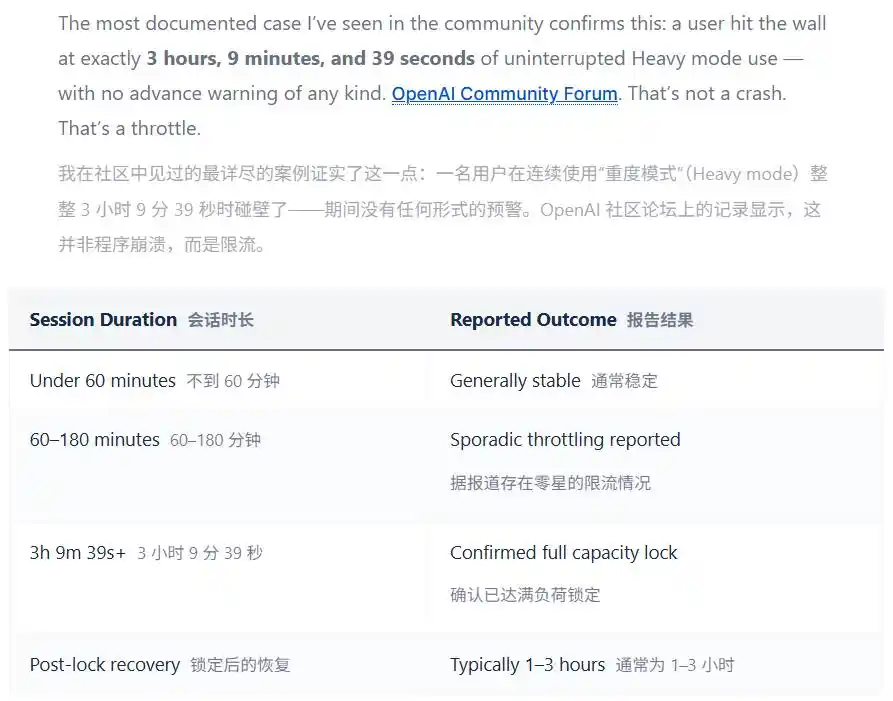
Heavy thinking mode, the top reasoning tier exclusive to Pro users, is also subject to capacity throttling when server load is high. Again, without any warning.

In other words, a $200/month Pro subscription buys you a service that can be "switched out" at any moment.
This kind of "label unchanged, brain swapped" operation was caught even earlier on the Codex side.

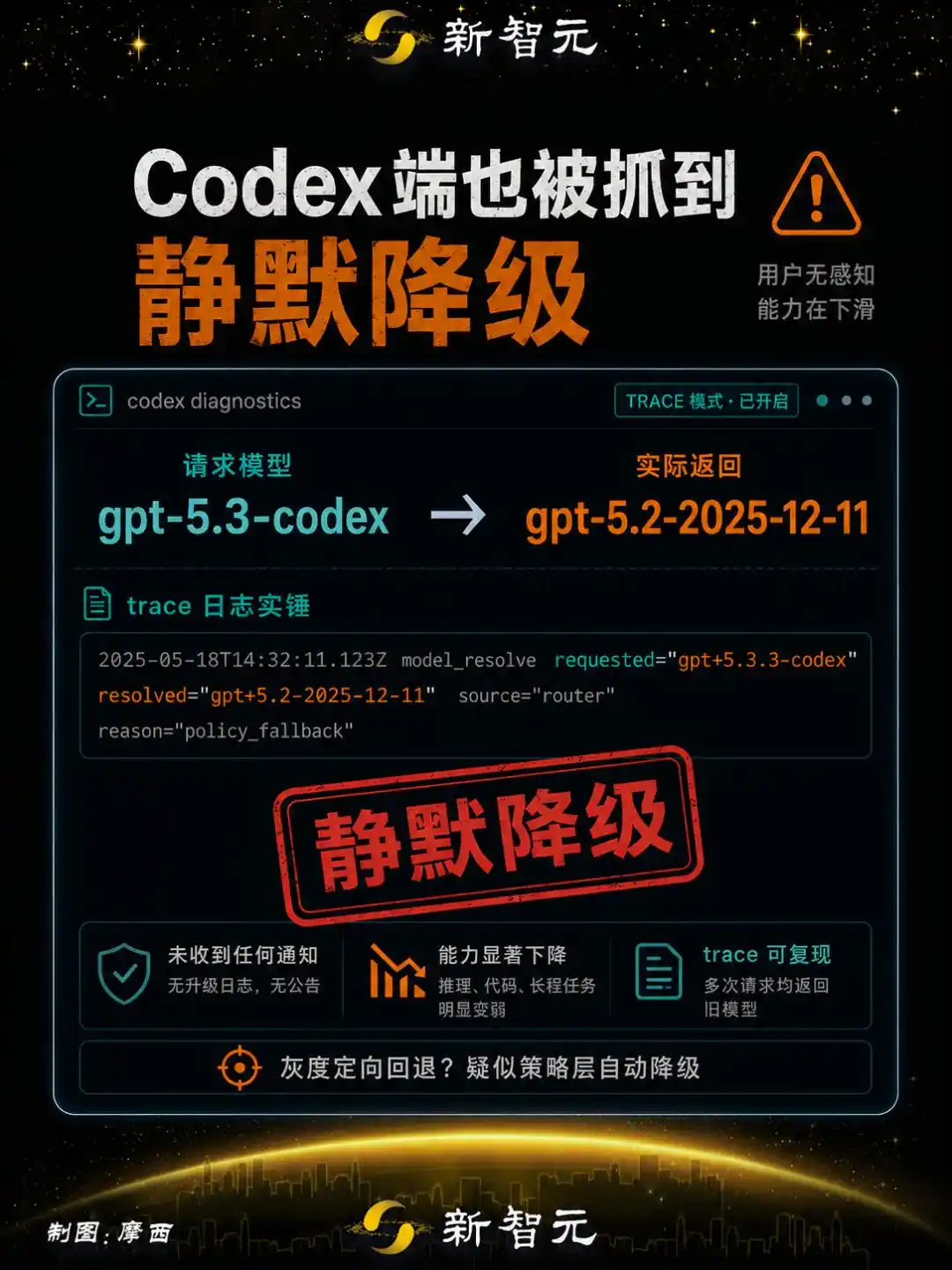
In February this year, an issue appeared on GitHub where a Pro user used a trace command to discover that they were requesting GPT-5.3 Codex, but the actual model returned was GPT-5.2.

Not even 5.2 Codex, but the lower-tier base 5.2.
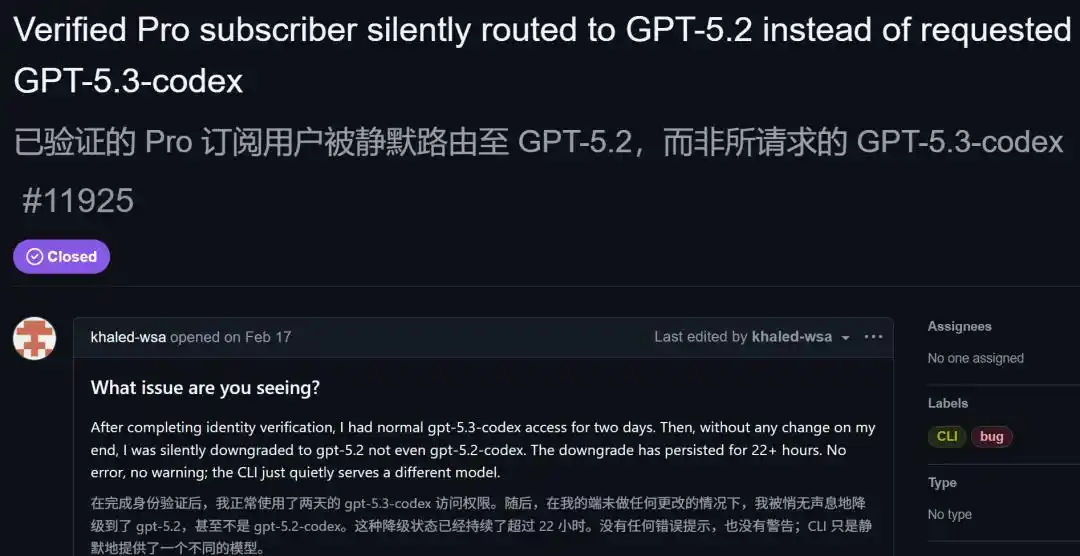
He posted the reproduction command:

  • RUST_LOG='codex_api::sse::responses=trace' codex exec --skip-git-repo-check -s read-only -m 'gpt-5.3-codex' 'hi' 2>&1 >/dev/null | rg -o --replace '$1' '"model":"([^"]+)"' | head -n1
  • Output: gpt-5.2-2025-12-11
  • Expected: gpt-5.3-codex

Multiple Pro users confirmed the same downgrade under the same issue.

And this kind of downgrade is "sticky," it doesn't revert on its own, and there's no explanation.
Even on the day GPT-5.5 was released in April, there were user reports that the speed of Fast mode was similar to Standard, but billing was still at the Fast rate.

A simple task took 7 minutes and 49 seconds, when normally it should be 5-6 minutes.

OpenAI admitted it, and then... nothing

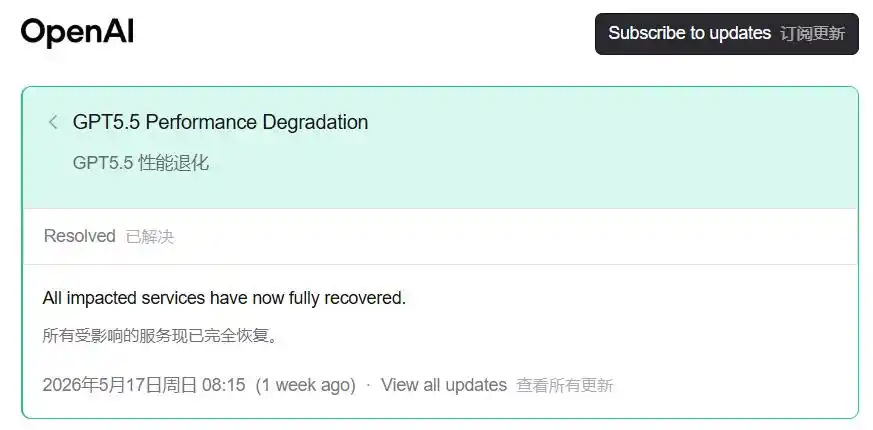
On May 15, a record appeared on OpenAI's status page.

GPT5.5 Performance Degradation, We are investigating reports of performance degradation for GPT-5.5 from some users.

On May 17, the status was updated to "Resolved."

But judging from the timeline of forum posts, complaints about "brain drain" from May 24-26 were even more intense than the wave on May 15.

Either the "resolved" problem came back, or it was never truly solved in the first place.
Every upgrade comes with a "brain drain controversy"

While all companies face complaints about their models "getting dumber," OpenAI hasn't missed a single one with every update from GPT-5 to GPT-5.5.

Every time OpenAI says it's investigating, every time it says it's resolved, and then continues with the next version.

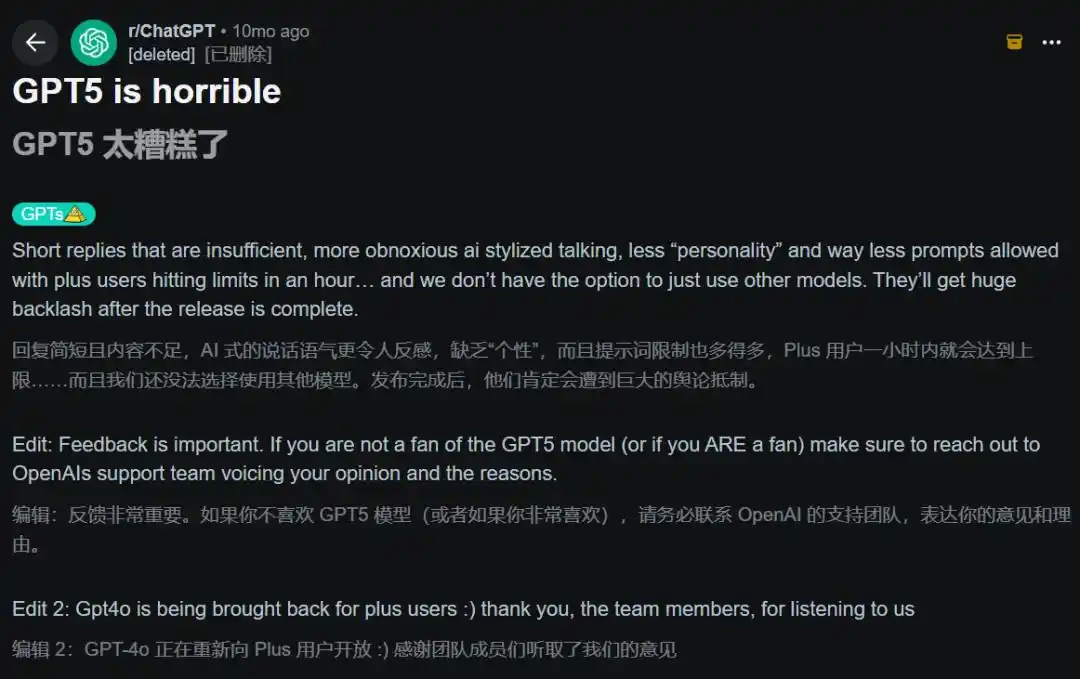
August 2025, GPT-5's debut. The hot post on Reddit was titled directly "GPT-5 is so bad." Users complained about short replies, more refusals, less personality.

OpenAI was forced to urgently restore the GPT-4o option. Altman personally admitted in a Reddit AMA, "bumpier than we expected."
December 2025, GPT-5.2. Translation quality regressed, fabricated non-existent APIs, refused to execute style instructions that 5.1 could easily handle.

February 2026, GPT-5.3-Codex. Pro users silently downgraded to 5.2, trace command confirmed.

March 2026, GPT-5.4. A post titled "GPT-5.4 has clearly regressed in Codex" appeared on the OpenAI community forum, with all replies confirming.

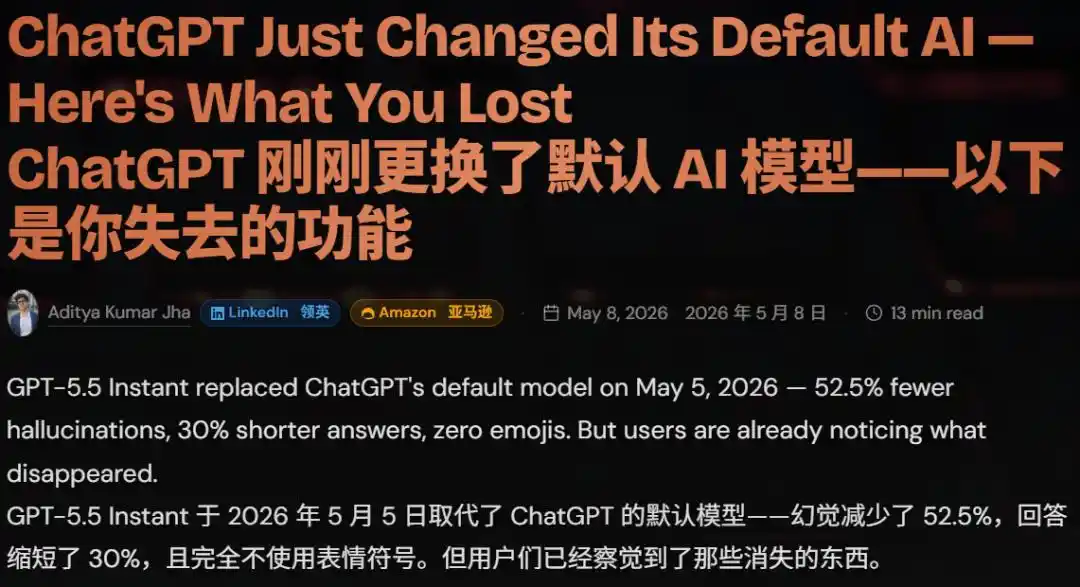
Early May 2026, GPT-5.5 Instant launched. Reply length shortened by 30%, emojis almost disappeared. User summary: Accuracy improved, but warmth vanished.
Late May 2026, now. Complaints about Thinking mode "brain drain" erupted again.

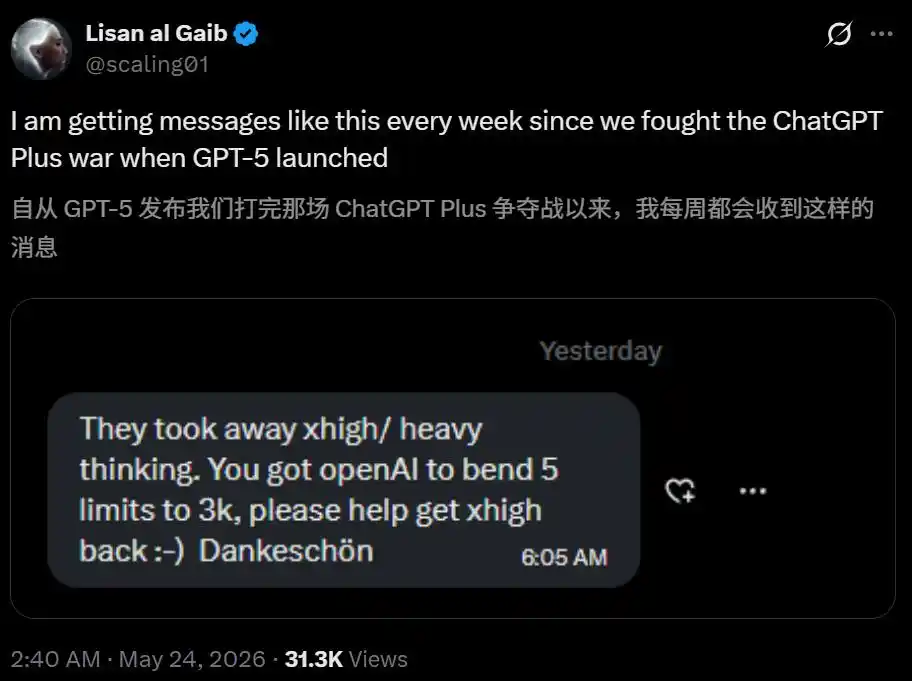
Lisan al Gaib revealed that since he led the fight for ChatGPT Plus quotas during GPT-5's release, "I receive DMs like this every week."

The latest one was someone asking him to help get their xhigh/heavy thinking back.
The day it benchmarks strongest is launch day

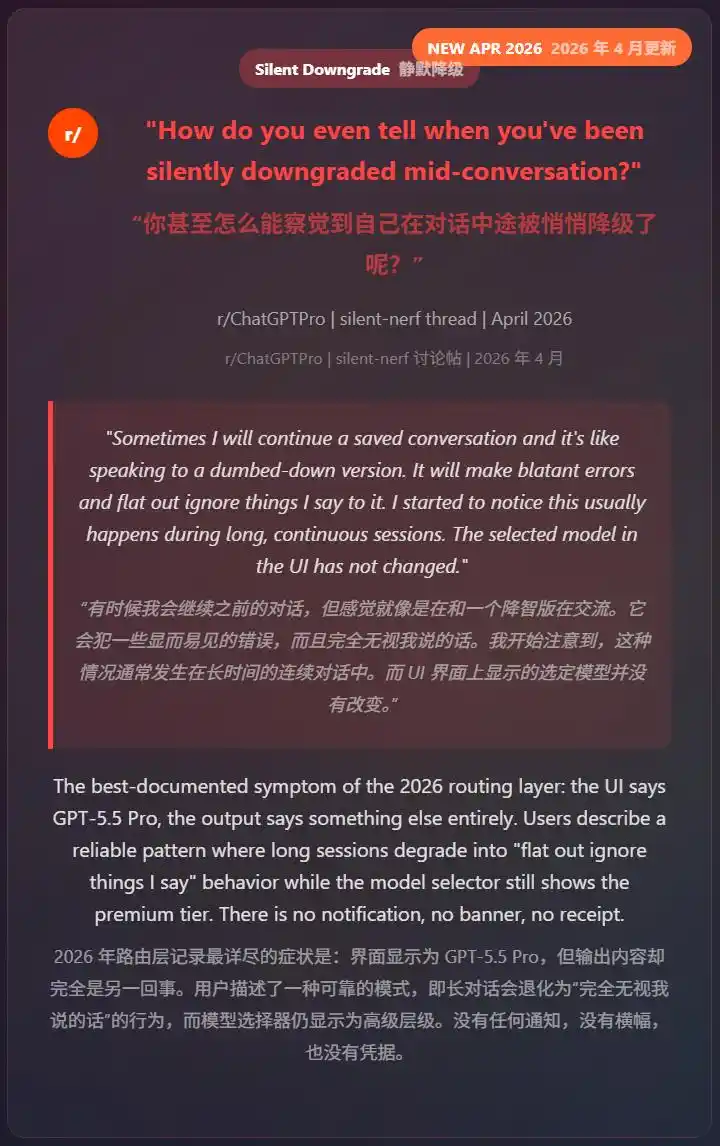
chatgptdisaster.com compiled 1087 verified user complaints, one frequently mentioned scenario is "routing layer failure," where the UI shows GPT-5.5 Pro, but the output is completely from another tier.

Users describe a reproducible pattern: after a long session, the model starts "completely ignoring what you say," but the top-tier label is still hanging on the model selector.
The most absurd footnote is that the mechanism for Plus users automatically switching to mini after using 160 messages/3 hours is described as a "feature" in OpenAI's official documentation.

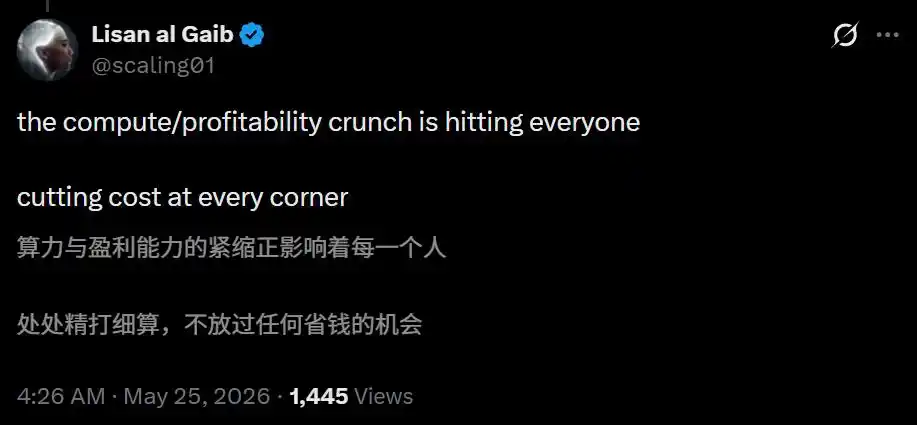
Why is this happening? Lisan al Gaib's analysis suggests the answer is two words: cost-saving.

The crunch on compute power and profitability is affecting everyone. Cutting corners everywhere, not missing any opportunity to save a buck.
Yet, in the same week GPT-5.5 users were collectively complaining, traces of GPT-5.6 had already appeared in Codex backend logs.

Internal codename iris-alpha, 1.5 million token context, Polymarket gave an over 85% probability for a June release.

On one side, 5.5 users can't even secure a basic experience; on the other, 5.6 is already quietly running real traffic in the background.

This is the 2026 ASI race.

The speed of creating new models is getting faster and faster, but making an old model run a single session properly is getting harder and harder.

The day it benchmarks strongest is always launch day, and every day after is Schrödinger's GPT.
Reference: https://x.com/scaling01/status/2058643470357590058?s=20

This article is from the WeChat public account "AI Era," author: ASI Apocalypse; Editor: Moses

Perguntas relacionadas

QWhat is the main issue reported by users regarding GPT-5.5?

AUsers report that after using GPT-5.5 for a short period, its performance degrades significantly, with responses becoming instant and of much lower quality, while the interface still shows the 'GPT-5.5 Extended Thinking' label, indicating a silent model switch.

QAccording to the article, what does OpenAI's official documentation reveal about user limits?

AOpenAI's official Help Center documentation states that Plus users are limited to 160 GPT-5.5 messages every 3 hours. Once this limit is reached, the system silently switches to a mini model until the quota resets, with no visual indication to the user.

QHow did developers verify that they were receiving a different model than selected?

ADevelopers used methods like comparing outputs between ChatGPT and Codex endpoints, asking the model for its training data cutoff date (which revealed an instant model date when thinking was selected), and using trace commands that showed the actual model returned was a lower-tier version than requested.

QWhat pattern does the article describe regarding OpenAI's model updates?

AThe article describes a recurring pattern where each major model update (GPT-5, 5.2, 5.3, 5.4, 5.5) is followed by widespread user complaints about performance degradation. OpenAI typically acknowledges and investigates the issue, but complaints resurface with subsequent releases.

QWhat reason does the article suggest is behind these performance issues and silent model switches?

AThe article suggests the primary reason is cost-saving. It cites an analysis stating that 'compute and profitability constraints are affecting everyone,' leading OpenAI to silently downgrade models to manage costs, even for users paying high subscription fees.

Leituras Relacionadas

Justin Sun’s Interview with Hurun Report: A New Order and Certainty for Value Flow in the Era of Transformation

In an interview with *Hurun Report*, Justin Sun, founder of TRON, discussed the evolution of the Web3 industry as it moves from initial exploration to large-scale adoption. He emphasized that the core value of blockchain lies in building an open and inclusive internet of value, enabling anyone globally to transfer and use funds efficiently and at low cost, regardless of location or access to banking. Sun highlighted that projects with lasting impact are those built on genuine demand and real-world usage. He pointed to the stablecoin payment ecosystem as the most mature and scalable application currently, noting that TRON has rapidly become one of the world's largest stablecoin networks. The circulation of USDT on TRON has surpassed $86.3 billion, driven by actual use cases such as cross-border transfers and daily payments, demonstrating strong network effects. Regarding strategy, Sun outlined a methodology combining data-driven iteration, rapid execution, and user-centric focus. He cited the decision to partner with Tether to launch TRC-20 USDT as a key strategic move, based on an assessment of market trends and long-term potential, which has become a significant growth engine for the TRON ecosystem. On globalization, Sun stressed the importance of local compliance and cultural adaptation, noting that success in different markets depends on deep understanding and local partnerships. He also addressed the convergence of AI and blockchain, describing it as a transformative direction where blockchain provides decentralized infrastructure for AI, while AI enhances the intelligence and user experience of blockchain systems. For industry participants and young entrepreneurs, Sun advised continuous learning and adaptability in a fast-changing environment, focusing on building irreplaceable core strengths rather than spreading resources too thinly. Through infrastructure development, global strategy, and technological foresight, TRON aims to advance the practical implementation and evolution of the value internet.

marsbitHá 17m

Justin Sun’s Interview with Hurun Report: A New Order and Certainty for Value Flow in the Era of Transformation

marsbitHá 17m

Samsung Leverages Technology Cycles, SK Hynix Relies on HBM, What Enabled Micron to Win a Trillion-Dollar Market Cap?

Micron Technology, the Idaho-based memory chip maker, recently saw its market cap surpass $1 trillion, securing its position as one of the top three DRAM manufacturers alongside Samsung and SK Hynix. Its survival and growth story is marked by a unique combination of political maneuvering and hard-won manufacturing efficiency, but also strategic missteps that now challenge its future. Founded in 1978 in Boise without significant government or capital backing, Micron repeatedly turned to Washington for survival during critical junctures. In the 1980s, it filed anti-dumping complaints against Japanese firms, leading to the U.S.-Japan Semiconductor Agreement. Ironically, this created an opening for Samsung, which Micron had earlier licensed its 64K DRAM technology to. In 2002, Micron avoided heavy fines in a price-fixing investigation by acting as a whistleblower against its competitors, cementing its reputation as a "political opportunist." A major strategic error occurred in 2013 with its $2.5 billion acquisition of bankrupt Japanese firm Elpida. This deal burdened Micron with integrating incompatible manufacturing processes just as the industry was pivoting toward HBM (High Bandwidth Memory), a critical technology for AI. SK Hynix had launched its first HBM chip that same year. By the time AI demand exploded with ChatGPT in 2022, SK Hynix commanded about 85% of the HBM3 market, while Micron, playing catch-up, held only around 3%. In 2017, Micron employed similar tactics against a new competitor, Chinese startup Fujian Jinhua, by alleging intellectual property theft, which led to U.S. sanctions effectively crippling the firm. However, this strategy backfired in 2023 when China banned Micron's products from its critical infrastructure, causing its revenue share from China to plummet from 14% in FY2023 to just 7.1% by FY2025. Today, Micron faces a triple squeeze: it lags in the high-margin HBM race, faces pricing pressure in low-end DRAM from Chinese manufacturers like CXMT, and has lost crucial access to the booming Chinese AI server market. Despite its political strategies, Micron's core strength is its exceptional manufacturing cost control, achieved through decades of engineering. Its DRAM chips have a smaller cell area than its rivals, yielding more chips per wafer. This efficiency has been vital for weathering industry downturns. However, this advantage cannot compensate for the decade lost in HBM development. Micron is now racing to ramp up production of its HBM3E, certified by NVIDIA, and develop HBM4. Its future hinges on whether it can close this technological "time debt" through relentless R&D and execution, in a marathon where its competitors, having started earlier, are not slowing down.

marsbitHá 36m

Samsung Leverages Technology Cycles, SK Hynix Relies on HBM, What Enabled Micron to Win a Trillion-Dollar Market Cap?

marsbitHá 36m

Deconstructing Mysterious Researcher Serenity's Chokepoint Algorithm and the Global Revaluation of Equity Assets

Unmasking Serenity's "Chokepoint Theory": A Framework for AI-Era Investment This article deconstructs the investment methodology of the pseudonymous online researcher Serenity (formerly AleaBito on Reddit), who claims extraordinary returns by identifying critical bottlenecks in AI and robotics supply chains. Rejecting Wall Street's typical top-down analysis, Serenity employs a bottom-up, reverse-engineering approach. Starting with an end product like an Nvidia GPU cluster, he meticulously maps the global supply chain down to its most essential, irreplaceable physical components—the "choke points." These are low-profile, often monopolized sub-sectors where a disruption could paralyze entire downstream industries, analogous to a strategic strait controlling global oil flow. His primary focus is the physical evolution of AI data centers, specifically the shift from copper interconnects to silicon photonics and Co-Packaged Optics (CPO). He identifies five critical, monopolized technical barriers within CPO: high-precision fiber alignment components (e.g., FOCI), external light sources and high-power lasers (e.g., SIVE), molecular beam epitaxy equipment (ALRIB/Riber), ultra-high-purity red phosphorus raw materials, and Silicon-on-Insulator (SOI) wafers (Soitec). Serenity extends this framework to humanoid robotics, arguing that while the AI "brain" resides in the US, the physical "body" hardware (actuators, gears, motors) is dominated by Asian manufacturers. He highlights a looming "demand tsunami" for specific rare earth elements essential for robot motors, presenting a severe future supply chain and geopolitical challenge. The article cites several of his investment targets (RPI, SIVE, Soitec, VLN, NBIS) where identifying such choke points, coupled with correcting market mispricings (e.g., ticker code confusion for VLN), allegedly led to significant re-ratings. Ultimately, the article posits that Serenity's core value is not in providing stock picks, but in demonstrating a paradigm: using deep technical analysis to find the silent, indispensable "physical switches" within complex systems, thereby exploiting institutional research blind spots. However, it warns of major risks, including illiquidity in micro-cap stocks, potential "pump-and-dump" accusations, and the foundational gamble that his identified technological paths (like CPO) are the correct and inevitable ones.

marsbitHá 38m

Deconstructing Mysterious Researcher Serenity's Chokepoint Algorithm and the Global Revaluation of Equity Assets

marsbitHá 38m

Cross-strait Regulators Jointly Block Hong Kong Stock Account Openings: Where Can Your Money Go Now?

**Summary:** On May 22, 2026, financial regulators in mainland China and Hong Kong launched a synchronized crackdown targeting informal channels used by mainland investors to trade in Hong Kong and US stocks via Hong Kong-based securities firms. The Hong Kong Securities and Futures Commission (SFC) issued a stringent circular to licensed brokers, mandating stricter onboarding procedures for mainland clients. New requirements include a mandatory written declaration stating that all investment funds originate from *outside* mainland China and are from legal sources. The SFC also demanded the closure of accounts opened with suspicious documents and dormant accounts. Simultaneously, China's securities regulator, along with seven other ministries, initiated a two-year rectification plan, penalizing firms like Futu and Tiger Brokers for illegal cross-border operations. This effectively ends the previously common grey-area practice for mainlanders. Immediate impacts are evident. Social media reports show mainland investors traveling to Hong Kong for in-person account openings are now frequently denied after signing the new declaration, even at firms like uSMART that still accept applications. The declaration acts as both a compliance shield for brokers and a filter for clients. While major internet brokers have halted new mainland accounts, limited options remain. A few Hong Kong-licensed firms like uSMART, Fosun Wealth, and Cheerful still offer avenues, but approval is not guaranteed and hinges on proving offshore fund sources. Crucially, funding accounts must now be in the investor's own name at qualified Hong Kong or international banks, blocking previous informal methods like third-party transfers. For compliant access, official channels like Stock Connect, QDII, and the Cross-boundary Wealth Management Connect remain open. Individuals with verifiable overseas residency or status have better prospects. The crackdown signals the definitive end of the loosely regulated expansion period, forcing mainland investors toward stricter, fully compliant pathways for overseas asset allocation.

marsbitHá 43m

Cross-strait Regulators Jointly Block Hong Kong Stock Account Openings: Where Can Your Money Go Now?

marsbitHá 43m

Iran and the Fed -- Three Scenarios That Will Impact Global Markets Next

"Three Scenarios for Iran and the Fed Shaping Global Markets" Iranian geopolitics and the Fed's monetary policy path are two dominant themes for markets. Deutsche Bank Research outlines three scenarios linking Iran ceasefire outcomes to Fed policy, with oil prices as the key transmission channel. **Scenario 1: Peace Deal.** A breakthrough leading to the Strait of Hormuz reopening would ease near-term Fed tightening pressure. Recent inflation would be viewed as a temporary energy shock. However, medium-term risks remain; rate hikes could resurface in 2027 if inflation persists. **Scenario 2: Stalemate.** A breakdown in talks and a prolonged Strait closure, but no major escalation, is deemed the scenario with the *highest* Fed hike risk. Sustained high oil prices would feed into core inflation and threaten inflation expectations, while not severely damaging demand enough to give the Fed a reason to pause. This environment could necessitate multiple Fed rate hikes in 2026. **Scenario 3: Conflict Escalation.** Renewed conflict and sharply higher oil prices create a two-way risk for Fed policy. On one hand, it would risk severe inflation expectations de-anchoring, forcing a hawkish response. On the other, extreme oil prices could severely damage demand and the labor market, potentially shifting the Fed's focus toward easing. The ultimate policy decision would depend on which risk materializes first. Overall, Deutsche Bank's framework emphasizes that the path for oil prices, dictated by Iran, will define the nature of inflation pressures and ultimately determine the Fed's policy space. Key signals to watch include ceasefire progress, whether Brent crude stabilizes below $100, and any shift in Fed officials' rhetoric from discussing cuts to potential hikes.

marsbitHá 52m

Iran and the Fed -- Three Scenarios That Will Impact Global Markets Next

marsbitHá 52m

Trading

Spot
Futuros
活动图片