Comprehensive Analysis of Canton Network: Wall Street's Blockchain Ambition

marsbitPublicado em 2026-03-15Última atualização em 2026-03-15

Resumo

Canton Network is positioned at the convergence of key crypto trends, including real-world asset tokenization, institutional blockchain adoption, privacy infrastructure, and stablecoin settlements. It has attracted major financial institutions like DTCC, Nasdaq, and Broadridge, which are deploying real workflows such as treasury tokenization, repo financing, and collateral management. The network is designed for regulated entities, offering granular transaction privacy and validator-level control while maintaining interoperability. Its architecture separates execution from coordination, using validator nodes operated by participants and synchronizers for atomic settlement. Key adoptions include DTCC tokenizing U.S. Treasuries, Broadridge processing trillions in repo transactions, and Nasdaq integrating its Calypso platform. Tokenomics are usage-driven, with weekly CC burns increasing by 216% since TGE, and the burn-to-mint ratio rising to 0.90, nearing a deflationary state. Despite generating the highest revenue among L1s in February, Canton trades at a discount to peers, possibly due to high emissions and its perception as financial infrastructure. Catalysts include regulatory clarity from the Clarity Act and DTCC’s broader tokenization platform launch in late 2026. Risks include token concentration, with 54% of CC held by a few entities, though these are largely operational holdings. Canton aims to become a core coordination layer for tokenized financial markets.

Source: Blockworks Research

Author: Kunal Doshi

Compilation and Editing: BitpushNews

Several of the most important narratives in the crypto space are beginning to converge: including the tokenization of real-world assets (RWA), institutional-grade blockchain adoption, privacy infrastructure, and stablecoins as a settlement rail.

Canton Network is at the intersection of these trends and has assembled the industry's most powerful group of institutional participants.

Major financial institutions, including DTCC (The Depository Trust & Clearing Corporation), Nasdaq, Broadridge, and several global banks, have already deployed real-world workflows on the network covering treasury tokenization, repo financing, collateral management, and payments.

If this trend continues, Canton could become the coordination layer for the tokenized financial market, with assets, cash, and collateral moving between institutions in real-time. As more financial activity flows through the network, the volume of transaction coordination increases, driving up network revenue and token burn, pushing the network towards deflation.

Key Takeaways

  • Architecture designed for regulated institutions. Canton supports granular transaction privacy and validator-level control while maintaining interoperability between applications, addressing key compliance hurdles faced by institutions.
  • Adoption spans the entire institutional financial stack. DTCC is bringing regulated collateral on-chain; Broadridge processes over $7 trillion in repo activity monthly; Nasdaq is integrating Canton with its Calypso risk and collateral management platform.
  • Network effects may increase coordination activity. As more institutions join and transact with each other, the number of counterparties increases, and more transactions are routed through the "Global Synchronizer," driving higher CC burn.
  • Tokenomics increasingly driven by usage. Since the Token Generation Event (TGE), the weekly burn has grown by 216%, and the burn-to-mint ratio has risen to 0.90. If activity continues to expand, the network will approach a potentially deflationary state.
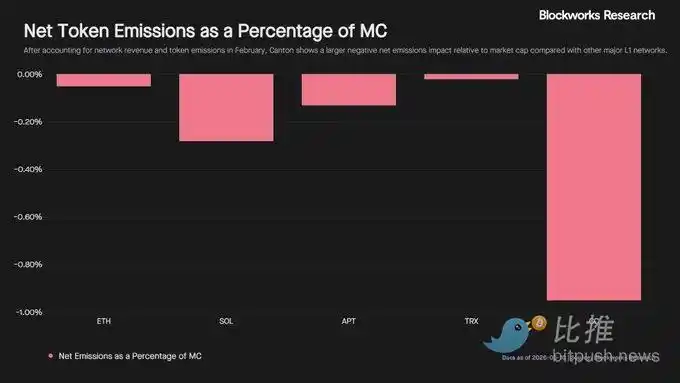
  • Valuation remains discounted relative to peers. Canton generated the highest revenue (REV) among major L1 networks in February, but its trading multiples are lower, possibly reflecting recent inflation and the market viewing it more as financial infrastructure than a general-purpose public chain.
  • Regulatory clarity and institutional rollouts are key catalysts. The passage of the Clarity Act and DTCC's broader tokenization platform launch in the second half of 2026 could accelerate institutional adoption and increase the volume of assets and transactions moving on Canton.
  • Token concentration remains a potential risk. Approximately 54% of the circulating CC is held by a small number of network participants, although many of these balances are operational rewards rather than speculative holdings.

Pain Points of Institutional Tokenization

Tokenization promises faster settlement, lower reconciliation costs, and more efficient capital utilization. But in practice, most blockchain designs force institutions to choose between regulatory compliance and the ability to transact across a shared network.

The Basel Committee on Banking Supervision has made it clear that the choice of infrastructure directly impacts regulatory treatment. Banks tokenizing traditional assets must demonstrate robust governance, clear validator control, strong data privacy, and sound operational risk management. If these conditions are not met, tokenized exposures could face significantly higher capital charges, eroding the economic benefits tokenization is meant to bring.

  • Public permissionless blockchains offer interoperability and composability, but transaction data is visible to validators and potentially the entire market. For regulated institutions, broadcasting information about liquidity needs, margin movements, or collateral positions is unacceptable. Even anonymized activity can leak commercially sensitive insights. Institutions need to know who validates their transactions and who has access to their data.
  • Private blockchains restrict access but introduce fragmentation. Each network becomes a silo, limiting asset liquidity and cross-platform composability. Privacy is often implemented at a broad channel level, and participants might still see more activity than a strict "need-to-know" basis allows.

Thus, institutions face a structural trade-off: public networks lack sufficient control, while private networks lack meaningful interoperability. Canton aims to bridge this gap by combining granular privacy and validator-level control with shared synchronization and atomic settlement across independent applications.

Network Architecture and Privacy Model

Canton separates execution from coordination. Smart contracts written in Daml run on validator nodes operated by participating institutions and application providers. Each organization runs its own validator node, which serves as its gateway to the network and only validates transactions it participates in. This design allows institutions to maintain control over their infrastructure and transaction validation.

Validators connect to a Synchronizer, responsible for routing and ordering messages between parties. The Synchronizer ensures multi-party transactions are settled atomically and consistently among participants. It does not validate transactions and cannot view transaction data, as all messages are end-to-end encrypted. The Synchronizer only orders the encrypted payloads, similar to a post office handling sealed envelopes.
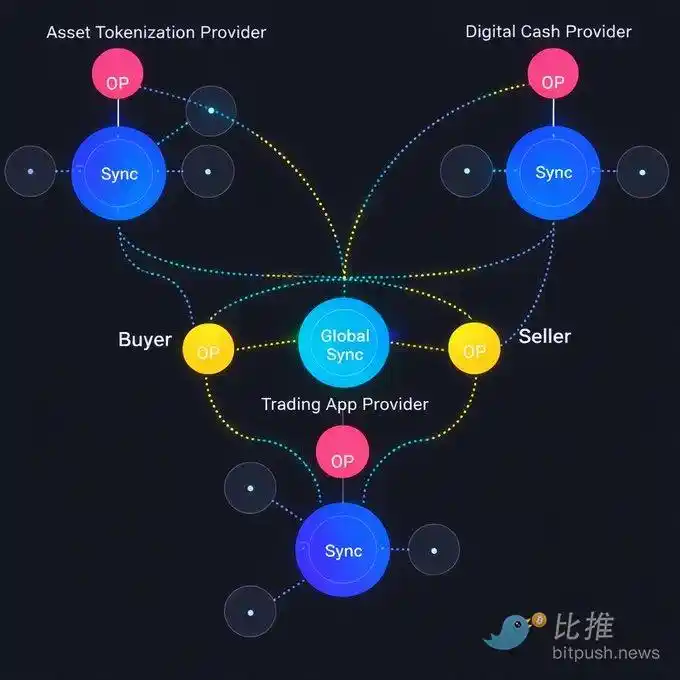
Canton supports multiple synchronizers. The Global Synchronizer acts as a shared public coordination layer operated by "Super Validators" using Byzantine Fault Tolerant (BFT) consensus. It provides a neutral backbone, allowing independent applications and institutions to interoperate while maintaining the flexibility of a connected ecosystem.

Network Participants

Validators: Infrastructure nodes operated by institutions. They store contract state, validate participating transactions, and provide application interfaces for users and services.

Applications: Business logic deployed on validators. They define the contract rules and data permissions for use cases like stablecoins, repo, custody, and tokenized assets.

Super Validators: Operate the Global Synchronizer and ensure decentralized message ordering for the public network. While validators only validate transactions they participate in, Super Validators maintain the shared coordination layer.

Governance is kept transparent through the Canton Foundation and follows institutional standards. Anyone can view or submit Canton Improvement Proposals (CIPs). The Super Validators operating the Global Synchronizer vote on key decisions, including upgrades and changes to code and services. The Canton Foundation supports the development and oversight of the Global Synchronizer, ensuring governance actions are publicly visible and members are involved. The Foundation runs a node on behalf of its members and participates in governance votes, helping to maintain the network's neutrality and trust.

Institutional Adoption to Date

DTCC Integrates DTC-Custodied Treasuries with Canton

DTCC is a core post-crisis infrastructure provider for the US capital markets. Through its central securities depository subsidiary (DTC), it custodies and protects over $100 trillion in assets, including stocks, ETFs, money market instruments, and more. Its decision to tokenize a subset of DTC-custodied Treasuries on Canton represents a structural step towards bringing core market collateral on-chain.

After receiving a "No Action Letter" from the SEC (Securities and Exchange Commission), DTCC announced plans to mint a subset of DTC-custodied Treasuries on Canton, with its MVP (Minimum Viable Product) targeted for the first half of 2026. These are not synthetic assets; the tokenized Treasuries retain the same CUSIP, meaning they remain the same security legally and operationally within existing market infrastructure. Participants can use the asset in traditional systems or in tokenized form without changing its legal status.

DTCC has also joined Canton as a Super Validator, operating infrastructure for the Global Synchronizer and participating in network governance.

More important than the issuance are the use cases proven. A Canton working group including Bank of America, Circle, Citadel, Cumberland, Société Générale, Tradeweb, and Virtu has completed real-time on-chain US Treasury financing for stablecoins. These transactions include weekend repos, atomic settlement, and real-time collateral reuse. DTCC's move brings regulated collateral on-chain, and these transactions demonstrate that these assets can be actively financed and mobilized at an institutional scale.

Broadridge: Institutional Repo at Production Scale

Broadridge's Distributed Ledger Repo (DLR) platform currently processes over $350 billion in daily transaction volume. Repos (repurchase agreements) are short-term collateralized financing backed by assets like US Treasuries and are a core liquidity engine for global capital markets. This activity is already running in production on Canton.
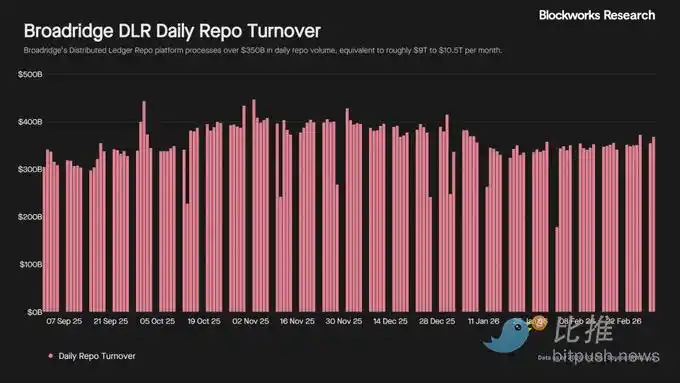
DLR has been operational since 2021, with a user base including major banks, broker-dealers, and traditional asset managers. The platform integrates with existing market infrastructure, including custodians, front-office trading systems, and back-office settlement platforms, allowing institutions to onboard with minimal operational disruption.

Within DLR, key components of the repo lifecycle are handled on-chain, including the custody of tokenized collateral, execution of repo trades, and settlement of cash and securities between counterparties. Certain operational processes remain off-chain, such as archival record-keeping and updates to control over the underlying collateral held in traditional custodian accounts. As DTCC plans to bring regulated, high-quality collateral directly onto Canton, the associated repo financing can also occur on-chain, which would increase activity on the Broadridge DLR platform.

Nasdaq: On-Chain Margin and Collateral Infrastructure

Nasdaq has completed a pilot connecting its Calypso platform to the Canton Network. Calypso is one of the most widely used institutional systems for managing risk, margin, and collateral among global banks and asset managers. This pilot demonstrated how on-chain infrastructure can integrate directly with existing institutional risk systems.

The test was conducted jointly by QCP, Primrose Capital, and Digital Asset. Enterprises can automatically calculate margin requirements on-chain in real-time and move collateral between counterparties, while continuing to use their existing portfolio and risk systems. For institutions operating across time zones and asset classes, this reduces operational friction and improves capital efficiency.

Nasdaq has also joined Canton as a Super Validator. This builds on Nasdaq's strategic investment in Digital Asset (the creator of Canton), with other investors including BNY (Bank of New York), iCapital, and S&P Global.

Other Key Institutional Partners

Several other global institutions are building applications on Canton. JPMorgan plans to natively introduce JPM Coin to the network for 24/7 institutional cash and collateral settlement. London Stock Exchange Group (LSEG) is launching its digital clearing house on Canton to support real-time post-trade workflows. Lloyds Banking Group executed the UK's first production-grade tokenized Treasury and deposit transaction on the network.

These initiatives are supported by a growing number of Super Validators operated by Digital Asset, Tradeweb, Cumberland, and others.

Institutional Impact

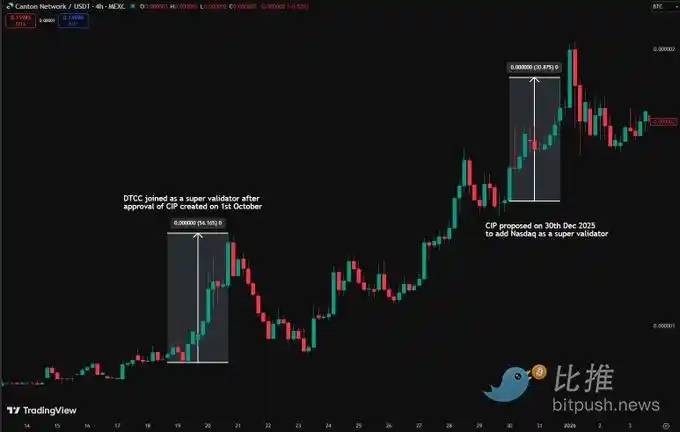
Announcements of major financial institutions becoming Super Validators have served as short-term price catalysts. Following the confirmations of DTCC and Nasdaq as Super Validators, CC outperformed BTC by 54% and 31%, respectively, over the subsequent two days. This move likely reflects increased market confidence that globally recognized financial institutions are committing to the network at the infrastructure and governance level, not just at the application level.
Beyond narrative-driven price movements, these developments could translate into sustained network activity:

  • Nasdaq's work focuses on collateral management. Margin recalculations, collateral pledging, and portfolio adjustments are high-frequency activities. If these workflows move on-chain between independent institutions, they will generate ongoing coordination transactions.
  • DTCC and Broadridge represent the asset and funding layers. DTCC brings regulated collateral on-chain, while Broadridge already facilitates repo financing activity at scale. Tokenizing an asset is a one-time act; the real potential lies in these Treasuries being repeatedly financed, pledged, and reused among counterparties.

Currently, much of the activity from large institutions runs in private synchronization environments, not through the Global Synchronizer. Therefore, this activity has not yet contributed substantially to the Global Synchronizer's message flow. However, as more independent institutions onboard and begin transacting with each other, the demand for coordination will increase. Each new participant expands the number of potential counterparties, enhancing the network effects of the entire system. Transactions spanning multiple validators are routed through the Global Synchronizer. As the scale of cross-institutional financing and collateral activity grows, the message volume will translate into higher CC burn.

Tokenomics

Transactions spanning multiple validators are ordered through the Global Synchronizer, where fees are paid by burning CC. Fees are priced in "USD per MB of transaction data" but settled in CC using an on-chain conversion rate. These fees are burned rather than paid to validators, directly reducing the token supply. This structure allows institutions to pay predictable, USD-based infrastructure costs while linking network usage to token supply dynamics.

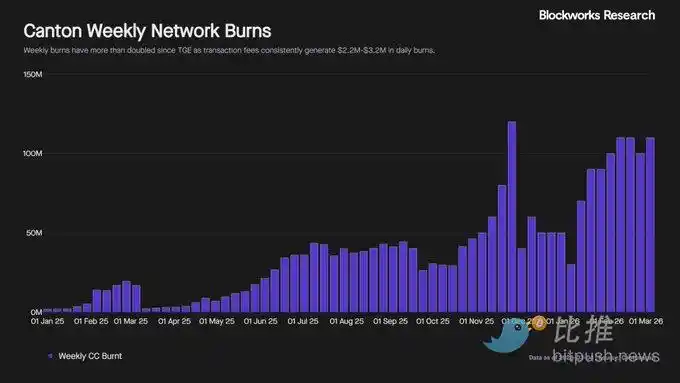
Burn Trends: Since TGE, the weekly CC burn has grown by 216%, from 46.2 million to approximately 100 million. In USD terms, daily fees in recent weeks have ranged between $2.2 million and $3.2 million. As a percentage of the circulating supply, the weekly burn rate has increased from 0.14% to 0.26%, with some weeks even exceeding 0.30%.
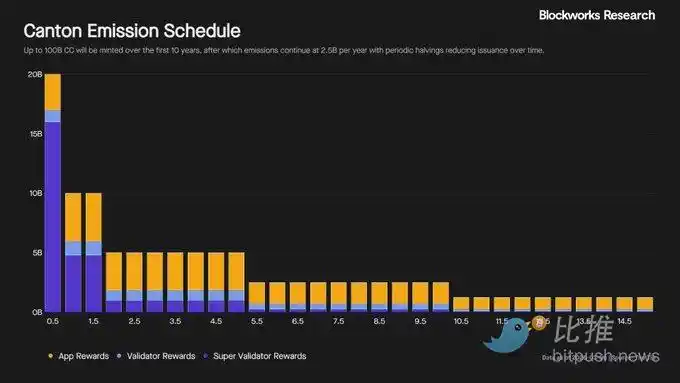
  • Emission Model: CC follows a pure earn model. There was no pre-allocation to investors, team, or foundation. All tokens are minted through network participation. A total of 100 billion CC can be minted over the first 10 years, followed by a fixed annual emission of 2.5 billion thereafter.

  • Halvings: Periodic halvings reduce the output over time. The most recent occurred on January 12, 2026, cutting the annual emission from 20 billion to 10 billion.

Reward Distribution: Newly minted tokens are distributed to Applications, Validators, and Super Validators. Over time, the allocation focus has shifted: the emission share for Super Validators has decreased from 80% at launch to 20% currently, while Application rewards have increased from 15% to 62%. The system is intentionally transitioning from early infrastructure incentives to application-driven incentives.
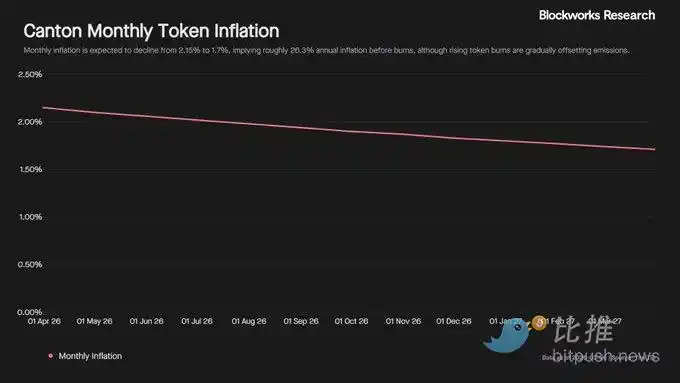
Inflation vs. Deflation: The current monthly inflation rate is gradually decreasing from 2.15% to 1.7% (approx. 26.3% annualized). While still high relative to other L1s, the burn rate is rapidly closing the gap. Since TGE, the daily burn-to-mint ratio has risen from 0.16 to 0.90.
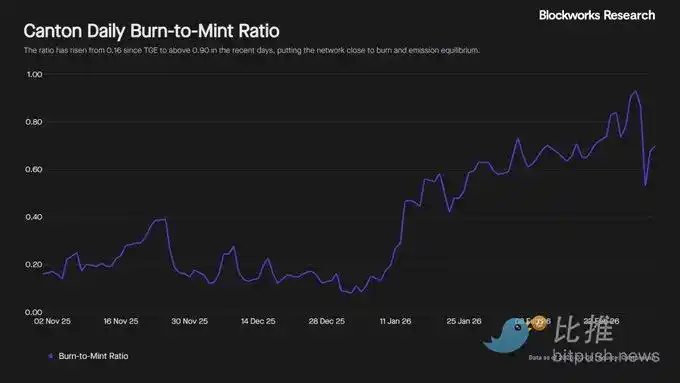
At the current rate, Canton is approaching a balance point where daily burn equals daily mint. If the burn ratio consistently exceeds 1, the network will enter net deflation, directly addressing a primary investor concern.

Active Applications and Emerging Use Cases

Looking at the top 10 applications by reward share, the number of active earners is steadily expanding, indicating a growing, healthy ecosystem. At current prices, approximately $82.2 million worth of CC is distributed to applications monthly. This creates significant economic incentives for builders, who can also pass rewards on to end-users to bootstrap liquidity and usage.
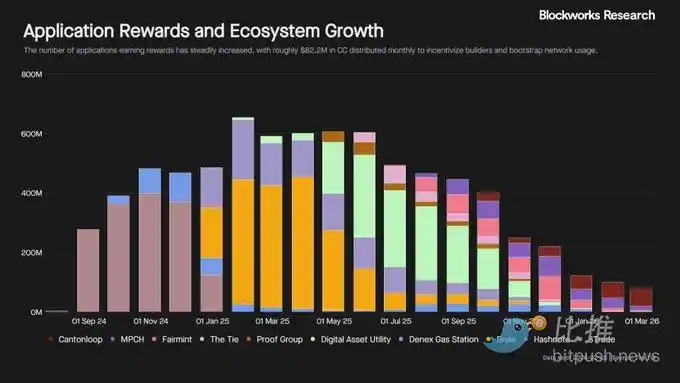
  • Brale: Currently leads in reward share. It has constructed a bridge converting USDC and USDT into Canton-native equivalents, enabling private, institutional-grade payments and settlement. It effectively serves as the ecosystem's on/off-ramp, allowing treasury and capital markets participants to move cash on-chain without exposing transaction details.

  • Hashnote: (Acquired by Circle in January 2025) brings yield-bearing collateral on-chain via USYC, a tokenized reverse repo product with assets under management exceeding $1 billion. USYC can be used for margin, collateral, and trading workflows while preserving privacy. Subscription fees are paid in CC, and Hashnote redistributes part of the rewards to connected validators.

Other top reward earners include infrastructure and tooling services: Denex Gas Station (bandwidth management), Cantara (peer-to-peer billing), Fairmint (on-chain equity issuance), The Tie (analytics services), 5North’s Loop (wallet provider), and Digital Asset’s DA Utility (asset tokenization standard).

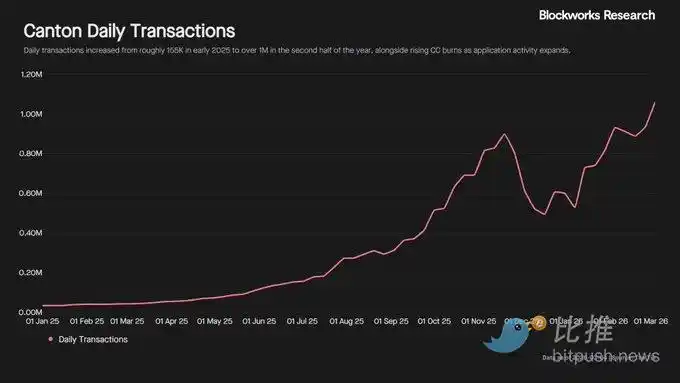
As the application base expands, network activity has increased dramatically. Daily transaction volume grew from around 155,000 in the first half of 2025 to over 1 million in the second half.
Circle's launch of USDCx is a significant recent development. USDCx is a privacy-preserving stablecoin, 1:1 backed by USDC in Circle's reserves. Only transacting parties can view the details, addressing a major obstacle to institutional stablecoin adoption.

In February 2026, a multinational corporation executed the first private on-chain stablecoin payroll on Canton. The transaction was powered by Toku (managing payroll logic) and Cantor8 (providing secure employee wallets).

Valuation Analysis

In terms of network revenue (REV), defined as paid block space and settlement coordination fees, Canton generated the highest revenue among major L1s in February, at $74.7 million, roughly 2.8 times that of second-place Solana.

We use the 10-year supply milestone of 100 billion to estimate the Fully Diluted Valuation (FDV). In practice, Canton's future supply is dynamic due to ongoing burns.
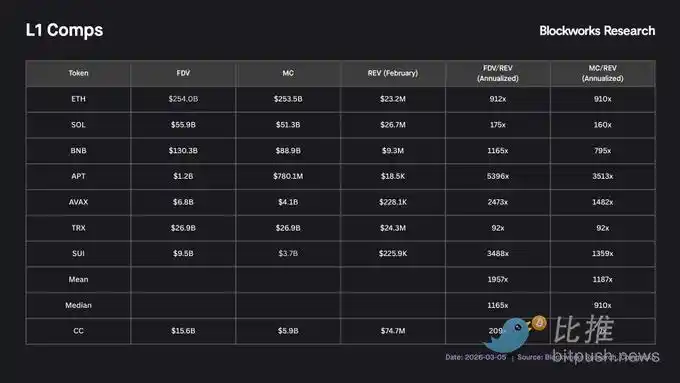
Despite a conservative adjustment for future supply expansion, Canton still trades at a significant discount to other L1 networks on both Market Cap/Revenue (MC/REV) and FDV/Revenue (FDV/REV) multiples.

  • Reason 1: Recent token emissions are high.

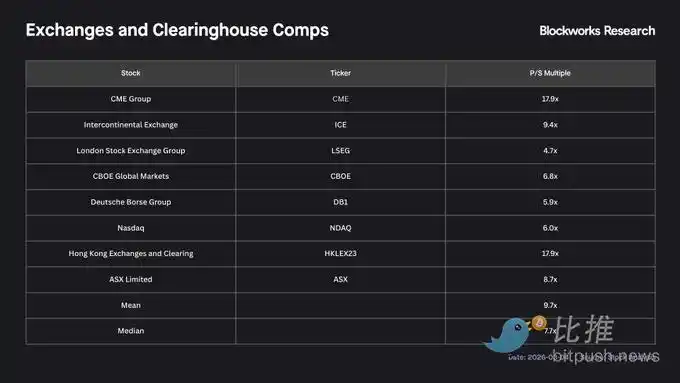
  • Reason 2: The market's interpretation of Canton's role. The market currently views it as financial infrastructure rather than a general-purpose public chain. Compared to traditional financial market infrastructure providers like CME, Nasdaq, ICE, and LSEG (which typically trade at multiples around 8x), Canton's valuation is more in line with them.
Additional upside potential could stem from the network beginning to support applications that generate sustained on-chain activity, such as prediction markets, perpetual trading, and lending markets.
  • Unhedged: The first privacy prediction market on Canton, has processed over 10 million CC in trading volume.
  • CantonSwap: A decentralized exchange, already ranked among the top 25 reward-receiving applications.
  • Franklin Templeton: Its BENJI tokenized money market fund is live on the network.

Potential Catalysts

Clarity Act: A potential regulatory catalyst. This legislation would help define the regulatory treatment of digital assets and blockchain infrastructure in the US, reducing uncertainty for banks and clearinghouses. The current probability of it being signed into law in 2026 is predicted to be around 60% on Polymarket.

DTCC Tokenization Platform Rollout: DTCC plans to launch a production-grade platform in the second half of 2026. If Canton is used as the settlement environment, it would significantly expand the asset range and transaction activity.

Potential Risks
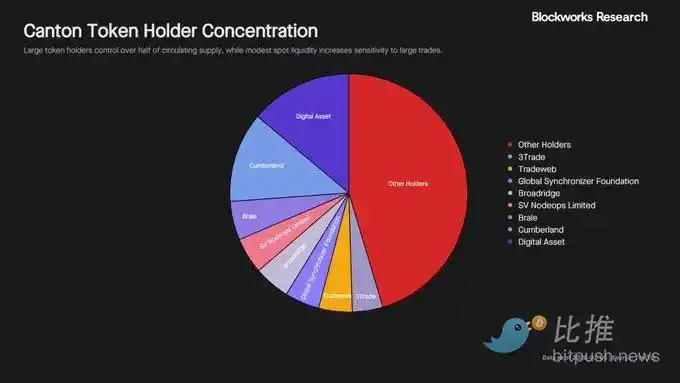
Token Concentration: CC ownership is concentrated among a small number of participants. The top reward recipients collectively hold approximately 54% of the circulating supply. If large holders cash out, it could create selling pressure.

Limited Market Liquidity: To date, the depth (around -2%) on the Bybit spot market is approximately $350,000; this means that even relatively small trades can significantly impact price action if large position holders choose to reduce their holdings, thereby exacerbating market volatility. However, over time, market liquidity is expected to improve if more exchanges list the token. Since the beginning of the year, exchanges like OKX and Robinhood have listed CC, which should gradually increase its trading depth and broaden market access.

Context: It's important to note that these balances primarily belong to core contributors and infrastructure providers and are operational rather than speculative in nature. The Canton Foundation recently approved a proposal allowing Super Validators to lock up part of their rewards to maintain validator weight, which should help strengthen long-term alignment and reduce the likelihood of large-scale sell-offs.

Conclusion

Canton represents one of the most credible attempts to bring traditional financial infrastructure on-chain. Its architecture is designed around institutional needs, and early adoption by organizations like DTCC, Nasdaq, and Broadridge indicates the network is gaining traction.

While much activity is still in its early stages, with the dual expansion of institutional and application activity, Canton may increasingly become a core coordination layer for financial markets.


Leituras Relacionadas

How Many Tokens Away Is Yang Zhilin from the 'Moon Chasing the Light'?

The article explores the intense competition between two leading Chinese AI companies, DeepSeek and Kimi (Moon Dark Side), and the mounting pressure on Yang Zhilin, the founder of Kimi. While DeepSeek re-emerged after 15 months of silence with its powerful V4 model—boasting 1.6 trillion parameters and low-cost, long-context capabilities—Kimi has been focusing on long-context processing and multi-agent systems with its K2.6 model. Yang faces a threefold challenge: technological rivalry, commercialization pressure, and investor expectations. Despite Kimi’s high valuation (reaching $18 billion), its revenue heavily relies on a single product with low paid conversion rates, while DeepSeek’s strategic silence and open-source influence have strengthened its market position and valuation prospects, now targeting over $20 billion. Both companies reflect broader trends in China’s AI ecosystem: Kimi aims for global influence through open-source contributions and agent-based advancements, while DeepSeek prioritizes foundational innovation and hardware independence, notably shifting to Huawei’s chips. Their competition is seen as vital for China’s AI progress, with the gap between top Chinese and U.S. models narrowing to just 2.7% on the Elo rating scale. Ultimately, the article argues that this rivalry, though anxiety-inducing for leaders like Zhilin, is essential for driving innovation and solidifying China’s role in the global AI landscape.

marsbitHá 4h

How Many Tokens Away Is Yang Zhilin from the 'Moon Chasing the Light'?

marsbitHá 4h

TechFlow Intelligence Bureau: ChatGPT Helps Amateur Mathematician Crack 60-Year-Old Problem, CFTC Sues New York Regulator Over Coinbase and Gemini

An amateur mathematician, with the assistance of ChatGPT, has solved a combinatorial mathematics puzzle originally proposed by Hungarian mathematician Paul Erdős in the 1960s. This marks another milestone in AI-aided mathematical research, demonstrating the evolving capabilities of large language models in formal reasoning. In other AI developments, OpenAI introduced a new privacy filter tool for enterprise API usage, automatically screening sensitive data. Meanwhile, the Qwen3.6-27B model achieved 100 tokens per second on a single RTX 5090 GPU using quantization, significantly lowering the cost barrier for local AI deployment. In crypto and Web3, the U.S. CFTC sued New York’s financial regulator, challenging its oversight of Coinbase and Gemini—a first-of-its-kind federal-state regulatory clash. Following a vulnerability, KelpDAO and major DeFi protocols established a recovery fund. Tether froze $344 million in assets linked to Iran’s central bank upon U.S. Treasury request, highlighting the centralized control risks in stablecoins. Separately, Litecoin underwent a 3-hour chain reorganization to undo a privacy-layer exploit. In the U.S., former President Trump invoked the Defense Production Act to address power grid bottlenecks affecting AI data centers and dismissed the entire National Science Board, raising concerns over research independence. A retail trader gained 250% on a $600k Intel options bet amid AI-related speculation. Xiaomi announced its first performance electric vehicle, targeting rivals like Tesla. Meanwhile, iPhone users reported devices automatically reinstalling a hidden app daily, suspected to be MDM-related. A Chinese securities report noted that A-share institutional crowding has reached its second-longest streak since 2007, signaling high valuations and potential style rotation. The day’s developments reflect a dual narrative: AI is enabling unprecedented individual breakthroughs, while centralized power structures—whether governmental or corporate—are becoming more assertive, underscoring that decentralization is as much a political-economic challenge as a technical one.

marsbitHá 4h

TechFlow Intelligence Bureau: ChatGPT Helps Amateur Mathematician Crack 60-Year-Old Problem, CFTC Sues New York Regulator Over Coinbase and Gemini

marsbitHá 4h

Trading

Spot
Futuros

Artigos em Destaque

O que é $S$

Compreender o SPERO: Uma Visão Abrangente Introdução ao SPERO À medida que o panorama da inovação continua a evoluir, o surgimento de tecnologias web3 e projetos de criptomoeda desempenha um papel fundamental na formação do futuro digital. Um projeto que tem atraído atenção neste campo dinâmico é o SPERO, denotado como SPERO,$$s$. Este artigo tem como objetivo reunir e apresentar informações detalhadas sobre o SPERO, para ajudar entusiastas e investidores a compreender as suas bases, objetivos e inovações nos domínios web3 e cripto. O que é o SPERO,$$s$? O SPERO,$$s$ é um projeto único dentro do espaço cripto que procura aproveitar os princípios da descentralização e da tecnologia blockchain para criar um ecossistema que promove o envolvimento, a utilidade e a inclusão financeira. O projeto é concebido para facilitar interações peer-to-peer de novas maneiras, proporcionando aos utilizadores soluções e serviços financeiros inovadores. No seu núcleo, o SPERO,$$s$ visa capacitar indivíduos ao fornecer ferramentas e plataformas que melhoram a experiência do utilizador no espaço das criptomoedas. Isso inclui a possibilidade de métodos de transação mais flexíveis, a promoção de iniciativas impulsionadas pela comunidade e a criação de caminhos para oportunidades financeiras através de aplicações descentralizadas (dApps). A visão subjacente do SPERO,$$s$ gira em torno da inclusão, visando fechar lacunas dentro das finanças tradicionais enquanto aproveita os benefícios da tecnologia blockchain. Quem é o Criador do SPERO,$$s$? A identidade do criador do SPERO,$$s$ permanece algo obscura, uma vez que existem recursos publicamente disponíveis limitados que fornecem informações detalhadas sobre o(s) seu(s) fundador(es). Esta falta de transparência pode resultar do compromisso do projeto com a descentralização—uma ética que muitos projetos web3 partilham, priorizando contribuições coletivas em vez de reconhecimento individual. Ao centrar as discussões em torno da comunidade e dos seus objetivos coletivos, o SPERO,$$s$ incorpora a essência do empoderamento sem destacar indivíduos específicos. Assim, compreender a ética e a missão do SPERO é mais importante do que identificar um criador singular. Quem são os Investidores do SPERO,$$s$? O SPERO,$$s$ é apoiado por uma diversidade de investidores que vão desde capitalistas de risco a investidores-anjo dedicados a promover a inovação no setor cripto. O foco desses investidores geralmente alinha-se com a missão do SPERO—priorizando projetos que prometem avanço tecnológico social, inclusão financeira e governança descentralizada. Essas fundações de investidores estão tipicamente interessadas em projetos que não apenas oferecem produtos inovadores, mas que também contribuem positivamente para a comunidade blockchain e os seus ecossistemas. O apoio desses investidores reforça o SPERO,$$s$ como um concorrente notável no domínio em rápida evolução dos projetos cripto. Como Funciona o SPERO,$$s$? O SPERO,$$s$ emprega uma estrutura multifacetada que o distingue de projetos de criptomoeda convencionais. Aqui estão algumas das características-chave que sublinham a sua singularidade e inovação: Governança Descentralizada: O SPERO,$$s$ integra modelos de governança descentralizada, capacitando os utilizadores a participar ativamente nos processos de tomada de decisão sobre o futuro do projeto. Esta abordagem promove um sentido de propriedade e responsabilidade entre os membros da comunidade. Utilidade do Token: O SPERO,$$s$ utiliza o seu próprio token de criptomoeda, concebido para servir várias funções dentro do ecossistema. Esses tokens permitem transações, recompensas e a facilitação de serviços oferecidos na plataforma, melhorando o envolvimento e a utilidade gerais. Arquitetura em Camadas: A arquitetura técnica do SPERO,$$s$ suporta modularidade e escalabilidade, permitindo a integração contínua de funcionalidades e aplicações adicionais à medida que o projeto evolui. Esta adaptabilidade é fundamental para manter a relevância no panorama cripto em constante mudança. Envolvimento da Comunidade: O projeto enfatiza iniciativas impulsionadas pela comunidade, empregando mecanismos que incentivam a colaboração e o feedback. Ao nutrir uma comunidade forte, o SPERO,$$s$ pode melhor atender às necessidades dos utilizadores e adaptar-se às tendências do mercado. Foco na Inclusão: Ao oferecer taxas de transação baixas e interfaces amigáveis, o SPERO,$$s$ visa atrair uma base de utilizadores diversificada, incluindo indivíduos que anteriormente podem não ter participado no espaço cripto. Este compromisso com a inclusão alinha-se com a sua missão abrangente de empoderamento através da acessibilidade. Cronologia do SPERO,$$s$ Compreender a história de um projeto fornece insights cruciais sobre a sua trajetória de desenvolvimento e marcos. Abaixo está uma cronologia sugerida que mapeia eventos significativos na evolução do SPERO,$$s$: Fase de Conceituação e Ideação: As ideias iniciais que formam a base do SPERO,$$s$ foram concebidas, alinhando-se de perto com os princípios de descentralização e foco na comunidade dentro da indústria blockchain. Lançamento do Whitepaper do Projeto: Após a fase conceitual, um whitepaper abrangente detalhando a visão, os objetivos e a infraestrutura tecnológica do SPERO,$$s$ foi lançado para atrair o interesse e o feedback da comunidade. Construção da Comunidade e Primeiros Envolvimentos: Esforços ativos de divulgação foram feitos para construir uma comunidade de primeiros adotantes e investidores potenciais, facilitando discussões em torno dos objetivos do projeto e angariando apoio. Evento de Geração de Tokens: O SPERO,$$s$ realizou um evento de geração de tokens (TGE) para distribuir os seus tokens nativos a apoiantes iniciais e estabelecer liquidez inicial dentro do ecossistema. Lançamento da dApp Inicial: A primeira aplicação descentralizada (dApp) associada ao SPERO,$$s$ foi lançada, permitindo que os utilizadores interagissem com as funcionalidades principais da plataforma. Desenvolvimento Contínuo e Parcerias: Atualizações e melhorias contínuas nas ofertas do projeto, incluindo parcerias estratégicas com outros players no espaço blockchain, moldaram o SPERO,$$s$ em um jogador competitivo e em evolução no mercado cripto. Conclusão O SPERO,$$s$ é um testemunho do potencial do web3 e das criptomoedas para revolucionar os sistemas financeiros e capacitar indivíduos. Com um compromisso com a governança descentralizada, o envolvimento da comunidade e funcionalidades inovadoras, abre caminho para um panorama financeiro mais inclusivo. Como em qualquer investimento no espaço cripto em rápida evolução, potenciais investidores e utilizadores são incentivados a pesquisar minuciosamente e a envolver-se de forma ponderada com os desenvolvimentos em curso dentro do SPERO,$$s$. O projeto demonstra o espírito inovador da indústria cripto, convidando a uma exploração mais aprofundada das suas inúmeras possibilidades. Embora a jornada do SPERO,$$s$ ainda esteja a desenrolar-se, os seus princípios fundamentais podem, de facto, influenciar o futuro de como interagimos com a tecnologia, as finanças e uns com os outros em ecossistemas digitais interconectados.

69 Visualizações TotaisPublicado em {updateTime}Atualizado em 2024.12.17

O que é $S$

O que é AGENT S

Agent S: O Futuro da Interação Autónoma no Web3 Introdução No panorama em constante evolução do Web3 e das criptomoedas, as inovações estão constantemente a redefinir a forma como os indivíduos interagem com plataformas digitais. Um projeto pioneiro, o Agent S, promete revolucionar a interação humano-computador através do seu framework aberto e agente. Ao abrir caminho para interações autónomas, o Agent S visa simplificar tarefas complexas, oferecendo aplicações transformadoras em inteligência artificial (IA). Esta exploração detalhada irá aprofundar-se nas complexidades do projeto, nas suas características únicas e nas implicações para o domínio das criptomoedas. O que é o Agent S? O Agent S é um framework aberto e agente, especificamente concebido para abordar três desafios fundamentais na automação de tarefas computacionais: Aquisição de Conhecimento Específico de Domínio: O framework aprende inteligentemente a partir de várias fontes de conhecimento externas e experiências internas. Esta abordagem dupla capacita-o a construir um rico repositório de conhecimento específico de domínio, melhorando o seu desempenho na execução de tarefas. Planeamento ao Longo de Longos Horizontes de Tarefas: O Agent S emprega planeamento hierárquico aumentado por experiência, uma abordagem estratégica que facilita a decomposição e execução eficientes de tarefas intrincadas. Esta característica melhora significativamente a sua capacidade de gerir múltiplas subtarefas de forma eficiente e eficaz. Gestão de Interfaces Dinâmicas e Não Uniformes: O projeto introduz a Interface Agente-Computador (ACI), uma solução inovadora que melhora a interação entre agentes e utilizadores. Utilizando Modelos de Linguagem Multimodais de Grande Escala (MLLMs), o Agent S pode navegar e manipular diversas interfaces gráficas de utilizador de forma fluida. Através destas características pioneiras, o Agent S fornece um framework robusto que aborda as complexidades envolvidas na automação da interação humana com máquinas, preparando o terreno para uma infinidade de aplicações em IA e além. Quem é o Criador do Agent S? Embora o conceito de Agent S seja fundamentalmente inovador, informações específicas sobre o seu criador permanecem elusivas. O criador é atualmente desconhecido, o que destaca ou o estágio nascente do projeto ou a escolha estratégica de manter os membros fundadores em anonimato. Independentemente da anonimidade, o foco permanece nas capacidades e no potencial do framework. Quem são os Investidores do Agent S? Como o Agent S é relativamente novo no ecossistema criptográfico, informações detalhadas sobre os seus investidores e financiadores não estão explicitamente documentadas. A falta de informações disponíveis publicamente sobre as fundações de investimento ou organizações que apoiam o projeto levanta questões sobre a sua estrutura de financiamento e roteiro de desenvolvimento. Compreender o apoio é crucial para avaliar a sustentabilidade do projeto e o seu impacto potencial no mercado. Como Funciona o Agent S? No núcleo do Agent S reside uma tecnologia de ponta que lhe permite funcionar eficazmente em diversos ambientes. O seu modelo operacional é construído em torno de várias características-chave: Interação Humano-Computador Semelhante: O framework oferece planeamento avançado em IA, esforçando-se para tornar as interações com computadores mais intuitivas. Ao imitar o comportamento humano na execução de tarefas, promete elevar as experiências dos utilizadores. Memória Narrativa: Utilizada para aproveitar experiências de alto nível, o Agent S utiliza memória narrativa para acompanhar os históricos de tarefas, melhorando assim os seus processos de tomada de decisão. Memória Episódica: Esta característica fornece aos utilizadores orientações passo a passo, permitindo que o framework ofereça suporte contextual à medida que as tarefas se desenrolam. Suporte para OpenACI: Com a capacidade de funcionar localmente, o Agent S permite que os utilizadores mantenham o controlo sobre as suas interações e fluxos de trabalho, alinhando-se com a ética descentralizada do Web3. Fácil Integração com APIs Externas: A sua versatilidade e compatibilidade com várias plataformas de IA garantem que o Agent S possa integrar-se perfeitamente em ecossistemas tecnológicos existentes, tornando-o uma escolha apelativa para desenvolvedores e organizações. Estas funcionalidades contribuem coletivamente para a posição única do Agent S no espaço cripto, à medida que automatiza tarefas complexas e em múltiplos passos com mínima intervenção humana. À medida que o projeto evolui, as suas potenciais aplicações no Web3 podem redefinir a forma como as interações digitais se desenrolam. Cronologia do Agent S O desenvolvimento e os marcos do Agent S podem ser encapsulados numa cronologia que destaca os seus eventos significativos: 27 de Setembro de 2024: O conceito de Agent S foi lançado num artigo de pesquisa abrangente intitulado “Um Framework Agente Aberto que Usa Computadores como um Humano”, mostrando a base para o projeto. 10 de Outubro de 2024: O artigo de pesquisa foi disponibilizado publicamente no arXiv, oferecendo uma exploração aprofundada do framework e da sua avaliação de desempenho com base no benchmark OSWorld. 12 de Outubro de 2024: Uma apresentação em vídeo foi lançada, proporcionando uma visão visual das capacidades e características do Agent S, envolvendo ainda mais potenciais utilizadores e investidores. Estes marcos na cronologia não apenas ilustram o progresso do Agent S, mas também indicam o seu compromisso com a transparência e o envolvimento da comunidade. Pontos-Chave Sobre o Agent S À medida que o framework Agent S continua a evoluir, várias características-chave destacam-se, sublinhando a sua natureza inovadora e potencial: Framework Inovador: Concebido para proporcionar um uso intuitivo de computadores semelhante à interação humana, o Agent S traz uma abordagem nova à automação de tarefas. Interação Autónoma: A capacidade de interagir autonomamente com computadores através de GUI significa um avanço em direção a soluções computacionais mais inteligentes e eficientes. Automação de Tarefas Complexas: Com a sua metodologia robusta, pode automatizar tarefas complexas e em múltiplos passos, tornando os processos mais rápidos e menos propensos a erros. Melhoria Contínua: Os mecanismos de aprendizagem permitem que o Agent S melhore a partir de experiências passadas, aprimorando continuamente o seu desempenho e eficácia. Versatilidade: A sua adaptabilidade em diferentes ambientes operacionais, como OSWorld e WindowsAgentArena, garante que pode servir uma ampla gama de aplicações. À medida que o Agent S se posiciona no panorama do Web3 e das criptomoedas, o seu potencial para melhorar as capacidades de interação e automatizar processos significa um avanço significativo nas tecnologias de IA. Através do seu framework inovador, o Agent S exemplifica o futuro das interações digitais, prometendo uma experiência mais fluida e eficiente para os utilizadores em diversas indústrias. Conclusão O Agent S representa um ousado avanço na união da IA e do Web3, com a capacidade de redefinir a forma como interagimos com a tecnologia. Embora ainda esteja nas suas fases iniciais, as possibilidades para a sua aplicação são vastas e cativantes. Através do seu framework abrangente que aborda desafios críticos, o Agent S visa trazer interações autónomas para o primeiro plano da experiência digital. À medida que avançamos mais profundamente nos domínios das criptomoedas e da descentralização, projetos como o Agent S desempenharão, sem dúvida, um papel crucial na formação do futuro da tecnologia e da colaboração humano-computador.

533 Visualizações TotaisPublicado em {updateTime}Atualizado em 2025.01.14

O que é AGENT S

Como comprar S

Bem-vindo à HTX.com!Tornámos a compra de Sonic (S) simples e conveniente.Segue o nosso guia passo a passo para iniciar a tua jornada no mundo das criptos.Passo 1: cria a tua conta HTXUtiliza o teu e-mail ou número de telefone para te inscreveres numa conta gratuita na HTX.Desfruta de um processo de inscrição sem complicações e desbloqueia todas as funcionalidades.Obter a minha contaPasso 2: vai para Comprar Cripto e escolhe o teu método de pagamentoCartão de crédito/débito: usa o teu visa ou mastercard para comprar Sonic (S) instantaneamente.Saldo: usa os fundos da tua conta HTX para transacionar sem problemas.Terceiros: adicionamos métodos de pagamento populares, como Google Pay e Apple Pay, para aumentar a conveniência.P2P: transaciona diretamente com outros utilizadores na HTX.Mercado de balcão (OTC): oferecemos serviços personalizados e taxas de câmbio competitivas para os traders.Passo 3: armazena teu Sonic (S)Depois de comprar o teu Sonic (S), armazena-o na tua conta HTX.Alternativamente, podes enviá-lo para outro lugar através de transferência blockchain ou usá-lo para transacionar outras criptomoedas.Passo 4: transaciona Sonic (S)Transaciona facilmente Sonic (S) no mercado à vista da HTX.Acede simplesmente à tua conta, seleciona o teu par de trading, executa as tuas transações e monitoriza em tempo real.Oferecemos uma experiência de fácil utilização tanto para principiantes como para traders experientes.

1.0k Visualizações TotaisPublicado em {updateTime}Atualizado em 2025.03.21

Como comprar S

Discussões

Bem-vindo à Comunidade HTX. Aqui, pode manter-se informado sobre os mais recentes desenvolvimentos da plataforma e obter acesso a análises profissionais de mercado. As opiniões dos utilizadores sobre o preço de S (S) são apresentadas abaixo.

活动图片









