CoinShares’ US Trading Debut Marred By 25% Stock Crash: Key Takeaways

bitcoinistPublicado em 2026-04-01Última atualização em 2026-04-01

Resumo

CoinShares, a major European crypto asset manager, debuted on the Nasdaq via a deSPAC merger with Vine Hill Capital, valuing the company at $1.2 billion. However, its stock plunged 25% on the first trading day, reflecting broader turbulence in crypto-related equities amid geopolitical tensions and volatile digital asset markets. CEO Jean-Marie Mognetti urged patience, emphasizing the listing was driven by business readiness rather than favorable market conditions. He downplayed short-term price movements, highlighting the company’s long-term strategy. Historical data shows deSPACs have averaged a 60% decline in the first year post-merger.

CoinShares (CSHR), one of Europe’s largest crypto asset managers, made its long‐anticipated US market debut on Wednesday after completing a merger with Vine Hill Capital that created the holding company CoinShares PLC.

The transaction, first announced in September and closed late Tuesday, values the business at about $1.2 billion and included a $50 million strategic investment from institutional backers.

CoinShares’ CEO Urges Patience After 25% Slide

The listing, however, got off to a rocky start. On its first session on the Nasdaq, CoinShares’ shares plunged roughly 25%, trading just below $8.30 at the time of writing, according to Yahoo Finance data.

The sharp sell‐off reflects broader turbulence in digital‐asset stocks and follows months of heightened volatility tied to geopolitical tensions in the Middle East and rising oil prices.
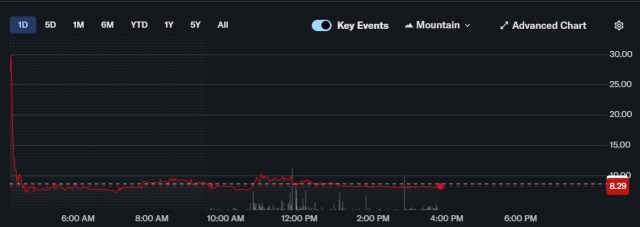
CoinShares stock price crash on Wednesday following its debut. Source: Yahoo Finance

Major crypto tokens such as Bitcoin (BTC) and Ethereum (ETH) have struggled to mount sustainable rallies during the same period, putting additional pressure on firms focused on crypto products.

CoinShares CEO Jean‐Marie Mognetti pushed back against reading too much into the market’s initial reaction. Speaking to Barron’s, he said the company’s US listing was driven by readiness rather than market convenience.

“We are not listing because the market is easy. We are listing because the business is ready, and that’s much more important,” Mognetti said, stressing the company’s long‐term strategy over short‐term share price movements.

deSPACs Average 60% Drop In Year One

CoinShares’ US listing is structured as a deSPAC — the operating company formed after a Special Purpose Acquisition (SPAC) merger — and deSPACs have generally performed poorly post‐deal.

Data compiled by SPAC Research and cited by Jay Ritter, director of the IPO Initiative at the University of Florida, show that deSPACs have fallen on average about 60% in the 12 months following their mergers over the last five years.

In his conversation with Barron’s, Mognetti framed the SPAC route as a regulatory and practical choice to facilitate the company’s cross‐border listing rather than as an urgent need for liquidity.

He also told reporters he remains untroubled by the initial market sell‐off and urged patience: “Give us time to just put real numbers out. The market will decide after that.”

The daily chart shows the total crypto market cap at $2.33 trillion. Source: TOTAL on TradingView.com

Featured image from OpenArt, chart from TradingView.com

Criptomoedas em alta

Perguntas relacionadas

QWhat was the main reason for the 25% drop in CoinShares' stock on its US debut according to the article?

AThe sharp sell-off reflected broader turbulence in digital-asset stocks, tied to geopolitical tensions in the Middle East and rising oil prices, which have caused months of heightened volatility.

QHow did CoinShares CEO Jean-Marie Mognetti respond to the poor initial market performance?

AMognetti pushed back against reading too much into the initial reaction, stating the listing was driven by business readiness, not market convenience, and urged patience, emphasizing the company's long-term strategy over short-term price movements.

QWhat type of transaction was used for CoinShares' US listing and how have similar transactions historically performed?

AThe listing was structured as a deSPAC (the company formed after a SPAC merger). Data shows that deSPACs have fallen an average of about 60% in the 12 months following their mergers over the last five years.

QWhat was the total valuation of CoinShares following its merger with Vine Hill Capital?

AThe transaction valued the business at approximately $1.2 billion.

QWhat major cryptocurrencies were mentioned as struggling to mount sustainable rallies, adding pressure on crypto-focused firms?

ABitcoin (BTC) and Ethereum (ETH) were mentioned as struggling to mount sustainable rallies during the same period.

Leituras Relacionadas

From South Korea to the United States: Blue-Collar Jobs Are Becoming Increasingly Popular, Thanks to AI

AI is reshaping the labor market's value proposition. The traditional four-year college degree is losing its appeal as a guaranteed career path, while skilled blue-collar trades like electricians, welders, and plumbers are experiencing historic demand and wage premiums. This shift is driven by dual pressures: AI's displacement of certain white-collar roles and a booming need for physical infrastructure and data center construction. Data confirms the trend. In the U.S., vocational school revenue surged, and a significant portion of recent layoffs are AI-related. Surveys show a majority of Gen Z adults plan to pursue blue-collar work, citing better job security against AI automation. Vocational education interest has exploded recently. Experts cite a psychological shift as younger generations seek tangible, AI-resistant careers and avoid high student debt. In many cases, salaries for skilled trades now match or exceed those requiring a bachelor's degree. In South Korea, semiconductor vocational high schools boast near-total employment, with graduates securing high-paying roles at companies like Samsung. The shortage is structural, exacerbated by a retiring baby boomer workforce and massive infrastructure projects. Companies like JPMorgan Chase, Meta, and Lowe's are investing heavily in training programs. However, overcoming historical stigma and a "perception gap" around trade careers remains a key challenge to closing the talent gap.

marsbitHá 1h

From South Korea to the United States: Blue-Collar Jobs Are Becoming Increasingly Popular, Thanks to AI

marsbitHá 1h

Qualcomm: AI Hype Subsides, When Will Smartphones Emerge from the Gloom?

Qualcomm reported its Q3 FY2026 results (ending June 2026), with revenue of $9.95B, down 4% YoY but above expectations. Gross margin declined to 53.1%, pressured by rising costs across manufacturing and memory. Key business segments showed mixed performance: Handset revenue fell 19.6% YoY to $5.09B, dragged by an 11% decline in non-Apple Android shipments and weaker high-end mix. Conversely, Automotive revenue surged 61% to $1.59B, and IoT grew 9% to $1.83B. Core operating profit dropped 41% YoY due to margin compression and higher expenses. Management's Q4 FY2026 guidance projects revenue of $9.7B-$10.5B, in line with consensus, but Non-GAAP EPS guidance of $2.05-$2.25 fell short of expectations. Amidst persistent weakness in its core handset market, Qualcomm is pursuing growth in AI, focusing on Edge AI (smartphones, PCs, automotive) and Data Center AI. Its data center strategy includes four pillars: AI accelerators (e.g., AI200), commercial CPUs (Dragonfly C1000), custom silicon, and connectivity solutions. While these initiatives initially boosted its stock, concerns over AI capital expenditure sustainability have since erased those gains. The company targets $5B in data center revenue for FY2027 and $15B for FY2029. The report concludes that with the traditional handset business still under pressure, the data center opportunity is currently viewed as a longer-term option, and a more conservative valuation based on core operations may be warranted until AI contributions materialize.

marsbitHá 1h

Qualcomm: AI Hype Subsides, When Will Smartphones Emerge from the Gloom?

marsbitHá 1h

From TPU to Self-Evolving Agents: How Jeff Dean Predicts the Next Step in AI

At the 2026 YC Startup School, Jeff Dean outlined his vision for AI's next phase, shifting focus from simply scaling models to building intelligent, autonomous systems. He believes AI's progress is no longer just about creating smarter models, but about integrating them into systems capable of long-term, iterative work, automated experimentation, and continuous learning. This evolution moves the competition from "who has the bigger model" to "who can best organize intelligence." Dean suggests AI capabilities are now comparable to a junior engineer, enabling the automation of complex workflows. However, the true challenge and opportunity lie in managing these AI "workers" at scale. He emphasizes the importance of **context engineering**—structuring tools, memory, and feedback loops—over raw model power. For startups, this means building deep expertise in niche domains where general models currently fail (near 0-1% success rates), leveraging proprietary data, specialized tools, and domain-specific evaluators. A recurring theme is re-examining fundamental constraints. Dean's past work, like moving Google's search index to memory or creating the TPU, stemmed from questioning outdated assumptions about hardware and cost. He sees similar inflection points today, particularly in **specialized inference hardware** to drastically reduce latency and energy consumption for real-time Agent operation. Notably, he points out that in modern AI systems, the dominant cost is often not computation but **data movement**. Reliable, long-running Agents require robust system design, borrowing concepts from distributed computing like checkpointing, state management, and parallel exploration to handle failures and maintain progress over days or weeks. As AI automates execution, the scarcest human skills will shift to **defining clear specifications**, **judging what problems are worth solving** (taste), and designing effective feedback loops. Ultimately, Dean's framework prioritizes understanding the problem deeply, identifying the true bottlenecks, and systematically building closed-loop systems where AI can not only perform tasks but also improve AI itself.

marsbitHá 1h

From TPU to Self-Evolving Agents: How Jeff Dean Predicts the Next Step in AI

marsbitHá 1h

Trading

Spot

Artigos em Destaque

Como comprar ONE

Bem-vindo à HTX.com!Tornámos a compra de Harmony (ONE) simples e conveniente.Segue o nosso guia passo a passo para iniciar a tua jornada no mundo das criptos.Passo 1: cria a tua conta HTXUtiliza o teu e-mail ou número de telefone para te inscreveres numa conta gratuita na HTX.Desfruta de um processo de inscrição sem complicações e desbloqueia todas as funcionalidades.Obter a minha contaPasso 2: vai para Comprar Cripto e escolhe o teu método de pagamentoCartão de crédito/débito: usa o teu visa ou mastercard para comprar Harmony (ONE) instantaneamente.Saldo: usa os fundos da tua conta HTX para transacionar sem problemas.Terceiros: adicionamos métodos de pagamento populares, como Google Pay e Apple Pay, para aumentar a conveniência.P2P: transaciona diretamente com outros utilizadores na HTX.Mercado de balcão (OTC): oferecemos serviços personalizados e taxas de câmbio competitivas para os traders.Passo 3: armazena teu Harmony (ONE)Depois de comprar o teu Harmony (ONE), armazena-o na tua conta HTX.Alternativamente, podes enviá-lo para outro lugar através de transferência blockchain ou usá-lo para transacionar outras criptomoedas.Passo 4: transaciona Harmony (ONE)Transaciona facilmente Harmony (ONE) no mercado à vista da HTX.Acede simplesmente à tua conta, seleciona o teu par de trading, executa as tuas transações e monitoriza em tempo real.Oferecemos uma experiência de fácil utilização tanto para principiantes como para traders experientes.

413 Visualizações TotaisPublicado em {updateTime}Atualizado em 2026.06.02

Como comprar ONE

Discussões

Bem-vindo à Comunidade HTX. Aqui, pode manter-se informado sobre os mais recentes desenvolvimentos da plataforma e obter acesso a análises profissionais de mercado. As opiniões dos utilizadores sobre o preço de ONE (ONE) são apresentadas abaixo.

活动图片













