Coinbase to debut prediction markets, tokenized stocks on Dec. 17: Report

cointelegraphPublicado em 2025-12-12Última atualização em 2025-12-12

Resumo

Coinbase, the largest US crypto exchange, is reportedly launch prediction markets and tokenized stocks on December 17, according to a Bloomberg report. The announcement will coincide with a livestream event to showcase new products. This follows earlier reports that Coinbase was preparing landing pages for these offerings in partnership with prediction market operator Kalshi. On the same day as the report, Coinbase joined the Coalition for Prediction Markets (CPM), a group announced by Kalshi and Crypto.com. The prediction market sector is experiencing significant growth, with weekly volumes reaching nearly $4 billion recently. Rival exchanges, including Crypto.com and the CFTC-approved Gemini, are also expanding into this space.

Coinbase, the largest US crypto exchange by trading volume, is days away from officially unveiling its push into prediction markets and tokenized stocks, according to Bloomberg.

Coinbase plans to announce that next week it will launch prediction markets and tokenized equities, Bloomberg reported on Thursday, citing anonymous sources familiar with the matter.

The exchange will hold a Dec. 17 livestream to showcase new products, though the report says it hasn’t disclosed whether prediction markets and tokenized stocks will be among them.

The news comes nearly a month after tech researcher Jane Manchun Wong reported that Coinbase was preparing landing pages for tokenized equities and Kalshi-provided prediction markets. However, the company has yet to officially release the products.

Coinbase enters a prediction market coalition with Kalshi

Bloomberg’s report came on the same day Coinbase became a member of the Coalition for Prediction Markets (CPM), a group of prediction market operators announced by Kalshi and Crypto.com.

“At Coinbase, our mission is to deliver financial freedom to the world — and prediction markets by nature democratize fact finding and the seeking of truth,” Coinbase’s chief policy officer Faryar Shizad said.

He also underscored the CPM’s ambition to engage with policymakers to ensure continued access to these markets for people in the US.
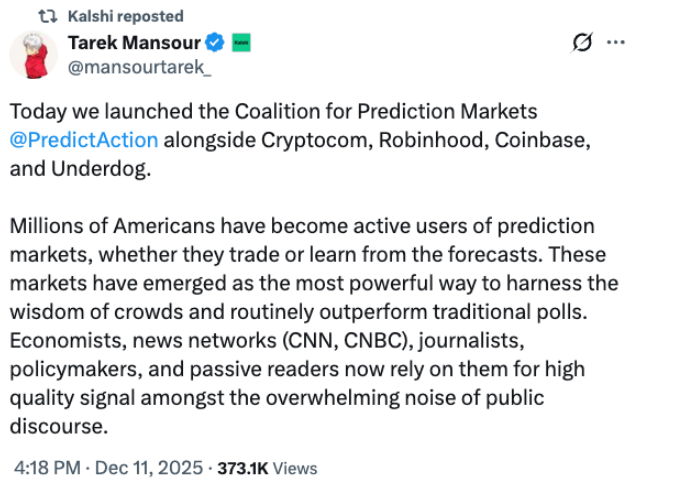
Source: Tarek Mansour

Founded in 2018 by MIT graduates Tarek Mansour and Luana Lopes Lara, Kalshi enables users to trade outcomes on real-world events just like financial assets.

The platform has emerged as a major prediction market operator alongside rivals such as Polymarket and Opinion, with weekly trading volumes of about $1 billion, according to Dunedata figures on Dune Analytics.

Coinbase’s push into prediction markets comes amid a boom in the sector, with weekly trading volumes hitting a record last week near $4 billion, though some experts have questioned the accuracy of the reported figures.
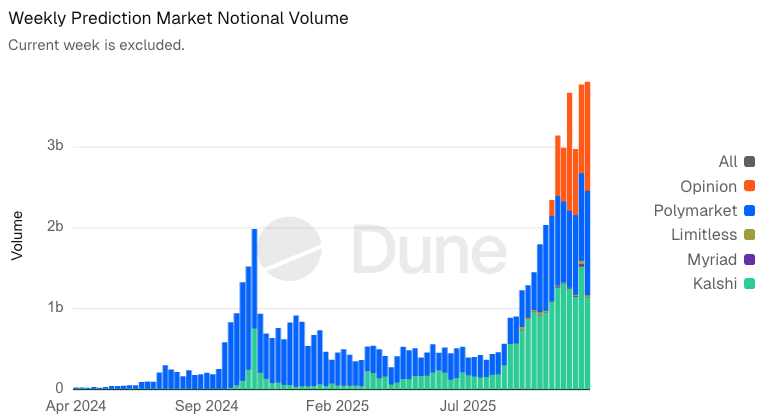
Weekly trading volumes on prediction markets. Source: Dune

Rival exchanges have been racing to roll out prediction markets, with Crypto.com in October announcing a dedicated platform set for integration with Trump Media.

Related: CFTC gives prediction markets leeway on data and record-keeping rules

On Wednesday, the Winklevoss twins-founded exchange Gemini scored approval from the Commodity Futures Trading Commission to offer prediction markets in the US.

Cointelegraph approached Coinbase for comment regarding its prediction markets and tokenized securities push, but had not received a response by publication.



Criptomoedas em alta

Leituras Relacionadas

Olympus DAO Myth Reappears? A "Sovereign On-Chain Central Bank" Written with 4000 Lines of Immutable Code

A new project called The Standard Reserve has emerged, branding itself as a "sovereign on-chain central bank." It aims to replicate core central bank functions—currency issuance, money supply adjustment, and reserve accumulation—entirely through 4,000 lines of immutable code, with no human governance. Its core mechanism is a "reflexive monetary policy" based on a single signal: the net ETH flow into or out of the system's sole Uniswap v4 ETH/$STANDARD pool. Sustained net ETH inflows trigger an "expansion" phase, increasing $STANDARD issuance and using protocol fees to buy tokenized gold as a permanent hard reserve. Net outflows (or zero flow) trigger an immediate "contraction" phase, reducing issuance and using fees to buy back and burn $STANDARD. The system involves six key entities: the $STANDARD token (hard-capped at 1 billion), the central Uniswap pool, the Central Bank contract, Charter NFTs (acting as "banking licenses"), Branch units under each Charter (which earn a share of newly minted $STANDARD), and separate Vaults for expansion (buying gold) and contraction (buying back $STANDARD). To participate, users ideally acquire a Founding Charter NFT (initially 1,000 are free via allowlist/public mint). Each Charter comes with one Branch; more can be opened by burning $STANDARD for "expansion permits," increasing revenue share. Retiring a Branch lets users claim accumulated $STANDARD but imposes a dynamic exit fee (higher if many exit simultaneously), with half the fee burned and half distributed to remaining participants. All protocol revenue (from pool fees and Charter auctions) is allocated: 70% to the active Vault (for gold or buybacks), 15% to permanent protocol-owned liquidity, and 15% to the team. The project presents an innovative, game-theoretic model where user actions (expanding Branches by burning tokens or exiting) align with system goals of building reserves or inducing deflation. However, it is fully anonymous, with key parameters undefined and unaudited code, posing significant risks.

marsbitHá 5m

Olympus DAO Myth Reappears? A "Sovereign On-Chain Central Bank" Written with 4000 Lines of Immutable Code

marsbitHá 5m

US Jobs, China PMI, and Inflation on Stage: Can Global Growth Maintain Resilience?

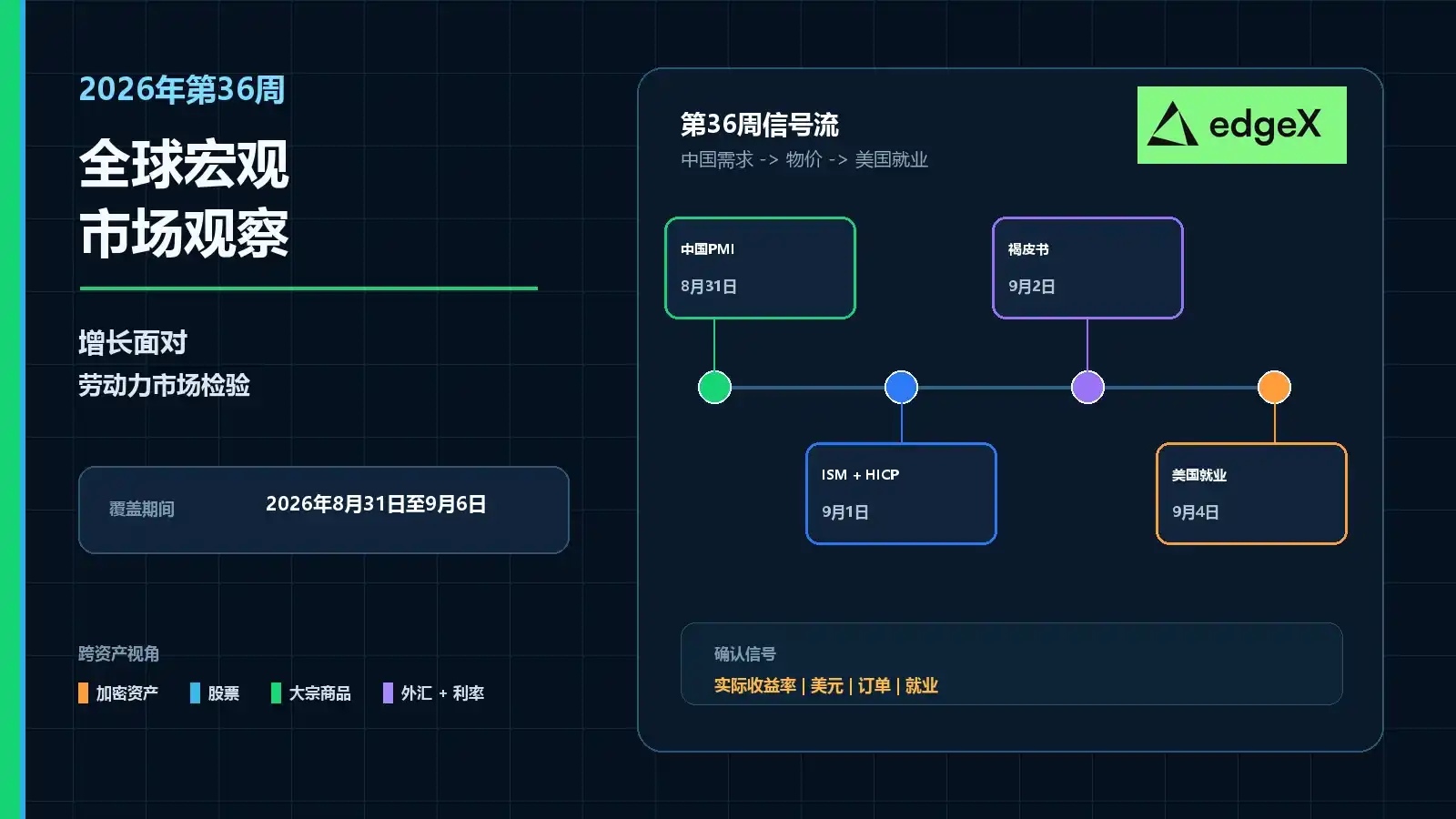
**Week 36 Macro Outlook: Key Data to Test Global Growth Resilience** The week from August 31 to September 6 will shift focus from policy discussions to a critical test of global economic activity. The sequence of events is key, starting with China's official August PMI on Aug 31, which will provide early signals on factory orders, services, and employment following July's contraction. The data flow then broadens. On September 1, US ISM Manufacturing PMI and the Eurozone's flash inflation estimate will offer simultaneous checks on demand, prices, and regional divergence. The subsequent US Federal Reserve Beige Book on September 2 adds granular, qualitative evidence on consumer spending, wages, and regional conditions. Australian Q2 GDP and Canadian trade and jobs data will test resilience in other major economies. The week's pivotal event, however, is the US August employment report on September 4. It will decisively influence expectations for interest rates, the US dollar, and broader risk appetite, acting as a final cross-check for the preceding data. The core question for markets is whether global growth can remain resilient. An ideal outcome would combine a rebound in China's PMI, stable US jobs growth, cooling inflation, and signs of a gradual demand slowdown. Conversely, weak Chinese manufacturing, sticky Eurozone prices, and disappointing US non-farm payrolls would create a more complex scenario of reduced corporate confidence and limited room for aggressive monetary easing, increasing pressure on cyclical assets. Investors should monitor the breadth of improvements—such as new orders and employment—rather than headline PMI figures alone. Confirmation across different data points is crucial. A positive combination of steady activity and disinflation could support equities, industrial commodities, and risk assets like crypto. However, if a growth slowdown triggers lower yields, it must be distinguished from a scenario of rising recession risks that would pressure corporate earnings, potentially limiting rallies. The market's final reaction will hinge on whether the week's signals align to either reinforce or challenge the current growth narrative.

marsbitHá 7m

US Jobs, China PMI, and Inflation on Stage: Can Global Growth Maintain Resilience?

marsbitHá 7m

Trading

Spot

Artigos em Destaque

Como comprar US

Bem-vindo à HTX.com!Tornámos a compra de Talus Network (US) simples e conveniente.Segue o nosso guia passo a passo para iniciar a tua jornada no mundo das criptos.Passo 1: cria a tua conta HTXUtiliza o teu e-mail ou número de telefone para te inscreveres numa conta gratuita na HTX.Desfruta de um processo de inscrição sem complicações e desbloqueia todas as funcionalidades.Obter a minha contaPasso 2: vai para Comprar Cripto e escolhe o teu método de pagamentoCartão de crédito/débito: usa o teu visa ou mastercard para comprar Talus Network (US) instantaneamente.Saldo: usa os fundos da tua conta HTX para transacionar sem problemas.Terceiros: adicionamos métodos de pagamento populares, como Google Pay e Apple Pay, para aumentar a conveniência.P2P: transaciona diretamente com outros utilizadores na HTX.Mercado de balcão (OTC): oferecemos serviços personalizados e taxas de câmbio competitivas para os traders.Passo 3: armazena teu Talus Network (US)Depois de comprar o teu Talus Network (US), armazena-o na tua conta HTX.Alternativamente, podes enviá-lo para outro lugar através de transferência blockchain ou usá-lo para transacionar outras criptomoedas.Passo 4: transaciona Talus Network (US)Transaciona facilmente Talus Network (US) no mercado à vista da HTX.Acede simplesmente à tua conta, seleciona o teu par de trading, executa as tuas transações e monitoriza em tempo real.Oferecemos uma experiência de fácil utilização tanto para principiantes como para traders experientes.

580 Visualizações TotaisPublicado em {updateTime}Atualizado em 2026.06.02

Como comprar US

Discussões

Bem-vindo à Comunidade HTX. Aqui, pode manter-se informado sobre os mais recentes desenvolvimentos da plataforma e obter acesso a análises profissionais de mercado. As opiniões dos utilizadores sobre o preço de US (US) são apresentadas abaixo.

活动图片