Coinbase Targets Crypto Crime, Freezing $3M Linked To Scam Operations

bitcoinistPublicado em 2026-06-05Última atualização em 2026-06-05

Resumo

Coinbase froze over $3 million in cryptocurrency linked to Southeast Asian scam networks as part of a multi-agency "Disruption Week" campaign. The operation, coordinated by the DOJ's Scam Center Strike Force, involved companies like Meta, Microsoft, and Starlink, and disrupted over 1.4 million scam accounts. The DOJ noted that investment fraud, including "pig butchering" scams, is among the fastest-growing threats, with crypto-related scams causing billions in losses. This action follows other recent crackdowns targeting scam infrastructure globally. Coinbase highlighted that blockchain provides a permanent transaction record, aiding investigations and countering the narrative that crypto is solely a tool for crime.

Coinbase moved to freeze more than $3 million in crypto linked to scam networks operating across Southeast Asia, a move that came as US authorities and private firms widened a joint campaign against fraud rings that have drained billions from Americans. The freeze was announced during Disruption Week, a coordinated push led by the DOJ’s Scam Center Strike Force.

Multi-Agency Push

According to Coinbase, the effort pulled in government agencies and private companies to hit the fraud chain at several points at once, from online accounts to money flows and physical sites. The exchange said no single company or agency could stop the crews on its own.

The company said the work involved social platforms, financial institutions, connectivity providers, and law enforcement working together, while the Justice Department framed the action as part of a broader strike against Southeast Asian criminal organizations. Officials said those groups have defrauded Americans of billions of dollars.
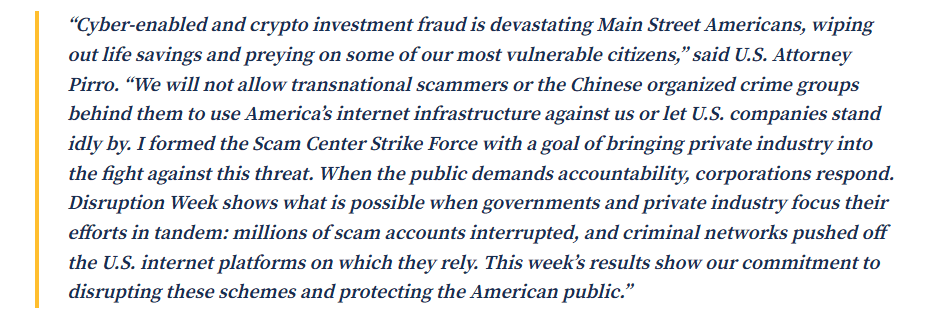
Source: US DOJ

Accounts, Servers, And Arrests

Meta, Microsoft, and Starlink were among the private firms named in the operation, helping take down servers and other hosting tools linked to the scam networks. Authorities also said more than 1.4 million social media and email accounts were disrupted, and the Royal Thai Police Anti-Cyber Scam Center made arrests tied to the effort.

The scam pattern is familiar, but the scale keeps climbing. The DOJ said investment fraud and pig butchering remain among the fastest-growing and most damaging scams aimed at Americans, and the FBI reported earlier this month that losses from crypto- and AI-related scams in 2025 topped $11 billion, with investment scams causing the most damage.

Total crypto market cap currently at $2.15 trillion. Chart: TradingView

Another part of the same push came in April, when the Scam Center Strike Force and its partners restrained more than $701 million in crypto tied to investment scams. Authorities have also carried out other crackdowns this year, including actions in Dubai and Albania, as pressure on scam infrastructure spread beyond Southeast Asia.

Crypto’s Place In The Crackdown

Coinbase also argued that blockchain gives investigators a permanent record of transactions, a point it used to push back on the idea that crypto is only a tool for crime. The coalition behind the operation included the FBI, the US Secret Service, and law enforcement partners in the UK, Australia, Canada, New Zealand, and Thailand.

The latest freeze fits a pattern of steady pressure on scam centers rather than one-off arrests. Officials have kept aiming at websites, messaging channels, servers, and the money trail itself, hoping to cut off the machinery that lets these fraud rings keep running.

Featured image from Unsplash, chart from TradingView

Perguntas relacionadas

QAccording to the article, how much cryptocurrency did Coinbase freeze that was linked to Southeast Asian scam networks?

ACoinbase moved to freeze more than $3 million in crypto linked to scam networks operating across Southeast Asia.

QWhat was the name of the coordinated law enforcement push during which this crypto freeze was announced?

AThe freeze was announced during Disruption Week, a coordinated push led by the DOJ's Scam Center Strike Force.

QWhich private companies were named as helping to take down servers linked to the scam networks?

AMeta, Microsoft, and Starlink were among the private firms named in the operation, helping take down servers and other hosting tools linked to the scam networks.

QWhat does the FBI report say about total losses from crypto- and AI-related scams in 2025?

AThe FBI reported earlier this month that losses from crypto- and AI-related scams in 2025 topped $11 billion, with investment scams causing the most damage.

QHow does Coinbase argue that blockchain technology can assist in fighting crime, according to the article?

ACoinbase argued that blockchain gives investigators a permanent record of transactions, pushing back on the idea that crypto is only a tool for crime.

Leituras Relacionadas

BIT Research: The 2028 Halving Is Not the End, the Real Shake-Up of the Bitcoin Mining Industry Is Just Beginning

The Bitcoin mining industry is undergoing its most complex structural adjustment since inception. Despite Bitcoin's price holding near $61,000 and the network hash rate approaching a record 1 ZH/s, miner profitability is deteriorating. The industry is operating close to its breakeven point, with the 2028 halving expected to accelerate consolidation. The challenges extend beyond the halving's subsidy reduction; the industry's revenue model has yet to successfully transition towards a fee-driven structure. Increasingly, mining companies are evolving from simple Bitcoin producers into infrastructure and energy operators, including providers of AI/HPC computing power. Competition is shifting from pure hash rate expansion to business model upgrades. Economic pressure is evident. The theoretical daily mining revenue at current prices is around $78 million, yet the actual figure is only about $33 million—a 136% gap. Transaction fees remain low at roughly $220k daily, far below historical implied levels. With a current estimated industry-wide breakeven price near $65,000, mining alone is struggling to generate ideal profits. The 2028 halving is projected to push the fundamental production cost floor to approximately $93,289. This will likely accelerate a shift towards consolidation among larger, well-capitalized miners with diversified revenue streams. Competitive advantage will belong to institutionalized players with access to low-cost energy, AI/HPC hosting operations, and stronger balance sheets. In essence, Bitcoin mining is transitioning from a "mining business" to an "infrastructure business." Future profitability and resilience will depend less on block rewards and more on diversified income sources like energy management and computational infrastructure services. For investors, the key question is not the halving itself, but which miners can successfully navigate this business model transformation.

marsbitHá 36m

BIT Research: The 2028 Halving Is Not the End, the Real Shake-Up of the Bitcoin Mining Industry Is Just Beginning

marsbitHá 36m

This is How God Karpathy Uses Claude?

Andrej Karpathy, a prominent figure in AI, has reportedly joined Anthropic, leading to a noticeable decrease in his open-source contributions and social media activity. A document claiming to be his personal "CLAUDE.md" file—a set of instructions for the Claude AI to follow within a specific codebase—has been circulating online. While its authenticity is unverified, the content aligns closely with Karpathy's publicly shared principles on effective AI-assisted programming. The document outlines key rules for AI coding assistants, emphasizing the importance of reading existing code thoroughly before writing new code to maintain consistency. It advises against over-engineering, advocating for simple, surgical modifications that match the project's existing style. Other guidelines include clarifying assumptions upfront, writing meaningful tests, thoughtful debugging, and carefully considering dependencies. The core message is that these principles help prevent common AI coding failures, such as introducing unnecessary abstractions, style drift, or making invisible architectural decisions. The community has noted that even experts like Karpathy require detailed instructions to guide AI effectively, akin to managing a junior developer. A related GitHub repository, "andrej-karpathy-skills," which encapsulates these ideas, is reported to significantly reduce Claude's code error rate. Ultimately, the advice stresses that the best CLAUDE.md is tailored to one's own tech stack and coding practices.

marsbitHá 36m

This is How God Karpathy Uses Claude?

marsbitHá 36m

Trading

Spot
活动图片