Coinbase Stock Slides 4.3% as Nevada Gaming Regulator Targets Unlicensed Sports Betting Contracts

bitcoinistPublicado em 2026-02-05Última atualização em 2026-02-05

Resumo

Coinbase shares declined 4.3% as Nevada gaming regulators filed a civil complaint against the company, alleging its prediction market products constitute unlicensed sports betting. The state seeks to halt these markets, arguing they fall under Nevada's gambling laws rather than federal derivatives regulation. Coinbase, which partners with CFTC-regulated Kalshi, maintains the products are legal derivatives. The action adds to regulatory pressures on Coinbase, which has seen an 11-session stock decline amid legal uncertainties and a recent data breach. The company is challenging similar state-level actions in other jurisdictions, claiming exclusive CFTC oversight.

Coinbase shares continued their recent decline after Nevada regulators moved to block the crypto exchange’s prediction market products, adding another layer of legal uncertainty for the company.

The enforcement action highlights a growing conflict between state gaming authorities and platforms offering event-based contracts that resemble sports betting, even when those products operate under federal oversight.

On Monday, the Nevada Gaming Control Board filed a civil enforcement complaint against Coinbase Financial Markets in Carson City. Regulators are seeking a temporary restraining order and a permanent injunction to stop Coinbase from offering prediction markets tied to sports and elections within the state.

The board argues that these contracts amount to unlicensed gambling under Nevada law and should fall under state gaming authority rather than federal derivatives regulation.
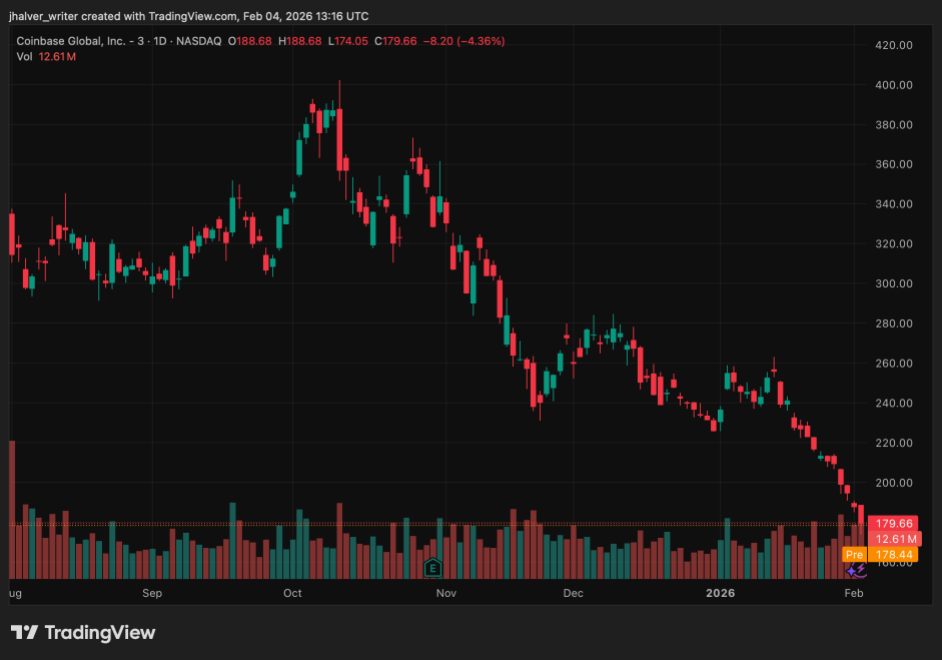
COIN's price trends to the downside on the daily chart. Source: COINUSD on Tradingview

Nevada Challenges Coinbase’s Prediction Markets

Coinbase launched its US prediction markets last month through a partnership with Kalshi, a Commodity Futures Trading Commission-regulated designated contract market.

The exchange maintains that these event-based contracts are federally regulated derivatives, not gambling products. Nevada officials disagree, saying contracts linked to sporting outcomes and elections constitute wagering activity and therefore require state gaming licenses.

In its filings, the board also raised concerns about age restrictions, noting that Coinbase allows users aged 18 and older to trade event contracts, below Nevada’s legal gambling age of 21.

Regulators said the platform’s continued operation creates ongoing harm and gives Coinbase an unfair advantage over licensed sportsbooks that must meet strict compliance, tax, and location requirements.

The action against Coinbase follows similar moves by Nevada against other prediction market platforms. A state court recently granted a temporary restraining order blocking Polymarket from offering event-based contracts to Nevada residents.

Legal Pressure Weighs on Coinbase Stock

The Nevada lawsuit has added to broader pressure on Coinbase shares. The stock fell 4.36% on Wednesday, extending its losing streak to eleven consecutive sessions and pushing it to its lowest level since April.

Investor sentiment has been weighed down by regulatory risks and a recent disclosure of an insider-related data breach affecting roughly 30 clients.

Coinbase has pushed back against state-level actions elsewhere, filing federal lawsuits against gaming regulators in Connecticut, Michigan, and Illinois. The company argues that prediction markets fall exclusively within the CFTC’s jurisdiction and that state enforcement efforts unlawfully restrict federally regulated products.

Cover image from ChatGPT, COINUSD chart on Tradingview

Perguntas relacionadas

QWhy did the Nevada Gaming Control Board file a complaint against Coinbase?

AThe Nevada Gaming Control Board filed a complaint because it argues that Coinbase's prediction market products tied to sports and elections constitute unlicensed gambling under Nevada law and should be regulated by the state gaming authority, not as federal derivatives.

QWhat is the impact of the Nevada enforcement action on Coinbase's stock?

AThe Nevada lawsuit contributed to a 4.36% decline in Coinbase's stock on Wednesday, extending its losing streak to eleven consecutive sessions and pushing it to its lowest level since April.

QHow does Coinbase defend its prediction market products against state regulators?

ACoinbase maintains that its event-based contracts are federally regulated derivatives overseen by the CFTC, not gambling products, and it has filed federal lawsuits arguing that state enforcement efforts unlawfully restrict these federally regulated products.

QWhat specific concerns did Nevada regulators raise about Coinbase's platform besides licensing?

ANevada regulators raised concerns about age restrictions, noting that Coinbase allows users aged 18 and older to trade, which is under Nevada's legal gambling age of 21, and that it gives Coinbase an unfair advantage over licensed sportsbooks that must meet strict compliance requirements.

QHas Nevada taken similar actions against other prediction market platforms besides Coinbase?

AYes, the Nevada Gaming Control Board has taken similar action against other platforms. A state court recently granted a temporary restraining order blocking Polymarket from offering event-based contracts to Nevada residents.

Leituras Relacionadas

US Stock Market Trend (June 16): SpaceX Rises 42% in Two Days, New Fed Chairman Takes Office Today

**U.S. Stocks Trend (June 16): SpaceX Soars 42% in Two Days, New Fed Chair Takes Office Today** Markets surged on Monday following former President Trump's social media announcement of a completed U.S.-Iran deal to reopen the Strait of Hormuz, pending a June 19 signing. The news triggered a broad risk-on rally: oil prices crashed, tech stocks soared, bond yields fell, and defensive sectors lagged. **Market Performance:** The Nasdaq jumped 3.07%, led by semiconductor stocks like Micron (+9.2%). The S&P 500 gained 1.65%, and the Dow rose 0.92% to a record high. However, the Russell 2000 small-cap index underperformed (+0.72%). SpaceX continued its hot streak, rising another 5% pre-market after disclosures of large buys by an Australian billionaire and Cathie Wood's ARK. Boeing also rallied on the transportation optimism. Conversely, energy stocks like Chevron fell over 3% on the oil price plunge, with other defensive sectors also selling off. The day's action showed a clear rotation of funds from energy/defensive plays into AI and tech narratives. **Macro & Outlook:** The VIX fear index fell 8.37%. Treasury yields declined, and WTI crude dropped over 5%. Attention now shifts to a packed schedule: the Bank of Japan is widely expected to hike rates to 1.0% on Tuesday. The Fed's June meeting concludes Wednesday, marking new Chair Wash's debut. While rates are expected to hold, his tone on stubborn inflation and the "dot plot" will be crucial for gauging the 2024 rate path. The formal Iran deal signing is set for Friday. **Trend Perspective:** While the peace deal is a genuine positive, Monday's explosive rally may have gotten ahead of itself, pricing in a swift resolution to inflation concerns. The shortened trading week faces a triple test: BoJ tightening, the Fed's policy stance, and deal implementation details. Tech and semiconductors, which led the surge, remain vulnerable to any disappointment from these key events. The real price discovery begins with the central banks' communications this week.

marsbitHá 22m

US Stock Market Trend (June 16): SpaceX Rises 42% in Two Days, New Fed Chairman Takes Office Today

marsbitHá 22m

Xiaohongshu's Second Great Voyage, This Time Sailing Towards AI

Xiaohongshu's Second Voyage: Navigating Towards AI Since ChatGPT's emergence, Xiaohongshu's founder Mao Wenchao has been acutely aware of AI's potential threat, recognizing that the life advice people seek from chatbots overlaps directly with his platform's core business. Founded in 2013 as a PDF shopping guide for Chinese tourists, Xiaohongshu evolved into a massive community where millions share authentic, personal experiences—from product reviews to travel tips. This vast repository of "I've tried this" human judgment became its most valuable asset. However, the rise of AI, which delivers instant answers, challenges the very need for users to sift through numerous personal notes. Fearing its treasure trove of lived experience could become mere training data for others, Xiaohongshu is proactively adapting. In 2026, it established a dedicated AI division (Dots), launched RED Skill to turn user experiences into usable AI tools, and acquired the AI search product "Diandian." Its investments now extend to AI firms like MiniMax and hardware startups, moving upstream to address needs before they even become search queries. The platform's commercialization strategy is also evolving. With a newly acquired payment license and tools like the AIPS model to track consumer decision journeys, Xiaohongshu aims to seamlessly integrate recommendations with transactions, embedding commerce within AI-generated answers. Yet, a critical tension remains. While building smarter machines to organize and leverage its human experiences, Xiaohongshu must prevent AI from drowning out the authentic, flawed, and trustworthy "I've tried this" voices that built its community. Its core challenge is to harness AI's power without letting the map—the machine's perfect, synthesized answer—replace the territory of genuine human experience. This balance between technological advancement and preserving human trust defines its current journey and its future.

marsbitHá 55m

Xiaohongshu's Second Great Voyage, This Time Sailing Towards AI

marsbitHá 55m

SharpLink CEO: How to Understand Ethereum Developers Just Exceeded 1 Million?

SharpLink CEO reflects on the milestone of Ethereum surpassing 1 million historical developers, emphasizing that this figure represents the largest pool of technical talent ever assembled around an open, permissionless blockchain network. While approximately 232,000 developers remain active, the key question for the crypto industry is not which chain is fastest, but where the best builders choose to build long-term. Ethereum's advantage lies in a decade-long accumulation of infrastructure, standards, tools, liquidity, and a cohesive culture, making it the default operating system for programmable finance. This developer base is tackling complex challenges: the Glamsterdam upgrade aims to enhance scalability while preserving core principles; synchronous composability seeks to unify Rollup ecosystems; and significant efforts are underway for post-quantum security. Ethereum's deeper network effects stem from composability and shared standards (like the EVM and Solidity), creating a flywheel of more developers, tools, and liquidity. Three reinforcing strengths cement Ethereum's lead: credible neutrality (secured by ~900k validators), a modular architecture with interconnected Rollups, and a culture that attracts top researchers. The ecosystem is consolidating as the trusted coordination layer for internet-native finance, favored by large institutions valuing security and liquidity. The future of Ethereum is being built by this global community of founders and architects.

链捕手Há 1h

SharpLink CEO: How to Understand Ethereum Developers Just Exceeded 1 Million?

链捕手Há 1h

Trading

Spot
Futuros
活动图片