Coinbase Stock Slides 4.3% as Nevada Gaming Regulator Targets Unlicensed Sports Betting Contracts

bitcoinistPublicado em 2026-02-05Última atualização em 2026-02-05

Resumo

Coinbase shares declined 4.3% as Nevada gaming regulators filed a civil complaint against the company, alleging its prediction market products constitute unlicensed sports betting. The state seeks to halt these markets, arguing they fall under Nevada's gambling laws rather than federal derivatives regulation. Coinbase, which partners with CFTC-regulated Kalshi, maintains the products are legal derivatives. The action adds to regulatory pressures on Coinbase, which has seen an 11-session stock decline amid legal uncertainties and a recent data breach. The company is challenging similar state-level actions in other jurisdictions, claiming exclusive CFTC oversight.

Coinbase shares continued their recent decline after Nevada regulators moved to block the crypto exchange’s prediction market products, adding another layer of legal uncertainty for the company.

The enforcement action highlights a growing conflict between state gaming authorities and platforms offering event-based contracts that resemble sports betting, even when those products operate under federal oversight.

On Monday, the Nevada Gaming Control Board filed a civil enforcement complaint against Coinbase Financial Markets in Carson City. Regulators are seeking a temporary restraining order and a permanent injunction to stop Coinbase from offering prediction markets tied to sports and elections within the state.

The board argues that these contracts amount to unlicensed gambling under Nevada law and should fall under state gaming authority rather than federal derivatives regulation.
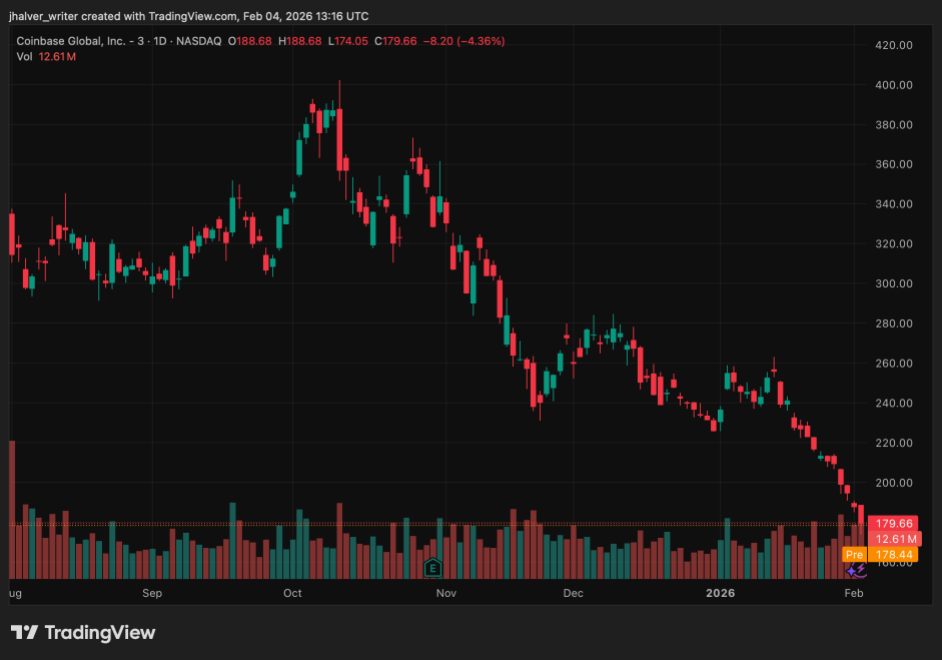
COIN's price trends to the downside on the daily chart. Source: COINUSD on Tradingview

Nevada Challenges Coinbase’s Prediction Markets

Coinbase launched its US prediction markets last month through a partnership with Kalshi, a Commodity Futures Trading Commission-regulated designated contract market.

The exchange maintains that these event-based contracts are federally regulated derivatives, not gambling products. Nevada officials disagree, saying contracts linked to sporting outcomes and elections constitute wagering activity and therefore require state gaming licenses.

In its filings, the board also raised concerns about age restrictions, noting that Coinbase allows users aged 18 and older to trade event contracts, below Nevada’s legal gambling age of 21.

Regulators said the platform’s continued operation creates ongoing harm and gives Coinbase an unfair advantage over licensed sportsbooks that must meet strict compliance, tax, and location requirements.

The action against Coinbase follows similar moves by Nevada against other prediction market platforms. A state court recently granted a temporary restraining order blocking Polymarket from offering event-based contracts to Nevada residents.

Legal Pressure Weighs on Coinbase Stock

The Nevada lawsuit has added to broader pressure on Coinbase shares. The stock fell 4.36% on Wednesday, extending its losing streak to eleven consecutive sessions and pushing it to its lowest level since April.

Investor sentiment has been weighed down by regulatory risks and a recent disclosure of an insider-related data breach affecting roughly 30 clients.

Coinbase has pushed back against state-level actions elsewhere, filing federal lawsuits against gaming regulators in Connecticut, Michigan, and Illinois. The company argues that prediction markets fall exclusively within the CFTC’s jurisdiction and that state enforcement efforts unlawfully restrict federally regulated products.

Cover image from ChatGPT, COINUSD chart on Tradingview

Perguntas relacionadas

QWhy did the Nevada Gaming Control Board file a complaint against Coinbase?

AThe Nevada Gaming Control Board filed a complaint because it argues that Coinbase's prediction market products tied to sports and elections constitute unlicensed gambling under Nevada law and should be regulated by the state gaming authority, not as federal derivatives.

QWhat is the impact of the Nevada enforcement action on Coinbase's stock?

AThe Nevada lawsuit contributed to a 4.36% decline in Coinbase's stock on Wednesday, extending its losing streak to eleven consecutive sessions and pushing it to its lowest level since April.

QHow does Coinbase defend its prediction market products against state regulators?

ACoinbase maintains that its event-based contracts are federally regulated derivatives overseen by the CFTC, not gambling products, and it has filed federal lawsuits arguing that state enforcement efforts unlawfully restrict these federally regulated products.

QWhat specific concerns did Nevada regulators raise about Coinbase's platform besides licensing?

ANevada regulators raised concerns about age restrictions, noting that Coinbase allows users aged 18 and older to trade, which is under Nevada's legal gambling age of 21, and that it gives Coinbase an unfair advantage over licensed sportsbooks that must meet strict compliance requirements.

QHas Nevada taken similar actions against other prediction market platforms besides Coinbase?

AYes, the Nevada Gaming Control Board has taken similar action against other platforms. A state court recently granted a temporary restraining order blocking Polymarket from offering event-based contracts to Nevada residents.

Leituras Relacionadas

Korean Youth, Making a 'Last Stand' in an Epic Bull Market

South Korea is experiencing an unprecedented stock market boom in the first half of 2026, with the KOSPI index doubling in six months, driven primarily by tech giants Samsung Electronics and SK Hynix. This "epic bull run," tied to the semiconductor cycle, has sparked a nationwide frenzy for stock trading. The country, with a population of just over 50 million, now has over 105 million securities accounts. The article, from the perspective of a Chinese national living in Seoul, explores how this speculative fever reflects deeper societal anxieties among Korean youth. Facing stagnant wages, high costs of living, housing pressures, and rigid social stratification, many young people see the volatile market as a "last chance" to alter their predetermined life trajectories and escape financial precarity. Stories include a young office worker investing her meager savings, a couple delaying marriage due to financial pressures, and a seasoned trader navigating exclusive social circles where market information is currency. However, the boom also exposes and exacerbates existing inequalities. While some achieve windfalls, others face devastating losses, with borrowing to invest reaching record highs. The narrative contrasts the illusion of equal opportunity with the harsh reality that the ability to absorb risk is unevenly distributed. Ultimately, the market frenzy is portrayed not as a solution, but as a symptom of a generation's struggle against a system offering limited upward mobility, where daily life is a precarious balance of bills, debts, and societal expectations.

marsbitHá 15m

Korean Youth, Making a 'Last Stand' in an Epic Bull Market

marsbitHá 15m

Young South Koreans, Making a 'Last-Ditch Effort' in an Epic Bull Market

This article explores how an unprecedented stock market boom in South Korea during the first half of 2026, driven by the semiconductor industry, is transforming the lives of ordinary people, particularly the youth. The KOSPI index doubled in six months, fueled by giants Samsung and SK Hynix, leading to a frenzy of retail investing. With over 105 million stock accounts in a population of just over 50 million, a sense of "FOMO" (fear of missing out) is pervasive. Through the perspective of Li Yuning, a Chinese woman living in Seoul, the piece follows several young Koreans who see the market as a last chance to escape stifling economic pressures, high housing costs, and narrow social mobility. Individuals like Minji, a low-paid office worker, and Junho, saving for marriage, invest their limited savings, while experienced traders like Suhu navigate exclusive social circles. The narrative reveals that this speculative fever stems less from greed and more from deep-seated anxiety about being left behind in a society with growing wealth inequality and rigid class structures. However, the boom also exposes stark social divides. It exacerbates wealth gaps, as those with family support or existing capital fare better. The pressure to succeed is immense, with stories of devastating losses leading to personal tragedy. Ultimately, the article suggests the牛市 acts as a pressure valve and a temporary illusion of opportunity in a system where traditional paths to advancement seem increasingly closed, leaving young people to gamble on the market as a final, desperate bid for a better future.

链捕手Há 21m

Young South Koreans, Making a 'Last-Ditch Effort' in an Epic Bull Market

链捕手Há 21m

Doubao Charges More than GPT, While DeepSeek Slashes Prices Dramatically: Who Will Win?

The article discusses the divergent pricing strategies of two major Chinese AI companies. In May, Doubao (by ByteDance) began testing fees, with its professional tier priced higher than ChatGPT Plus. Meanwhile, DeepSeek permanently cut prices for its V4-Pro API to a quarter of the original, setting new global lows. Doubao, with high user traffic from ByteDance apps like TikTok, leads in monthly active users but faces massive compute costs from its free model. Its move to a freemium model targets heavy users, aiming to balance scale and monetization amid substantial investments. DeepSeek's price cut is attributed to architectural innovations that slash inference costs, adaptation to domestic hardware reducing dependency, and engineering optimizations. It focuses on the enterprise (B2B) market, aiming to become a leading model base. Both companies are currently unprofitable. The article contrasts their approaches with Anthropic, which is profitable by primarily serving enterprises with high-value use cases like coding and agents. It argues that sustainable AI business models require integrating AI into real workflows to deliver tangible ROI, rather than just offering chat services. DeepSeek's recent $7 billion funding round, including investments from Tencent, is noted to bolster its B2B position. The ultimate winner will be the player that successfully transforms AI into measurable returns, whether through consumer productivity ecosystems or enterprise platforms.

marsbitHá 30m

Doubao Charges More than GPT, While DeepSeek Slashes Prices Dramatically: Who Will Win?

marsbitHá 30m

Promised Year of Crypto IPOs? Only One Went Public in Six Months, Down 70%

The much-anticipated wave of crypto IPOs in 2026 has failed to materialize, with market conditions worsening dramatically. While SpaceX prepares for the largest IPO in history, raising $75 billion at a $1.75 trillion valuation, the crypto sector faces a frozen pipeline. The sole crypto IPO success this year, BitGo, serves as a cautionary tale. After launching on the NYSE in January at $18, its stock has plummeted approximately 70%. Other major contenders have stalled or delayed. Kraken, which secretly filed in late 2025, has put its plans on ice, seeing its valuation drop 33% to $13.3 billion. Consensys has postponed its filing until autumn at the earliest, and Bitpanda is poised to miss its self-imposed H1 deadline for a Frankfurt listing. This widespread retreat is driven by a severe liquidity crunch. Bitcoin has fallen below $60,000, with capital being diverted to AI stocks and the massive SpaceX offering. The poor performance of earlier crypto listings like Gemini and the stagnant price of Coinbase further dampen investor appetite. A key underlying pressure is the impending US midterm elections in November, which could alter the currently favorable regulatory landscape. Companies had hoped to go public during this window of policy certainty, but challenging market dynamics have overridden those plans. The transparency that comes with being a public company is now seen as a potential liability rather than a benefit in a down market. The industry's fate now hinges on a few critical watchpoints: whether Kraken restarts its process in H2, if Consensys files in the fall, and if SpaceX's debut can revitalize market liquidity. Otherwise, the promised "crypto IPO year" will likely be pushed beyond the election.

marsbitHá 45m

Promised Year of Crypto IPOs? Only One Went Public in Six Months, Down 70%

marsbitHá 45m

Trading

Spot
Futuros
活动图片