Coinbase Posts $394 Million Loss In Q1 2026 — And The Worst May Not Be Over

bitcoinistPublicado em 2026-05-08Última atualização em 2026-05-08

Resumo

Coinbase reported a net loss of $394 million for Q1 2026, a sharp reversal from a $65.6 million profit a year ago. This missed analyst expectations as total revenue fell 30.5% to $1.41 billion, largely driven by a 23% decline in transaction revenue due to lower crypto trading volumes and prices. A significant factor was $482 million in unrealized losses on crypto holdings, primarily linked to Bitcoin's price drop. Excluding that, the adjusted net loss was $46 million. While subscription and services revenue remained strong at $584 million and adjusted EBITDA was positive, the results highlight the exchange's continued sensitivity to crypto market cycles. This follows recent workforce reductions and shows operating margin collapsing to -1.5%. The quarter underscores that despite its institutional standing, Coinbase's path to durable profitability remains tied to volatile crypto market conditions.

Coinbase reported a net loss of $394 million for the first quarter of 2026, swinging from a $65.6 million profit in the same period last year and missing Wall Street expectations on both revenue and earnings per share — as a sharp pullback in crypto prices and trading volumes hit the exchange’s core business harder than analysts had anticipated.

The results, reported by Bloomberg after market close on May 7, showed total revenue of $1.41 billion — a 30.5% year-over-year decline and a miss against the analyst consensus of approximately $1.51 billion. On a per-share basis, Coinbase posted a GAAP loss of $1.49 against expectations of a $0.29 profit — a significant miss that sent shares down roughly 4% in after-hours trading.
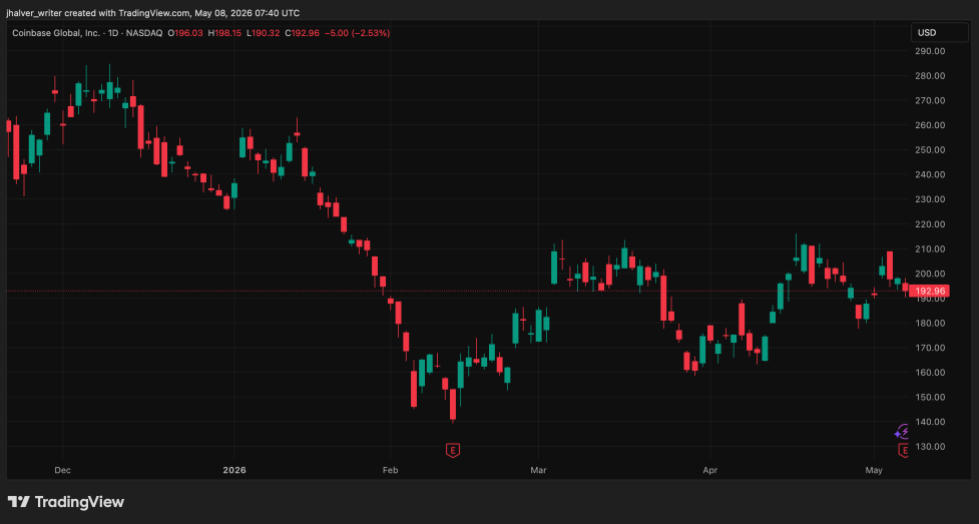
COIN's price records a modest loss following their Q1 earnings report, as seen on the daily chart. Source: COINUSD on Tradingview

What Drove Coinbase To A Loss

The single largest drag on the quarter was $482 million in unrealized losses on crypto assets held for investment, tied primarily to Bitcoin’s roughly 23% decline during Q1, a separate report from TheStreet crypto claims. Strip out that mark-to-market impact and the adjusted net loss narrows to $46 million — a meaningful distinction, but one that still reflects a materially weaker operating environment than the prior year.

Transaction revenue, the exchange’s primary revenue engine, came in at $755.8 million — down 23% quarter-over-quarter and below the $805.2 million analysts had projected. The main driver was straightforward: total crypto market capitalization and spot trading volumes declined more than 20% quarter-over-quarter, per Investing.com, pulling Coinbase’s most volatile revenue line with it.

Not everything was negative. Subscription and services revenue reached $584 million — representing 44% of net revenue — while stablecoin revenue hit $305 million on record average USDC holdings of $19 billion in Coinbase products. Adjusted EBITDA came in at $303 million, marking the company’s 13th consecutive positive quarter on that metric, per CFO Alesia Haas on the earnings call.

A Quarter That Confirms The Pattern

The Q1 loss arrives just days after Coinbase announced a 14% reduction in its workforce — approximately 700 roles — citing the need to restructure around AI-driven operations. Taken together, the layoffs and the earnings miss paint the picture of an exchange managing through a difficult cycle rather than riding one.

Operating margin collapsed to -1.5% from 34.7% in the year-ago quarter, underlining how quickly Coinbase’s profitability profile can shift when crypto markets pull back. The company closed the quarter with over $10 billion in cash and equivalents, per the earnings call transcript, which provides a substantial buffer — but does little to address the structural revenue sensitivity that has defined every down cycle in the exchange’s short public history.

For the nascent sector, Coinbase’s Q1 results serve as a reminder that even the most institutionally established crypto exchange remains tightly tethered to market conditions — and that the road to durable profitability runs directly through the unpredictable terrain of crypto price cycles.

Cover image from Grok, COINUSD chart from Tradingview

Perguntas relacionadas

QWhat were Coinbase's reported Q1 2026 financial results in terms of net loss and revenue?

ACoinbase reported a net loss of $394 million for Q1 2026, swinging from a $65.6 million profit in Q1 2025. Total revenue was $1.41 billion, a 30.5% year-over-year decline.

QWhat was the largest single factor contributing to Coinbase's Q1 2026 loss according to the article?

AThe single largest drag was $482 million in unrealized losses on crypto assets held for investment, primarily tied to Bitcoin's roughly 23% decline during the quarter.

QHow did Coinbase's transaction revenue perform in Q1 2026 compared to analyst expectations?

ATransaction revenue came in at $755.8 million, which was down 23% quarter-over-quarter and below the $805.2 million analysts had projected.

QDespite the overall loss, which areas of Coinbase's business showed positive performance in Q1 2026?

ASubscription and services revenue reached $584 million, representing 44% of net revenue. Stablecoin revenue hit $305 million on record average USDC holdings. Adjusted EBITDA was $303 million, marking the 13th consecutive positive quarter on that metric.

QWhat recent operational decision by Coinbase, mentioned alongside the earnings, highlights its response to a difficult cycle?

AJust days before the earnings report, Coinbase announced a 14% reduction in its workforce (approximately 700 roles), citing a restructuring around AI-driven operations.

Leituras Relacionadas

Qualcomm: AI Hype Subsides, When Will Smartphones Emerge from the Gloom?

Qualcomm reported its Q3 FY2026 results (ending June 2026), with revenue of $9.95B, down 4% YoY but above expectations. Gross margin declined to 53.1%, pressured by rising costs across manufacturing and memory. Key business segments showed mixed performance: Handset revenue fell 19.6% YoY to $5.09B, dragged by an 11% decline in non-Apple Android shipments and weaker high-end mix. Conversely, Automotive revenue surged 61% to $1.59B, and IoT grew 9% to $1.83B. Core operating profit dropped 41% YoY due to margin compression and higher expenses. Management's Q4 FY2026 guidance projects revenue of $9.7B-$10.5B, in line with consensus, but Non-GAAP EPS guidance of $2.05-$2.25 fell short of expectations. Amidst persistent weakness in its core handset market, Qualcomm is pursuing growth in AI, focusing on Edge AI (smartphones, PCs, automotive) and Data Center AI. Its data center strategy includes four pillars: AI accelerators (e.g., AI200), commercial CPUs (Dragonfly C1000), custom silicon, and connectivity solutions. While these initiatives initially boosted its stock, concerns over AI capital expenditure sustainability have since erased those gains. The company targets $5B in data center revenue for FY2027 and $15B for FY2029. The report concludes that with the traditional handset business still under pressure, the data center opportunity is currently viewed as a longer-term option, and a more conservative valuation based on core operations may be warranted until AI contributions materialize.

marsbitHá 3m

Qualcomm: AI Hype Subsides, When Will Smartphones Emerge from the Gloom?

marsbitHá 3m

From TPU to Self-Evolving Agents: How Jeff Dean Predicts the Next Step in AI

At the 2026 YC Startup School, Jeff Dean outlined his vision for AI's next phase, shifting focus from simply scaling models to building intelligent, autonomous systems. He believes AI's progress is no longer just about creating smarter models, but about integrating them into systems capable of long-term, iterative work, automated experimentation, and continuous learning. This evolution moves the competition from "who has the bigger model" to "who can best organize intelligence." Dean suggests AI capabilities are now comparable to a junior engineer, enabling the automation of complex workflows. However, the true challenge and opportunity lie in managing these AI "workers" at scale. He emphasizes the importance of **context engineering**—structuring tools, memory, and feedback loops—over raw model power. For startups, this means building deep expertise in niche domains where general models currently fail (near 0-1% success rates), leveraging proprietary data, specialized tools, and domain-specific evaluators. A recurring theme is re-examining fundamental constraints. Dean's past work, like moving Google's search index to memory or creating the TPU, stemmed from questioning outdated assumptions about hardware and cost. He sees similar inflection points today, particularly in **specialized inference hardware** to drastically reduce latency and energy consumption for real-time Agent operation. Notably, he points out that in modern AI systems, the dominant cost is often not computation but **data movement**. Reliable, long-running Agents require robust system design, borrowing concepts from distributed computing like checkpointing, state management, and parallel exploration to handle failures and maintain progress over days or weeks. As AI automates execution, the scarcest human skills will shift to **defining clear specifications**, **judging what problems are worth solving** (taste), and designing effective feedback loops. Ultimately, Dean's framework prioritizes understanding the problem deeply, identifying the true bottlenecks, and systematically building closed-loop systems where AI can not only perform tasks but also improve AI itself.

marsbitHá 3m

From TPU to Self-Evolving Agents: How Jeff Dean Predicts the Next Step in AI

marsbitHá 3m

Trading

Spot
活动图片





