Coinbase + Glassnode: Charting Crypto Q2 2026

insights.glassnodePublicado em 2026-06-03Última atualização em 2026-06-03

Resumo

Amid geopolitical uncertainty overshadowing crypto-native drivers, Q2 2026 market analysis reveals capital rotation within crypto rather than full exit. While the total crypto market cap (ex-stablecoins) fell ~18% in Q1, stablecoin supply grew, indicating investors are de-risking into cash-like instruments while staying engaged. Bitcoin sentiment reset to 'Fear' with supply tightening as speculative capital diminished. Ethereum shows capital concentrating at its base layer for utility-driven use cases like stablecoins and tokenized assets, despite softening broader activity. Most surveyed institutions (82%) now view the market in a bear or late-bear phase, though derivatives markets show rebuilding risk appetite. Historical cycle analogs are becoming less reliable for timing inflection points.

Geopolitical events in recent months have introduced persistent uncertainty for investors, making it challenging to take short-term positions with conviction. Macro developments now overshadow crypto-native drivers in shaping near-term price action.

Produced in collaboration with Coinbase Institutional, the latest Charting Crypto report distills the key market and on-chain trends impacting institutional crypto strategy this quarter. From investor sentiment and stablecoin liquidity to Bitcoin accumulation signals and Ethereum’s evolving market structure, the report offers a data-driven view of a market waiting for clearer direction.

Some of the many highlights in this edition:

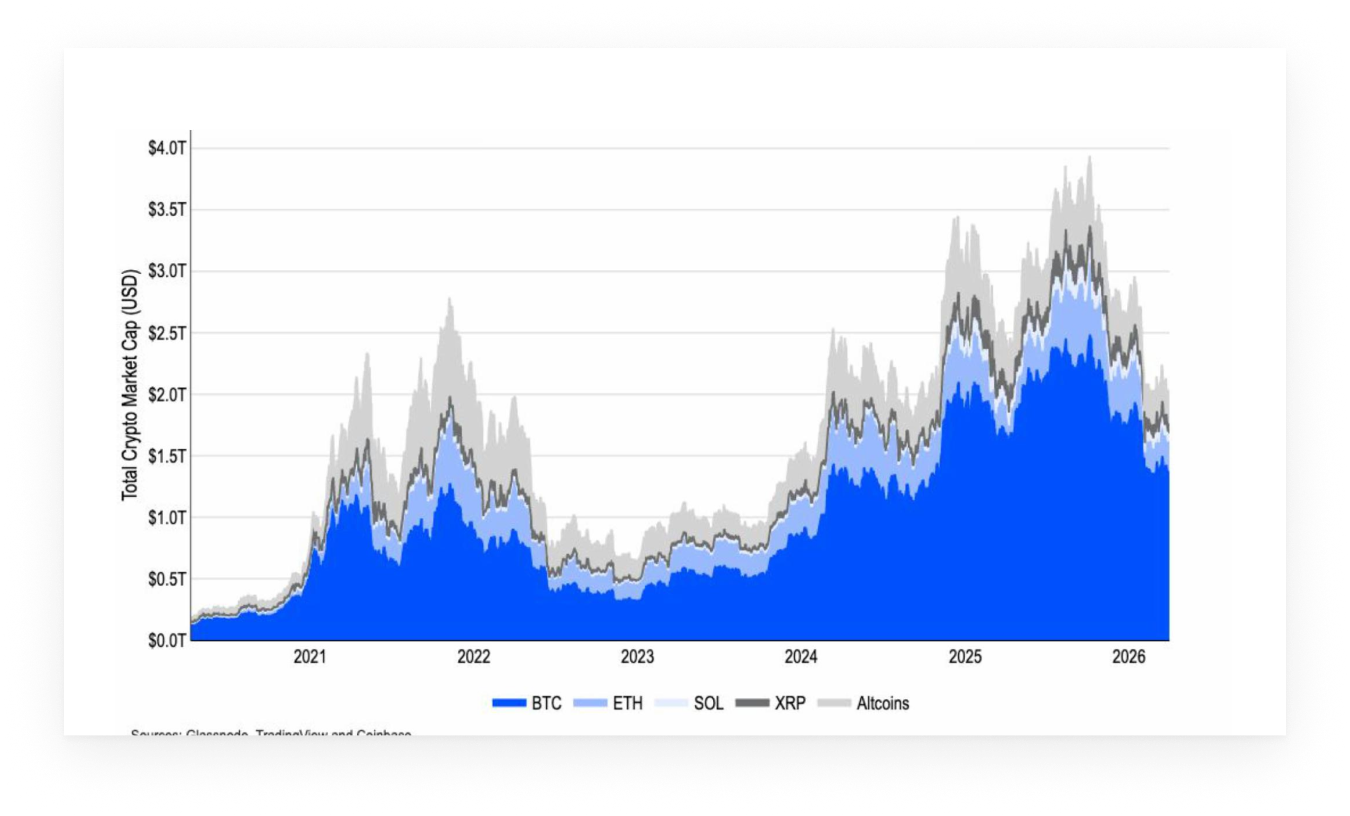
  • Liquidity is rotating into stablecoins rather than exiting the asset class, as total crypto market cap (excluding stablecoins) fell by ~18% in Q1, while stablecoin supply increased from $308B to $318B
  • Past cycle analogues are becoming less useful for timing market inflection points as both Bitcoin and Ethereum cycles continue to diverge from historical patterns
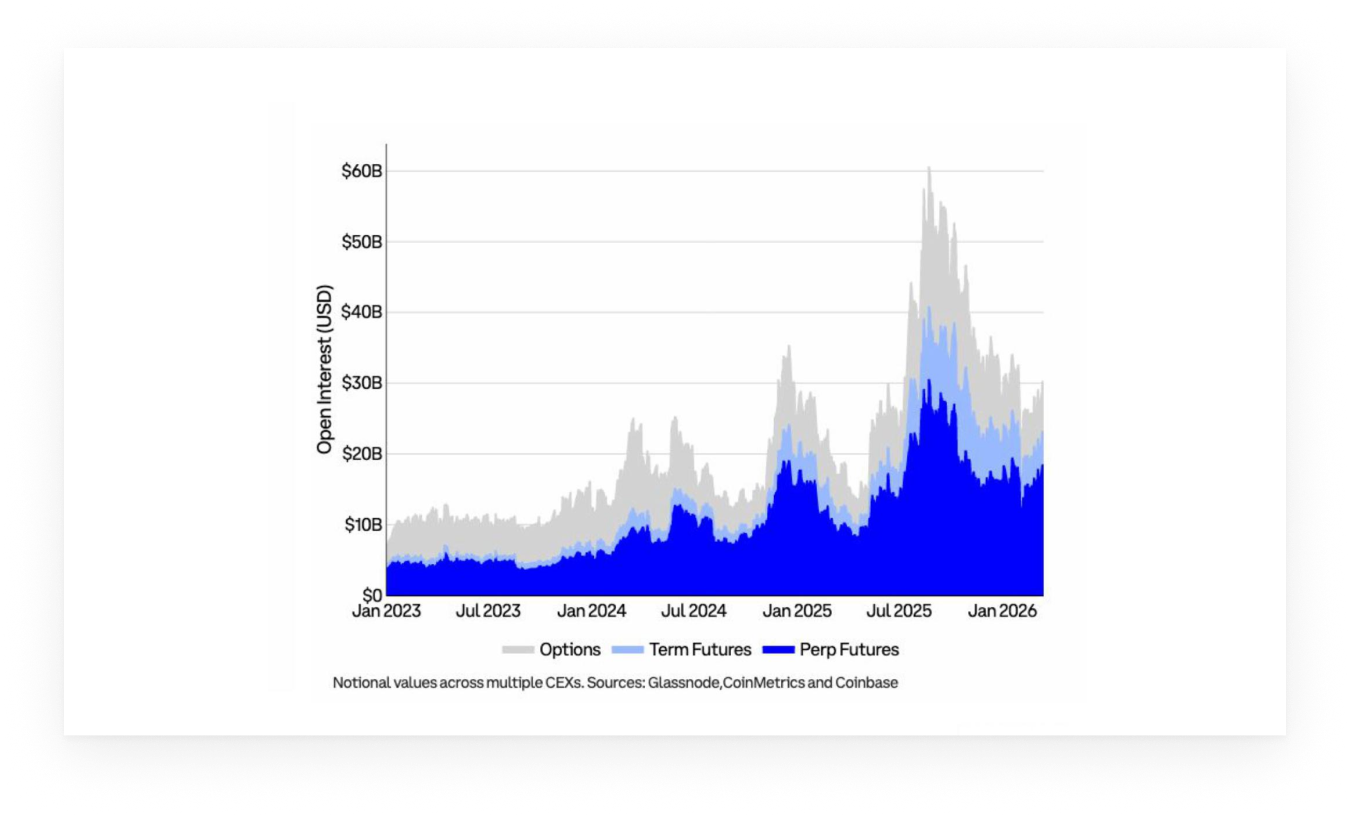
  • Market structure shows signs of normalization, with BTC derivatives open interest recovering (particularly in perpetuals), indicating a rebuilding of risk appetite in leveraged markets
  • 82% of surveyed institutions now place the market in a bear or late-bear phase (up from 31% in December)
  • Ethereum’s ecosystem is becoming more differentiated: Capital concentrates in base-layer use cases as broader activity softens, highlighting a shift toward utility-driven demand over speculative flows.

Liquidity Remains Inside the System

Despite the broad risk-off move in Q1, liquidity dynamics tell a more nuanced story. Total crypto market capitalization (excluding stablecoins) declined by roughly 18%, yet stablecoin supply increased over the same period.

This divergence suggests that capital is not fully leaving crypto markets, but rather rotating into cash-like instruments while awaiting clearer signals. In effect, investors are de-risking without disengaging, preserving optionality for re-entry.
Bitcoin: Sentiment Reset, Supply Tightens

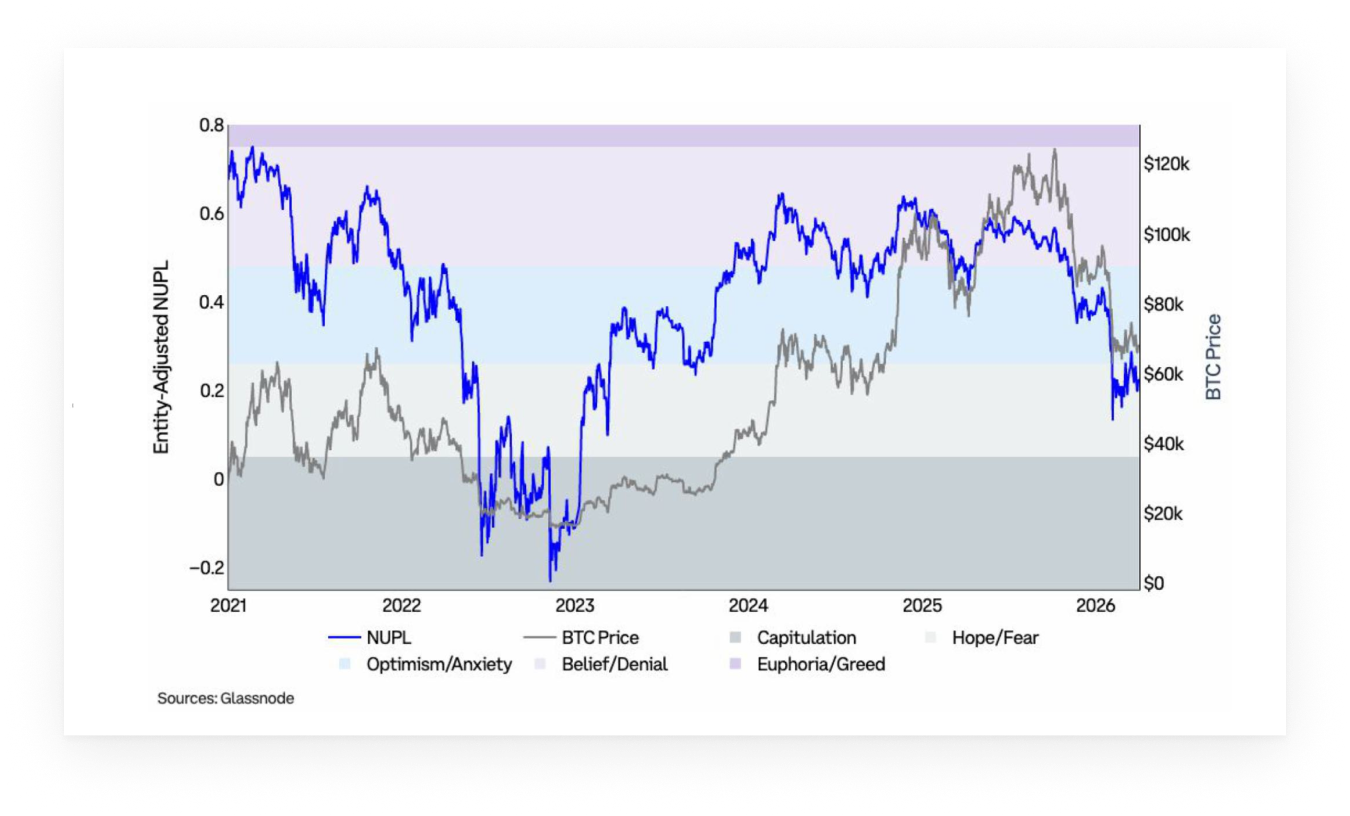
Bitcoin’s February drawdown was reflected in a deterioration in investor sentiment, with Net Unrealized Profit/Loss (NUPL) moving from Anxiety into Fear for the rest of Q1. While sentiment has started to show early signs of improvement in April, it remains closely tied to external developments, suggesting conviction is still fragile.

At the same time, onchain supply dynamics indicate a transfer of coins away from more reactive participants. The contraction in recently active supply, alongside a modest increase in long-term held coins, implies that shorter-term, speculative capital has been reduced.
Ethereum: Capital Concentration at the Base Layer

Ethereum data points to a divergence between activity and capital allocation. Short-term participation declined throughout the first quarter, as reflected in a sharp drop in recently active supply and a prolonged period of depressed sentiment. However, capital flows have remained concentrated on the base layer.

Stablecoin supply on Ethereum continues to expand with positive momentum, and tokenized real-world assets have reached new highs, indicating sustained demand for settlement and collateral use cases. At the same time, ETH has outperformed major L2 tokens since late 2025, suggesting that capital is consolidating at the base layer rather than rotating further out on the risk curve.
To help you navigate the current challenging crypto environment, check out the full insights and data in the Glassnode x Coinbase report: download the report here.


Perguntas relacionadas

QAccording to the Coinbase and Glassnode report, what does the increase in stablecoin supply alongside a decrease in the total crypto market cap (excluding stablecoins) suggest about capital movement in Q1 2026?

AIt suggests that capital is not fully exiting the crypto market, but rather rotating into stablecoins (cash-like instruments) while awaiting clearer signals. Investors are de-risking without disengaging, preserving optionality for re-entry.

QHow has institutional sentiment shifted regarding the market phase from December to the time of the report, and what does this indicate?

A82% of surveyed institutions now place the market in a bear or late-bear phase, a significant increase from 31% in December. This indicates a dramatic deterioration in institutional sentiment and conviction in the market over that period.

QWhat key trend does the report highlight regarding Bitcoin's on-chain supply dynamics and investor behavior in Q1 2026?

AThe report highlights a transfer of Bitcoin away from more reactive participants. The contraction in recently active supply and a modest increase in long-term held coins imply that shorter-term, speculative capital has been reduced, tightening available supply.

QWhat evidence does the report provide for Ethereum's capital concentrating at its base layer despite broader activity softening?

AThe evidence includes: continued expansion of stablecoin supply on Ethereum with positive momentum, tokenized real-world assets (RWAs) reaching new highs, and ETH outperforming major Layer 2 tokens since late 2025. This suggests sustained demand for settlement/collateral use cases and capital consolidation on the base chain.

QWhat does the recovery in Bitcoin derivatives open interest, particularly in perpetuals, signal about the market according to the report?

AIt indicates a normalization of market structure and a rebuilding of risk appetite within leveraged markets, as open interest recovers from previous declines.

Leituras Relacionadas

ByteDance Adopts Arm CPUs, Jensen Huang: So Sad I Didn't Buy Arm

**Summary:** At Computex 2026, Arm CEO Rene Haas announced that ByteDance and Oracle have adopted Arm's self-designed Arm AGI data center CPU. The company expects significant revenue growth from this product, projecting $20 billion in demand for the 2027/2028 fiscal years. Haas noted that restricting AI-capable CPUs from the US to China is nearly impossible due to their widespread applications. Arm's stock has surged dramatically this year, notably rising 16% after NVIDIA's Arm-based Vera CPU and RTX Spark announcements. A highlight was the informal, humorous on-stage conversation between Haas and NVIDIA CEO Jensen Huang. Huang joked about NVIDIA's failed attempt to acquire Arm and playfully lamented selling his Arm shares. Both executives showed a clear sense of camaraderie and shared regret over the missed merger. Key technical topics were discussed: 1. **AI PC Design:** Huang explained NVIDIA's RTX Spark superchip (with a 20-core Arm CPU) is designed for future AI agents that will autonomously run and use tools on PCs, blending local and cloud processing. 2. **Agent vs. OS:** Huang emphasized the operating system remains crucial, as AI agents rely on its APIs and tools to function. 3. **Growth Constraints:** He identified the shift to "useful AI" that generates profitable tokens as a primary driver for immense, almost limitless, computational demand. Haas outlined Arm's strategy across PC and data centers. For PCs, Arm collaborates with partners like NVIDIA and MediaTek, offering its compute subsystem (CSS) for custom SoCs. In data centers, its Arm AGI CPU (built on TSMC's 3nm process) has gained major partners including OpenAI, Meta, and now ByteDance and Oracle. Arm presented a multi-year roadmap for its in-house CPU line. The article concludes that while GPUs dominated the AI training race, the explosion of AI agents is shifting significant focus to CPUs for inference, state management, and tool orchestration. The industry is trending towards vertical integration, with companies like cloud providers designing chips and chip/IP firms offering full solutions, all competing to deliver more efficient computing per watt.

marsbitHá 3m

ByteDance Adopts Arm CPUs, Jensen Huang: So Sad I Didn't Buy Arm

marsbitHá 3m

New Wall Street Play: Yen Shorts Still Adding, But Japan Stocks Don't Rely on Carry Trade Unwinding

On June 3rd, USD/JPY hit 160.44, its highest level since July 2024, while the Nikkei 225 surged past 68,000 points. Contrary to popular narratives of an imminent "carry trade unwind" akin to August 2024, data reveals a more complex picture. Speculative net short positions in yen futures have actually increased, reaching -114,667 contracts by late May, suggesting traders are doubling down rather than retreating. Meanwhile, Japan's Finance Ministry conducted its largest-ever single-round FX intervention (11.73 trillion yen) in April-May but failed to hold the 160 yen line. The Nikkei's rally is not driven by carry trade dynamics. Foreign investors are aggressively buying Japanese stocks, with net purchases in 2026 running nearly 16 times higher than 2025 levels. This inflow is concentrated in AI and semiconductor-related stocks like SoftBank and Socionext, fueled by positive sector outlooks, rather than being a flight from unwinding yen shorts. Furthermore, the Nikkei has continued climbing despite the Bank of Japan's (BOJ) rate hikes to 0.75%. This disconnect exists because the current equity boom is fueled by AI-driven foreign investment, not reliant on cheap yen funding. However, this relationship remains fragile. Should the BOJ hike rates further (e.g., to 1.0%) while dollar weakness increases carry trade costs, the trajectories of the yen and Japanese stocks could reconverge, potentially triggering volatility.

marsbitHá 7m

New Wall Street Play: Yen Shorts Still Adding, But Japan Stocks Don't Rely on Carry Trade Unwinding

marsbitHá 7m

Broadcom's Q3 Guidance Misses Expectations by $12 Billion, After-Hours Trading Plummets Over 13%, AI Narrative "Cooling"?

On June 3, Broadcom released record Q2 FY26 results with revenue of $22.19B, up 48% YoY, and AI chip sales of $10.8B, up 143%. Adjusted EPS of $2.44 beat estimates. However, its Q3 AI semiconductor revenue guidance of $16B, while up over 200% YoY, fell roughly $1.2B (7%) short of analyst consensus expectations of $17.2B. This miss, coupled with slightly weaker-than-expected software revenue, triggered a severe market reaction. CEO Hock Tan maintained the FY26 AI revenue outlook of over $100B but did not raise it, disappointing investors who had priced in more robust growth. The stock plummeted over 13% in after-hours trading, erasing roughly $270B in market cap. The sell-off extended to peers like Marvell. A key concern for markets, particularly for Chinese optical module suppliers, was Tan's comment that the contribution of AI networking (e.g., Ethernet switches, optical interconnect chips) to AI revenue, currently near 40%, is expected to normalize to around 30% over time, signaling a potential peak in growth for that segment. Despite the guidance shortfall, Tan reiterated that AI demand remains "insatiable" and reaffirmed the long-term target of exceeding $100B in AI revenue by FY27. The reaction highlights the heightened sensitivity and premium valuation placed on AI-exposed stocks, where anything less than stellar guidance can prompt significant profit-taking. The broader question is whether this represents a cooling AI narrative or a correction in overstretched valuations.

marsbitHá 8m

Broadcom's Q3 Guidance Misses Expectations by $12 Billion, After-Hours Trading Plummets Over 13%, AI Narrative "Cooling"?

marsbitHá 8m

Trading

Spot
Futuros
活动图片