Coinbase CLO turns bullish on CLARITY: ‘Confident we’re going to see progress’

ambcryptoPublicado em 2026-04-02Última atualização em 2026-04-02

Resumo

Coinbase Chief Legal Officer Paul Grewal expressed strong optimism about the imminent passage of the Digital Asset Market CLARITY Act of 2025, predicting a breakthrough in U.S. crypto regulation within the next 48 hours. Despite resistance from traditional banks, Grewal emphasized the importance of the bill in fulfilling former President Trump’s vision of making the U.S. a global crypto capital. He differentiated crypto from fractional-reserve banking, dismissing concerns about deposit flight due to stablecoins. His shift in stance surprised Patrick Witt of the President’s Council on Digital Assets, given Coinbase’s previous hesitation. Polymarket odds of the bill becoming law by 2026 rose to 65%, reflecting growing confidence.

An interesting plot twist has emerged in the ongoing chatter around the Digital Asset Market CLARITY Act of 2025.

Coinbase Chief Legal Officer (CLO) Paul Grewal, in a recent television appearance, has shared his optimism about the passage of the crypto bill. He believes that the U.S. is on the verge of a major crypto breakthrough despite banks’ resistance.

More importantly, Grewal revealed that the deal between crypto and banks will likely pass within the next 48 hours.

I’m very confident we’re going to see progress.

However, he also pointed out that,

Other key elements of the bill are critically important to making sure that President Trump’s vision of the United States as the crypto capital world is fulfilled.

Coinbase’s CLO is confident about the CLARITY Act passage

Explaining his stance, Coinbase CLO underlined that rules might be different for banks and crypto because “the game is very different”.

While comparing traditional banks and stablecoins, Grewal highlighted how banks operate on fractional reserve lending—where they hold less and focus more on deposits and lend-outs.

However, as the ongoing debate around ‘yield generations’ surges, critics believe that stablecoin could halt people from withdrawing money from banks. But speaking in defense, Grewal rejected that notion, stating,

There has been no evidence of deposit flight whatsoever.

He also stressed how the GENIUS Act introduced the initial rule for crypto and that the CLARITY Act is the finish line for a complete regulatory framework.

Shift in stance shocks executives

This optimism from Grewal comes after Coinbase’s recent holdout. For those unaware, this stepback had pushed Patrick Witt, the executive director of the President’s Council on Digital Assets, to issue a hidden warning at Coinbase.

However, after hearing Paul Grewal’s shift in stance. Witt expressed his surprise.

Source: Patrick Witt/X

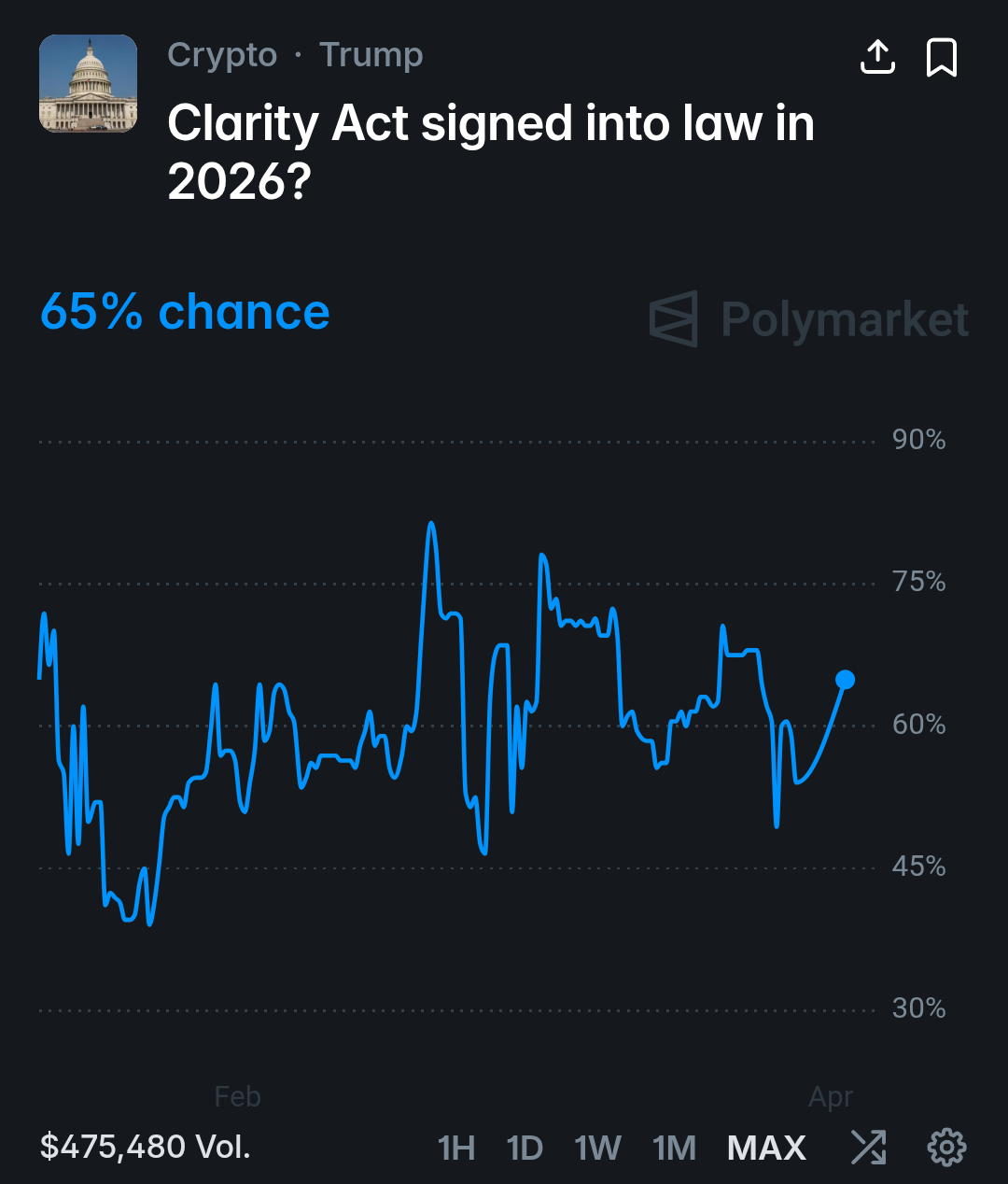
Meanwhile, the Polymarket odds of the CLARITY Act being signed into law in 2026 confirmed the positive sentiment, as it stood at 65% at the time of reporting.
Source: Polymarket

Final Summary

  • Paul Grewal’s optimism about the CLARTY Act shocks Patrick Witt, considering Coinbase’s past holdout.
  • Polymarket odds rocketed to 65%, reflecting this increased optimism.

Perguntas relacionadas

QWhat is Paul Grewal's position at Coinbase and what is his recent stance on the CLARITY Act?

APaul Grewal is the Chief Legal Officer (CLO) of Coinbase, and he has recently expressed optimism and confidence about the passage of the CLARITY Act.

QAccording to Grewal, when is the deal between crypto and banks likely to pass?

AGrewal revealed that the deal between crypto and banks is likely to pass within the next 48 hours.

QHow did Patrick Witt react to Paul Grewal's shift in stance on the CLARITY Act?

APatrick Witt, the executive director of the President’s Council on Digital Assets, expressed surprise at Paul Grewal's shift in stance, considering Coinbase's previous holdout.

QWhat were the Polymarket odds for the CLARITY Act being signed into law in 2026 at the time of reporting?

AThe Polymarket odds for the CLARITY Act being signed into law in 2026 stood at 65% at the time of reporting.

QWhat key difference did Grewal highlight between traditional banks and stablecoins?

AGrewal highlighted that traditional banks operate on fractional reserve lending, where they hold less and focus more on deposits and lend-outs, while implying stablecoins operate differently.

Leituras Relacionadas

In Jinjiang, Fujian, a Storage Super Unicorn Lies Quiet

In Fujian's Jinjiang, a city known for sportswear, lies a quiet semiconductor giant: Fujian Jinhua Integrated Circuit Co. (JHICC). Once a promising domestic DRAM manufacturer alongside Yangtze Memory and ChangXin Memory Technologies (CXMT), its journey was derailed in 2018 when the U.S. placed it on an Entity List and filed criminal charges for alleged trade secret theft. This halted production for years. A turning point came in February 2024 when a U.S. federal court found JHICC not guilty. However, it had lost crucial time. While CXMT soared to become a top-valued A-share company in 2024, JHICC, with an estimated valuation of 80 billion RMB, was just restarting. Its current output is primarily customized DDR4 chips, not the advanced DDR5/HBM demanded for AI, but it still benefits from the broader memory chip upcycle. JHICC's story is tied to Chen Zhengkun, a veteran engineer who left Micron to lead the venture. Founded in 2016 with state-backed funding, JHICC partnered with Taiwan's UMC to develop DRAM technology. Rapid progress was cut short by the U.S. actions, which Micron initiated, partly due to its heavy reliance on the Chinese market. Post-sanctions, Chen's team worked to rebuild the production line with reduced reliance on U.S. technology. According to its records, JHICC achieved small-scale production and revenue growth under immense pressure. It now focuses on the stable "niche" DRAM market (e.g., TVs, routers) with a monthly capacity of ~40,000 wafers, aiming for 60,000 by 2026. It holds over 1,000 patents but remains on the Entity List. For Jinjiang, investing in JHICC was a bold industrial leap. The local government provided unwavering financial and logistical support during the crisis, helping the company survive. JHICC has become the anchor for a growing local semiconductor cluster. Though its scale lags behind domestic peers, JHICC's persistence symbolizes a hard-won foothold in a global market long dominated by Samsung, SK Hynix, and Micron. Having missed one boom, it seeks a place in the new AI-driven memory supercycle.

marsbitHá 1h

In Jinjiang, Fujian, a Storage Super Unicorn Lies Quiet

marsbitHá 1h

Trading

Spot
活动图片