Code Is Getting Cheaper, Licenses Are Getting More Valuable: The Real Moat of Fintech in the AI Era

marsbitPublicado em 2026-03-16Última atualização em 2026-03-16

Resumo

"The article argues that in the AI era, code is becoming cheaper, but true competitive advantages in Fintech come from hard-to-replicate elements like banking licenses, underwriting data from credit losses, and proprietary risk models trained on real transaction volumes. While traditional software companies face compressed margins as AI lowers both development and distribution costs, Fintech's real moats lie in regulatory compliance, risk management, and data accumulation—areas where AI actually strengthens incumbents. Companies that own the "fin" side (licenses, risk-bearing, proprietary data) will benefit from AI, while those relying solely on "tech" (software interfaces built atop others' infrastructure) will suffer from eroding differentiation. The new arbitrage is no longer about applying software valuations to financial economics, but about owning the foundational elements of finance itself."

Author: Matt Brown

Compiled by: Deep Tide TechFlow

Deep Tide Introduction: Matrix VC partner Matt Brown presents a counterintuitive argument: AI is making code increasingly cheaper, but it's making the truly hard-to-replicate elements in Fintech—banking licenses, underwriting data accumulated from credit losses, risk control models fed by real transaction volumes—more valuable than ever before.

"You can't vibe-code your way into a banking charter," a phrase that captures the core of the entire article.

This is not just a Fintech analysis; it's a map of "what moats are stronger" in the AI era.

Full Text Below:

The term "Fintech" has long relied on ambiguity arbitrage within its name.

"Fin" implies a flood of emails from .gov domains, months-long audits, compliance officers who know your SAR filing history better than you do, and weekday trips to Charlotte or Washington D.C. "Tech" implies a sleek mobile app, a 10x user experience, and discussing investments over coffee at Blue Bottle.

"Fin" and "tech" have always existed on a spectrum, but the market has typically rewarded those Fintech companies that act as much like "tech" and as little like "fin" as possible.

This is understandable. In 2021, the gross profit pool for software was about $0.7 trillion, commanding high premium valuations. The gross profit pool for financial services was an order of magnitude larger, yet valued much more conservatively. Fintech allowed you to arbitrage both sides: the economics of financial services, paired with the valuation multiples of software companies.

The size of this profit pool also tells you where the real money is. Financial services generate the most gross profit among global industries. The "fin" side of Fintech is not only more defensive; it's a vastly larger market.
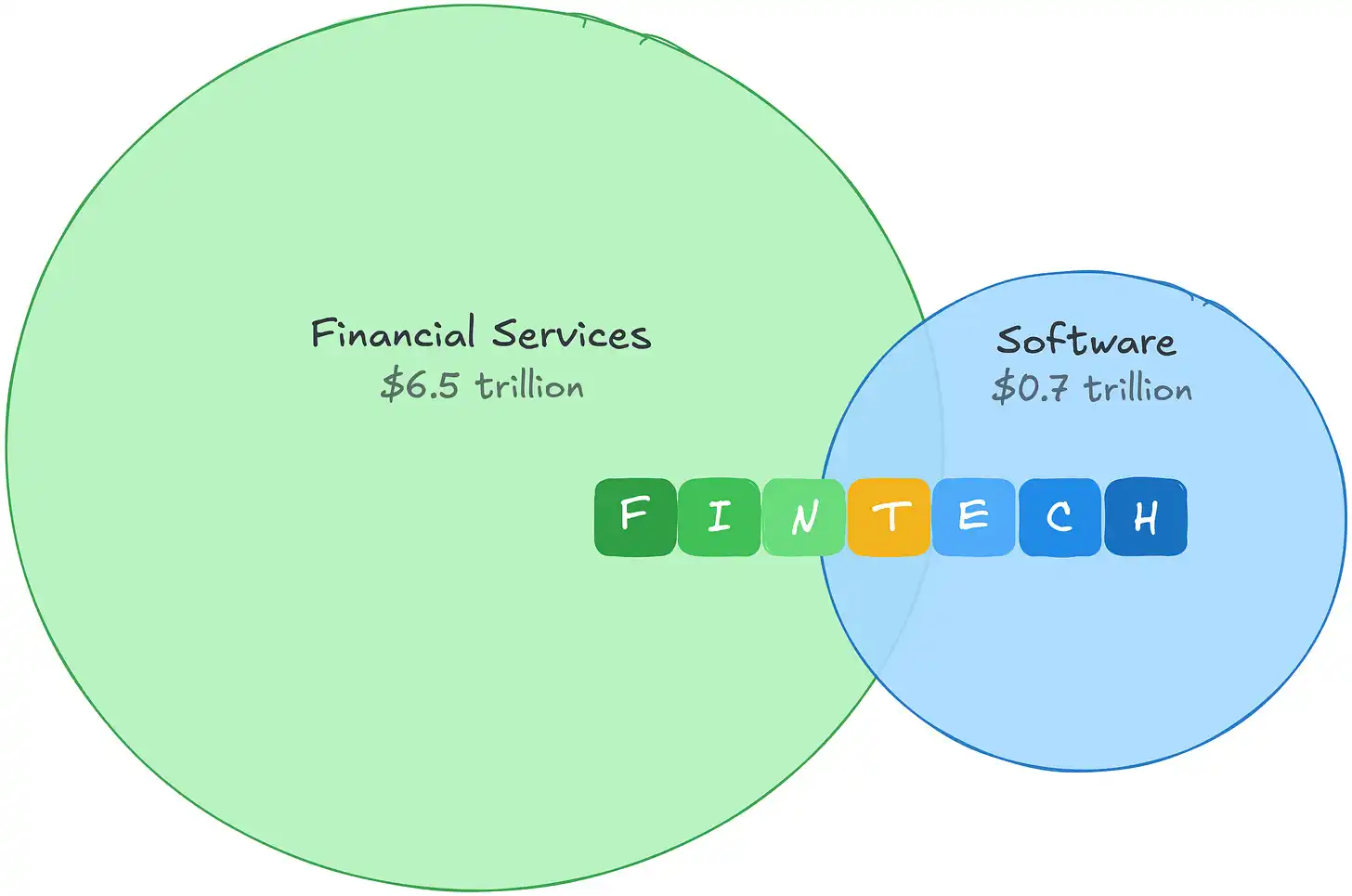
Then AI, and the arbitrage space vanished. As investors repriced "what code is worth in a world where code is getting cheaper," software valuations compressed. Fintech companies, being categorized by the market as software companies, were caught in the crossfire.

But the market got the categorization wrong. Fintech's costs, and its moats, were never in the code, and in the face of AI-driven cost compression, they look increasingly anti-fragile.

A Tale of Two Cost Structures

Software once had one of the best business models in history: code was expensive to produce, but once written, distribution was nearly free. The gap between "expensive to build" and "free to distribute" was the margin. If you were a SaaS company spending 22 to 25% of revenue on R&D, that expenditure was also your barrier to entry. Competitors couldn't easily replicate something that took years and tens of millions of dollars to build.

AI compresses this gap from the top. If code is both cheap to build *and* cheap to distribute, margins narrow. The wall keeping competitors out gets lower, more players enter, and pricing power erodes.

If your business *is* software, this is a real problem. But Fintech's spend isn't engineering spend. Follow the money, and the difference becomes obvious quickly.

PayPal spends 9% of revenue on R&D; Block spends 12%. This isn't because Fintech engineering isn't important—Stripe's engineering capability is world-class and a real competitive advantage. It's that most of the money doesn't flow to engineering.

The money flows to the "fin". Unlike R&D spend, these costs don't just produce the product; they produce the moat:

Credit Losses Buy Underwriting Data

Affirm spends 35% of its revenue on credit losses and funding costs *before* it pays a single engineer. Every dollar lost to a bad loan is repayment data a competitor doesn't get. A new entrant training a model on synthetic data has no real benchmark. You cannot build a reliable loss history on synthetic data alone.

Compliance Spend Buys Regulatory Permission

Wise dedicates a third of its employees to compliance and financial crime prevention across 65+ regulatory licenses. Money transmitter licenses in 50 states, BSA/AML compliance programs, bank charter requirements. These aren't advantages you build; they're permissions you continually earn. You can't vibe-code your way into a banking charter.

Volume Buys Proprietary Data

Toast's Payments segment has gross margins around 22%, far below its 70% SaaS margins, but generates nearly twice the gross profit dollars. Those costs buy merchant-level transaction data, which in turn feeds Toast Capital, which has originated over $1 billion in loans. Adyen's risk models are trained on transaction patterns across 30+ markets.

Fintech Margins Were Never High, and That's the Point

Payment companies have gross margins of 20 to 50%, not 80%. But low margins don't equal a weak business. Fintech margins are low because a huge portion of the costs are generating compounding advantages. And even the costs that don't generate advantages are outside the reach of AI-driven cost compression.

AI makes every one of these moats stronger. Better models push down loss rates, better fraud detection reduces chargebacks, better compliance tools let smaller teams hold more licenses. AI doesn't replace the moat; it rewards the companies that chose to build in the hardest parts of Fintech: money movement, risk-taking, proprietary data, and regulation.

So the real argument isn't just "AI helps Fintech," but that AI is shifting value away from product surface area and towards proprietary data, risk-taking capacity, regulatory permission, and distribution embedded in real money movement. If you're building in these areas, AI is compounding in your direction. If your differentiation is in the code, AI is compounding in the opposite direction.

Demand-side growth continues, too. Every vibe-coded checkout flow is a new fraud vector, every autonomously transacting AI agent is a chargeback risk. The more that gets built on top of Fintech infrastructure, the more indispensable that infrastructure itself becomes.

"Fin" is Where You Win

This realization is already forcing smart Fintech founders to rethink their place on the "fin" vs. "tech" spectrum:

Do we take and price risk ourselves, or pass it to a counterparty and let them take the profit?

Do we own the regulatory relationship, or rent it from someone who does?

Is every transaction making our own risk model sharper, or training someone else's?

Is our ledger the source of truth for data, or an incomplete mirror of someone else's ledger?

This distinction splits the Fintech landscape in two. Companies that own the regulatory relationships, take their own credit losses, and accumulate transaction data are building moats that AI will deepen. Companies that rent the "fin"—slapping a better interface on a partner bank's charter, a BaaS provider's ledger, someone else's risk model—face the exact same problem as SaaS companies. Their differentiation was in the code, and the code just got cheaper.
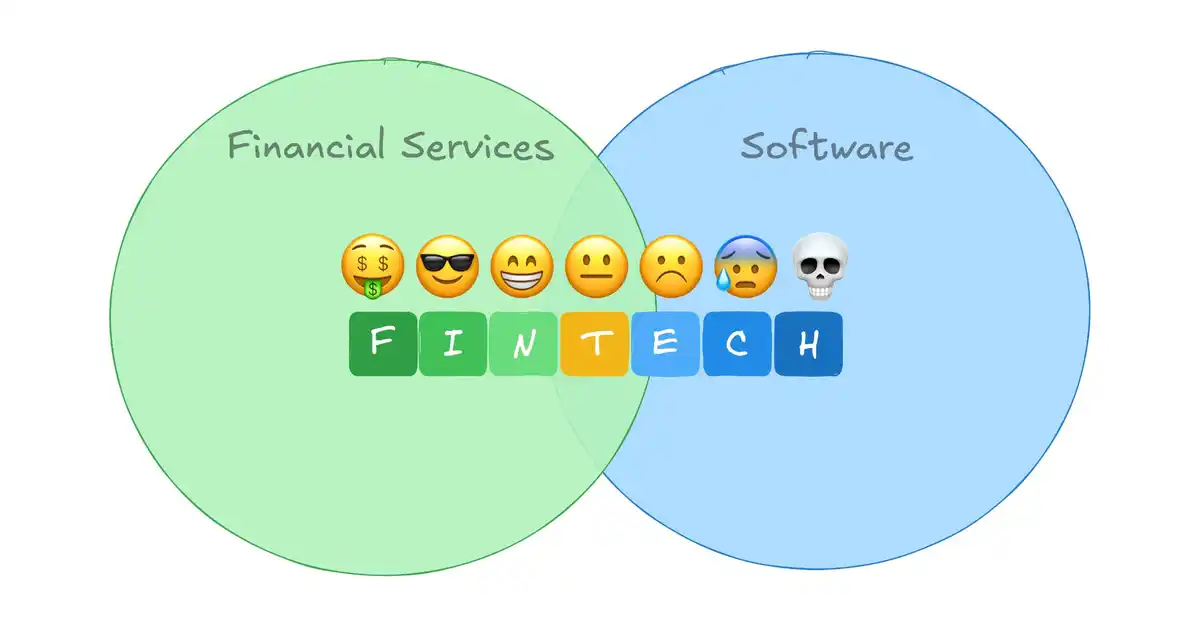
The old arbitrage of applying software multiples to financial services economics is dead. The new arbitrage is simpler: own the "fin".


Criptomoedas em alta

Perguntas relacionadas

QAccording to the article, why are banking licenses and underwriting data becoming more valuable in the AI era?

ABecause AI makes code cheaper to produce and distribute, but it cannot replicate hard-to-obtain assets like banking licenses (which require regulatory approval and compliance) or real underwriting data (built from actual credit losses and transaction histories). These elements form defensible moats that AI actually strengthens.

QHow does AI impact the cost structure and moats of traditional software companies versus Fintech companies?

AAI compresses the profit margins of traditional software companies by making code cheaper to build and distribute, lowering entry barriers and eroding pricing power. In contrast, Fintech companies' moats—built on regulatory licenses, proprietary data from transactions, and credit risk experience—are not only resistant to AI-driven cost compression but are actually enhanced by AI through better models for risk and compliance.

QWhat are some examples of Fintech companies investing in 'fin' moats rather than 'tech' differentiation?

AExamples include: Affirm spending 35% of revenue on credit losses and funding costs to build underwriting data; Wise investing heavily in compliance across 65+ regulatory licenses; and Toast using low-margin payment processing to gather proprietary transaction data that fuels its lending business (Toast Capital).

QWhat key questions should Fintech founders ask to determine if they are building a durable AI-era moat?

AFounders should ask: Do we take and price risk ourselves or pass it to partners? Do we own regulatory relationships or rent them? Does each transaction improve our own risk models or train someone else's? Is our ledger a source of truth or an incomplete copy of another ledger?

QHow does the article characterize the shift in valuation dynamics for Fintech companies in the age of AI?

AThe old arbitrage of applying software valuation multiples to Fintech businesses is disappearing. The new arbitrage is owning the 'fin' elements—regulatory licenses, risk-bearing capabilities, and proprietary data—which AI makes more valuable, rather than relying solely on 'tech' (code and user experience) which is becoming commoditized.

Leituras Relacionadas

Must-Watch Events Next Week|CLARITY Act Could Face Senate Vote; SpaceX, Circle to Report Earnings (8.3-8.9)

**Summary: Key Events and Developments to Watch (August 3-9)** The upcoming week is marked by significant financial disclosures, key legislative deadlines, and notable product updates. **Major Financial Events:** Several companies are scheduled to release their Q2 2026 earnings. American Bitcoin (ABTC) will report on August 3, followed by SpaceX and Hut 8 Mining Corp. on August 4, and Circle on August 5. Notably, a significant portion of SpaceX shares (up to 12% of total shares) will be unlocked on August 6 following their earnings release. **Key Legislative Deadline:** The U.S. Senate faces an August 7 deadline to secure 60 votes for the CLARITY Act, a bipartisan bill aiming to establish a federal regulatory framework for cryptocurrencies. The Senate may hold a full vote on the bill during the week. **Economic Data:** The U.S. July Non-Farm Payrolls report will be released on August 7, providing crucial labor market data. **Technology & Product Updates:** * **Shutdowns:** DeFi portfolio tracker Zapper and wallet app Ctrl Wallet will cease operations on August 3. * **Upgrades:** LayerZero will deprecate its v1 relayers on August 3. XRP Ledger's new version 3.3.0, featuring five new functions, is expected next week. * **AI:** Elon Musk announced that the advanced Grok 4.6 AI model is set for release around August 7. * **Bitcoin:** The BIP-110 forced signaling for a potential Bitcoin network change is scheduled to begin around August 8. **Other Notable Events:** Chinese robotics firm Unitree Tech has set its preliminary price inquiry for its IPO for August 5. South Korean exchange Upbit will delist AQT and AERGO tokens on August 3.

marsbitHá 1h

Must-Watch Events Next Week|CLARITY Act Could Face Senate Vote; SpaceX, Circle to Report Earnings (8.3-8.9)

marsbitHá 1h

Stocks Are Plummeting More Sharply Than Cryptocurrencies. Where Has the Money Gone?

Stock Markets Plunge Deeper Than Cryptocurrencies: Where Did the Money Go? In late July, Seoul's Kospi index triggered circuit breakers for two consecutive days, plummeting over 40% from its June high. The collapse was led by heavyweight stocks like SK Hynix, whose record profits still disappointed investors, and devastating leveraged ETFs, with one major product losing over 83% of its value. This signaled a global, forced deleveraging targeting the most crowded trades. Interestingly, while stocks exhibited extreme volatility akin to crypto markets, Bitcoin rose nearly 15% in July after a prior steep drop. Analysis shows the money fleeing equities did not flow into Bitcoin. Instead, Bitcoin had already absorbed its sell-off in May-June, when U.S. spot Bitcoin ETFs saw historic outflows. The true safe-haven beneficiary was gold, whose price rose over 20% year-on-year, highlighting a decoupling between Bitcoin and gold as "digital gold." The sell-off was a targeted unwinding of leveraged positions in tech and semiconductors, accelerated by broker-dealer risk management and shifts in the AI narrative, including new competition from Chinese memory chipmakers. The retreat path was clear: from high-valuation tech stocks to cash and U.S. Treasuries, then to gold. For Bitcoin to attract sustained institutional inflows, conditions like eased global liquidity pressure, a "soft-landing" Fed rate cut, and U.S. regulatory clarity via legislation like the stalled CLARITY Act are needed. Currently, Bitcoin is not a safe haven but an already-cleared asset. Its low correlation with tech stocks, however, makes it a potential diversification play for institutional portfolios once the storm passes. The money isn't here yet, but the positioning is underway.

marsbitHá 1h

Stocks Are Plummeting More Sharply Than Cryptocurrencies. Where Has the Money Gone?

marsbitHá 1h

In Conversation with Ray Dalio: We Are Currently in an AI Bubble, with 1% of My Portfolio in Bitcoin

Ray Dalio, founder of Bridgewater Associates, warns in an interview that the current AI boom shows classic bubble characteristics, which could lead to significant economic downturns as seen in past cycles like 1929 or 2000. He explains that speculative enthusiasm, fueled by debt and overvaluation, often precedes a crash when rising rates or taxation force asset sales, causing widespread losses and recession. Dalio also outlines his "Big Cycle" theory, describing an approximate 80-year pattern where widening wealth gaps, massive government deficits, and shifting geopolitical power (like China's rise) create internal conflict and global instability. He emphasizes that we are in a late-cycle, transitional phase where traditional powers like the US and UK face decline. For personal wealth protection, Dalio advises diversification beyond cash into assets like stocks, bonds, real estate, and particularly gold, which he prefers over Bitcoin. While he holds about 1% of his portfolio in Bitcoin as a non-printable hard asset, he views gold as more secure from technological or governmental threats. Regarding AI's impact, Dalio believes it will disproportionately benefit capital owners, worsening inequality by replacing both physical and cognitive labor. He suggests that human intuition and emotional intelligence, combined with AI, will be key for future workers. On taxation, Dalio argues that wealth taxes are impractical and risk triggering asset sell-offs, reducing productive investment. He points to the UK as a cautionary example of debt, low productivity, and political strife. Geopolitically, Dalio foresees a more regionalized world, with the US showing weakness in prolonged conflicts like with Iran, akin to past imperial declines. The ideal outcome, he suggests, is coexisting powerful blocs (e.g., Americas, China-Asia Pacific) without major war.

marsbitHá 5h

In Conversation with Ray Dalio: We Are Currently in an AI Bubble, with 1% of My Portfolio in Bitcoin

marsbitHá 5h

Trading

Spot

Artigos em Destaque

Como comprar ERA

Bem-vindo à HTX.com!Tornámos a compra de Caldera (ERA) simples e conveniente.Segue o nosso guia passo a passo para iniciar a tua jornada no mundo das criptos.Passo 1: cria a tua conta HTXUtiliza o teu e-mail ou número de telefone para te inscreveres numa conta gratuita na HTX.Desfruta de um processo de inscrição sem complicações e desbloqueia todas as funcionalidades.Obter a minha contaPasso 2: vai para Comprar Cripto e escolhe o teu método de pagamentoCartão de crédito/débito: usa o teu visa ou mastercard para comprar Caldera (ERA) instantaneamente.Saldo: usa os fundos da tua conta HTX para transacionar sem problemas.Terceiros: adicionamos métodos de pagamento populares, como Google Pay e Apple Pay, para aumentar a conveniência.P2P: transaciona diretamente com outros utilizadores na HTX.Mercado de balcão (OTC): oferecemos serviços personalizados e taxas de câmbio competitivas para os traders.Passo 3: armazena teu Caldera (ERA)Depois de comprar o teu Caldera (ERA), armazena-o na tua conta HTX.Alternativamente, podes enviá-lo para outro lugar através de transferência blockchain ou usá-lo para transacionar outras criptomoedas.Passo 4: transaciona Caldera (ERA)Transaciona facilmente Caldera (ERA) no mercado à vista da HTX.Acede simplesmente à tua conta, seleciona o teu par de trading, executa as tuas transações e monitoriza em tempo real.Oferecemos uma experiência de fácil utilização tanto para principiantes como para traders experientes.

548 Visualizações TotaisPublicado em {updateTime}Atualizado em 2026.06.02

Como comprar ERA

Discussões

Bem-vindo à Comunidade HTX. Aqui, pode manter-se informado sobre os mais recentes desenvolvimentos da plataforma e obter acesso a análises profissionais de mercado. As opiniões dos utilizadores sobre o preço de ERA (ERA) são apresentadas abaixo.

活动图片












