Cloudflare Cuts Over 1,100 Jobs; Earnings Beat Expectations but Stock Plunges 18% After Hours

marsbitPublicado em 2026-05-08Última atualização em 2026-05-08

Resumo

Cloudflare announced the layoff of over 1,100 employees, representing about 20% of its workforce, on the same day it reported better-than-expected Q1 2026 earnings. While revenue grew 34% to $639.8 million and full-year guidance was raised, the stock plummeted over 18% in after-hours trading, likely due to the layoffs and a slightly weaker Q2 revenue forecast. CEO Matthew Prince framed the massive restructuring as necessary preparation for the "AI agent era," not a cost-cutting measure. He cited a 600% surge in AI usage across the company in three months, with 97% of engineers using AI coding tools. Prince stated that many support roles are no longer needed as AI boosts the productivity of customer-facing and engineering staff, and that job types are changing rapidly. The company expects to incur $140-$150 million in restructuring charges. Laid-off U.S. employees will receive severance pay covering their full salary until the end of 2026, extended healthcare, and accelerated stock vesting. This move comes less than a year after Cloudflare famously announced plans to hire 1,111 interns in 2026. This announcement is part of a broader trend, as companies like Coinbase and PayPal also announced significant layoffs recently, with AI frequently cited as a driving force behind workforce transformations.

Author: Claude, Shenchao TechFlow

Shenchao TechFlow Introduction: On the same day it reported better-than-expected quarterly earnings, Cloudflare announced a reduction of approximately 20% of its workforce (over 1,100 employees). CEO Matthew Prince framed the move as a comprehensive restructuring for the "era of AI agents" rather than a cost-cutting measure. The company's AI usage surged over 600% in the past three months, with 97% of engineers already using AI coding tools. Following the news, the stock plummeted over 14% in after-hours trading. The restructuring is expected to incur $140 million to $150 million in charges.
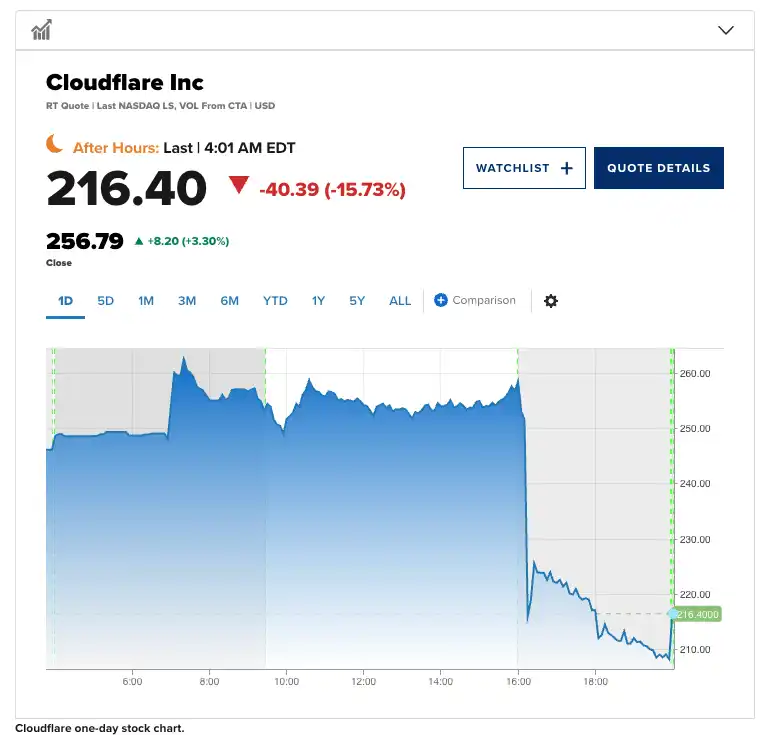
Cybersecurity and cloud services giant Cloudflare accomplished two things on May 7th: delivering a quarterly earnings report that exceeded expectations across the board, and announcing the layoff of one-fifth of its employees.

According to Cloudflare's official blog, CEO Matthew Prince and President & COO Michelle Zatlyn sent an internal email to all employees that day, announcing a global reduction of over 1,100 positions. The email's subject line was "Building for the Future." A few hours after the layoff notice was sent, the company released its Q1 2026 earnings report.

Prince stated on the subsequent earnings call: "We discovered some roles at Cloudflare that are no longer needed for our future. Just because you're fit doesn't mean you can't be more fit."

Earnings Beat Expectations, Yet Stock Plunges

Cloudflare's Q1 revenue was $639.8 million, a 34% year-over-year increase, beating Wall Street's expectation of $620.9 million by approximately 3%. Adjusted earnings per share were $0.25, higher than the analyst consensus of $0.23. Non-GAAP operating profit was $73.1 million, with an operating margin of 11.4%. Free cash flow was $84.1 million.

The company also raised its full-year guidance: projecting 2026 full-year revenue between $2.805 billion and $2.813 billion (previously $2.785 billion to $2.795 billion), and adjusted EPS between $1.19 and $1.20 (previously $1.11 to $1.12), both exceeding market consensus expectations.

However, investors were clearly more concerned about the layoffs and the slightly below-expectations Q2 guidance. The company forecasts Q2 revenue between $664 million and $665 million, narrowly below the analyst consensus of $665.34 million. According to CNBC, Cloudflare's stock plunged over 18% in after-hours trading, hitting a low of around $212. As of the end of 2025, the company had 5,156 full-time employees.

Restructuring for the "AI Agent Era": 600% Surge in Usage, Roles Redefined

In the internal email, Prince and Zatlyn attributed the layoffs not to poor performance but to the fundamental shift AI is bringing to the company's operational methods.

The email stated that Cloudflare's AI usage grew over 600% in the past three months. Employees across all departments, from engineering to HR, finance, and marketing, run thousands of AI agent sessions daily to complete their work. According to Prism News, 97% of the company's engineers are already using AI coding tools.

Prince further explained on the earnings call: "Over the last six months, the productivity increase for people directly talking to customers and directly writing code has been phenomenal. And many of the supporting roles behind them will not be the roles driving the company's future forward."

He expects Cloudflare's total headcount in 2027 will exceed any point in 2026, "but the types of roles are changing dramatically, and you have to do something dramatic to drive that change." He emphasized this is not about cutting costs but about "getting the right people into the right roles."

According to Cloudflare's SEC filing, this restructuring is expected to generate $140 million to $150 million in charges, with $105 million to $110 million in cash expenses (including severance, notice period, and benefits) and $35 million to $40 million in non-cash stock-based compensation expenses, primarily concentrated in Q2 and Q3.

Severance Package: Pay Until Year-End, Stock Vesting Extended to August

Regarding severance terms, Cloudflare offered relatively generous conditions. Laid-off employees will receive a severance package equivalent to their full base salary through the end of 2026. US employees' medical insurance coverage will also continue through year-end. Equity vesting is extended to August 15th. For employees who have not yet met their one-year vesting cliff, the company will waive the restriction and grant prorated vesting through August.

Prince and Zatlyn stated in the email they hope this layoff only needs to be executed once. "Small, repeated layoffs or reorganizations dragged out over quarters only create ongoing emotional uncertainty for employees and slow down the speed at which we can build."

Last Year's High-Profile Announcement to Hire 1,111 Interns, This Year Layoffs of 1,100 Employees

According to Cloudflare's official blog, in September 2025 (during its birthday week activities), the company high-profile announced plans to hire up to 1,111 interns in 2026, a number derived from its signature product, the 1.1.1.1 public DNS resolver. The blog post at the time claimed this exemplified the company's culture of "long-term investment in talent."

Less than eight months later, the company laid off almost the same number of full-time employees. According to Prism News, this contrast sparked significant discussion on social media.

AI-Led Layoff Wave Spreads: Coinbase, PayPal Announce Major Job Cuts Same Week
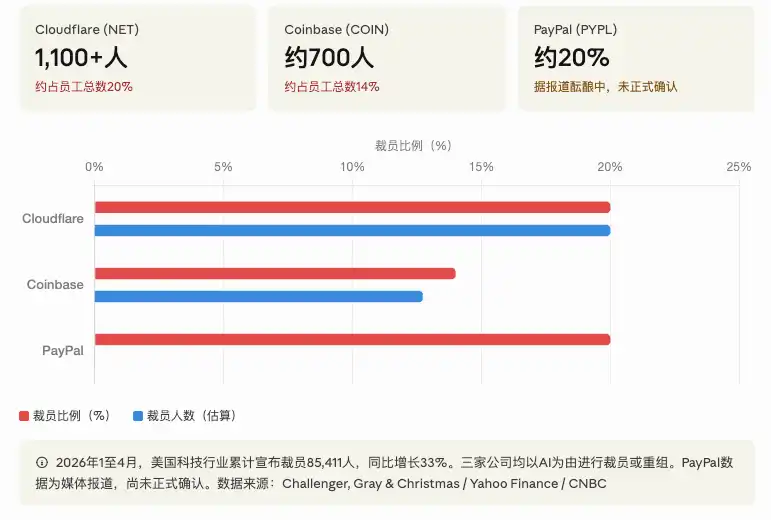
Cloudflare is not alone. According to Yahoo Finance, within the same week, Coinbase announced cutting approximately 14% of its workforce (about 700 employees), and PayPal was reportedly planning layoffs of about 20%. From January to April this year, the US tech industry announced 85,411 layoffs, a 33% increase compared to the same period last year.

Citing AI as a reason for layoffs is becoming a collective narrative for tech companies. The Register, in its reporting, directly headlined the layoffs as "jobs just aren't AI enough." Prince called AI the "single biggest tailwind Cloudflare has ever seen" on the earnings call.

For the employees who remain and those who were laid off, this "tailwind" is blowing in opposite directions.


Perguntas relacionadas

QWhat was the main reason given by Cloudflare's CEO for laying off over 1,100 employees?

AThe main reason was not cost-cutting but a comprehensive restructuring for the 'AI agent era.' The CEO stated that the nature of work at Cloudflare is fundamentally changing due to AI, with a 600%+ increase in AI usage, making certain supporting roles no longer aligned with the company's future direction.

QDespite beating Q1 2026 earnings expectations, why did Cloudflare's stock price drop significantly in after-hours trading?

AThe stock price dropped significantly (reportedly over 14-18%) due to investor concerns over the large-scale layoffs and the company's Q2 revenue guidance, which was slightly below analysts' expectations.

QWhat are the key financial details of Cloudflare's restructuring plan as mentioned in the article?

AThe restructuring is expected to incur total expenses of $140 million to $150 million. This includes $105 million to $110 million in cash expenditures (for severance, notice periods, and benefits) and $35 million to $40 million in non-cash stock-based compensation expenses.

QWhat notable contrast does the article highlight regarding Cloudflare's hiring and layoff actions within a short period?

AThe article highlights that in September 2025, Cloudflare announced plans to hire up to 1,111 interns for 2026. Less than eight months later, the company laid off approximately 1,100 full-time employees, a nearly identical number.

QAccording to the article, which other major tech companies announced significant layoffs around the same week as Cloudflare?

AIn the same week, Coinbase announced layoffs of about 14% of its workforce (around 700 employees), and reports indicated PayPal was planning layoffs of approximately 20% of its staff.

Leituras Relacionadas

Apple Also Has to Pay Rent Now

Apple Pays Rent Too: The Two-Way Flow of "Traffic Tax" and "AI Capability Rent" Between Tech Giants For over two decades, Google has paid Apple an estimated $20 billion annually to remain the default search engine on Safari, a "traffic tax" for a critical user entry point. However, in 2026, the direction of this cash flow partially reversed. Apple agreed to pay Google roughly $1 billion per year to license its Gemini AI models, as Apple's own models reportedly struggled with complex tasks. This creates a unique dynamic: Apple acts as the "landlord" in the established search ecosystem, collecting rent from Google for access. Simultaneously, in the emerging AI arena, Apple becomes the "tenant," paying Google for access to cutting-edge AI capabilities it cannot currently match internally. While Apple claims its new models are "distilled" from Gemini outputs and contain "not a drop" of Google's original code, core dependencies remain. Its knowledge base is refined using Gemini's outputs, and its most powerful cloud model runs on Google's infrastructure. Apple has structured the deal as non-exclusive, allowing it to theoretically switch AI suppliers—a hedge against over-reliance. The future hinges on whether advanced AI models become a commodity (cheap and abundant) or remain a concentrated, scarce resource (expensive and controlled by few). Apple is betting on the former, leveraging its massive device ecosystem to be a powerful, choosy customer. If the latter proves true, its bargaining power could erode. This power dynamic is extending to developers. Apple, Google, and WeChat are all pushing for apps to expose their core functions as standardized "actions" or "intents" that their respective AI assistants (Siri, Gemini, WeChat AI) can directly call. The new scarce resource is no longer just app store visibility, but "being selected by the AI." The currency of "rent" has changed from a 30% revenue share to ceding control over how users interact with an app's functions.

marsbitHá 1h

Apple Also Has to Pay Rent Now

marsbitHá 1h

Missed the SpaceX IPO? WEEX's "First Trade Protection" Lets You Experience US Stock Trading Risk-Free.

With the excitement around SpaceX's recent public listing reigniting interest in the US stock market, Chinese investors face significant challenges accessing compliant and convenient trading channels following regulatory actions against major online brokers. This article explores the available options, highlighting their risks and limitations. Traditional paths for US stock investments remain problematic. Qualified Domestic Institutional Investor (QDII) and Listed Open-Ended Fund (LOF) products, while compliant, suffer from high fees, significant purchase premiums, and a very limited selection of assets. Small, unregulated offshore brokers pose substantial risks, including potential insolvency. While secure, VIP accounts at banks in Hong Kong or Singapore require high minimum deposits (often 1-2 million RMB) and in-person visits, placing them out of reach for most retail investors. The article positions cryptocurrency exchanges, specifically their TradFi (traditional finance on-chain) offerings, as a compelling alternative. Platforms like WEEX are noted for providing access to a wide range of US stocks and ETFs, including SpaceX (SPCXON), through tokenized assets. This method offers advantages such as a single account for both crypto and traditional assets, USDT-based settlement avoiding fiat complexities, flexible leverage, and robust risk management. To attract users, WEEX is promoting a "First Trade Guarantee" campaign. Running from June 15 to July 8 (UTC+8), it features a $30,000 prize pool. Users who trade $500 worth of US stock contracts can qualify for a guarantee on their first eligible trade: 100% loss coverage up to $30 or a 20% bonus on profits up to $30. The campaign is presented as a low-risk opportunity for both crypto natives and traditional investors to experience US stock trading.

marsbitHá 1h

Missed the SpaceX IPO? WEEX's "First Trade Protection" Lets You Experience US Stock Trading Risk-Free.

marsbitHá 1h

How Difficult is Chip Making? A Division Error Costs 475 Million Dollars

How Hard Is It to Make a Chip? A Division Error Cost $475 Million Chip expert Shi Kan, a researcher at the Chinese Academy of Sciences and a popular tech creator, explains the immense challenges of chip development. Chips are foundational to modern technology, but their creation is extraordinarily difficult. The journey from sand to a functional chip involves complex design and manufacturing, but a critical bottleneck is verification—ensuring the design works flawlessly before costly production. A single, undetected bug can have catastrophic consequences, as illustrated by the infamous 1994 Intel Pentium FDIV bug. A flaw in the floating-point division unit forced a recall costing $475 million. Unlike software, chips cannot be easily patched after manufacture, making "first-time success" paramount. However, industry surveys show only 24% of chip projects achieve this; over three-quarters require at least one costly re-spin due to design flaws. Verification has thus become the dominant phase, consuming up to 70% of the design cycle. The core challenge is a "verification impossible triangle" between high performance, good debuggability, and low cost. Exhaustively verifying a modern CPU core could take 15,000 years with software simulation, or 30 years with advanced hardware emulation—timeframes utterly impractical for development. Despite being essential, verification is often seen as unglamorous "dirty work," receiving less academic attention than fields like AI. Shi and his team are tackling this by developing an agile verification research framework called ENCORE, based on FPGA technology, to improve verification efficiency and debug capability. Beyond research, Shi engages in public science communication through long-form video content, aiming to demystify chip technology, AI, and computer science. He argues for the value of pursuing "hard and long-term" endeavors, whether in the meticulous world of chip verification or in creating substantive educational content, believing such sustained effort is likely the right path forward.

marsbitHá 1h

How Difficult is Chip Making? A Division Error Costs 475 Million Dollars

marsbitHá 1h

Trading

Spot
Futuros
活动图片




