Claude's New Policy Abandons Its Most Loyal Agent Users

marsbitPublicado em 2026-05-15Última atualização em 2026-05-15

Resumo

Anthropic, in a move signaling the end of the "all-you-can-eat" era for AI subscriptions, has separated programmatic usage from its Claude subscription plans. Starting June 15, 2024, usage of the Claude Agent SDK, `claude -p` command, and third-party tools like OpenClaw will no longer draw from subscription limits. Instead, users receive a fixed monthly credit based on retail API prices: $20 for Pro, $100 for Max 5x, and $200 for Max 20x. This change drastically reduces usable capacity for heavy users—previously, their shared subscription limit was worth an estimated $2,000-$5,000 in API value. While Anthropic simultaneously increased Claude Code interactive limits to appease users, the new policy primarily impacts developers running automated, high-frequency agents, pushing their effective costs nearly ten times higher. Seizing the opportunity, OpenAI promptly announced a free two-month migration plan for its Codex enterprise service, which does not differentiate between interactive and automated usage, directly targeting discontented Claude users. This marks an opening salvo in the broader ASI (Artificial Superintelligence) competition, where the final battle is shifting from pure model capability to ecosystem strength, developer loyalty, and infrastructure. The article frames this as a necessary correction of a pricing "loophole" by Anthropic ahead of its IPO, as programmatic calls lack training data value and can incur massive costs. The move underscores a wider indust...

Anthropic has separated Agent SDK usage from subscriptions, offering a fixed credit based on API retail prices instead. Heavy users have seen their usable volume shrink by nearly tenfold. In the same week, OpenAI offered enterprise users two months of free migration to Codex. The first pricing battle in the final round of the ASI race has begun.

Anthropic has changed programmatic calls from an "all-you-can-eat buffet" to "rationed portions."

Effective June 15, calls from claude -p, Agent SDK, GitHub Actions, and third-party tools like OpenClaw and Hermes are all being separated from subscription quotas.
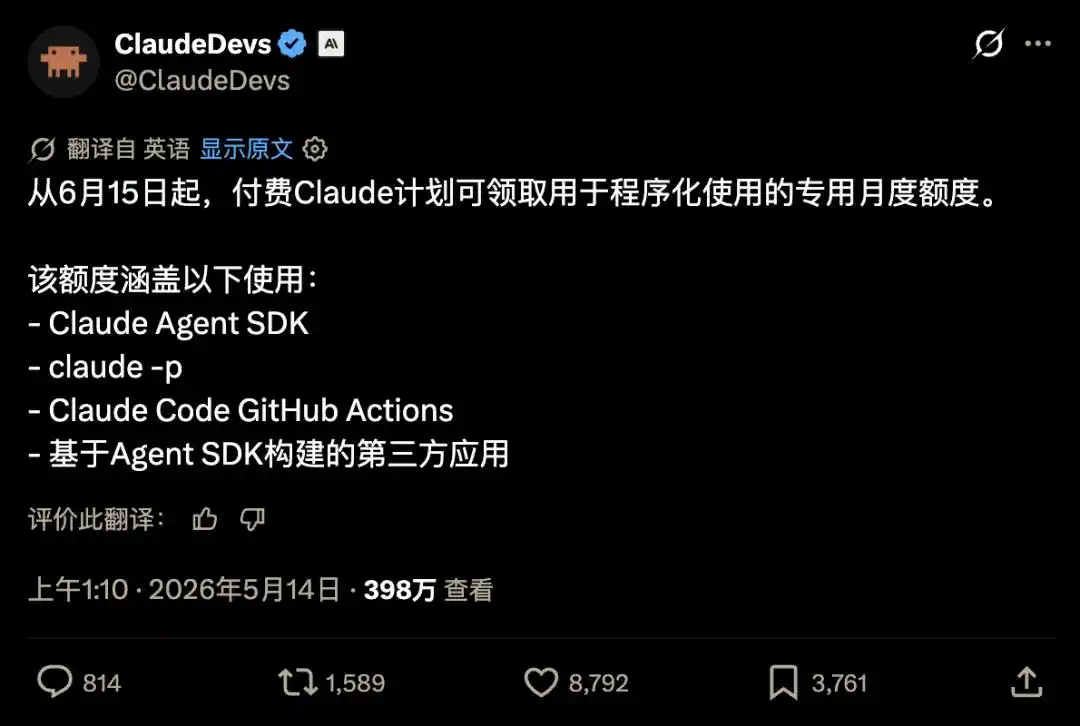
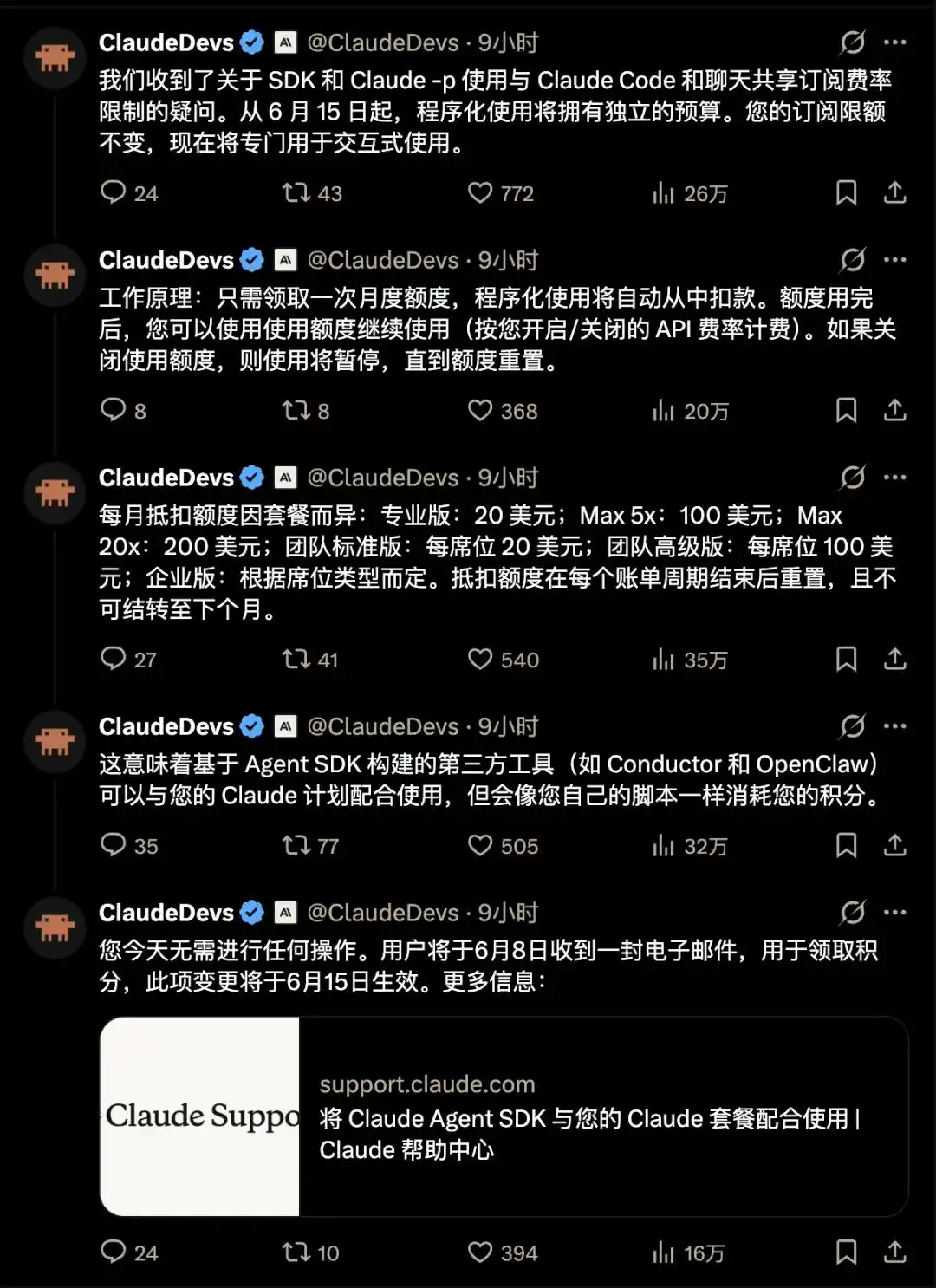
https://x.com/ClaudeDevs/status/2054610152817619388

This is being replaced by a monthly Credit calculated based on API retail prices: $20 for Pro, $100 for Max 5x, and $200 for Max 20x.
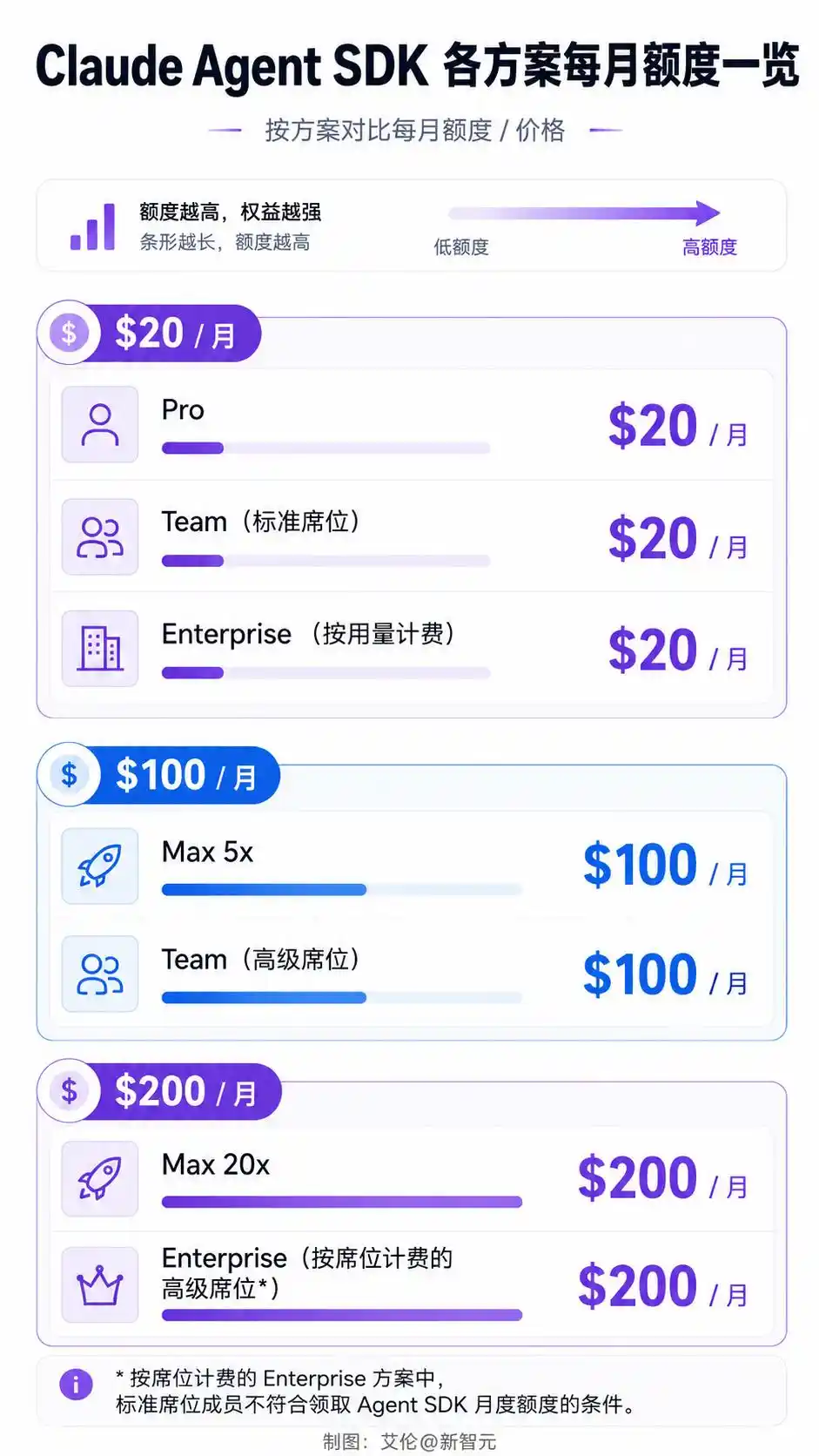
The original subscription quota remains unchanged, dedicated exclusively to Claude Code interactive use and claude.ai chat. The two pools do not interfere with each other.

Credits must be manually claimed. Notification emails were sent on June 8, effective from June 15, resetting monthly without rollover.

Anticipating user frustration, Claude Code quotas were raised twice in a row to appease users.

Last week, the 5-hour rolling window doubled, and this week the weekly total increased by another 50%. These are cumulative and effective until July 14.

https://x.com/ClaudeDevs/status/2054639777685934564

All paying users are automatically adjusted; no action is required.

Anthropic's biggest competitor, OpenAI, quickly seized this opportunity, immediately launching a free Codex migration for enterprises.
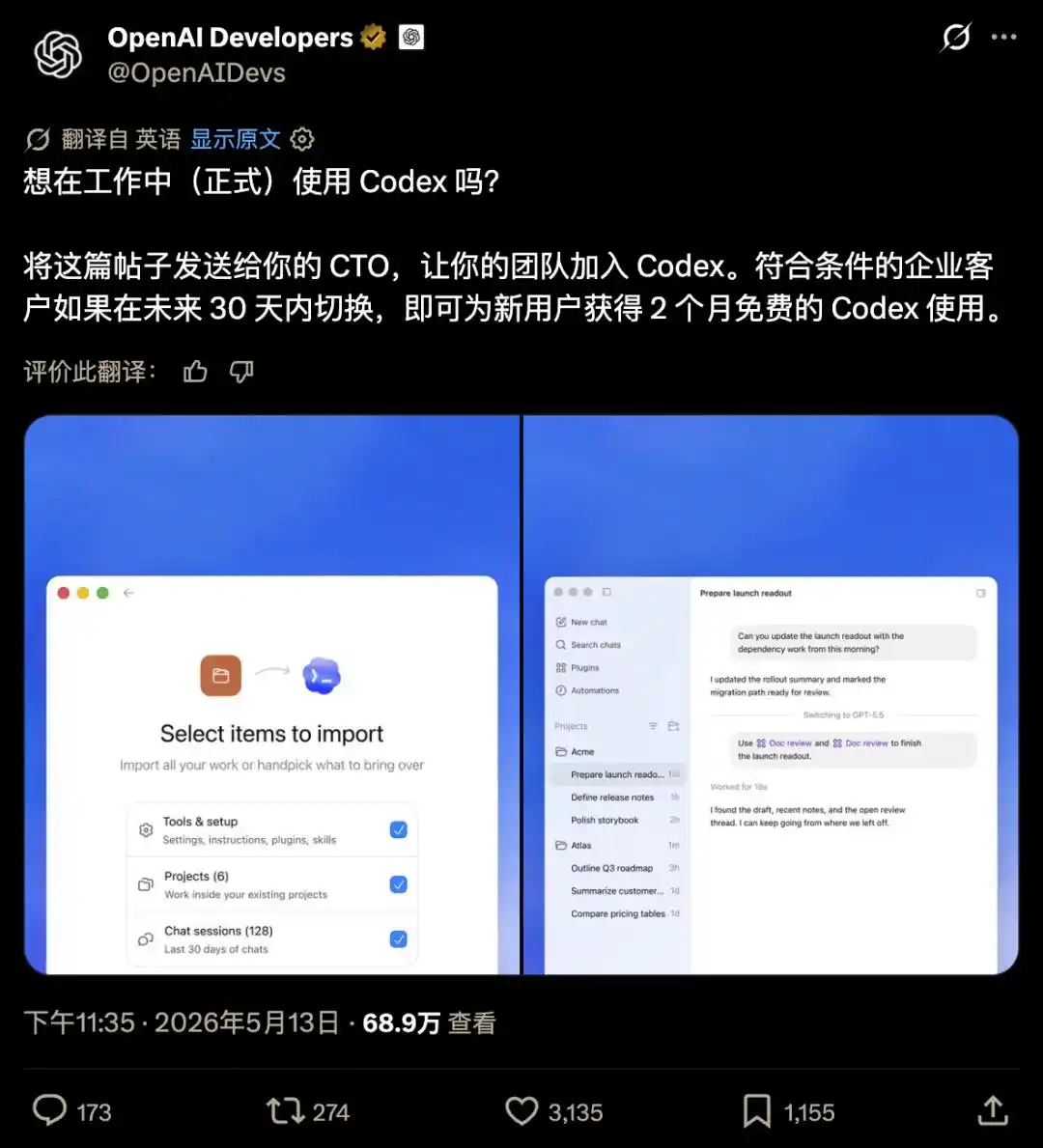
https://x.com/OpenAIDevs/status/2054586214112780518

Apply within 30 days for 2 months free, with a built-in one-click migration tool that can directly transfer Claude Code's system prompts, Skills, and MCP configurations.

Codex does not differentiate between interactive and programmatic calls; subscription users can use it however they want.

These three events happening simultaneously are not a coincidence.

Why Split?

There is a structural flaw in Anthropic's subscription model. On the eve of its impending IPO and the ASI sprint, Anthropic can no longer tolerate this flaw.

The economic model of subscriptions is based on the premise that human typing speed is limited.

The Token volume a $200/month Max 20x user can consume through manual interaction translates to an API retail price between $2000 and $5000.

Anthropic was willing to subsidize this difference because interactive data is valuable for model training.

Agent SDK and claude -p broke this premise.

Machines calling 24/7, a for loop could consume a month's quota in just a few hours. Moreover, programmatic calls have almost no training value from user behavior data.

It was tolerable when the user base was small.

But SpaceX just leased 220,000 GPUs to Anthropic, Google added up to $40 billion in investment, and Amazon signed a $25 billion capacity agreement.

For further reading: Breaking News, Musk's xAI Disbands! 220,000 GPUs Reluctantly Given Entirely to Claude

With compute power secured and user numbers poised to explode, the subsidy bleeding would amplify exponentially.

Anthropic's help documentation also explicitly states its position: teams running production-grade automation should switch to the developer platform and use API keys for pay-as-you-go billing.

This is a pricing flaw patch, timed by the rhythm of the ASI competition.

How Big is the Cost?

Same face value, but actual shrinkage is nearly tenfold.

A Max 20x user pays $200 monthly and receives a Credit of $200.

But before, they shared the subscription quota, which, converted to API retail price, was worth approximately $2000-$5000.

Now it's replaced by a fixed $200 credit calculated at API retail price.
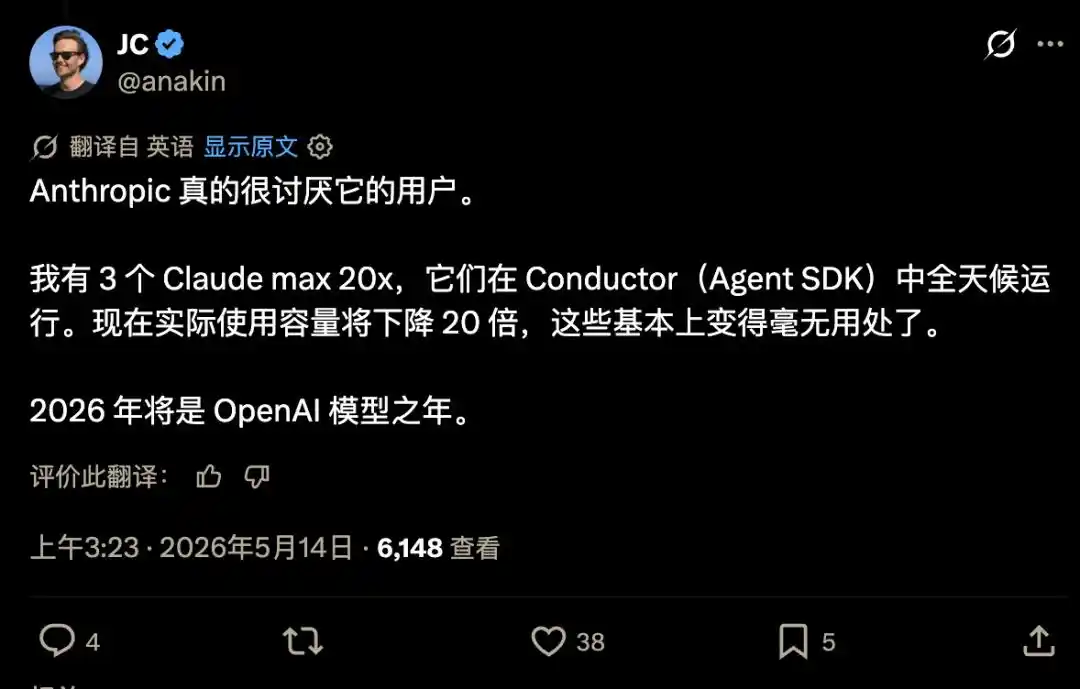
https://x.com/anakin/status/2054643675590807884

Pro users are in an even more awkward position. $20 for Sonnet only allows about six to seven million input Tokens or a little over a million output Tokens. A few rounds of intensive Agent loops will deplete it.
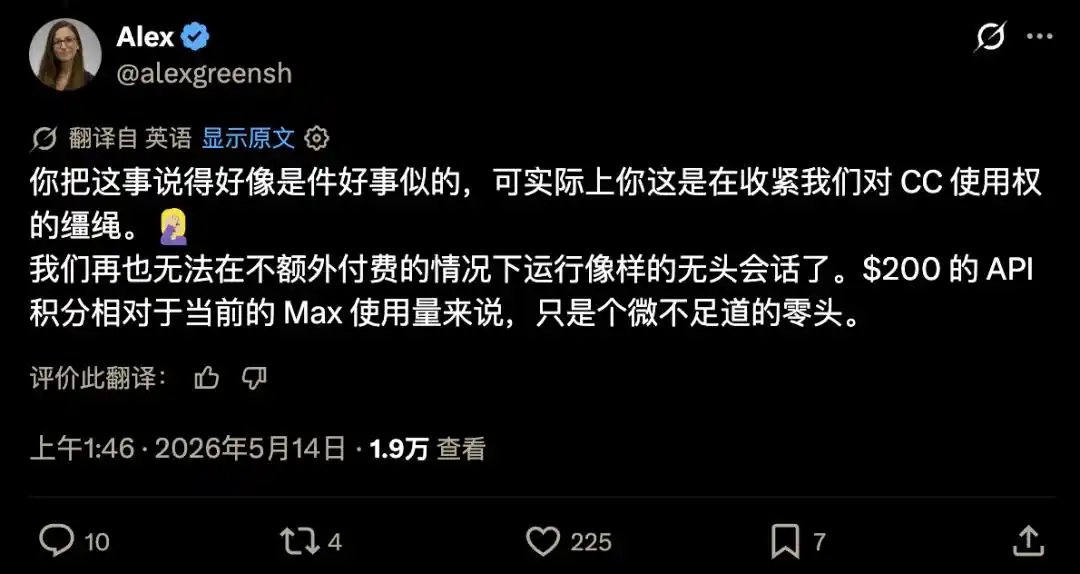
https://x.com/alexgreensh/status/2054619241811169402

Third-party tool users are hit the hardest.

Previously, using Agent tools like OpenClaw and Hermes was equivalent to running high-frequency automation at subscription prices.

Under the new policy, this path is left with only that small amount of credit. Once burned, users either enable Extra Usage to continue at API prices or stop until next month.

The only good news is that third-party tools finally received their "official ID."

Two months ago, Anthropic still viewed OpenClaw as a means of exploiting loopholes. Now, the announcement directly names and acknowledges their legitimacy.

Mismatch Between Compute Power and Developers

At the moment of greatest compute power, Anthropic uses pricing policy to push heavy developers toward competitors.

SpaceX's 220,000 GPUs are currently the only compute power cooperation that can be immediately deployed; other partners' capacity all needs to wait until late 2026 or even 2027.

With this batch of spot compute power backing it up, Claude Code quotas can be successively raised.

But the Claude Code quota increase and the SDK Credit cap target two different groups.

The overlap between interactive users and programmatic call users is limited. The improved experience for the former does not offset the losses for the latter.

OpenAI precisely stepped into this crack.

Codex does not separate usage by method, does not differentiate between call types, has zero seat fee, charges by Token, and includes a tool for one-click migration from Claude Code.

The pain point just created by Anthropic is immediately used as a selling point by OpenAI.

https://x.com/brodieferguson/status/2054653995864707344

The two-month free period is just enough for enterprises to get their automated pipelines running and form muscle memory.

After the free period ends, the migration cost is already too high to move back.

Why This Matters to Everyone

The era of "unlimited all-you-can-eat buffets" for AI subscriptions is ending.

Anthropic's patching of this loophole is just the beginning.

As Agent capabilities grow stronger and automated calls become more frequent, all AI companies will face similar economic pressure.

AI payment models will gradually shift from monthly flat rates to pay-as-you-go based on actual consumption, much like the path cloud computing took.

The ownership of the developer ecosystem determines what AI ordinary users will use in the future.

Whoever wins over developers will have a richer tool ecosystem.

Today's battle between Claude Code and Codex will directly reflect the quality of AI applications available on everyone's phones in three to five years.

The endgame of the ASI competition is not just about model capabilities, but also about ecosystems.

The final round of the ASI competition, the contenders are basically locked in: on one side, OpenAI + Microsoft + Stargate (Oracle + SoftBank); on the other, Anthropic + Google + Amazon + SpaceX.
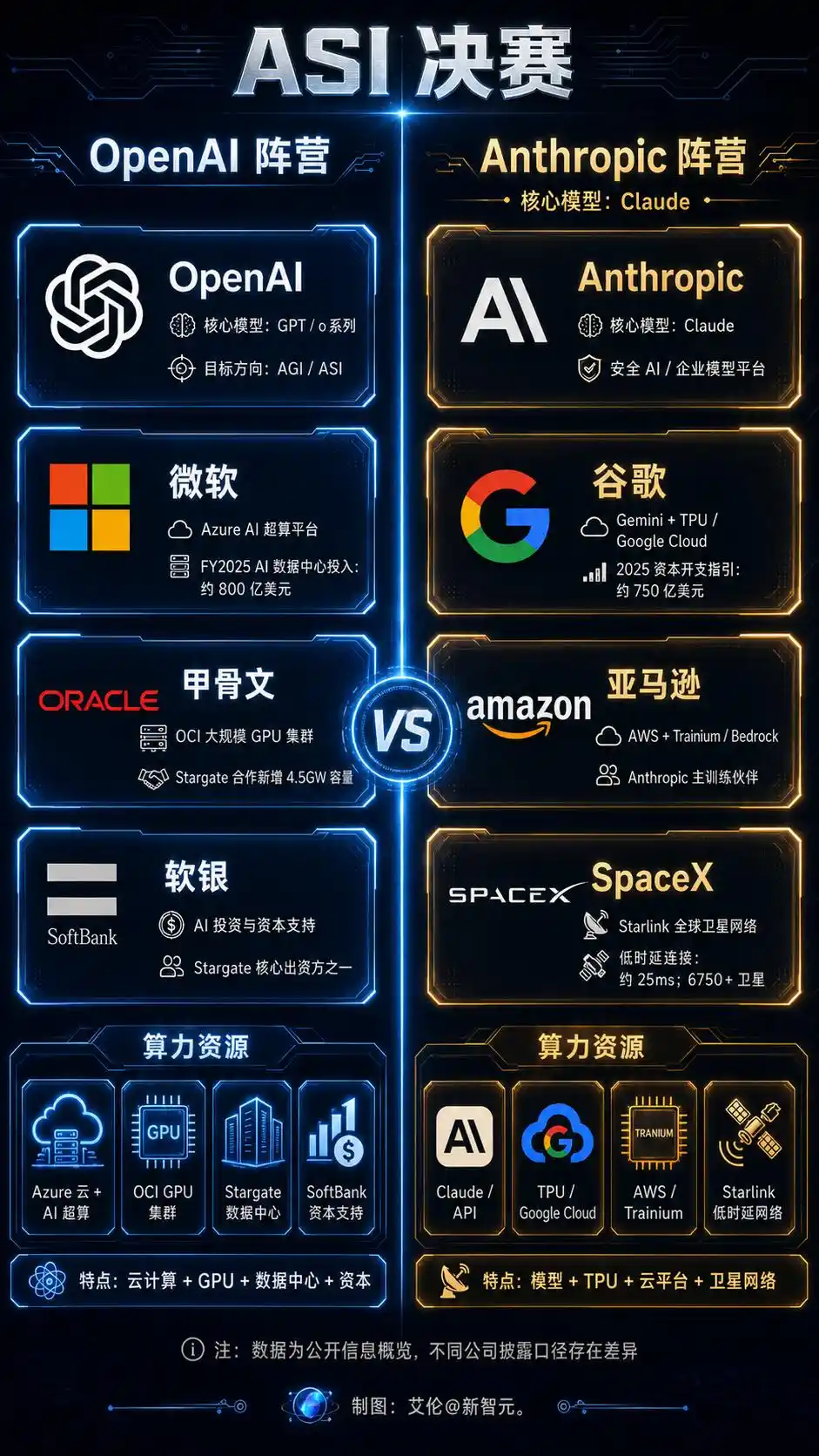
Model capabilities are converging. The real moat lies in who has the strongest infrastructure, the most developers, and the most entrenched enterprise customers.

This week's covert pricing war is the first shot in the final round.

Three things to watch next: the verdict in the Musk vs. Altman case in mid-May, Anthropic's IPO pricing in June, and whether the temporary Claude Code quota increase becomes permanent after its expiration on July 14.

The direction of these three events will directly determine which side the developer ecosystem scale tips towards in the ASI race.

Remember to claim your Credit on June 8. If you don't claim, it's $0; claiming gives you at least $200.

Appendix: Full Announcement

Using Claude Agent SDK in Your Claude Plan

Updated today

Claude subscription plans are now eligible for monthly Agent SDK credits. These credits cover Claude Agent SDK usage, the claude -p command, and third-party applications built on the Agent SDK. This article explains what is covered by the credit, how it works, and how to claim it.

Available in Pro, Max, Team, and Enterprise plans from June 15, 2026. Claude developer platform accounts using API keys will not receive credits. Pay-as-you-go billing remains unchanged.

What's Changing

From June 15, 2026, Claude Agent SDK and claude -p usage will no longer count against your Claude plan's usage limits. Your subscription usage limits remain unchanged and are reserved for interactive use of Claude Code, Claude Cowork, and Claude.

To support Agent SDK usage, eligible Pro, Max, Team, and Enterprise plan users can claim a separate monthly credit. This credit applies only to Agent SDK usage and refreshes with your billing cycle.

Monthly Credit by Plan
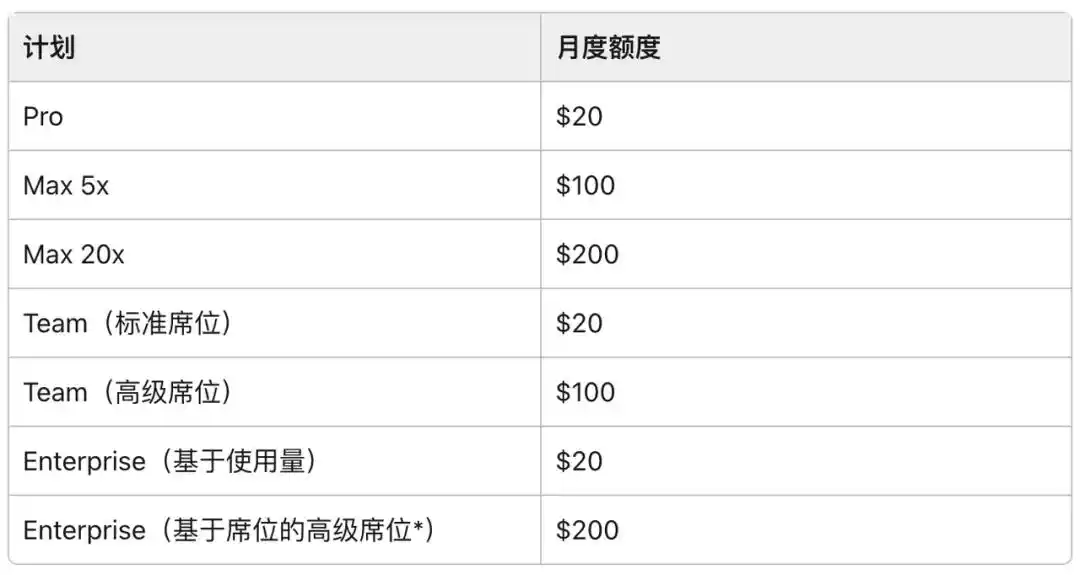
*Members using standard seats in seat-based Enterprise plans are not eligible to claim the Agent SDK monthly credit.

What the Credit Covers

The Agent SDK monthly credit applies to:

Claude Agent SDK usage (Python or TypeScript) in your own projects

The claude -p command (non-interactive mode) in Claude Code

Claude Code GitHub Actions integration

Third-party applications using your Claude subscription for authentication via Agent SDK

The Credit Does Not Apply to:

Interactive Claude Code in terminals or IDEs

Claude conversations on web, desktop, or mobile apps

Claude Cowork

Other features deducted from extra usage

How the Credit Works

Per user, not shared. Credits belong to individual accounts. They cannot be shared or pooled among team members.

Refreshes monthly. Your credit resets at the start of each billing cycle. Unused credits do not carry over to the next cycle.

One-time opt-in. You claim the credit once through your Claude account. Afterwards, it refreshes automatically each cycle.

Priority deduction. Agent SDK usage is deducted first from your monthly credit, then from other sources.

Usage transfers to extra usage after credit is exhausted. When your monthly credit is used up, additional Agent SDK usage flows to extra usage at standard API rates—but only if you have extra usage enabled. If extra usage is not enabled, Agent SDK requests will stop until your credit refreshes.

What Remains Unchanged

This change does not affect:

Subscription usage limits. Your plan's usage limits have not changed as part of this update.

Interactive Claude Code. Using Claude Code in terminals or IDEs continues to use your subscription usage limits exactly as before.

Claude conversations. Web, desktop, and mobile chat continue to use subscription usage limits.

API key users. If you use Agent SDK with an API key from the Claude developer platform, nothing changes. Pay-as-you-go billing continues, and you will not receive an Agent SDK monthly credit.

For Team and Enterprise Administrators

If you manage a Team or Enterprise account, here's what you need to know:

Credit is per user. Each eligible user in your team claims their own credit. Credits cannot be pooled, transferred, or shared across the organization.

Large-scale production automation. The Agent SDK monthly credit is sized for personal experimentation and automation. Teams running shared production automation should use the Claude developer platform and API keys for predictable pay-as-you-go billing.

What you need to do. No action is required now. Eligible users in your team will receive an email with details and instructions for claiming the credit before June 15, 2026.

References:

https://support.claude.com/zh-CN/articles/15036540-%E5%9C%A8%E6%82%A8%E7%9A%84-claude-%E8%AE%A1%E5%88%92%E4%B8%AD%E4%BD%BF%E7%94%A8-claude-agent-sdk

https://x.com/ClaudeDevs/status/2054610152817619388

https://x.com/ClaudeDevs/status/2054639777685934564

This article is from the WeChat public account "Xinzhiyuan," author: Xinzhiyuan, editor: Ellen

Perguntas relacionadas

QWhat is the main change Anthropic made to its pricing structure regarding Claude Agent SDK and related tools?

AAnthropic separated programmatic calls (via Claude Agent SDK, claude -p, GitHub Actions, and third-party tools like OpenClaw and Hermes) from the standard subscription limits. Instead, it now provides a separate monthly credit based on API retail prices ($20 for Pro, $100 for Max 5x, $200 for Max 20x) for such usage.

QWhy did Anthropic implement this pricing change, according to the article?

AAnthropic implemented this change to fix a structural flaw in its subscription model. The model was based on limited human typing speed, but programmatic/Agent usage allows for unlimited automated calls, creating unsustainable cost subsidies for Anthropic, especially as user numbers are expected to grow.

QWhat was OpenAI's response to Anthropic's pricing policy change?

AOpenAI seized the opportunity by offering a free migration to Codex for enterprise users. It provides two months of free service, an integrated migration tool to move from Claude Code, and a usage model that does not differentiate between interactive and programmatic calls.

QHow does the article describe the impact of the change on heavy Agent SDK or third-party tool users?

AThe impact is severe, described as a nearly tenfold reduction in effective usage for heavy users. Previously, subscription limits (valued at $2000-$5000 in API retail terms for a Max 20x user) covered this usage. Now, they receive a fixed credit worth only its face value ($200 for Max 20x).

QWhat broader trend in AI service pricing does the article suggest this change represents?

AThe article suggests this marks the beginning of the end for the 'all-you-can-eat' subscription model in AI. It predicts a shift towards usage-based billing, similar to the evolution of cloud computing, as Agent capabilities and automated usage increase the cost pressure on AI companies.

Leituras Relacionadas

After Three Consecutive Quarters of Decline, Can the Crypto Market Find a Window for Stabilization in Q3?

The cryptocurrency market has just concluded its worst-performing quarter since 2022, with total capitalization dropping 12.6% to $2.1 trillion. All core metrics indicate capital is leaving the sector, not just rotating within it. Bitcoin fell 14.2% and Ethereum dropped 25.4% in Q2, breaking their previous correlation with US tech stocks. A key driver is the reversal in US spot Bitcoin ETF flows, which saw a net outflow of approximately $4.67 billion in Q2, including a record monthly outflow near $4.5 billion in June. While recent data suggests long-term holders are accumulating again, sustained ETF outflows mean continued selling pressure. Market focus is now singularly on the Federal Reserve. The upcoming July FOMC meeting is seen as the most critical event for Q3. A dovish signal could support Bitcoin reclaiming a $68,000-$84,000 range, while a hawkish stance might establish a new trading band around $50,000-$56,000. Additionally, regulatory uncertainty persists, with the progress of the crucial *CLARITY Act* stalling in the Senate, reducing its perceived 2026 passage probability to 40-45%. Despite the broad downturn, a few sectors showed growth. Prediction markets saw nominal volume surge 48.7% year-over-year to $113.8 billion, and tokenized collectibles transaction volume rose 143% quarterly to $1.4 billion. The Real-World Asset (RWA) tokenization sector also continued steady growth, now representing ~$28.1 billion in on-chain value. The market's foundation for an extreme crash appears limited, with Bitcoin price hovering near its 200-week moving average. However, the trading paradigm has shifted from narrative-driven speculation to decisions based on price action, policy developments, and interest rate expectations, making a broad sentiment-driven rally unlikely in the near term.

marsbitHá 13h

After Three Consecutive Quarters of Decline, Can the Crypto Market Find a Window for Stabilization in Q3?

marsbitHá 13h

BIT Trading Moment: BTC Still Suppressed by Weekly 200 EMA, Rejection May Restart Decline; Storage and Semiconductors that Surged Last Night Begin Falling in Evening Trading

**Crypto & Stock Market Wrap: Bitcoin Tests Resistance, Stocks Retreat After AI Surge** Bitcoin consolidates around $66,000, facing key resistance near $68,000—an area seen as a major psychological and technical hurdle where previous rallies have failed. Analysts note the cryptocurrency is caught between its 200-week moving average (~$63,333) and 200-week EMA (~$68,328). A clear break above $68k is needed to signal a stronger bullish trend, while a rejection could lead to a retest of $63k support. Market sentiment remains cautious, with low futures open interest pointing to a low-liquidity rebound rather than a full bull market. Bitcoin spot ETFs saw another $203 million inflow. US stock futures pointed lower after a strong Tuesday session led by a massive rebound in semiconductors and memory stocks. The rally was fueled by renewed optimism about AI-driven hardware demand, with Micron, SanDisk, and SK Hynix surging. However, those gains reversed in pre-market trading. Super Micro Computer (SMCI) soared over 20% after hours on strong guidance and a record backlog. Other standouts included Rocket Lab and nuclear energy plays Oklo and X-Energy. Rising oil prices (Brent above $91) and climbing Treasury yields (10-year near 4.64%), however, are reigniting inflation concerns and acting as a headwind for equities. In Asia, markets were mixed. South Korea's KOSPI pared early gains to close slightly higher as semiconductor stocks like SK Hynix gave back initial surges. Japan's Nikkei edged lower as the yen hit a fresh 38-year low against the dollar, raising fears of potential market intervention. Key events to watch include the Samsung Galaxy launch, AMD's AI event, and a slew of major tech earnings from Alphabet, Tesla, and IBM after the close on Wednesday, followed by the ECB meeting and Intel's earnings on Thursday.

marsbitHá 13h

BIT Trading Moment: BTC Still Suppressed by Weekly 200 EMA, Rejection May Restart Decline; Storage and Semiconductors that Surged Last Night Begin Falling in Evening Trading

marsbitHá 13h

Former CFTC Chairman, Circle President Tarbert: Preaching Long-Termism While Cashing Out $30 Million Himself

Former CFTC Chairman and Circle President Heath Tarbert has consistently advocated for a long-term vision in public, urging patience from investors as Circle’s stock price has fallen significantly from its peak. However, it has been revealed that since Circle’s IPO, Tarbert has continuously sold his CRCL shares through pre-arranged trading plans, cashing out approximately $30 million, without making any public market purchases. This contrast between his public messaging and personal actions has drawn criticism. Tarbert joined Circle in July 2023 as Chief Legal Officer, leveraging his regulatory experience to help guide the company through its IPO and expansion. Despite promoting stablecoins as long-term infrastructure, he established a 10b5-1 trading plan just before Circle went public, leading to substantial stock sales over the following year. In March 2026, he initiated another plan to sell more shares. His career trajectory highlights a pattern of moving between high-level regulatory roles and influential positions in the financial sector. After resigning as CFTC Chairman in early 2021, he joined Citadel Securities as Chief Legal Officer just 27 days later, during a period of intense regulatory scrutiny for the firm. He later joined Circle, aiding its efforts to navigate regulatory challenges for its public listing. While Tarbert's expertise in policy and compliance is valuable to companies like Circle, his actions—advocating long-term confidence while personally divesting—raise questions about the alignment between his public statements and his private financial decisions, leaving investors who followed his advice to bear the market risks.

marsbitHá 13h

Former CFTC Chairman, Circle President Tarbert: Preaching Long-Termism While Cashing Out $30 Million Himself

marsbitHá 13h

Gate Research Institute: The 'Wall Street-ization' Wave of Crypto Financial Products – Competition or Integration?

The article titled "Gate Research Institute: Are Crypto Financial Products Sparking a 'Wall Street' Wave—Competition or Convergence?" explores the evolving relationship between the crypto ecosystem and traditional finance (TradFi). The piece begins by reflecting on Bitcoin's original 2009 vision of decentralization, disintermediation, and moving away from banks. It then contrasts this with the 2024 landscape, where key crypto assets like Bitcoin are increasingly held through Wall Street products like ETFs issued by giants like BlackRock. The article questions whether this signifies that TradFi is systematically taking over the rights to issue, price, custody, and distribute crypto financial assets. The core argument is that this is not a zero-sum takeover but rather a bidirectional convergence where each side addresses the other's weaknesses. Crypto offers 24/7 global markets, programmable settlement, and open access but lacks compliant channels, institutional-grade custody, deep fiat liquidity, and mainstream distribution. TradFi possesses these but is constrained by legacy systems, limited operating hours, and slow settlement. Two primary convergence paths are highlighted: * **Path A (CEX to TradFi):** Exemplified by Gate, which has progressed from offering tokenized stocks and CFDs to providing direct, real stock trading (US, Hong Kong, South Korea) within its platform, using USDT. * **Path B (TradFi to Crypto):** Exemplified by Robinhood, which has integrated crypto trading, acquired exchanges like Bitstamp, and is moving traditional assets like stocks onto the blockchain via tokenization and its own Layer 2. Both paths are ultimately competing to become the next-generation, unified financial account—a "super account" where users can seamlessly trade cryptocurrencies, stocks, ETFs, RWA (Real World Assets), and tokenized treasury products in one interface. The growth of RWA and tokenized treasuries (e.g., BlackRock's BUIDL) is presented as the asset-layer fusion, providing stable, yield-bearing assets on-chain and acting as a bridge between the two worlds. In conclusion, the "Wall Street-ization" of crypto is framed as a mutual transformation. Decentralized ideals persist in the protocol layer, while at the application layer, a more efficient, global, and accessible unified capital market is emerging from this convergence. The future competition lies not between crypto exchanges and stockbrokers, but between platforms vying to offer the most comprehensive asset coverage, liquidity, and user experience within a single account.

marsbitHá 13h

Gate Research Institute: The 'Wall Street-ization' Wave of Crypto Financial Products – Competition or Integration?

marsbitHá 13h

Trading

Spot
活动图片





