Claude Starts Independently Designing New Proteins, Efficiency Surpasses Human Experts by Dozens of Times

marsbitPublicado em 2026-08-19Última atualização em 2026-08-19

Resumo

Anthropic's Claude AI autonomously designed novel protein binders, achieving a 26.8% overall success rate (354 validated designs out of 1320) across 14 out of 15 target proteins—double to triple the industry average of 10-15%. Guided by a detailed 16k-word prompt but making all design decisions itself, Claude orchestrated existing tools like RFdiffusion and ProteinMPNN over 24-48 hours per target. Notably, it succeeded on challenging targets like TNFα (where expert teams had failed) and outperformed a public competition's results on RBX1. While promising for accelerating therapeutic discovery, Anthropic has restricted such capabilities in its public model due to dual-use concerns. The prompts, data, and all designs are publicly released.

Anthropic had Claude design proteins itself, hitting 14 out of 15 targets—a result that amazed researchers in the field.

On August 18, Anthropic released an experimental result: Claude (Mythos Preview and Opus 4.8) autonomously completed an entire protein design workflow.
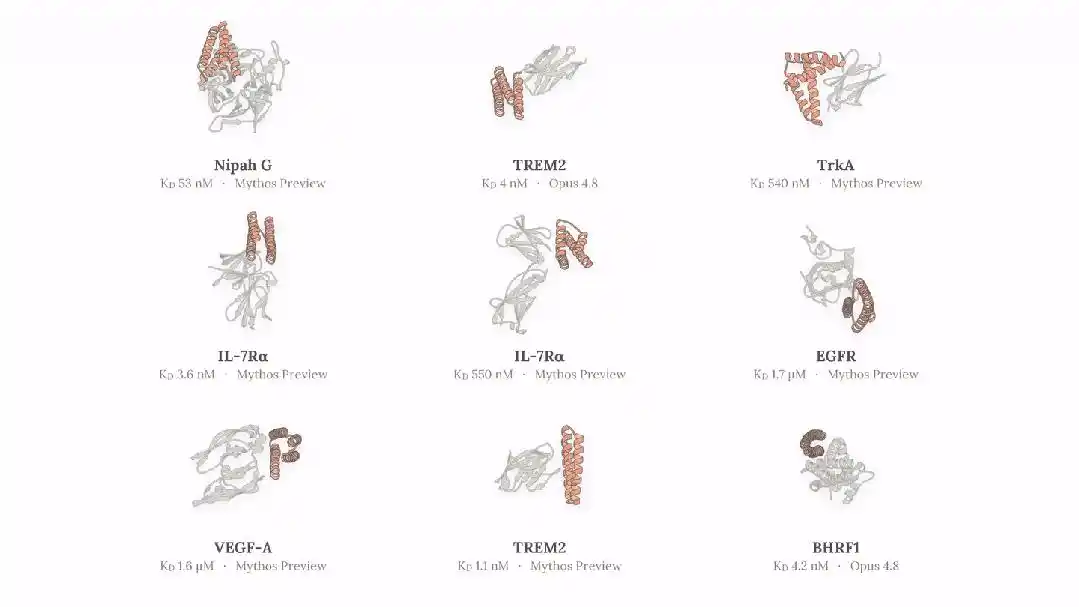
Given 15 protein targets, it was asked to independently design new proteins to bind to them, succeeding for 14 targets.

Out of 1320 designs, 354 were validated as effective by two independent labs, with an overall success rate of 26.8%.

The industry average in this field is 10%–15%.

Protein binders are the foundation for how many drugs work: first, design a molecule that can grab the target protein, then it might become a drug.

This design process typically requires protein engineers weeks of computation, optimization, and screening.

From AlphaFold to Claude: Predicting Proteins and Designing Proteins Are Two Different Things

What AlphaFold did in 2020: given a protein sequence, predict the shape it folds into.

The input is known, the output is a prediction.

It is a specially trained protein model, doing one thing extremely well.

What Claude did this time is different.

It was only given the name of a target protein, with the task of designing a brand new protein from scratch to bind to it.

The input is a name, the output is a new protein.

One is describing a picture, the other is writing an essay from a prompt.

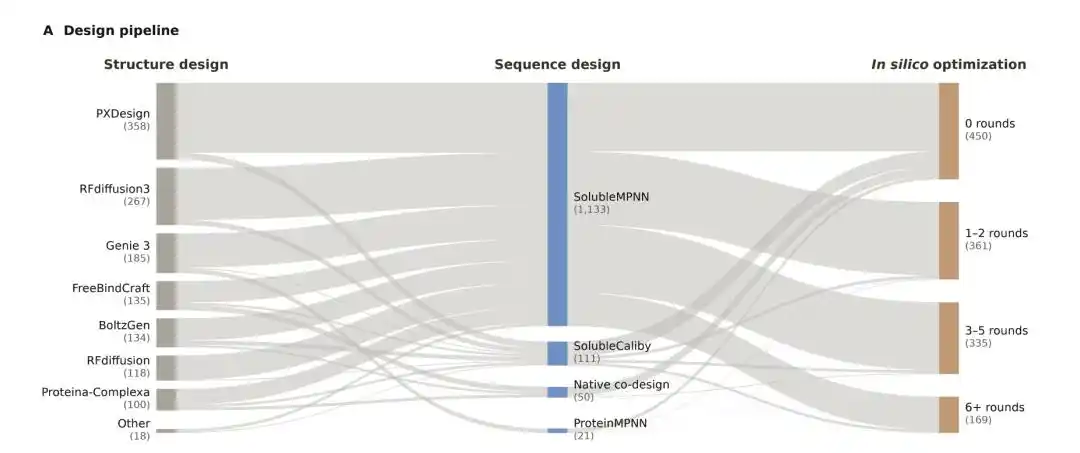
The tools Claude used were all off-the-shelf—RFdiffusion, ProteinMPNN, ESMFold2. These open-source models for protein design and structure prediction already exist and can be downloaded by any lab.

Claude didn't invent new tools; what it did was orchestration: the research team wrote a prompt of approximately 16,000 words, encoding the working knowledge of protein engineers, including the stages of the experiment, the tools available at each stage, and screening criteria.

This prompt did not specify which face of the protein to target, which generation method to use, or preset any sequences.

It was given to Claude, along with a cloud server account, and left to run.

In multi-target mode, a single 48-hour Session handled 14 targets simultaneously; in single-target mode, each target took 24 hours.

Human operators only did three things: approved network access, monitored infrastructure, and sent the designs prioritized by Claude to two independent labs (Adaptyv Bio and Twist Bioscience) for synthesis and testing—no one intervened in any design decisions.

Claude autonomously selected targets, selected epitopes, installed tools, ran models, screened and optimized, prioritized deliverables, and ultimately utilized 10 different structure generation methods, combining them into 24 tool combinations.
Results

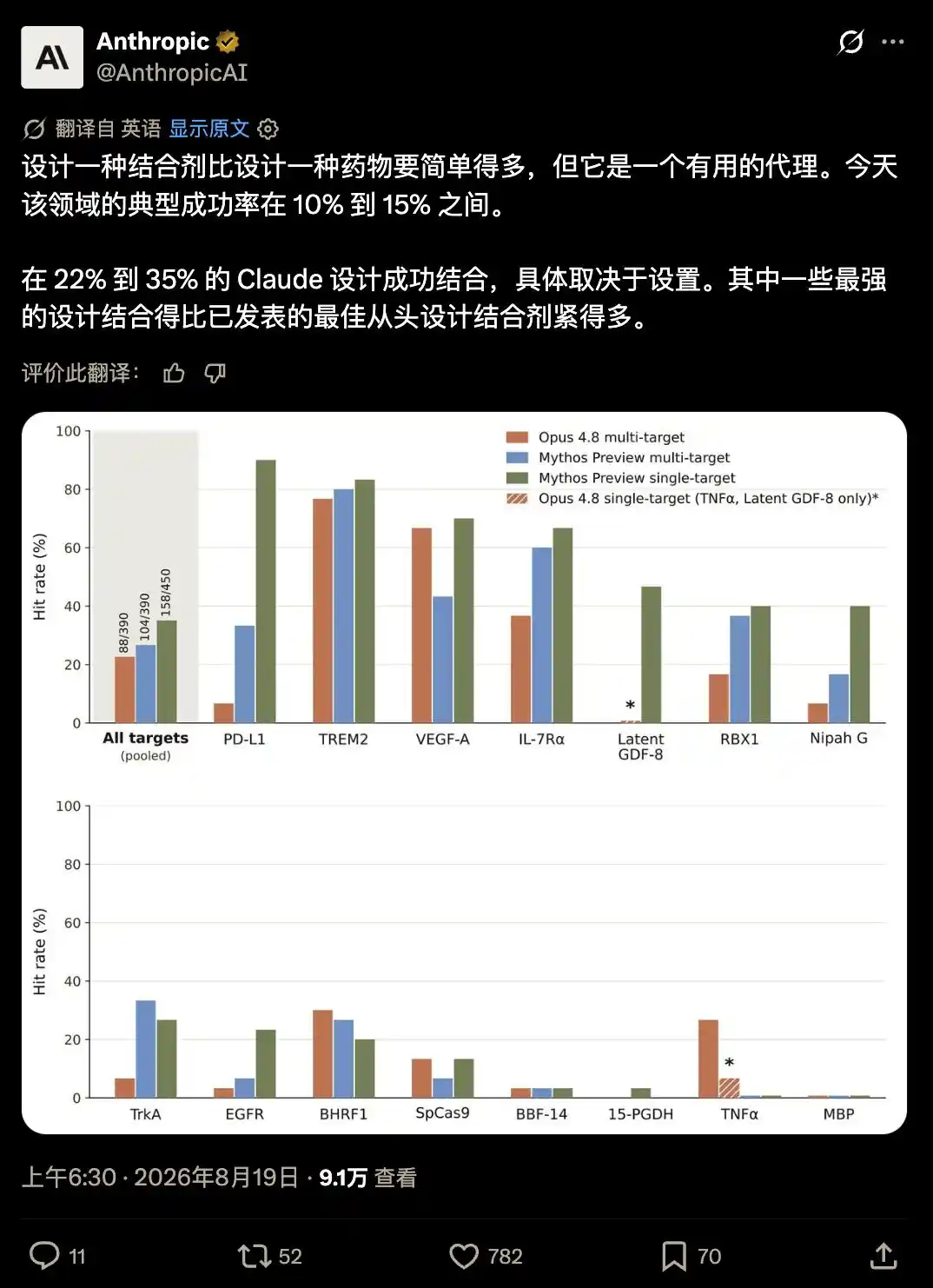
The current average success rate in the protein design field is 10%–15%.

Claude, in different modes, achieved 22%–35%, two to three times the industry average.
https://x.com/AnthropicAI/status/2089842389682954621

If we look only at Claude's own top-ranked design, the hit rate was 49%: for every two targets, the design ranked first was directly usable for one.

Results for several targets are worth mentioning separately.

Adaptyv Bio previously hosted an open design competition for a protein called RBX1; global participants submitted 245 designs, only 9 of which were successful.

Claude submitted 90 designs for the same target, with 28 successes; its best design bound the target ten times more tightly than the competition champion.

TNFα is an even harder target—Humira, one of the world's best-selling drugs, works by binding to this protein, but multiple expert teams had previously attempted *de novo* binder design, all failing.

Opus 4.8 produced 12 effective designs, some of which could even cross-species binding to human, monkey, and mouse TNFα simultaneously.

There were also failures: for a protein called MBP, all 90 designs failed.

Similar signals exist in analytical chemistry.

Given raw data from an NMR spectrometer and a one-sentence instruction, Claude Opus 5 produced results in 23 minutes, consistent with conclusions from a lab chemist's manual analysis taking half an hour to an hour.

The two experimental directions are different, but the signal is consistent: this generalist model, Claude, autonomously ran and produced lab-validated, expert-level results in 24 to 48 hours (48 hours in multi-target mode, 24 hours in single-target mode) for research tasks that would take experts weeks.

Just Six Years, A World Transformed

Binders are still far from being drugs, with steps like toxicology and clinical trials in between, each taking years.

All structures are computational predictions, not yet verified by experimental structural biology.

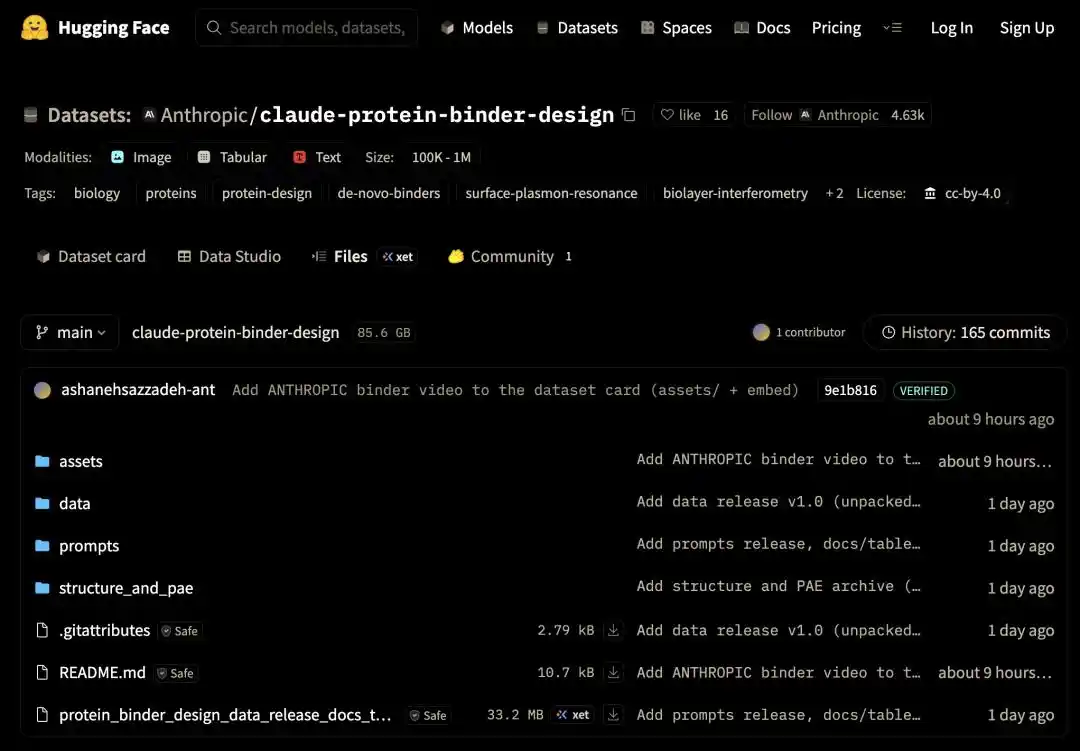
Claude used only open-source tools; Anthropic has open-sourced the prompt, data, and all 1440 design models on HuggingFace, allowing any lab to reproduce the work.
https://huggingface.co/datasets/Anthropic/claude-protein-binder-design/tree/main

Such autonomous research capabilities carry dual-use risks; Anthropic has blocked protein design and other biological capabilities in the public version of Claude.

Only six years have passed from AlphaFold predicting protein structures to Claude autonomously designing proteins.

References:

https://www.anthropic.com/research/Claude-accelerates-protein-design

https://www-cdn.anthropic.com/30bf50e22a01388bb29bf077ee3f244531594b7a.pdf

This article is from the WeChat public account "新智元" (New Wisdom), author: ASI启示录

Perguntas relacionadas

QWhat was Claude's overall success rate in designing novel proteins that could bind to given targets?

AClaude achieved an overall success rate of 26.8% (354 validated designs out of 1320), which is approximately two to three times the industry average of 10%–15%.

QHow did Claude's performance on the RBX1 target compare to a previous public competition?

AIn a previous public competition for the RBX1 target, global participants submitted 245 designs with only 9 successes. In contrast, Claude submitted 90 designs for the same target, achieving 28 successes. Its best design bound the target ten times more tightly than the competition winner.

QWhat key role did human operators play during Claude's autonomous protein design process?

AHuman operators performed only three tasks: approving network access, monitoring the computing infrastructure, and sending Claude's prioritized designs for synthesis and testing to two independent labs. No human intervened in any design decisions.

QWhat makes Claude's task different from what AlphaFold does, according to the article?

AAlphaFold predicts the 3D structure of a protein given its amino acid sequence (input known, output predicted). Claude's task was de novo protein design: starting only with a target protein's name, it had to design a completely new protein sequence capable of binding to that target (input is a name, output is a new protein).

QWhat was a notable challenge where Claude failed, and on which target?

AClaude failed completely on the MBP (Maltose-binding protein) target, where all 90 of its designed proteins did not work.

Leituras Relacionadas

Interview with Dr. Han, Founder of Gate: Fewer User Trades Can Also Be a Better Business

Interview with Dr. Han, founder and CEO of Gate, discussing the launch of Gate Money, a new platform integrating fiat, digital assets, stocks, gold, banking, and payment services. Dr. Han argues that a future where users hold assets and use them for daily spending, rather than frequent trading, represents a better business model. While trading remains Gate's primary revenue source currently, he envisions payment and daily financial services becoming larger as the platform attracts a broader, non-trader user base. Gate Money aims to serve two key groups: those underserved by traditional banking (e.g., for international remittances) and users in mature markets seeking a faster, lower-cost alternative. The app simplifies the interface for these everyday users, contrasting with the complex trader-focused design. Dr. Han details the challenges of expanding into traditional finance, including securing necessary licenses and partnerships with brokers, custodians, and clearinghouses. He also discusses revenue sources for different assets (cash, crypto, stocks) within the platform and addresses transparency and trust-building measures like reserve proofs. Reflecting on his technical background, Dr. Han emphasizes balancing innovation with product refinement. He sees AI agents playing a significant future role in transactions and asset management, with Gate focusing on the user's fund management and allocation side. The interview concludes by noting this shift marks a new chapter for both Gate and Dr. Han himself, as they move beyond a pure exchange model towards broader financial services.

marsbitHá 4m

Interview with Dr. Han, Founder of Gate: Fewer User Trades Can Also Be a Better Business

marsbitHá 4m

Castle Labs Report: Solana Builds a Full-Stack On-Chain Economy, From Consumer Apps to the RWA Flywheel

Castle Labs Report: Solana is building a full-stack on-chain economy, driven by a flywheel from consumer applications to RWA. Over the past 30 days, Solana generated $193.1M in application-layer revenue, far ahead of competitors, with consumer apps like launchpads, trading terminals, and wallets contributing ~80%. Contrary to criticism that this revenue is speculative and fleeting, data shows a resilient weekly income floor between $13.5M and $42.6M. Top applications from Q4 2025 largely retained their dominance, with new entrants like StonkFun gaining significant share, demonstrating sustainable demand. Beyond consumer apps, Solana's DeFi ecosystem is rapidly evolving. Lending protocols like Jupiter Lend and Kamino are integrating yield-bearing stablecoins and principal tokens to drive leverage loops. Perpetual DEX volume reached $42B, ranking fourth among chains. Stablecoin supply grew to $16.3B, with new entrants diversifying beyond USDC. Most notably, Solana's Real World Asset (RWA) sector exploded by over 600% in the past year, from $700M to $4.3B, now constituting 26% of Ethereum's RWA size. Tokenized stocks, treasury products, and credit assets are being actively used as collateral in lending markets, with over $650M generating on-chain yield. This integration of productive, yield-bearing RWAs is fueling a new credit expansion flywheel within Solana's financial stack. In summary, Solana has established a robust, high-revenue consumer application base and is successfully channeling that momentum into a mature, diversified DeFi and RWA economy, moving towards a self-reinforcing, full-stack on-chain ecosystem.

marsbitHá 43m

Castle Labs Report: Solana Builds a Full-Stack On-Chain Economy, From Consumer Apps to the RWA Flywheel

marsbitHá 43m

S&P 500 Today: A Historical High, The Bottom of a Bull Market

The S&P 500 is near its all-time high, yet presents a paradox: a "bull market within a bear market." While the index is up 23% since its March 30th low, its performance is concentrated; 70% of those gains come from just 10 stocks, primarily large-cap tech names like Nvidia, Apple, and Microsoft. Conversely, 84% of S&P 500 components are in a bear market, trading at least 10% below their highs. This concentration is seen as a potential opportunity. Key drivers like AI are fueling unprecedented corporate earnings growth (52% in Q2 2026). Despite significant price increases, many leading tech stocks now trade at valuations (e.g., forward P/E ratios) comparable to or even below the broader S&P 500, implying a "discount" due to macro headwinds. These include the ongoing Iran war, soaring energy prices, high inflation (~4%), and a shifting Fed policy from expected cuts to hikes. The thesis is that resolving these macro pressures—like an end to the Iran conflict—could trigger a powerful rally. Lower energy prices would ease inflation, potentially allowing a more dovish Fed, eliminate the current valuation discount on tech leaders, and broaden market participation. Combined with persistent investor demand for inflation-hedging assets after 67 months of above-target CPI, this sets the stage for the S&P 500 to surge significantly in 2027, moving from a narrow, resilient bull market to a much broader one.

marsbitHá 44m

S&P 500 Today: A Historical High, The Bottom of a Bull Market

marsbitHá 44m

Trading

Spot
活动图片