Claude Code Source Code Leaked, Over 500,000 Lines of Code Obtained by Developers

marsbitPublicado em 2026-04-01Última atualização em 2026-04-01

Resumo

Anthropic faces a major security incident as the complete source code for its AI tool Claude Code, exceeding 500,000 lines of TypeScript, was leaked. The breach originated when a developer shared a compressed file on Twitter, which quickly gained over 5.3 million views. The exposure was due to Anthropic accidentally including .map files when publishing to npm, revealing core code. The leaked code unveils several advanced features, including a project codenamed BUDDY, which offers a personalized cyber pet system with traits like debugging power and even a "sarcasm value." Another feature, KAIROS, aims to create an "always-on" AI assistant capable of maintaining memory across sessions and initiating tasks. The code also includes a "Nightly Dreaming" mechanism, allowing Claude to organize information and consolidate core content while the user sleeps. Despite the breach, the incident has inadvertently showcased Anthropic's innovative capabilities, turning a PR crisis into an unexpected demonstration of their cutting-edge AI developments.

Recently, artificial intelligence company Anthropic encountered an unprecedented crisis when the complete source code of its latest tool, Claude Code, was accidentally leaked within the developer community. The incident began when a developer, Chaofan Shou, posted a compressed package containing over 500,000 lines of TypeScript code on Twitter, sparking widespread attention and discussion among developers globally. This leak quickly exploded online, with page views surpassing 5.3 million within hours, becoming a hot topic in the tech circle.
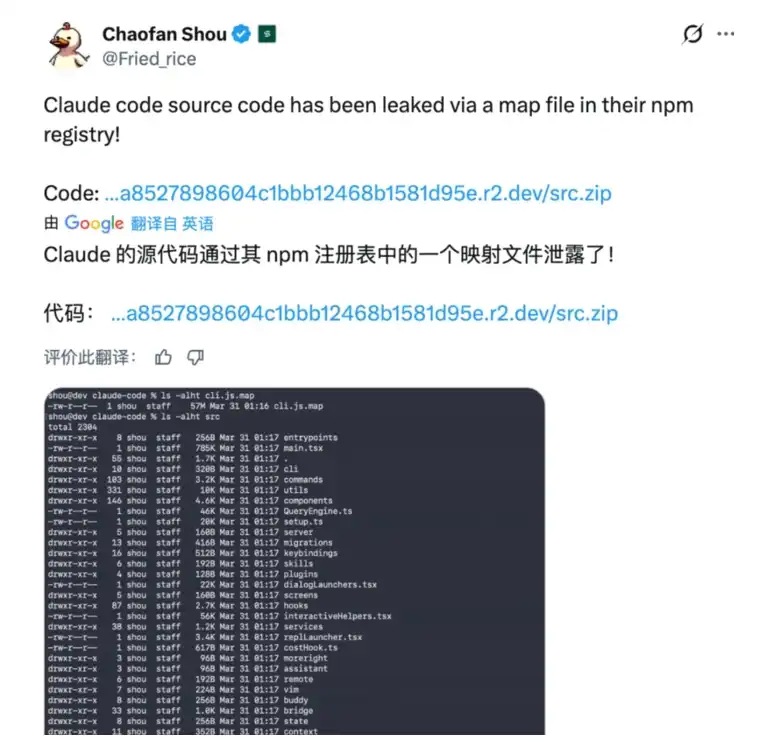
So, what was the cause of this leak? According to reports, when Anthropic published the code to npm, it actually forgot to remove the .map files, leading to the exposure of the core code. This mistake not only embarrassed the company but also raised external doubts about its security management. However, this accidental leak has given the outside world an early glimpse into some of Anthropic's cutting-edge functionalities in the AI field.

From the source code, it can be seen that Claude Code includes several astonishing features, with the project codenamed BUDDY being particularly notable. It can not only accompany developers in writing code but also has a unique personalized pet system, allowing users to incubate their own cyber pets based on personal information. This pet not only has a cute appearance but also has dynamic stats like debugging power and patience, and even a "sarcasm value," undoubtedly adding a lot of fun to the work atmosphere.

Even more forward-looking is the feature codenamed KAIROS, which aims to achieve an "always-on" AI assistant. Unlike traditional conversation methods, KAIROS can maintain memory across multiple sessions and proactively initiate tasks. Additionally, the source code includes a Nightly Dreaming mechanism, where Claude organizes information and consolidates core content while the user sleeps. This innovative concept not only makes the AI smarter but also brings new possibilities for future work methods.

Although Anthropic is currently busy dealing with this leak, the unexpected exposure might also provide a platform to showcase their cutting-edge technology. This accidental PR crisis has instead highlighted the company's innovative capabilities. The future of the AI field will become even more exciting because of such attempts.


Perguntas relacionadas

QWhat was the cause of the Claude Code source code leak at Anthropic?

AAnthropic forgot to remove .map files when publishing the code to npm, which exposed the core source code.

QHow many lines of TypeScript code were leaked in the Claude Code incident?

AOver five hundred thousand lines of TypeScript code were leaked.

QWhat is the name of the project that features a personalized cyber pet system for developers?

AThe project is called BUDDY, which includes a personalized cyber pet system with traits like debugging power and patience.

QWhat is the KAIROS feature designed to do according to the leaked source code?

AKAIROS is designed to be an 'always-on' AI assistant that maintains memory across multiple sessions and can proactively initiate tasks.

QWhat mechanism does Claude have for processing information during user inactivity?

AClaude has a 'Nightly Dreaming' mechanism where it organizes information and consolidates core content while the user is sleeping.

Leituras Relacionadas

In Jinjiang, Fujian, a Storage Super Unicorn Lies Quiet

In Fujian's Jinjiang, a city known for sportswear, lies a quiet semiconductor giant: Fujian Jinhua Integrated Circuit Co. (JHICC). Once a promising domestic DRAM manufacturer alongside Yangtze Memory and ChangXin Memory Technologies (CXMT), its journey was derailed in 2018 when the U.S. placed it on an Entity List and filed criminal charges for alleged trade secret theft. This halted production for years. A turning point came in February 2024 when a U.S. federal court found JHICC not guilty. However, it had lost crucial time. While CXMT soared to become a top-valued A-share company in 2024, JHICC, with an estimated valuation of 80 billion RMB, was just restarting. Its current output is primarily customized DDR4 chips, not the advanced DDR5/HBM demanded for AI, but it still benefits from the broader memory chip upcycle. JHICC's story is tied to Chen Zhengkun, a veteran engineer who left Micron to lead the venture. Founded in 2016 with state-backed funding, JHICC partnered with Taiwan's UMC to develop DRAM technology. Rapid progress was cut short by the U.S. actions, which Micron initiated, partly due to its heavy reliance on the Chinese market. Post-sanctions, Chen's team worked to rebuild the production line with reduced reliance on U.S. technology. According to its records, JHICC achieved small-scale production and revenue growth under immense pressure. It now focuses on the stable "niche" DRAM market (e.g., TVs, routers) with a monthly capacity of ~40,000 wafers, aiming for 60,000 by 2026. It holds over 1,000 patents but remains on the Entity List. For Jinjiang, investing in JHICC was a bold industrial leap. The local government provided unwavering financial and logistical support during the crisis, helping the company survive. JHICC has become the anchor for a growing local semiconductor cluster. Though its scale lags behind domestic peers, JHICC's persistence symbolizes a hard-won foothold in a global market long dominated by Samsung, SK Hynix, and Micron. Having missed one boom, it seeks a place in the new AI-driven memory supercycle.

marsbitHá 1h

In Jinjiang, Fujian, a Storage Super Unicorn Lies Quiet

marsbitHá 1h

Trading

Spot
活动图片




