CLARITY Act On Track For April Passage, Senator Says

bitcoinistPublicado em 2026-02-20Última atualização em 2026-02-20

Resumo

Senator Bernie Moreno stated the CLARITY Act is on track for potential passage by April, generating significant market and political reactions. The key contentious issue is the bill's proposed ban on interest-bearing stablecoins, which places the SEC as the lead regulator. This has created a divide, with crypto firms like Coinbase opposing the ban and banks expressing concerns about competition for deposits. While the White House is pushing for a quick agreement, bipartisan support remains fragile. Prediction markets initially showed increased odds of passage but later pulled back as details were questioned. The final outcome will determine clearer regulatory rules for exchanges, banks, and stablecoin issuers.

US lawmakers and crypto leaders say a major bill could move fast. According to an on-site interview, Senator Bernie Moreno told reporters he hopes the US CLARITY Act will clear Congress by April.

The comment came during a recent gathering with members of the press, and it set off a flurry of reaction across markets and inside the halls of power.

Lawmakers And Industry At Odds Over Clarity Act

Reports note that the biggest fight left on the table is stablecoin yields. Coinbase CEO Brian Armstrong said industry talks are more hopeful now, but he had pulled his group’s backing earlier because the bill would ban interest-bearing stablecoins and put the SEC front and center as the lead regulator.

That tug-of-war matters. Banks worry that easy yield on crypto tokens could pull deposits and weaken their model. Crypto firms counter that such products are useful and in demand. Both sides also want clear rules so firms can plan ahead.

Policymakers Have Momentum

Based on reports, the White House reacted strongly when one major exchange stepped back from support. The executive office signaled surprise and urged quicker agreement.

Markets noticed. Prediction markets moved, with odds on passage swinging dramatically in response to the media interview.

Polymarket showed a sharp uptick in probability that the bill would pass — then a pullback once details were questioned.
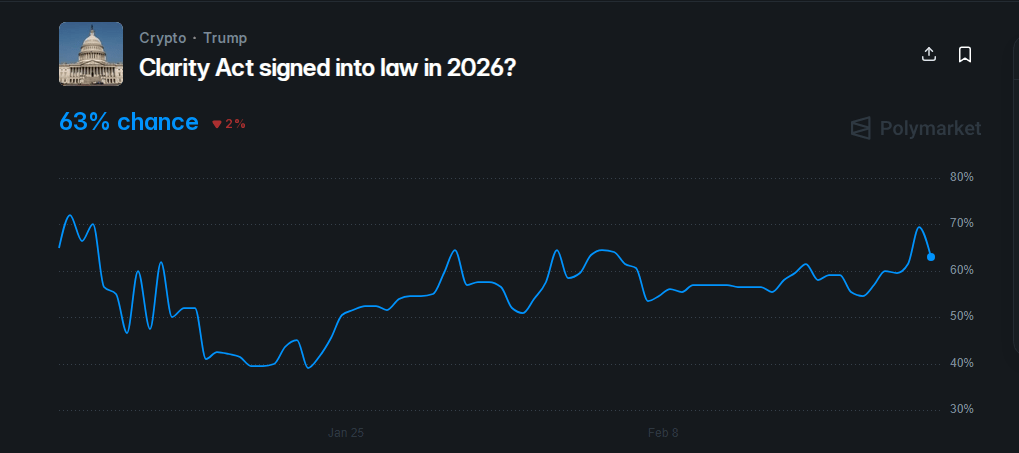
Source: Polymarket

“Hopefully by April,” Moreno said during an interview at US President Donald Trump’s Mar-a-Lago resort in Florida on Wednesday.

BTCUSD currently trading at $66,621. Chart: TradingView

What Could Break The Deal

Trump has pushed a pro-crypto message, and that helps gathering momentum among allies in Congress. But partisan lines remain.

If members tie the bill too closely to a single political brand, bipartisan support could fray. Also, banks and regulators are not uniform: some large institutions want stricter rules; others prefer limited, clearer guardrails that let certain products exist under oversight.

Why Fast Passage Is Uncertain

Reports say industry players want clarity asap, while some regulators want broader authority. That difference explains the public sparring.

Negotiators can and do move quickly when leadership prioritizes a measure, yet complex financial bills often require many rounds of drafting and amendment. Even so, lawmakers and execs at industry meetings appear to be pushing hard for a resolution soon.

If the bill clears, it could bring clearer rules for exchanges, banks, and stablecoin issuers. For investors, clarity is usually good. For firms, the shape of the final text will determine whether new products live or die.

Featured image from Wallpapers.com, chart from TradingView

Perguntas relacionadas

QWhat is the expected timeline for the CLARITY Act to pass Congress according to Senator Bernie Moreno?

ASenator Bernie Moreno hopes the CLARITY Act will clear Congress by April.

QWhat is the main point of contention regarding the CLARITY Act between lawmakers and the crypto industry?

AThe biggest fight is over stablecoin yields, specifically the bill's provision to ban interest-bearing stablecoins and establish the SEC as the lead regulator.

QHow did the prediction market Polymarket react to the news about the CLARITY Act?

APolymarket showed a sharp uptick in the probability that the bill would pass, followed by a pullback once details were questioned.

QWhy is there uncertainty surrounding the fast passage of the CLARITY Act despite momentum?

AUncertainty exists because complex financial bills often require many rounds of drafting and amendment, and there are differences between industry wanting clarity and some regulators wanting broader authority.

QWhat potential consequence could arise if the bill is tied too closely to a single political brand?

ABipartisan support for the bill could fray if it is tied too closely to a single political brand.

Leituras Relacionadas

Annual Salary of Millions Competing for Electricians, Meta Rushes to Open Its Own Technical School

The AI boom is facing an unexpected bottleneck: a severe shortage of skilled construction workers and electricians. As tech giants like Meta, OpenAI, and Alphabet race to build massive data centers—such as OpenAI's $16 billion "Stargate" project—they are hitting a critical labor wall. The U.S. needs an estimated 130,000 more electricians, 240,000 construction workers, and 150,000 supervisors by 2030 for AI infrastructure alone, but tens of thousands of electrician jobs go unfilled each year. While AI companies offer high premiums, with electricians earning up to $280,000 annually, worker scarcity still causes massive losses—delays on a single project can cost $14.2 million per month. The complexity of building AI data centers, which require immense power (equivalent to powering hundreds of thousands of homes), sophisticated electrical systems, and advanced liquid cooling solutions, demands highly skilled technicians who are in short supply. To combat this, companies are investing heavily in training. Meta has committed $115 million to a free training school offering tuition, housing, and stipends, targeting 5,000 new workers. OpenAI is partnering with unions to secure skilled labor. These efforts are paying off, with a significant rise in Gen Z interest in trade schools over college. However, the power demands are staggering. AI data centers are driving a rapid surge in electricity consumption, projected to account for up to 12% of U.S. power use by 2028 and raising costs for consumers. Furthermore, the construction boom is project-based, leading to a potential future glut of trained workers once building peaks, which could depress wages industry-wide. The race for AI supremacy now depends as much on skilled hands as on advanced chips.

marsbitHá 1h

Annual Salary of Millions Competing for Electricians, Meta Rushes to Open Its Own Technical School

marsbitHá 1h

OpenAI No Longer Sells Its Most Expensive Model for Profit

OpenAI is shifting its business strategy away from promoting its most expensive, flagship models for every task. Recent price cuts—80% for GPT-5.6 Luna and 20% for Terra—signal a deeper change: the company now actively advises users that many tasks don't require the most powerful model. Instead, OpenAI recommends a tiered approach: use the high-end GPT-5.6 Sol for complex planning and analysis, then delegate execution to cheaper models like Luna. This mirrors moves by Anthropic, which recently launched Claude Opus 5 at half the price of its top model, Fable 5. Both companies are de-emphasizing flagship models as primary revenue drivers, using them instead for brand prestige and technological showcases. The industry is entering a "mass-market" phase, similar to automotive, where high-volume, cost-effective models handle daily operations and drive scale. OpenAI's price reductions are partly enabled by AI models themselves optimizing underlying code and infrastructure, creating a self-reinforcing cycle of efficiency gains and cost reduction. Competition is shifting from "who is smartest" to "who offers the best value." The goal is no longer selling individual models but fostering widespread API adoption and ecosystem lock-in. By making AI calls cheap and ubiquitous, companies like OpenAI aim to become the indispensable, utility-like infrastructure powering automated workflows—the "water and electricity" of software, quietly embedded everywhere.

marsbitHá 1h

OpenAI No Longer Sells Its Most Expensive Model for Profit

marsbitHá 1h

Trading

Spot
活动图片





