CLARITY Act Countdown 25 Days: If It Doesn't Pass Before the August Recess, What Will Happen to the Crypto Market?

Odaily星球日报Publicado em 2026-07-03Última atualização em 2026-07-03

Resumo

The "CLARITY Act," a major U.S. crypto market structure bill, faces a tight 25-day window before the Senate's August 10 recess. Its passage this year is now uncertain, with prediction markets giving only a 40% probability. The bill aims to clarify SEC/CFTC jurisdiction and provide a non-security path for tokens, but is stalled by political and law enforcement negotiations. If it fails to pass before the recess, the likely market impact is not a crash but a "slow bleed" through premium products like ETFs, as seen in June's record $4.5B net outflows from U.S. Bitcoin ETFs. XRP, which would gain permanent commodity status from the bill, stands to lose regulatory premium. Bitcoin and Ethereum, already classified as commodities, would be less directly impacted but face prolonged uncertainty for DeFi and institutional investment. The path forward includes passage before August (a major catalyst), delay to 2027 (prolonging uncertainty), or failure, requiring the bill to restart in the next Congress. Analysts note that even failure wouldn't halt the push for U.S. regulatory clarity, but would extend the timeline for establishing a global standard.

Original | Odaily (@OdailyChina)

Author | Qin Xiaofeng(@QinXiaofeng 888 )

The much-watched "Crypto-Asset Regulatory Infrastructure and Transparency Act" (CLARITY Act) has, unsurprisingly, faced further delays. Senator Cynthia Lummis previously stated that negotiators expected to finalize a compromise text around July 4th (U.S. Independence Day) and "move forward in July," but progress has clearly lagged.

Now, with the Senate's August 10th recess approaching, the window is shrinking rapidly: the bill must overcome a 60-vote threshold in the Senate (requiring at least 7 Democratic defections), reconcile its text with the Senate Agriculture Committee's version, merge with the House bill, and receive the President's signature. All of this must be accomplished within the next 25 working days, creating an extremely tight timeline.

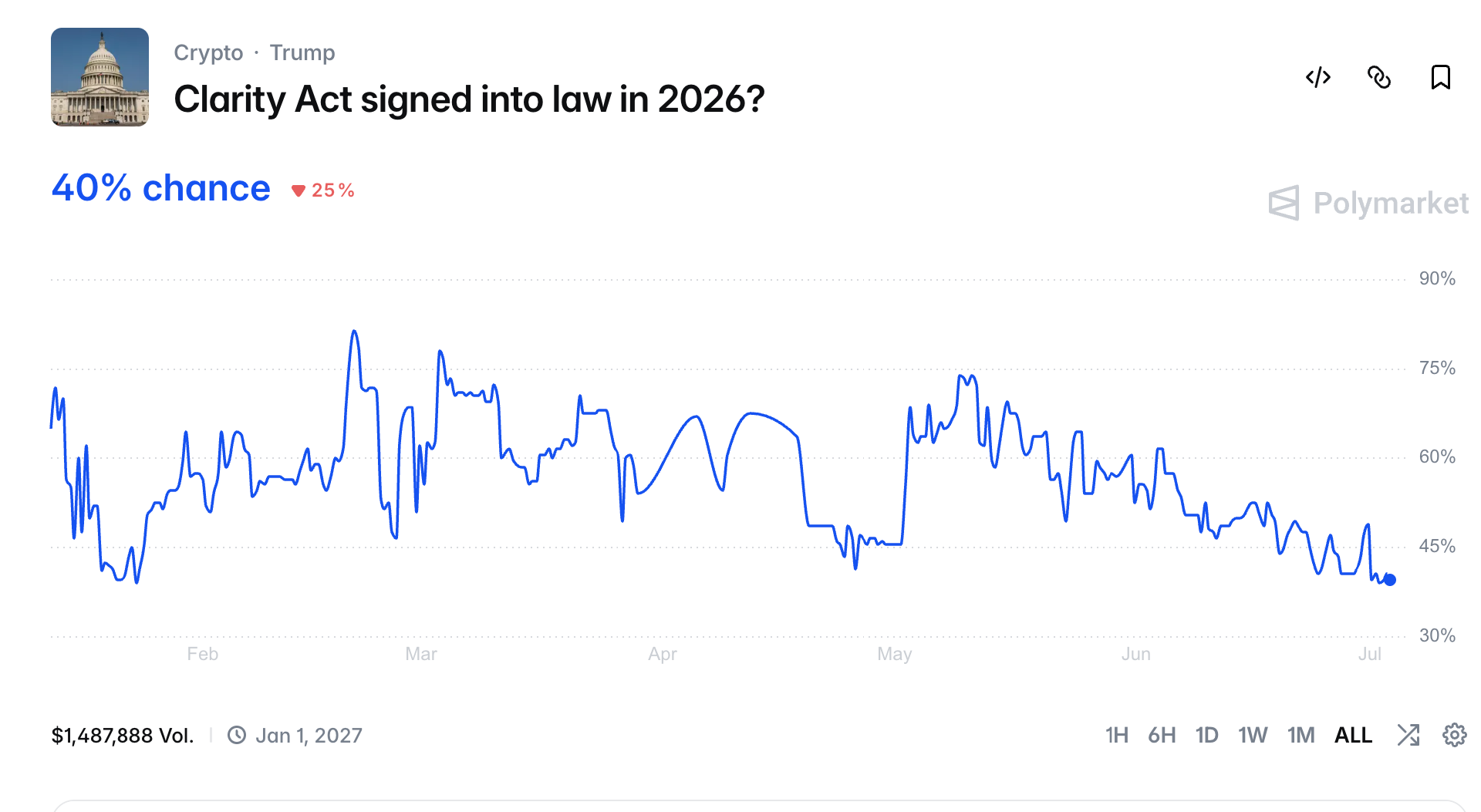
Should the pre-recess window be missed, the probability of the CLARITY Act passing this year drops further. Indeed, data from the prediction market Polymarket shows only a 40% chance of passage this year; Galaxy Digital has also lowered its 2026 passage probability to 50%.
1. A Recap of the CLARITY Act's Latest Progress

The CLARITY Act is landmark crypto market structure legislation being advanced by the U.S. Congress. It aims to clarify the regulatory boundaries between the SEC and CFTC, provide a non-security pathway for decentralized tokens, and require registration and anti-money laundering obligations for digital commodity intermediaries.

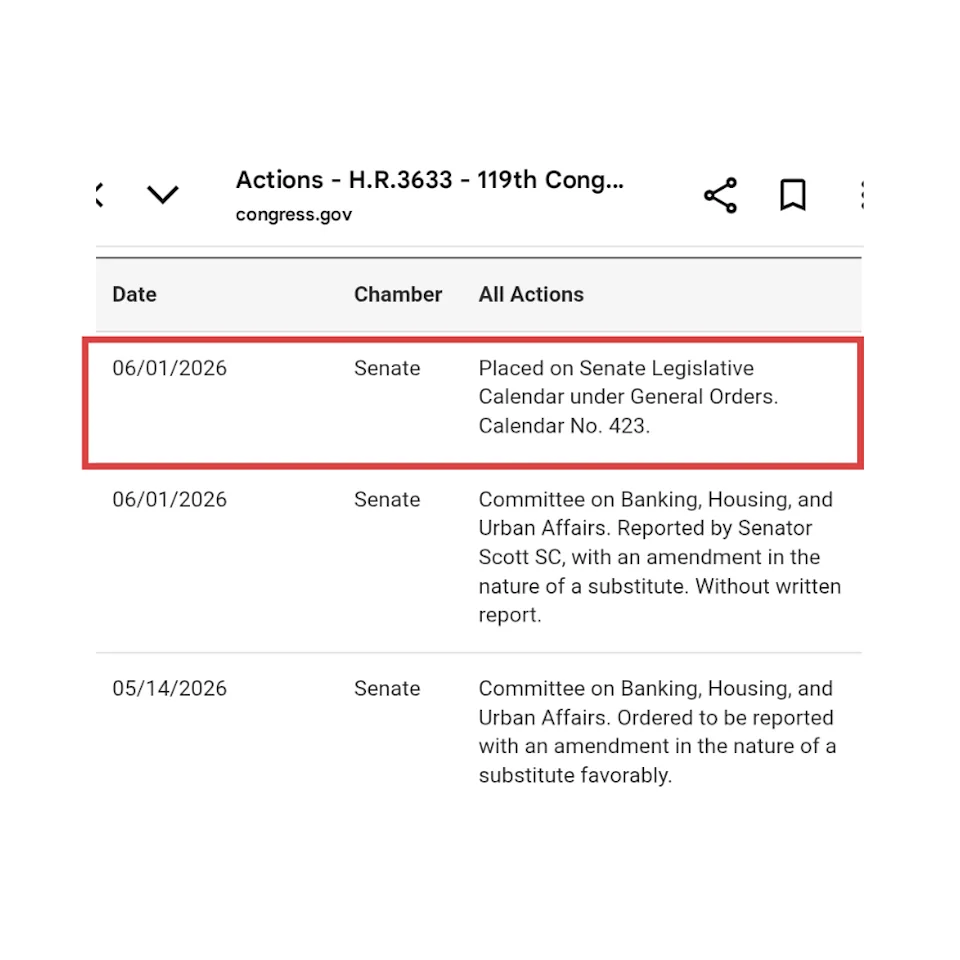
On July 17, 2025, the House passed the HR 3633 bill introduced by French Hill with a vote of 294 in favor and 134 against, receiving over 70 votes from Democrats. On May 14, 2026, the Senate Banking Committee advanced and passed it with a 15-9 vote (supported by 13 Republicans and 2 Democrats). On June 1, 2026, the CLARITY Act was officially placed on the Senate legislative calendar (Calendar No. 423), qualifying it for full consideration.
However, the entire month of June saw little progress for the CLARITY Act. On June 9th, negotiations around ethical provisions concerning presidential crypto holdings broke down, directly leading to softened stances or additional demands from some Democratic senators, slowing the bill's progress to floor debate. On June 10th, the White House met with police and prosecutor groups. Subsequently, an enforcement dispute over Section 604 (the developer protection clause) within the "Blockchain Regulatory Certainty Act" reached a stalemate; if unresolved, law enforcement groups may lobby against it, and Democratic senators might vote 'no' for "insufficient consumer protection/crime fighting."

Simply put, the former is a "political/ethical hurdle," and the latter a "law enforcement/security red line." Together, they constitute the final two major obstacles for the CLARITY Act to "pass" in the Senate before the recess. Failure to resolve them makes it difficult to gather the necessary 60 votes and finalize the text, thus preventing completion of the legislative process before the August 10th recess. These two negotiation points are the key "stumbling blocks" that have directly hindered the final advancement of the CLARITY Act, causing the July 4th target to be missed and the overall progress to stall. Negotiations are still attempting to break the impasse, but time is running extremely short.

Brian Gardner, Stifel's Chief Washington Policy Strategist, stated that for the bill to pass in 2026, "it likely needs to pass the Senate by the end of July, preferably in June," and warned that prospects would worsen significantly if the Senate misses the recess window.
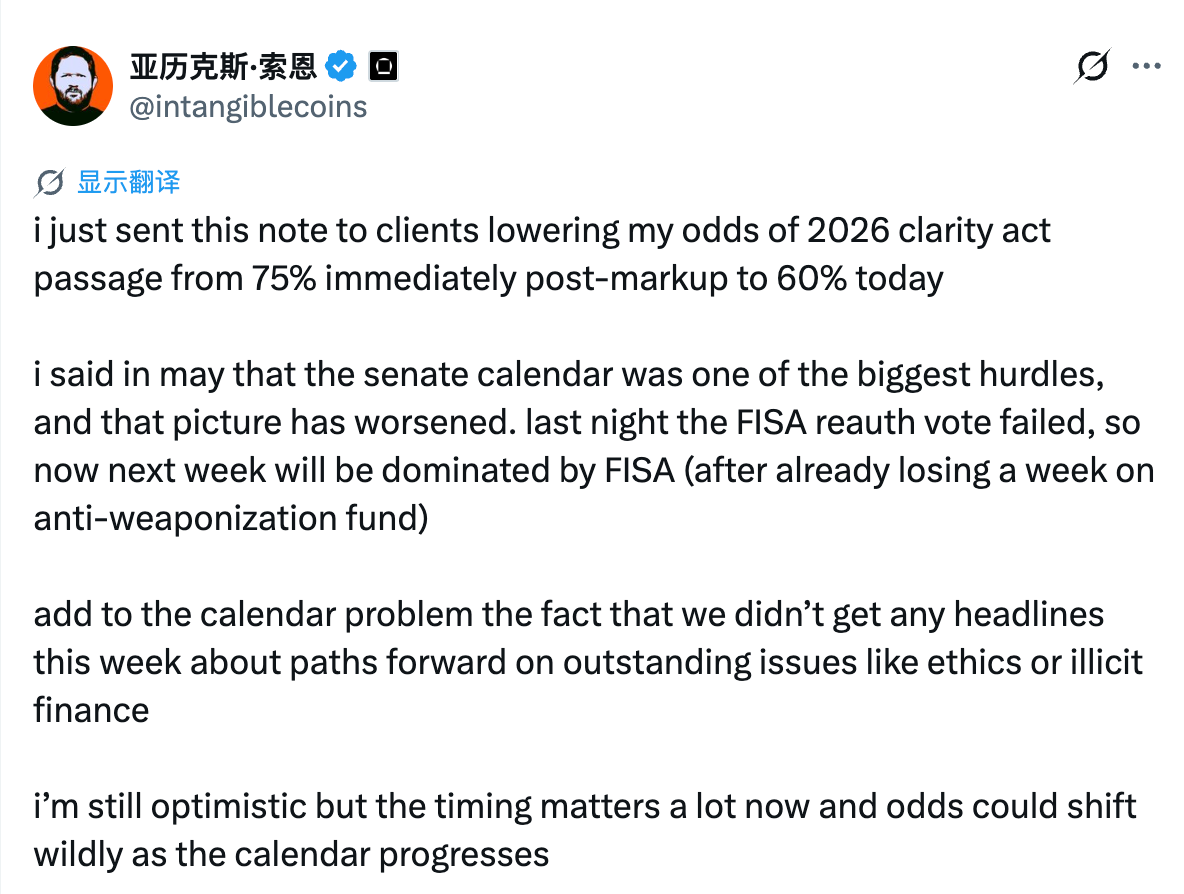
However, the market is not holding much hope for the bill's passage this year. Alex Thorn, Head of Galaxy Research, lowered his 2026 passage prediction from 75% to 60% on June 5th, citing the Senate's increasingly crowded schedule. Data from prediction market Polymarket shows only a 40% chance of passage this year.

2. If the CLARITY Act Doesn't Pass on Schedule, What Will Happen to Crypto?

According to CCN's analysis, if the CLARITY Act fails to pass before the August recess, the market's most likely reaction would not be a crash, but a "slow bleed through premium products." In fact, crypto's poor performance throughout June already indicates the market has begun repricing for legislative uncertainty. (Odaily Note: Here, "premium products" primarily refer to various spot ETFs)

Data shows that throughout June, U.S. spot Bitcoin ETFs saw cumulative net outflows of approximately $4.5 billion, equivalent to about 77,000 BTC redeemed. This marks the largest monthly net outflow since the products launched in January 2024, surpassing the previous record from February 2025 (about $3.56 billion), setting a new worst monthly record.

In fact, XRP might be the asset most directly and significantly impacted by the bill, as it would permanently classify it as a commodity, eliminating the risk of reversible agency interpretation. If delayed long-term or failed, XRP could lose some of its "regulatory upside premium."

Geoffrey Kendrick, Global Head of Digital Assets Research at Standard Chartered, forecasts an XRP price target of $8, contingent on the Senate fully passing the relevant legislation and $4-8 billion in ETF inflows. J.P. Morgan predicts that if the bill passes, XRP ETFs could see inflows of $4.3 billion to $8.4 billion in their first year. Data shows that since the XRP spot ETF launched in November 2025, it has seen cumulative net inflows of about $1.41 billion, with 84% coming from retail; institutional inflows still await clearer regulatory signals.

For Bitcoin, already classified as a commodity via the joint SEC-CFTC interpretation in March 2026, the CLARITY Act's main role is to permanently codify this reversible decision into federal law. Even if the bill fails or is long delayed, Bitcoin's "digital gold" narrative remains relatively robust, facing less direct impact.

The impact on ETH is similar to Bitcoin. Ethereum was also classified as a commodity via the joint interpretation. Bill failure could mean DeFi protocols face prolonged compliance ambiguity longer, suppressing innovation and capital inflows. Standard Chartered's Geoffrey Kendrick forecasted a $7,500 year-end 2026 target for ETH (later revised to $4,000), contingent on the relevant bill passing.

Kristin Smith, President of the Solana Foundation, stated that many asset allocators are actively exploring digital asset investments but are holding back funds due to the lack of clear regulatory guidelines. The same applies to institutional DeFi, where projects are currently on hold awaiting the outcome of Section 604.

3. What Lies Ahead?

There isn't much time left for the CLARITY Act to push through. Several scenarios could unfold:

  • 1. Passage before the August recess: The biggest catalyst, potentially leading to a significant price rebound, especially for XRP and related ETFs.
  • 2. Postponement to 2027: The market's least desired outcome, extending the "slow bleed" process and keeping institutional capital on the sidelines.
  • 3. Failure and push to the next Congress: The CLARITY Act is currently in the 119th Congress. If the Senate floor vote, reconciliation, and final passage are not completed before the August 2026 recess, the entire process cannot conclude within this Congress. When the new Congress (the 120th, 2027-2028) begins, the bill must be reintroduced and go through the entire committee review, floor debate, etc., all over again.

The CLARITY Act is currently at a critical "on the verge but stuck" stage—technically on the Senate calendar, yet political negotiations, the time window, and bipartisan support remain the biggest hurdles.

However, as Vincent Chok, CEO of First Digital, stated: "The CLARITY Act's entry into Senate floor voting itself shows the U.S. is closer than ever to resolving regulatory ambiguity... A successful vote would accelerate this process, but failure wouldn't necessarily stop it. In fact, delays in the U.S. framework could create urgency and extend the time window for setting global standards, potentially allowing the U.S. to become the de facto global digital asset hub."


Perguntas relacionadas

QWhat is the CLARITY Act and what are its main objectives?

AThe CLARITY Act is a landmark cryptocurrency market structure legislation in the U.S. Congress. Its main objectives are to clarify the regulatory boundary between the SEC and CFTC, provide a non-security path for decentralized tokens, and mandate registration and anti-money laundering obligations for digital commodity intermediaries.

QWhat are the two main obstacles currently preventing the CLARITY Act from passing in the Senate before the August recess?

AThe two main obstacles are: 1) Negotiations around ethics clauses related to presidential crypto holdings, which have softened the stance of some Democratic lawmakers. 2) A stalemate over the developer protection clause (Section 604) in the Blockchain Regulatory Certainty Act, which involves law enforcement concerns.

QAccording to the article, what is the market's expected reaction if the CLARITY Act fails to pass before the August recess?

AThe market is not expected to crash. Instead, the most likely reaction is 'slow bleeding through premium products,' such as various spot ETFs, as market prices adjust to the continued legislative uncertainty.

QWhy is XRP considered the asset most directly and significantly impacted by the outcome of the CLARITY Act?

AXRP is considered the most directly impacted because the Act would permanently classify it as a commodity, thereby eliminating the risk of a reversible institutional interpretation. Long-term delay or failure of the Act could cause XRP to lose some of its 'regulatory benefit premium.'

QWhat happens to the CLARITY Act if it does not complete the legislative process before the 119th Congress ends?

AIf the CLARITY Act does not complete the Senate floor vote, reconciliation, and final passage before the August 2026 recess, the entire process cannot be concluded within the current (119th) Congress. In the new Congress (120th, 2027-2028), the bill must be reintroduced and go through all legislative procedures again from the beginning.

Leituras Relacionadas

Wang Xing Is Happy, Wang Xingxing Is Not Necessarily

Yu Shu Technology's (Unitree) IPO on the STAR Market sparked discussions centered on wealth creation: the surge in founder Wang Xingxing's net worth, the substantial gains for early investors like Meituan's Wang Xing, and employee stock wealth. Yet, a key observation from the listing ceremony was the founder's calm demeanor, contrasting with the celebratory atmosphere. The article explores this divergence. For investor Wang Xing, the IPO represents a successful bet on embodied AI and robotics as the next foundational tech wave, with Meituan's stake now highly valuable. For founder Wang Xingxing, the milestone brings a new set of pressures. His company, now valued at ~341.8 billion yuan, must transition from proving technological feasibility (which it has done with its quadruped and humanoid robots) to delivering scalable commercial success. The market's high valuation is an advance payment for a future that Yu Shu must now build. Post-IPO, Yu Shu faces the critical challenge of moving beyond impressive demos to creating sustainable businesses. This means making robots reliable, affordable, and indispensable for both consumers and industrial clients, proving their real-world economic value. As the "first stock" in embodied AI on the STAR Market, Yu Shu also becomes a public benchmark for the entire industry, its performance influencing sector-wide expectations. Ultimately, while investors can celebrate realized gains, Wang Xingxing's work is just beginning. He must now manage a public company, meet heightened market expectations, and navigate the complex journey from innovative engineering to large-scale commercial execution. The IPO is a starting line, not a finish line.

marsbitHá 6m

Wang Xing Is Happy, Wang Xingxing Is Not Necessarily

marsbitHá 6m

U.S. Market Trend (August 20): U.S. Treasury Intervention Halts Stock Decline; Moderna's Cancer Vaccine Breakthrough Sparks 180% Surge

U.S. Stocks Rebound on Treasury Intervention; Moderna Soars 180% on Cancer Vaccine Breakthrough Key Points: • U.S. stocks ended a three-day decline, with the rebound driven primarily by the U.S. Treasury Department's move to significantly increase its long-term bond repurchase ceiling. This action briefly pushed the 30-year Treasury yield down by about 10 basis points, easing long-term interest rate pressures. • Despite this, the market faced a countervailing force from the hawkish July FOMC meeting minutes, which revealed broader support for potential rate hikes among officials due to lingering inflation concerns. • Moderna shares skyrocketed nearly 180% after announcing positive Phase 3 trial results for its personalized mRNA cancer vaccine in partnership with Merck, which also rose nearly 13%. This fueled a major rally in the healthcare sector. • Contrary to the broader market, the Philadelphia Semiconductor Index fell over 2%, highlighting persistent pressure on the AI hardware chain. Concerns include AI's potential inflationary impact and questions about application-side cash flows supporting high capital expenditures. • Commodities and cryptocurrencies rallied alongside the equity rebound, supported by a weaker dollar and lower long-term yields. Geopolitical risks continued to underpin oil prices. Outlook: Market focus shifts to whether long-term bond yields stabilize post-intervention, upcoming U.S. economic data (jobless claims, Philly Fed index), and the impact of SK Hynix's massive share buyback plan on the memory chip sector. The tech sector's full recovery remains contingent on the semiconductor index's performance.

marsbitHá 15m

U.S. Market Trend (August 20): U.S. Treasury Intervention Halts Stock Decline; Moderna's Cancer Vaccine Breakthrough Sparks 180% Surge

marsbitHá 15m

The 19 Must-Know Top Chinese and American Entrepreneurs Born After 2000 • The 21st-Century Successors Have Arrived

The 21st century's first generation of entrepreneurs, born in the 2000s, are already taking center stage. This analysis of publicly prominent founders reveals distinct trends between China and the U.S., shaped by their respective ecosystems. In China, young founders are heavily focused on giving AI a physical presence, tackling challenges in robotics and hardware. Examples include Huang Yi (RoboParty, humanoid robots), Qin Shentao (Yuanchen Taichu, embodied AI data infrastructure), and founders working on robotic hands, home cleaning robots, and computing power networks. Their paths often emerge from university labs and robotics competitions, prioritizing prototype demonstration, cost control, and manufacturing delivery. In contrast, their U.S. counterparts frequently leverage software, AI, and capital networks to rapidly reorganize digital services and information flows. Startups like Mercor (AI talent/data, reaching $10B revenue), Etched (AI chips), and various AI-powered SaaS tools for consumers and SMBs demonstrate a focus on user growth, subscription models, and global scalability. However, this velocity has also led to high-profile cases questioning business practices and credibility. The key differentiator for this generation is not merely youth, but the compressed early stage of venture creation. Access to open-source tools, AI models, mature supply chains, and willing venture capital allows them to bypass traditional career ladders. Yet, while technology lowers the barrier to product creation, it does not reduce the challenges of building a sustainable company—managing teams, ensuring reliable delivery, and establishing trust remain hard-earned skills. The article concludes that the true test for these founders will be the "second growth": evolving from product creators into responsible company leaders capable of sustained execution and organizational building. For established businesses, the rise of these fast-moving, technologically adept teams necessitates new strategies for collaboration, competition, and investment.

marsbitHá 20m

The 19 Must-Know Top Chinese and American Entrepreneurs Born After 2000 • The 21st-Century Successors Have Arrived

marsbitHá 20m

A Trillion-Dollar Consumer Credit Market Lacks Key Players

The trillion-dollar global consumer credit market remains largely untapped by blockchain technology. While projects like Pharos have rapidly attracted millions in stablecoin deposits for short-term consumer loans in emerging markets, they represent early attempts to bring this massive asset class on-chain. The core challenge isn't technical tokenization, but the "repackaging" of countless small, heterogeneous loans into standardized, investable products that digital asset funds can understand and price. Current approaches primarily change the *distribution* of capital—using stablecoins for settlement and smart contracts for transparency—but do not eliminate underlying credit risk. Several models are emerging: Pharos and Huma Finance/Tala focus on connecting high-yield emerging market loans to global crypto capital. Figure stands out by building full-stack, regulated infrastructure, securing AAA ratings for its securitizations and proving blockchain assets can meet traditional institutional standards. Conversely, Goldfinch's difficulties highlight that on-chain transparency cannot replace offline credit underwriting and collection capabilities. The article identifies a four-layer value chain: 1) loan origination, 2) credit structuring & securitization, 3) on-chain infrastructure, and 4) capital. The current gap is in the second layer—the mature capital markets expertise for structuring, rating, credit enhancement, and institutional distribution. This is the critical link needed to transform scattered loans into large-scale, trustworthy on-chain credit assets, bridging traditional finance's rigor with blockchain's new capital pools.

marsbitHá 55m

A Trillion-Dollar Consumer Credit Market Lacks Key Players

marsbitHá 55m

Trading

Spot
活动图片