CLARITY Act: Banking Trade Groups Push For Yield Agreement Revision – Details

bitcoinistPublicado em 2026-05-10Última atualização em 2026-05-10

Resumo

US banking trade groups are urging revisions to the stablecoin yield compromise in the upcoming CLARITY Act ahead of a key committee markup. The Act currently aims to ban all passive, deposit-like interest on stablecoins to prevent competition with traditional bank savings, while allowing rewards tied to active uses like staking or transactions. In a letter, groups including the American Banking Association and Bank Policy Institute proposed stricter language to eliminate perceived loopholes for passive yield and prevent deposit flight from banks. However, these efforts are reportedly viewed as minor by some lawmakers. The Senate Banking Committee is scheduled to mark up the bill on May 14, a critical step before it can advance through Congress.

US banking trade groups have called for an amendment to the stablecoin yield compromise in the highly anticipated CLARITY Act. This statement comes ahead of an expected markup on the crypto legislation next week. After months of negotiations, legislators, crypto industry players, and US banks reached an agreement on how to adopt stablecoin yield under the incoming regulatory framework.

In particular, the CLARITY Act will ban all forms of passive, deposit-like interest on stablecoins, effectively preventing competition with traditional bank savings. However, the bill would permit all forms of rewards tied to bona fide activities, including staking, transaction activity, or liquidity provision. Essentially, the aim is to promote a “buy and use” approach towards stablecoins, rather than “buy and hold.”

Banking Unions Move To Close Passive ‘Loopholes’

In an X post on May 8, independent reporter Eleanor Terrett shared a letter by the banking trade groups proposing changes to the stablecoin yield section in the CLARITY Act. The parties to this letter included the American Banking Association, Bank Policy Institute, Consumer Bankers Association, Financial Services Forum, Independent Community Bankers of America, and National Bankers Association

The proposed revisions were primarily aimed at communicating an absolute ban on passive interest and preventing any deposit flights from traditional financial institutions. As seen below, these included grammatical adjustments, particularly within Section 404(c)(1), where the unions proposed replacing the phrase “functional and economic equivalent” with “substantially similar” in defining passive deposit income yield and stablecoin-related yield mechanisms.

There is also a recommendation to completely omit subsection (3)(B), which they claim introduces an ambiguity that undermines the main objective of the compromise. However, it’s unlikely these recommendations will receive much attention, as lawmakers have largely shifted their focus to other aspects of the CLARITY Act. In particular, Terrett reports a Senate aide describing the efforts of trade groups as “pretty milquetoast.”

CLARITY Act Approaches Key Mark-Up Stage

In other developments, the US Senate Committee on Banking, Housing, and Urban Affairs is set to hold a markup session for the CLARITY Act on Thursday, May 14, at 10:30 AM EST, reported by Terrett in a separate post.

During this process, the committee members are expected to review the bill, debate proposed amendments, and vote on whether the legislation should advance to the full Senate for consideration. Following approval by the committee, the CLARITY Act must pass through a full Senate vote and subsequently secure approval in the House of Representatives before reaching the President’s desk to be signed into law.

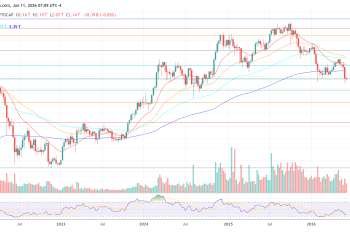
Total crypto market cap valued at $2.65 trillion on the daily chart | Source: TOTAL chart on Tradingview.com

Criptomoedas em alta

Perguntas relacionadas

QWhat is the main purpose of the stablecoin yield compromise in the CLARITY Act according to the article?

AThe main purpose of the stablecoin yield compromise in the CLARITY Act is to ban all forms of passive, deposit-like interest on stablecoins to prevent competition with traditional bank savings, while permitting rewards tied to bona fide activities like staking or liquidity provision. This aims to promote a 'buy and use' approach to stablecoins rather than 'buy and hold.'

QWhich banking trade groups are pushing for revisions to the stablecoin yield section of the CLARITY Act?

AThe banking trade groups pushing for revisions include the American Banking Association, Bank Policy Institute, Consumer Bankers Association, Financial Services Forum, Independent Community Bankers of America, and the National Bankers Association.

QWhat specific change did the banking trade groups propose regarding the definition of passive yield in Section 404(c)(1)?

AThe banking trade groups proposed replacing the phrase 'functional and economic equivalent' with 'substantially similar' in Section 404(c)(1) to more clearly define passive deposit income yield and stablecoin-related yield mechanisms.

QWhat is the next key legislative step for the CLARITY Act mentioned in the article?

AThe next key legislative step is a markup session by the US Senate Committee on Banking, Housing, and Urban Affairs, scheduled for Thursday, May 14, at 10:30 AM EST, where committee members will review, debate amendments, and vote on advancing the bill.

QHow did a Senate aide reportedly describe the efforts of the banking trade groups to revise the CLARITY Act language?

AA Senate aide reportedly described the efforts of the banking trade groups as 'pretty milquetoast,' suggesting the proposed revisions are unlikely to receive much attention as lawmakers have shifted focus to other aspects of the bill.

Leituras Relacionadas

Rubin Ultra Makes Major Cuts, Even Nvidia Can't Handle Memory Price Hikes?

NVIDIA's Rubin Ultra, the top-tier variant of the newly announced Rubin AI accelerators, has reportedly seen significant specification downgrades, according to an industry report from SemiAnalysis. Initially designed with four compute dies (4-die), the Rubin Ultra is now said to be reduced to a 2-die design. Key changes highlighted in the report include: * **No increase in peak theoretical compute performance**, remaining at 35 PFLOPs like the standard Rubin. * **Severe reduction in memory capacity** to 192GB using 8-Hi HBM stacks, which is less than the standard Rubin's 288GB using 12-Hi stacks. * **Negligible memory bandwidth improvement** of only 1 TB/s. * **Slightly higher chip-level power consumption**. * The **primary upgrade is a massive increase in scale-up interconnect capacity**, supporting connections for up to 576 GPUs via NVLink, compared to 72 for the standard Rubin. The report suggests the redesign is primarily a cost-optimization move driven by the sharp rise in HBM (High-Bandwidth Memory) prices. By reducing the expensive HBM content and shifting investment towards enhanced system-scale networking, NVIDIA aims to maintain the platform's value for large-scale AI training clusters while managing soaring material costs. The news reportedly triggered a sell-off in South Korean memory stocks, with SK Hynix and Samsung shares falling around 8%, as markets grew concerned that NVIDIA—a major HBM buyer—might be reducing its reliance on high-capacity memory, potentially capping future pricing power for memory makers.

Odaily星球日报Há 11m

Rubin Ultra Makes Major Cuts, Even Nvidia Can't Handle Memory Price Hikes?

Odaily星球日报Há 11m

Can Generative Models Finally Be Trained End-to-End? The Core Is a For Loop

This article introduces a novel training paradigm for generative models called Explorative Modeling (XM), which enables true end-to-end training. Traditionally, powerful generative models like autoregressive and diffusion models are not trained end-to-end. They are trained to predict a single small step but require iterative multi-step sampling for inference. This "exposure bias" leads to error accumulation and limits performance. The core challenge XM addresses is "mode blurring." In generative tasks, a single input (e.g., "generate a dog") corresponds to many valid outputs (multiple modes). Standard training objectives like reconstruction loss force the model to average these modes, producing unrealistic, blurry outputs. To avoid this, existing models break generation into many small, almost deterministic steps, sacrificing end-to-end training. XM tackles this by restructuring the training loop itself. Its key insight is to amplify "generative expressivity." For each training input, instead of generating one sample, the model generates K candidate outputs. Only the candidate closest to the real data is used for computing the loss and updating the model via backpropagation. This simple "best-of-K" mechanism is implemented as a short for-loop. By exploring multiple possibilities, the model learns to distribute its guesses across different modes rather than collapsing to their uninformative average. The paper demonstrates that "exploration" acts as a new, powerful scaling axis. Gains from XM increase with model size, data scale, and compute. Experiments show improvements in FID scores for image generation and significant efficiency gains, sometimes outperforming larger models without exploration. When pushed to the limit, XM enables fully single-step, end-to-end generative models. In robotics tasks, an "Explorative Policy" matched the performance of a 100-step Diffusion Policy with a single forward pass, drastically improving inference speed. While the best-of-K concept is not entirely new, the authors' contribution lies in formally understanding it as a direct method to boost generative expressivity without fragmenting the generation process. This work suggests that as models scale, enhancing exploration during training may become crucial for overcoming fundamental performance bottlenecks.

marsbitHá 1h

Can Generative Models Finally Be Trained End-to-End? The Core Is a For Loop

marsbitHá 1h

Trading

Spot

Artigos em Destaque

Como comprar PUSH

Bem-vindo à HTX.com!Tornámos a compra de Push Protocol (PUSH) simples e conveniente.Segue o nosso guia passo a passo para iniciar a tua jornada no mundo das criptos.Passo 1: cria a tua conta HTXUtiliza o teu e-mail ou número de telefone para te inscreveres numa conta gratuita na HTX.Desfruta de um processo de inscrição sem complicações e desbloqueia todas as funcionalidades.Obter a minha contaPasso 2: vai para Comprar Cripto e escolhe o teu método de pagamentoCartão de crédito/débito: usa o teu visa ou mastercard para comprar Push Protocol (PUSH) instantaneamente.Saldo: usa os fundos da tua conta HTX para transacionar sem problemas.Terceiros: adicionamos métodos de pagamento populares, como Google Pay e Apple Pay, para aumentar a conveniência.P2P: transaciona diretamente com outros utilizadores na HTX.Mercado de balcão (OTC): oferecemos serviços personalizados e taxas de câmbio competitivas para os traders.Passo 3: armazena teu Push Protocol (PUSH)Depois de comprar o teu Push Protocol (PUSH), armazena-o na tua conta HTX.Alternativamente, podes enviá-lo para outro lugar através de transferência blockchain ou usá-lo para transacionar outras criptomoedas.Passo 4: transaciona Push Protocol (PUSH)Transaciona facilmente Push Protocol (PUSH) no mercado à vista da HTX.Acede simplesmente à tua conta, seleciona o teu par de trading, executa as tuas transações e monitoriza em tempo real.Oferecemos uma experiência de fácil utilização tanto para principiantes como para traders experientes.

586 Visualizações TotaisPublicado em {updateTime}Atualizado em 2026.06.02

Como comprar PUSH

Discussões

Bem-vindo à Comunidade HTX. Aqui, pode manter-se informado sobre os mais recentes desenvolvimentos da plataforma e obter acesso a análises profissionais de mercado. As opiniões dos utilizadores sobre o preço de PUSH (PUSH) são apresentadas abaixo.

活动图片