Citi's Interpretation: Upgrading China, Downgrading South Korea, Is the Emerging Markets Rally Beginning to Broaden?

marsbitPublicado em 2026-07-20Última atualização em 2026-07-20

Resumo

In its latest emerging markets strategy report, Citi has upgraded China to overweight from neutral, while downgrading South Korea to neutral from overweight. It maintains an overweight rating for China-Taiwan markets. The report sets MSCI EM index targets of 1870 by end-2026 and 2050 by mid-2027, implying further upside of approximately 12% and over 20% respectively from current levels. Citi's move reflects a search for "broadening" opportunities beyond the concentrated rally in AI hardware and tech, which has driven EM gains year-to-date, led by South Korea and China-Taiwan markets. The upgrade for China is based on factors including light investor positioning, potential benefits from lower oil prices, and relative attractiveness in a recovering global growth cycle. While maintaining a strong long-term view on South Korea, Citi notes its recent outperformance and elevated volatility prompted a tactical downgrade. The report highlights that EM earnings revisions remain narrow, with the IT sector contributing about 85% of 2026 EPS estimate upgrades. For a sustained rally, Citi argues that market gains need to broaden to other sectors and regions. China, South Africa, and Mexico rank highly as potential "broadening candidates" based on factors like sensitivity to a weaker dollar, lower bond yields, and oil prices. Key uncertainties include the sustainability of AI capital expenditure returns, geopolitical risks, and Federal Reserve policy. Citi's stance is cautiously optimis...

According to Citi's latest Emerging Markets Strategy report, the bank has upgraded its stance on China equities from Neutral to Overweight, while tactically downgrading South Korea from Overweight to Neutral. It maintains an Overweight on Taiwan-China markets and sets target levels for the MSCI EM Index at 1870 by the end of 2026 and 2050 by mid-2027.

The most immediate market hook of this report is that despite the MSCI EM Index rising approximately 20% year-to-date, Citi still sees room for further upside. From the current level of around 1664 points, 1870 points implies about 12% upside, while the 2050 point target suggests around 20% potential gains by mid-2027.

However, Citi is not betting on a broad-based emerging markets bull run. Gains in EM have been highly concentrated in South Korea, Taiwan-China tech, and the AI hardware supply chain recently, with other countries and sectors not keeping pace. China's upgrade to Overweight stems from Citi beginning to look for 'broadening' candidates beyond the AI chain.
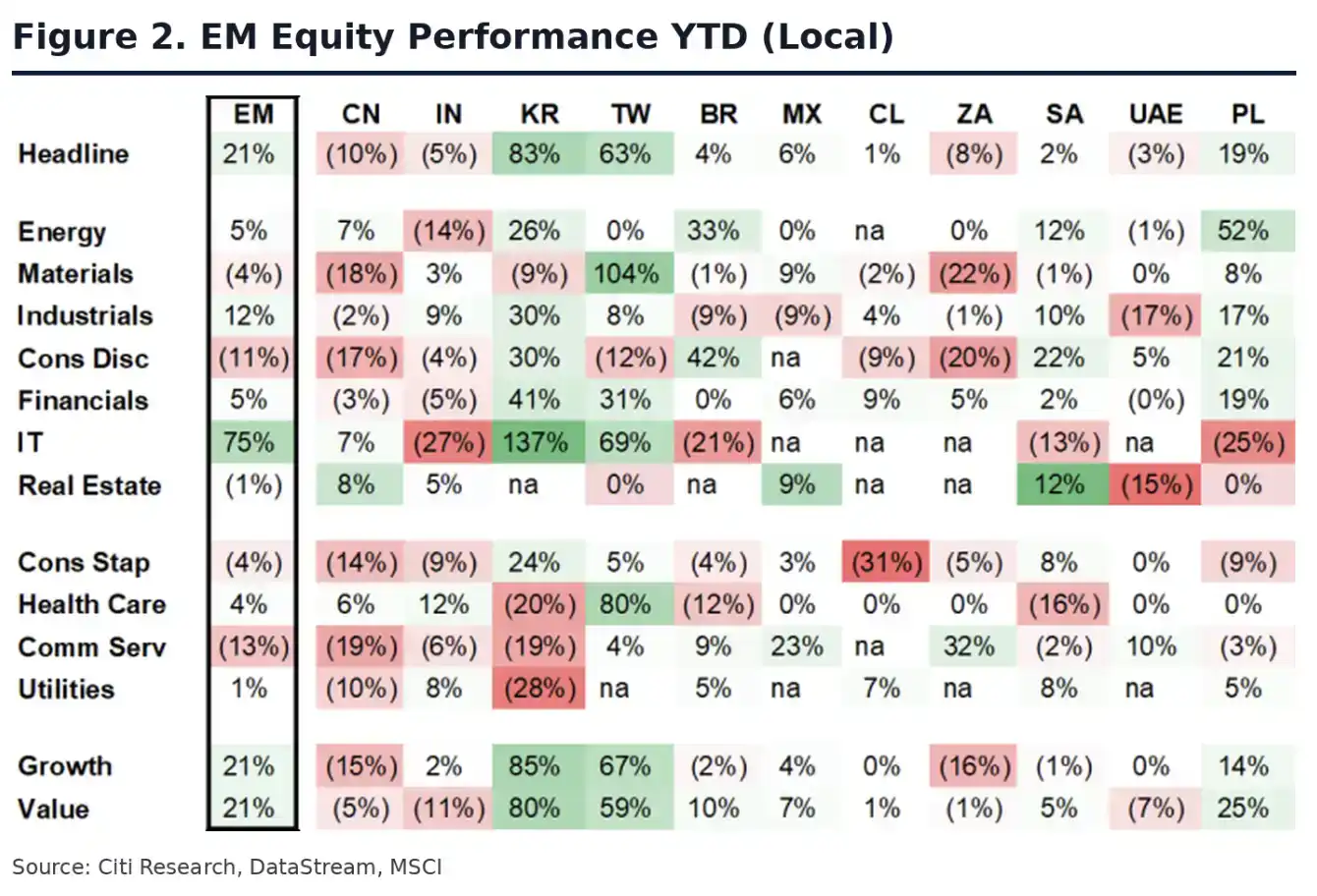
South Korea has delivered nearly 40% positive returns, and Taiwan-China markets over 30%, highlighting the high concentration of this year's EM rally.
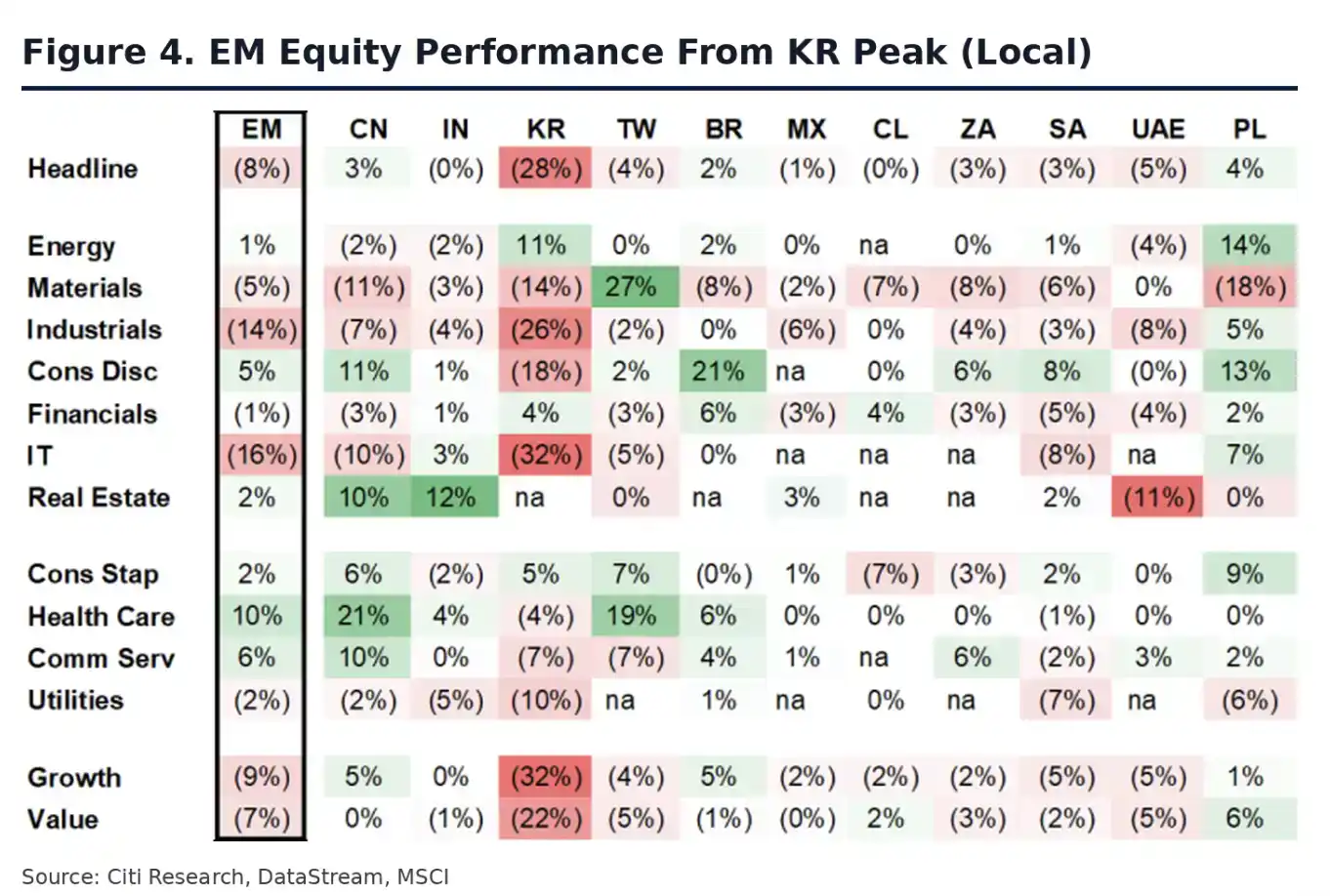
South Korea's pullback and the lack of comprehensive follow-through from other markets.

China Upgraded to Overweight, South Korea Cools Off First

In this round of allocation adjustments, China was upgraded from Neutral to Overweight, and Mexico was raised to Neutral. South Korea was downgraded from Overweight to Neutral, while Taiwan-China markets remain on the Overweight list.

China's appeal primarily stems from three factors. Global investors remain underweight on Chinese stocks, leaving significant room for capital inflows if global risk appetite improves. Falling oil prices benefit energy-importing markets like China. As global growth data improves, some cyclical assets regain support, with China ranking relatively high among macro-sensitive markets in this cycle.

This contrasts with the dominant theme in emerging markets over the past two years. The strongest trades were previously concentrated in the AI hardware supply chain, with South Korea and Taiwan-China markets being the biggest winners due to demand for semiconductors, memory, and AI servers. However, for the index to continue rising, relying solely on a few tech stocks becomes increasingly difficult, requiring funds to find more markets capable of sustaining the rally.

South Korea's downgrade does not equate to a weakening fundamental outlook. Public reports indicate that Citi retains a relatively strong long-term view on the South Korean equity market, with local strategists having previously set a KOSPI target of 10,000 points. According to the source report, the logic includes the potential for memory shortages to persist into 2027, and continued demand growth from AI tokens and customization supporting the memory upcycle. The near-term issue lies in South Korea's outsized prior gains, elevated implied volatility, and the amplification of fluctuations by retail leveraged products.

Taiwan-China markets remain one of the most direct beneficiaries within the AI hardware chain. According to the source report, local strategists have set a mid-2027 target for the Taiwan Weighted Index at 53,500 points. However, this market faces similar issues – trading has become crowded, and volatility often manifests first in these prior winners if greater skepticism emerges regarding the returns on AI capital expenditure.

EM Has Room to Run, Yet Earnings Revisions Remain Narrow

The two specific index targets set by Citi for MSCI EM are the clearest numerical calls in this report: 1870 by end-2026 and 2050 by mid-2027.

The support does not come from significant valuation expansion. The current 12-month forward P/E for MSCI EM is around 11.5x, roughly in line with its long-term average. Following this year's rally in emerging markets, valuations have not been pushed into a clear bubble zone; index gains have come more from improved earnings expectations.

The earnings numbers appear robust. The 2026 EPS growth forecast for MSCI EM reaches 63%, revised up by 28 percentage points cumulatively since late February. Growth is expected to moderate to 24% in 2027, but still remains above comparable assets in developed markets.

The issue is that the source of earnings improvement remains narrow. The Information Technology sector contributed about 85% of the 2026 EPS upward revisions, with South Korean and Taiwan-China AI supply chains still being the primary sources. Revisions for most non-tech sectors like Consumer, Real Estate, and Utilities remain weak. In other words, while the EM index appears supported by earnings on the surface, the upward earnings revisions have not yet broadened out to more industries.
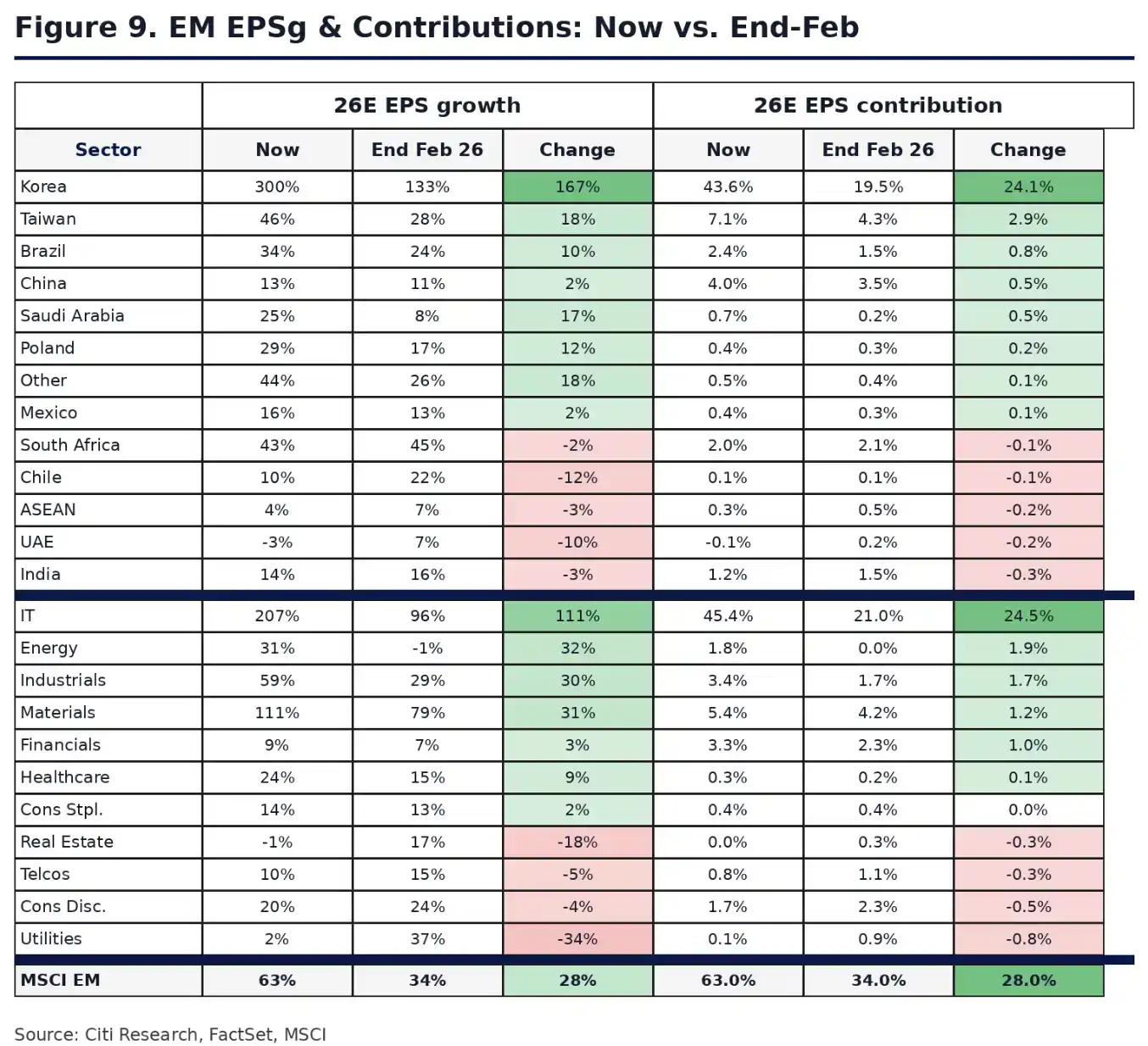
MSCI EM 2026E EPS growth of 63%, with the IT sector contributing roughly 85% of the upward revision magnitude.

This is also why Citi has not upgraded Emerging Markets to an Overweight stance within its global asset allocation framework. It can increase weights to markets like China within the region, but at the global asset allocation level, Emerging Markets remains Neutral. Citi's stance is closer to 'selectively adding exposure to broadening beneficiaries' rather than confirming a full-blown bull market.

The So-Called 'Broadening' Means Momentum Needs to Move Beyond a Few AI Winners

In plain terms, what Citi refers to as 'broadening trades' means this year's emerging market rally cannot continue to rely solely on gains in South Korea, Taiwan-China markets, and the AI chain. Funds either need to find new countries and sectors, or the index's further upside will be constrained.

This screening framework primarily looks at several conditions: whether a market benefits from a weaker US Dollar and declining US Treasury yields, whether it benefits from falling oil prices, its historical performance during improvements in global economic data, whether its near-term earnings revisions are turning positive, and whether its current trading is already too crowded.

Under this framework, China, South Africa, and Mexico rank high. According to the source report, their composite scores in the 'broadening candidate' screen are 4.2, 5.0, and 5.3 respectively. While South Korea and Taiwan-China markets remain recent winners, they face more pronounced issues of near-term crowding and volatility.

Oil prices present a real-world condition. Citi's baseline assumption is that oil averages around $75/barrel in Q3 2026, declining to around $65/barrel by early 2027. Falling oil prices typically benefit energy-importing markets like South Korea, Taiwan-China, India, and China, while posing challenges for some resource-heavy and oil-sensitive markets.
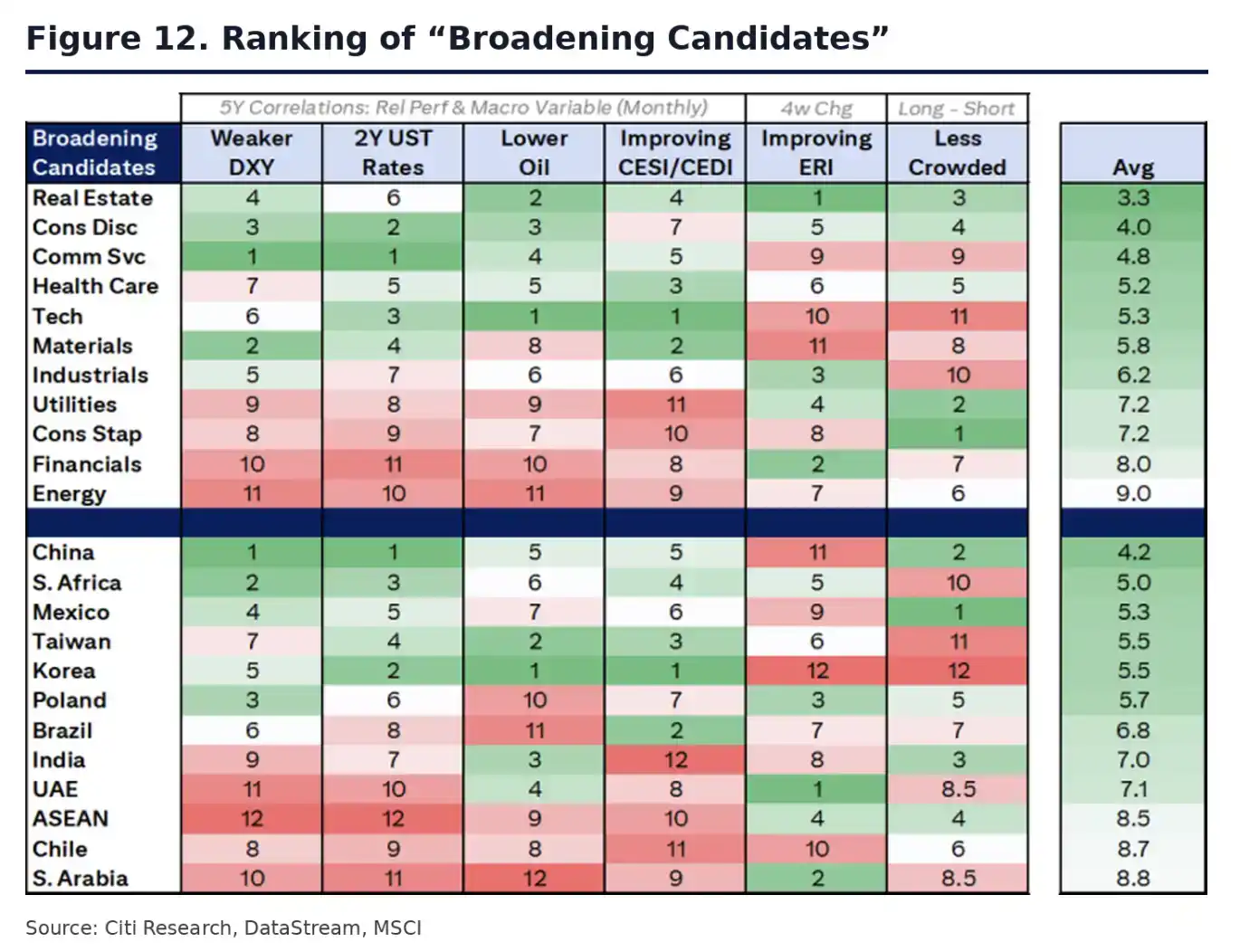
The 'Broadening Candidates' table shows China, South Africa, and Mexico ranking high across dimensions including weak USD, US Treasury yields, oil prices, and crowding.

This context is key to China's upgrade. It is neither this year's strongest performer nor the most crowded trade within the AI hardware chain. However, under the combination of improving global growth, declining oil prices, and room for positioning catch-up, it possesses the conditions to attract rotational flows.

Broadening Not Yet Complete; AI Chain Remains the Biggest Divergence

The cautious aspect of this report is that Citi does not present 'broadening' as an accomplished fact.

This year's EM gains are highly concentrated, with cross-market return dispersion reaching levels among the highest in the past 25 years. South Korean and Taiwan-China tech/AI sectors have contributed almost all the index-level returns. If future earnings revisions remain confined to the IT sector, the so-called broadening looks more like a short-term portfolio rotation rather than a broad-based fundamental improvement.

AI capital expenditure remains the greatest uncertainty. Previously, the market was willing to assign higher expectations to memory, semiconductors, and AI infrastructure due to sustained demand for training and inference pushing compute investment. However, if investors begin to question the returns on this capital expenditure, the prior winners like South Korea and Taiwan-China could face greater pressure.

Macro risks have not disappeared. Renewed geopolitical escalation could push oil prices away from the downward scenario. Fed policy remains a point of divergence; if rate cuts fall short of expectations, the US Dollar and Treasury yields could pressure emerging markets. A potential super El Niño could also bring new inflationary pressures.
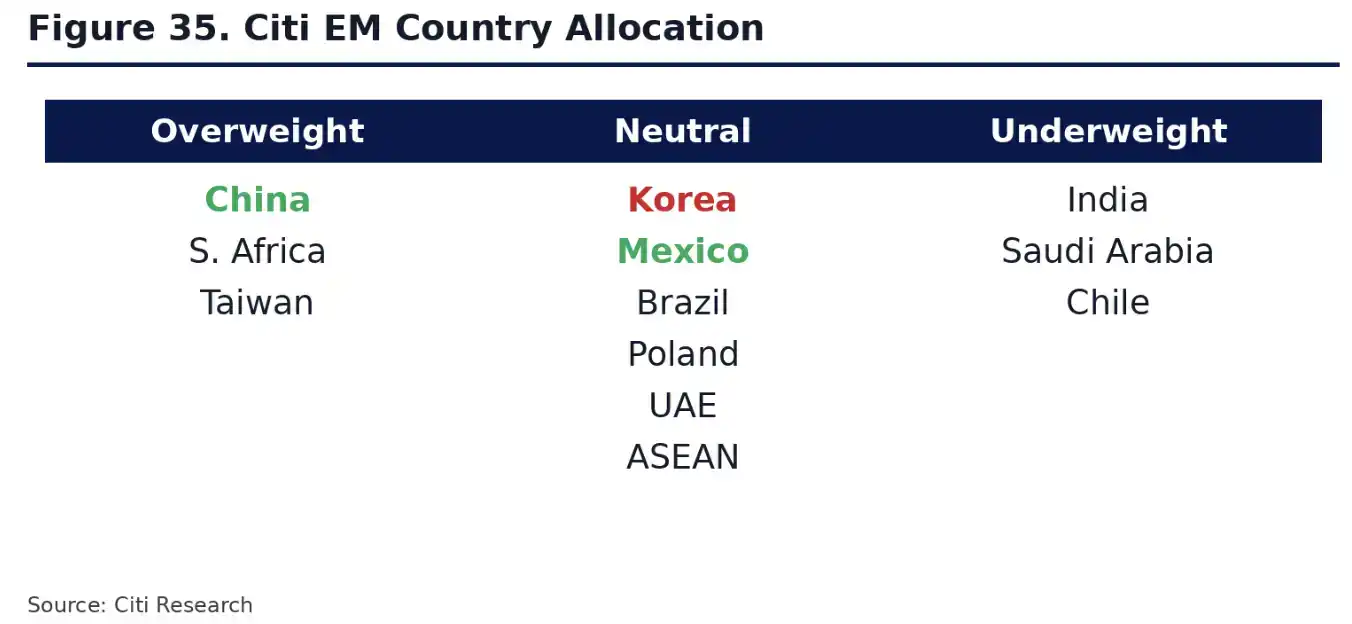
Citi's EM country allocation table shows Overweight positions in China, South Africa, and Taiwan-China markets, with South Korea downgraded to Neutral.

Citi's judgment on emerging markets is more akin to 'the rally has the potential to broaden' rather than 'a full-blown bull market is already confirmed.' China was upgraded because it offers better risk-reward in this potential broadening trade. South Korea was cooled off, indicating that prior winners are not necessarily incapable of further gains, but that their short-term gains and volatility have diminished their near-term appeal.

Whether MSCI EM can reach 1870 or even 2050 points depends not only on how much further the AI chain can rise but also on whether non-tech sector earnings can halt their downward revisions, whether the global cyclical improvement can be sustained, and whether funds are genuinely willing to flow from the few winners to a wider range of markets.


Criptomoedas em alta

Perguntas relacionadas

QWhat were the main changes made by Citi in its emerging market strategy report regarding China and South Korea?

ACiti upgraded China from neutral to overweight and tactically downgraded South Korea from overweight to neutral.

QWhat are the two price targets set by Citi for the MSCI EM Index, and what do they imply in terms of upside?

ACiti set a target of 1870 points for the MSCI EM Index by the end of 2026 and 2050 points by mid-2027. From the current level of approximately 1664 points, this implies an upside of about 12% and 20% respectively.

QWhat is the 'broadening' trade that Citi refers to in the context of emerging markets?

AThe 'broadening' trade refers to the potential for market gains to spread beyond the concentrated winners of the AI hardware chain (like South Korea and Taiwan/China tech) to other countries and sectors, such as China, South Africa, and Mexico, to sustain the index's upward momentum.

QWhat are the primary reasons Citi cites for upgrading China to overweight?

ACiti's reasons for upgrading China include: 1) Overseas investors remain underweight on Chinese stocks, leaving room for reallocation if global risk appetite improves. 2) Falling oil prices benefit energy-importing markets like China. 3) China ranks high among macro-sensitive markets as global growth data improves, supporting some cyclical assets.

QWhy does Citi maintain a neutral stance on emerging markets at the global asset allocation level despite its positive internal adjustments?

ACiti maintains a neutral stance globally because the earnings recovery in emerging markets is still narrow, driven overwhelmingly by the IT sector (especially the AI chain). For a more bullish overweight call, improvements need to broaden to more non-tech sectors and countries beyond the current concentrated winners.

Leituras Relacionadas

NFTs That Can Earn Stock Tokens? What Exactly is StonkBrokers?

Title: How StonkBrokers Connects NFTs to Stock Token Earnings StonkBrokers is an NFT project from the Web3 development team Clutch Labs (CLUTCH) built on Robinhood Chain. It consists of 4,444 "pixel broker" NFTs. Unlike typical NFTs, each one is linked to an ERC-6551 token-bound account, meaning it functions as its own wallet capable of holding assets like stock tokens. The project's ecosystem includes: 1. **STONKBROKER (ERC-20 Token)**: The fungible token connected to the NFTs via the Anvil AMM. Users can trade tokens for NFTs at a base rate of 666,666 STONKBROKER (plus ETH fees). 2. **NFT Activation & Rewards**: NFT holders must spend STONKBROKER tokens to "activate" their NFT into one of five tiers, which determines their weight in receiving stock token rewards. These rewards are funded by 70% of the ETH trading fees generated on the Anvil AMM. 3. **Lending**: NFTs can be used as collateral to borrow STONKBROKER tokens. 4. **Future Products**: The roadmap includes the Stonk Launcher (a token launchpad) and the Stonk Exchange (a "vote-directed DEX" based on Uniswap V3), scheduled for late July and August 2026, respectively. The project aims to provide NFTs with ongoing utility as active financial agents rather than static collectibles. Its token (STONKBROKER) and NFT collection have seen significant price increases recently. However, the project's long-term viability depends on successful product delivery, sustainable protocol revenue, and navigating risks like market volatility, smart contract security, and the nascent Robinhood Chain ecosystem.

Foresight NewsHá 12m

NFTs That Can Earn Stock Tokens? What Exactly is StonkBrokers?

Foresight NewsHá 12m

The Most Difficult Thing to Predict on Polymarket Is... When the POLY Airdrop Will Happen

During the recent World Cup, Polymarket saw record-breaking activity, with its "World Cup winner" market reaching $4.32 billion in volume, making it the platform's highest-volume single prediction event ever. Over the six-week tournament, football markets amassed $85 billion in nominal trading volume, cementing sports as a major growth driver. Capitalizing on this surge in traffic, Polymarket quietly increased fees for its sports markets in early July. The taker fee multiplier was raised from 0.03 to 0.05, effectively raising maximum costs per trade by nearly 70% and moving sports out of its lowest fee tier. This follows a broader trend of the platform gradually expanding fee structures across various market categories since the start of the year to boost revenue. However, community focus is increasingly shifting from trading volumes to the long-awaited POLY token airdrop. Despite a senior executive confirming in late 2025 that a token and airdrop were planned for after U.S. market re-entry, no timeline has been provided. Recent actions, like an affiliated account deleting a potentially suggestive tweet and official help pages stating "no airdrop or token generation event has been announced," have fueled speculation and frustration. The community is divided on the reasons for the delay. Some believe Polymarket is waiting for a more favorable regulatory window in the U.S., while others speculate that the platform's strong organic growth and rising fee revenue have reduced the urgency to issue a token, potentially following a path similar to OpenSea. The prolonged uncertainty has led users to question not the *if*, but the *when*, of the POLY airdrop, turning it into one of the platform's most unpredictable events.

Odaily星球日报Há 22m

The Most Difficult Thing to Predict on Polymarket Is... When the POLY Airdrop Will Happen

Odaily星球日报Há 22m

After Investing in Changxin, Hefei State Capital Makes Another Move

Two events unfolded within the same week. On July 13th, the Hefei Industrial Investment Xinzhi Xinyu Equity Investment Partnership with a pledged scale of 5 billion RMB was established. Three days later, ChangXin Technology launched its online and offline public offering at a price of 8.66 RMB per share, aiming to raise approximately 57.9 billion RMB. The link between these events is the Hefei Industrial Investment Group (Hefei ChanTou). Hefei ChanTou directly holds shares in ChangXin Technology through its wholly-owned subsidiary, ChangXin Integration, and is also behind the newly established 5 billion RMB fund. This highlights a strategic move: as ChangXin approaches its IPO, Hefei ChanTou establishes a new fund to prepare for the next round of industrial investment. Founded in 2015, Hefei ChanTou is a state-owned capital investment platform focused on industrial financing and innovation. Beyond direct equity holdings in major projects like ChangXin's 12-inch memory wafer manufacturing base, it manages various provincial and municipal government-guided funds. Its self-managed fund scale exceeds 100 billion RMB. ChangXin Technology, now China's leading DRAM manufacturer, exemplifies the classic "Hefei model." A decade ago, when founder Zhu Yiming sought entry into the capital-intensive DRAM sector, Hefei's state capital provided the crucial long-term support. Pre-IPO, entities within the Hefei ChanTou system hold significant direct and indirect stakes, with a theoretical combined value of roughly 116.2 billion RMB based on the IPO price. However, this long-cycle, concentrated investment model brings financial pressure. Hefei ChanTou's financials show significant liabilities, net outflows from investing activities, and reliance on investment income. The focus is now shifting alongside Hefei's broader "654X" industrial system, which encompasses six dominant industries, five emerging industries (like AI and biopharma), and four future industries (including quantum tech and nuclear fusion). The narrative is one of transition. As the ChangXin project reaches a major milestone with its IPO, the new 5 billion RMB fund symbolizes the beginning of the next investment chapter—targeting a more diverse and early-stage array of sectors within Hefei's expanded industrial vision.

marsbitHá 32m

After Investing in Changxin, Hefei State Capital Makes Another Move

marsbitHá 32m

Trading

Spot

Artigos em Destaque

O que é $BANK

Bank AI: Um Passo Revolucionário no Futuro da Banca Introdução Em uma era marcada por avanços rápidos na tecnologia, o Bank AI está na interseção da inteligência artificial (IA) e dos serviços bancários. Este projeto inovador visa redefinir o panorama financeiro, melhorando a eficiência operacional, as medidas de segurança e as experiências dos clientes através do poder da IA. Ao embarcarmos nesta exploração do Bank AI, iremos aprofundar no que o projeto implica, suas dinâmicas operacionais, seu contexto histórico e marcos significativos. O que é o Bank AI? No seu cerne, o Bank AI representa uma iniciativa transformadora com o objetivo de integrar a inteligência artificial em várias operações bancárias. Este projeto aproveita as capacidades da IA para automatizar processos, melhorar os protocolos de gestão de risco e melhorar a interação com os clientes através de serviços personalizados. Os principais objetivos do Bank AI incluem: Automatização das Funções Bancárias: Ao aproveitar as tecnologias de IA, o Bank AI visa automatizar tarefas rotineiras, reduzindo o peso sobre os recursos humanos e aumentando a eficiência. Gestão de Risco Melhorada: O projeto utiliza algoritmos de IA para prever e identificar riscos, fortalecendo assim as medidas de segurança contra fraudes e outras ameaças. Personalização dos Serviços Bancários: O Bank AI foca em oferecer produtos e serviços financeiros ajustados, analisando dados e comportamentos dos clientes. Melhoria da Experiência do Cliente: A implementação de soluções impulsionadas por IA, como chatbots e assistentes virtuais, visa proporcionar aos usuários interações mais humanizadas, revolucionando a forma como os clientes se envolvem com os bancos. Com esses objetivos, o Bank AI posiciona-se como um ator crucial para tornar a banca mais eficiente, segura e centrada no usuário. Quem é o Criador do Bank AI? Os detalhes sobre o criador do Bank AI permanecem desconhecidos. Assim, nenhuma pessoa ou organização específica foi identificada nas informações disponíveis. O anonimato que cerca a origem do projeto levanta questões, mas não diminui a sua ambiciosa visão e objetivos. Quem são os Investidores do Bank AI? Semelhante ao criador do projeto, informações específicas sobre os investidores ou organizações que apoiam o Bank AI não foram divulgadas. Sem essas informações, é difícil delinear o apoio financeiro e institucional que pode estar impulsionando o projeto para frente. No entanto, a importância de ter uma sólida base de investimento é fundamental para sustentar o desenvolvimento em um campo tão inovador. Como Funciona o Bank AI? O Bank AI opera em várias frentes inovadoras, focando em fatores únicos que o diferenciam das estruturas bancárias tradicionais. Abaixo estão as principais características operacionais: Automatização: Ao aplicar algoritmos de aprendizado de máquina, o Bank AI automatiza vários processos manuais dentro dos bancos. Isso resulta na redução dos custos operacionais e permite que os trabalhadores humanos redirecionem os seus esforços para atividades mais estratégicas. Gestão de Risco Avançada: A integração da IA nas práticas de gestão de risco equipa os bancos com ferramentas para prever com precisão potenciais ameaças, como fraudes, garantindo que as informações e ativos dos clientes permaneçam seguros. Recomendações Financeiras Personalizadas: Através do aprendizado contínuo a partir das interações com os clientes, os sistemas de IA desenvolvem uma compreensão sutil das necessidades dos usuários, permitindo oferecer conselhos adaptados sobre decisões financeiras. Interações Melhoradas com os Clientes: Utilizando chatbots e assistentes virtuais alimentados por IA, o Bank AI permite uma experiência de cliente mais envolvente, permitindo que os usuários tenham suas dúvidas resolvidas rapidamente, reduzindo assim os tempos de espera e melhorando os níveis de satisfação. Juntas, estas características operacionais posicionam o Bank AI como um pioneiro no setor bancário, estabelecendo novos padrões para a prestação de serviços e a excelência operacional. Cronologia do Bank AI Compreender a trajetória do Bank AI requer uma análise do seu contexto histórico. Abaixo está uma cronologia que destaca marcos e desenvolvimentos importantes: Início de 2010: A conceituação da integração da IA nos serviços bancários começou a ganhar atenção à medida que instituições bancárias reconheciam os potenciais benefícios. 2018: Ocorreu um aumento significativo na implementação de tecnologias de IA, quando os bancos começaram a usar ferramentas de IA como chatbots para atendimento ao cliente básico e sistemas de gestão de risco para melhorar o tratamento de segurança. 2023: A sofisticação da IA continuou a avançar, com a introdução de IA generativa para tarefas mais complexas, como processamento de documentos e análise de investimentos em tempo real. Este ano marcou um salto significativo nas capacidades proporcionadas aos bancos pela tecnologia de IA. 2024-Estado Atual: Neste ano, o Bank AI está em uma trajetória ascendente, com pesquisas e desenvolvimentos em andamento prontos para aprimorar ainda mais as capacidades nas operações bancárias. A exploração contínua das aplicações de IA sugere desenvolvimentos emocionantes por vir. Pontos Chave Sobre o Bank AI Integração da IA na Banca: O Bank AI foca na adoção da inteligência artificial para simplificar os processos bancários e melhorar as experiências dos usuários. Automatização e Foco em Gestão de Risco: O projeto enfatiza fortemente essas áreas, visando transferir o peso das tarefas rotineiras enquanto melhora as estruturas de segurança através de análises preditivas. Soluções Bancárias Personalizadas: Ao aproveitar os dados dos clientes, o Bank AI possibilita serviços bancários ajustados que atendem às necessidades individuais dos usuários. Compromisso com o Desenvolvimento: O Bank AI permanece comprometido com contínuas pesquisas e esforços de desenvolvimento, garantindo a sua adaptabilidade e relevância contínua à medida que a tecnologia continua a evoluir. Conclusão Em resumo, o Bank AI exemplifica um passo crucial em frente na indústria bancária, aproveitando a inteligência artificial para remodelar paradigmas operacionais, melhorar a segurança e promover a satisfação do cliente. Apesar das lacunas de informação em torno do criador e dos investidores, os objetivos claros e os mecanismos funcionais do Bank AI fornecem uma base sólida para sua evolução contínua. À medida que a tecnologia de IA continua a avançar e se fundir com o setor bancário, o Bank AI está bem posicionado para impactar significativamente o futuro dos serviços financeiros, aprimorando a maneira como entendemos e interagimos com a banca.

74 Visualizações TotaisPublicado em {updateTime}Atualizado em 2024.12.03

O que é $BANK

Como comprar BANK

Bem-vindo à HTX.com!Tornámos a compra de Lorenzo Protocol (BANK) simples e conveniente.Segue o nosso guia passo a passo para iniciar a tua jornada no mundo das criptos.Passo 1: cria a tua conta HTXUtiliza o teu e-mail ou número de telefone para te inscreveres numa conta gratuita na HTX.Desfruta de um processo de inscrição sem complicações e desbloqueia todas as funcionalidades.Obter a minha contaPasso 2: vai para Comprar Cripto e escolhe o teu método de pagamentoCartão de crédito/débito: usa o teu visa ou mastercard para comprar Lorenzo Protocol (BANK) instantaneamente.Saldo: usa os fundos da tua conta HTX para transacionar sem problemas.Terceiros: adicionamos métodos de pagamento populares, como Google Pay e Apple Pay, para aumentar a conveniência.P2P: transaciona diretamente com outros utilizadores na HTX.Mercado de balcão (OTC): oferecemos serviços personalizados e taxas de câmbio competitivas para os traders.Passo 3: armazena teu Lorenzo Protocol (BANK)Depois de comprar o teu Lorenzo Protocol (BANK), armazena-o na tua conta HTX.Alternativamente, podes enviá-lo para outro lugar através de transferência blockchain ou usá-lo para transacionar outras criptomoedas.Passo 4: transaciona Lorenzo Protocol (BANK)Transaciona facilmente Lorenzo Protocol (BANK) no mercado à vista da HTX.Acede simplesmente à tua conta, seleciona o teu par de trading, executa as tuas transações e monitoriza em tempo real.Oferecemos uma experiência de fácil utilização tanto para principiantes como para traders experientes.

429 Visualizações TotaisPublicado em {updateTime}Atualizado em 2026.06.02

Como comprar BANK

Discussões

Bem-vindo à Comunidade HTX. Aqui, pode manter-se informado sobre os mais recentes desenvolvimentos da plataforma e obter acesso a análises profissionais de mercado. As opiniões dos utilizadores sobre o preço de BANK (BANK) são apresentadas abaixo.

活动图片