Circle’s USDC Leads 45 EU E-Money Tokens With Landmark MiCA Classification

TheNewsCryptoPublished on 2026-10-15Last updated on 2026-10-15

Abstract

Circle's USDC has become the first stablecoin, and the first of 45 notified e-money tokens in the European Union, to be classified as a "significant" e-money token under the MiCA regulatory framework. This designation by the European Banking Authority (EBA) triggers a dual-supervision model starting November 12, 2026, where the EBA will oversee areas like reserve assets and liquidity, while France's ACPR handles governance and other matters. USDC, issued in the EU by Circle Internet Financial Europe SAS, is the world's second-largest stablecoin. To manage its cross-border operations, the EBA has also established a cooperative agreement with New York's Department of Financial Services. This landmark classification marks MiCA's transition into practical enforcement and sets a supervisory template for other stablecoins that may meet the significance threshold in future annual assessments.

Circle’s USDC has become the first stablecoin in the European Union to be classified as a significant e-money token under MiCA. It is the EU’s comprehensive crypto asset regulatory framework. The European Banking Authority made the designation after assessing USDC against the criteria set out in the regulation. It makes it the first of 45 notified e-money tokens in the EU to receive the significant classification.

USDC is the world’s second-largest stablecoin by market capitalisation. In addition, in Europe, it is issued by Circle Internet Financial Europe SAS. In addition, the significance classification comes with a materially different supervisory structure that takes effect on November 12, 2026.

What Dual Supervision Actually Means?

From November 12, USDC moves from single national oversight to a split supervisory model involving both the EBA and France’s Autorité de Contrôle Prudentiel et de Résolution, known as the ACPR.

The EBA takes direct oversight of own funds, reserve of assets, liquidity requirements, and recovery and redemption plans. The ACPR retains responsibility for governance, qualifying holdings, fit and proper assessments, outsourcing arrangements, and conflicts of interest.

Both authorities are expected to work closely together to ensure a smooth transition and consistent supervision going forward. This structure is precisely what MiCA Article 117 mandates for significant e-money token issuers. Once the significance threshold is crossed, the dual supervision model kicks in automatically.

The Cross-Border Dimension

USDC operates across jurisdictions. While Circle Internet Financial Europe SAS handles EU issuance, Circle Internet Financial LLC covers the United States side. To address the cross-border supervisory challenge that this creates, the EBA has signed a Memorandum of Understanding with the New York State Department of Financial Services.

Also, the agreement is designed to facilitate information sharing and regulatory cooperation between the two authorities on stablecoin activity that crosses jurisdictions. That formal regulatory coordination between a European authority and a U.S. state regulator is relatively new territory. This signals how seriously both sides are treating stablecoin oversight at scale.

Furthermore, there are currently 45 e-money tokens notified under MiCA across the EU. USDC is the first to be classified as significant, but the EBA conducts annual assessments, meaning others could follow. The criteria are applied consistently, and any token that meets the significance threshold faces the same dual supervision structure.

For the stablecoin market broadly, the MiCA stops being a framework on paper and starts being a regulatory reality. Circle navigated it first, and how the EBA and ACPR handle this supervision in practice will set the template for every significant stablecoin designation that follows.

Crypto Market Highlights

Safe Wallet Brings CoinShares Stablecoin Yield Strategies to Self-Custody Users

[googlesitekit-end-of-content]
TagsCircleCryptomarketEUMiCAUSDC

Related Questions

QWhat is the regulatory significance of USDC's classification under MiCA in the European Union?

AUSDC is the first stablecoin to be classified as a significant e-money token under the EU's MiCA regulatory framework. This is a landmark designation that moves it from a theoretical framework to a regulatory reality, setting a precedent for other tokens. It subjects USDC to a materially different, dual-supervision model involving both the European Banking Authority and France's ACPR.

QHow will the supervision of USDC change on November 12, 2026, and which authorities are involved?

AOn November 12, 2026, USDC will transition from single national oversight to a dual-supervision model mandated by MiCA Article 117. The European Banking Authority (EBA) will directly oversee own funds, reserve assets, liquidity requirements, and recovery/redemption plans. France's Autorité de Contrôle Prudentiel et de Résolution (ACPR) will retain responsibility for governance, qualifying holdings, fit and proper assessments, outsourcing, and conflicts of interest.

QWhat action has the EBA taken to address the cross-border nature of USDC's operations between the EU and the US?

ATo address cross-border supervisory challenges, the European Banking Authority (EBA) has signed a Memorandum of Understanding with the New York State Department of Financial Services. This agreement facilitates information sharing and regulatory cooperation on stablecoin activity that crosses jurisdictions, representing a significant step in formal coordination between European and U.S. state regulators.

QAmong the e-money tokens notified under MiCA, how many have received the 'significant' classification so far?

AAs reported in the article, there are currently 45 e-money tokens notified under MiCA across the EU. USDC is the first and, so far, the only one to be classified as 'significant'. The EBA conducts annual assessments, meaning other tokens could receive the same classification if they meet the established criteria.

QWhat entity is responsible for issuing USDC in the European Union?

AIn Europe, USDC is issued by Circle Internet Financial Europe SAS. This is the entity that will be subject to the dual supervision of the EBA and France's ACPR under the significant e-money token classification.

Related Reads

Monad's $909 Million Credit Economics: How a High-Performance Public Chain Breaks Through via Lending

Monad, developed by former Jump Trading quant engineers, has seen its on-chain revenue model shift dramatically from high-frequency trading to lending interest. Over the ten months to September 2026, global DeFi TVL fell from $111.4B to $95.5B, yet Monad's market share rose from 0.14% to 1.09%—an nearly eightfold increase—ranking tenth among all chains by DeFi TVL. Lending now dominates fee revenue: in September, lending apps contributed 71% of application fees versus just 16% from trading, with borrowers paying roughly 6.2% annualized interest on an average $903M loan book. Monad's capital efficiency is notably high, with every $1 of TVL generating $0.89 in borrowings versus 42% on Ethereum and 45% on Base. Institutional credit vaults hold $287M in uncollateralized loans—second only to Ethereum mainnet—with Accountable at 33% and Aave at 29% of lending balances. Aave's Monad market became its third-largest fee-generating deployment globally within 46 days. Spot trading fees fell to 1.2 basis points as monthly volume surged to $4B. MON trades at just 0.25x its DeFi TVL versus 7–12x for peers like AVAX, SUI, SOL, and SEI, and has outperformed competitors since its first full trading day. Annualized interest income stands at about $56.5M at current levels, with each additional $100M in loans adding $6.2M yearly—upside supported by upcoming Aave V4, infiniFi Prime, StraitsX stablecoins, and Category Labs' institutional clearing domain.

marsbit2m ago

Monad's $909 Million Credit Economics: How a High-Performance Public Chain Breaks Through via Lending

marsbit2m ago

BTC Short-Term Bottoming and Gathering Momentum, HYPE Triple Support Faces Critical Test | Guest Analysis

Last week, the crypto market was driven by news. On Nov 4, midterm election news sparked a 3.92% Bitcoin rally above $80K, but a day later, US stock declines triggered a 5.48% drop to ~$75,222, a new low since Sept 21, with fear index near 25. HYPE also fell 15.19% weekly, erasing prior gains and returning to ~$75. Key points: Bitcoin has held above the 52-week MA for eight weeks, satisfying the "price breakout principle," but the pullback confirmation signal is not yet issued and the 52-week MA (~$76,110) remains downward-sloping. The rebound from the July 1 low of $57,820 is still classified as an oversold bounce, not a confirmed bull market. On the daily chart, price remains in a descending channel, has broken below the key MA crossover (~$77,200), but holds above the 0.382 Fibonacci level ($76,130). The correction (wave i) has run 48 trading days with a max drawdown of 15.9%; a wave ii rebound is expected but not yet started. The "Shijie Ribbon" model still signals a long market. Strategy: mid-term stay in cash; short-term use 30% position for range trading, favoring buying dips near $72,500–73,500 with strict stops. HYPE: the weekly bearish engulfing candle was driven by external shocks, not fundamentals. Three support layers: the ribbon upper band (~$74.05, lower ~$71), the box lower edge (~$75, which triggered a 20% bounce on Oct 24), and the long-term uptrend line (~$68). Key support zones: $74–75 (ribbon upper + box bottom), $71 (ribbon lower), $68 (long-term trendline). Strategy: if price stabilizes at $74–75 or $68–71, consider light long positions (≤30%) with strict stops. Special rules: set initial stop at entry; move to breakeven at +1% profit; trail stop 1% per 1% gain. All analysis is personal technical opinion, not investment advice; markets carry risk.

Odaily星球日报17m ago

BTC Short-Term Bottoming and Gathering Momentum, HYPE Triple Support Faces Critical Test | Guest Analysis

Odaily星球日报17m ago

Canton Foundation Launches Official Daml 3 Certification, Expanding Developer Access and Establishing Institutional Finance Standards

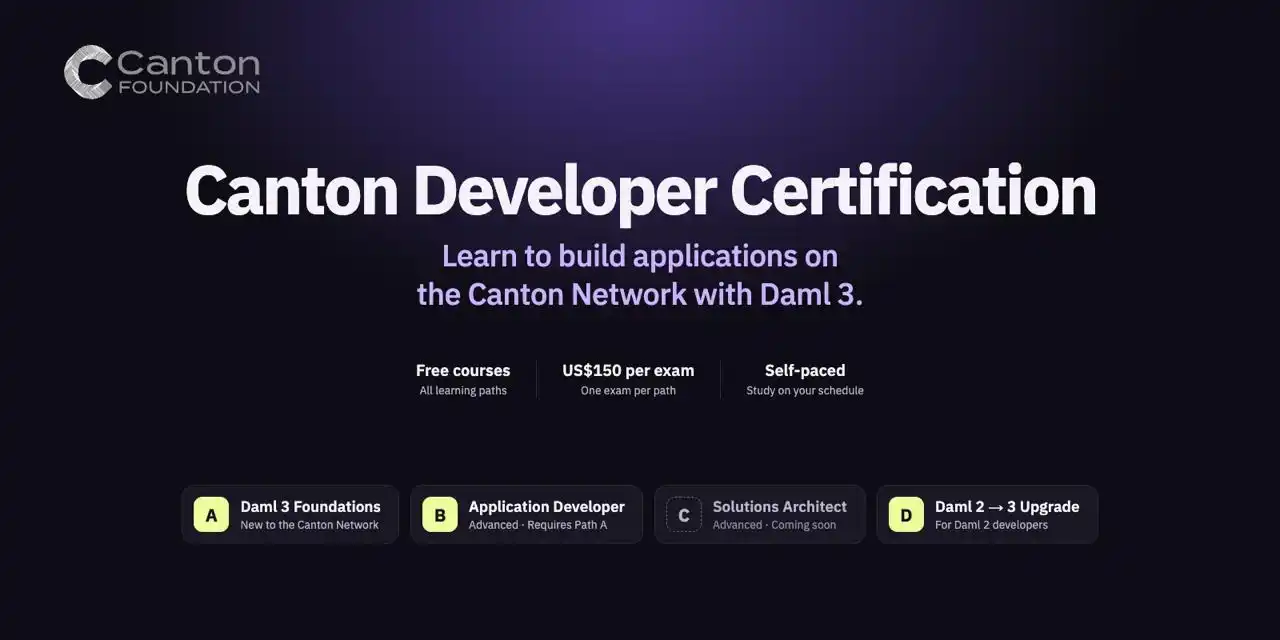
Canton Foundation has launched the Canton Developer Certification, an official certification program for Daml 3, the smart contract language of the Canton Network. Combining a self-paced course with a certification exam, it offers developers worldwide a structured path to building applications for regulated financial markets. Canton Network is a public, permissionless blockchain designed for regulated finance, with over $6 trillion in on-chain assets processed by its supported applications. Daml is built to manage who may act on a contract and who may access its terms; the certification validates practical mastery of these authorization and privacy principles, establishing a recognized standard intended to strengthen institutional confidence in applications built on the network. The program is based on Daml 3 and Canton 3.x, the current technology underlying the network, letting newcomers start on the latest stack, helping production engineers deepen expertise, enabling institutional architects to design and integrate Canton deployments, and allowing existing Daml 2 developers to migrate their skills and codebases to Daml 3, unifying the community on a single, current platform. For ecosystem partners—financial institutions, application providers, system integrators, and validators—the certification provides a common technical foundation and a consistent way to assess developers' understanding of authorization and privacy requirements. Canton Foundation COO Amanda Martin said financial institutions need confidence that the applications they rely on are built by developers who understand regulated market requirements, and that the program both opens opportunities for developers globally and establishes a shared professional standard, building a stronger foundation for Canton's future growth by bringing the community together on Daml 3. The certification is now live at certification.canton.foundation; the course is self-paced and free to all developers, and the exam costs $150 per attempt. Canton Foundation is an independent nonprofit responsible for the governance and long-term development of Canton Network's shared infrastructure, supporting transparent and decentralized governance, ecosystem coordination, and broad participation by Global Synchronizer operators and network stakeholders, while working with financial institutions, technology providers, developers, and other participants to support the network's continued global growth and adoption.

marsbit28m ago

Canton Foundation Launches Official Daml 3 Certification, Expanding Developer Access and Establishing Institutional Finance Standards

marsbit28m ago

Nvidia Faces Independent Investigation, Bernstein Maintains $400 Target Price

Nvidia's board has launched an independent investigation following reports about CEO Jensen Huang's contacts with Megaspeed executive Alice Huang, though it says there is no reason to believe U.S. national security or company secrets were compromised. Three Republican House committee chairs have requested Huang attend a closed-door briefing on November 18 to explain the contacts and Nvidia's internal procedures for countering foreign intelligence activities, and Democratic Senator Chris Coons said Congress will investigate. Some reports suggested Alice Huang may have influenced Huang's lobbying to ease chip export restrictions to China, a claim Bernstein doubts, noting Huang has long publicly pushed to expand sales in China and that revenue from mainland China and Hong Kong has fallen sharply since export controls. Only H20 and limited H200 chips were approved for China sales, well behind Nvidia's most advanced products, and Bernstein sees limited room for recovery as Chinese customers prioritize domestic alternatives. Regulatory pressure may persist, with hawkish lawmakers potentially revisiting export limits. Bernstein maintains an Outperform rating and a $400 target price, about 114% above the November 6 close of $186.64, citing data center demand and earnings growth. It projects adjusted EPS of $4.77 for FY2026, $9.20 for FY2027 and $15.80 for FY2028. The target is based on average FY2028-2029 non-GAAP EPS of $19.04 at about 21x. Bernstein also flags Huang's succession as a key risk, given his central role and roughly 60 direct reports.

marsbit38m ago

Nvidia Faces Independent Investigation, Bernstein Maintains $400 Target Price

marsbit38m ago

Two Blocks Hit in 7 Hours: Two Retail Miners Take on the Entire Network's Hashrate and Walk Away with $476,000

Two individual solo miners using home mining rigs hit two Bitcoin blocks within seven hours on November 7, earning a combined $476,000. One miner using a Canaan AvalonQ home miner with roughly 80–87 TH/s earned about $239,000; the other earned roughly $237,000. A CKPool solo platform took about 2% (0.0629 BTC) as a service fee, with the rest going directly to the miners' wallets. Given current network difficulty of about 148.4 trillion, such a rig would normally need over a century to find a block, making the win a luck value of over 10,000%. This is part of a broader trend: in 2026 so far, solo miners have found 36 blocks, nearly one lucky winner per week. Earlier examples include a 6.5 TH/s Avalon Nano 3S worth a few hundred dollars earning $250,000 on October 27, another Nano 3S earning $232,000 on May 30, and a $150 Bitaxe Gamma earning $200,000 on July 10. Home solo mining is often called "plug-in lottery": a 1.2 TH/s mini miner has about a 1-in-16,000 annual chance of winning, far better than Powerball's 1-in-292 million, but rigs cost thousands of dollars and electricity runs $400–$1,100 monthly, with zero income until a block is found. Each viral win serves as free advertising for the industry. Rig manufacturers sell the dream of "maybe I'll win too"; solo pool platforms collect a steady ~2% fee from any winner; and the Bitcoin network preserves its "anyone can participate" narrative despite mining being dominated by large farms. The people paying for it all are ordinary buyers who purchase miners and pay electricity bills hoping for a life-changing jackpot.

marsbit53m ago

Two Blocks Hit in 7 Hours: Two Retail Miners Take on the Entire Network's Hashrate and Walk Away with $476,000

marsbit53m ago

Trading

Spot
活动图片