Original | Odaily Planet Daily (@OdailyChina)
Author | Azuma (@azuma_eth)
On August 5th, before the US stock market opened, stablecoin issuer Circle officially released its Q2 2026 financial report.
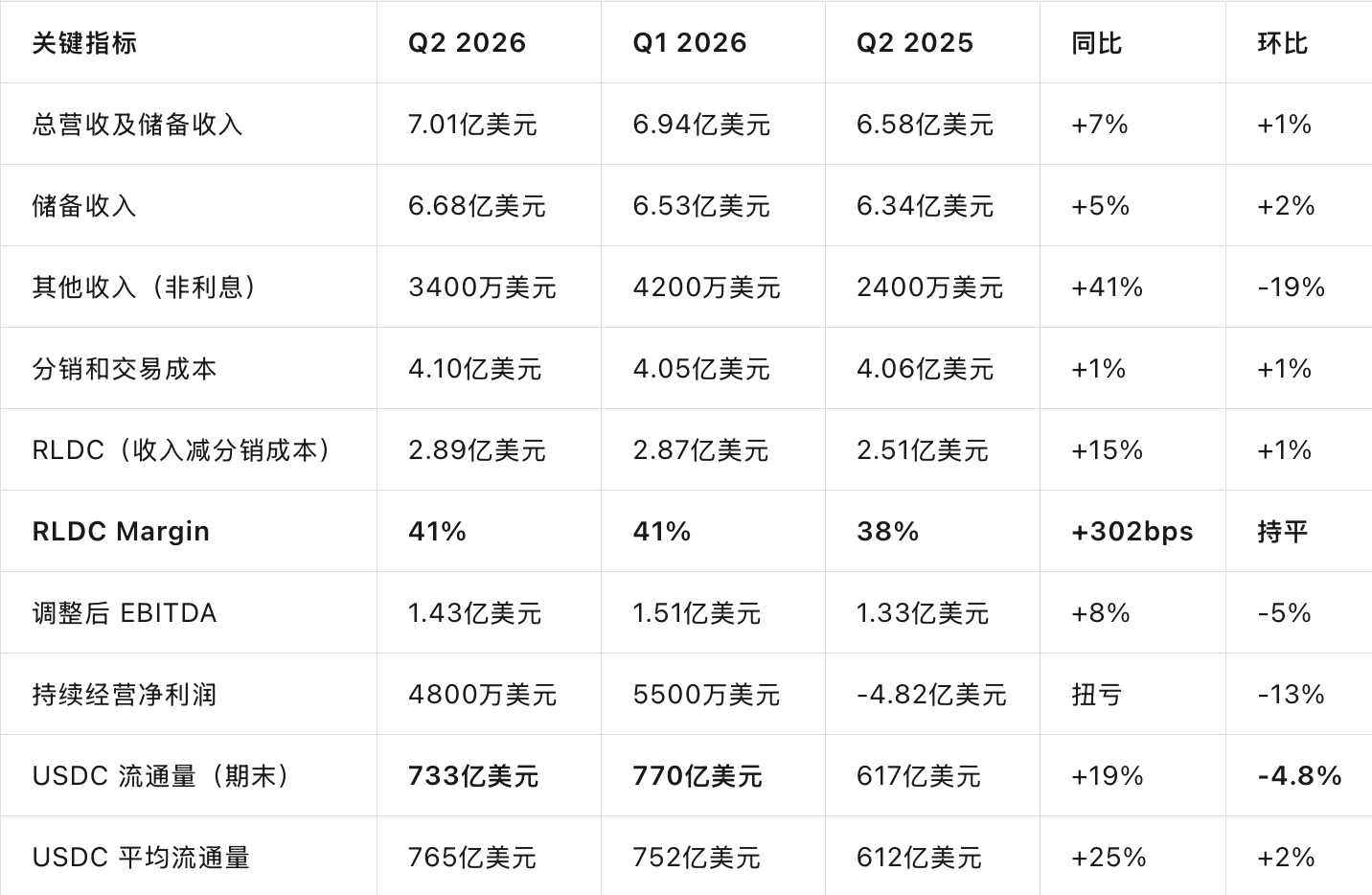
The financial report data shows that Circle's total revenue and reserve income for the second quarter were $701 million (below market expectations of $717 million), a year-on-year increase of 7%; Adjusted EBITDA was $143 million, a year-on-year increase of 8%; Net income from continuing operations was $48 million (above market expectations of $43 million), an increase of $530 million year-on-year.
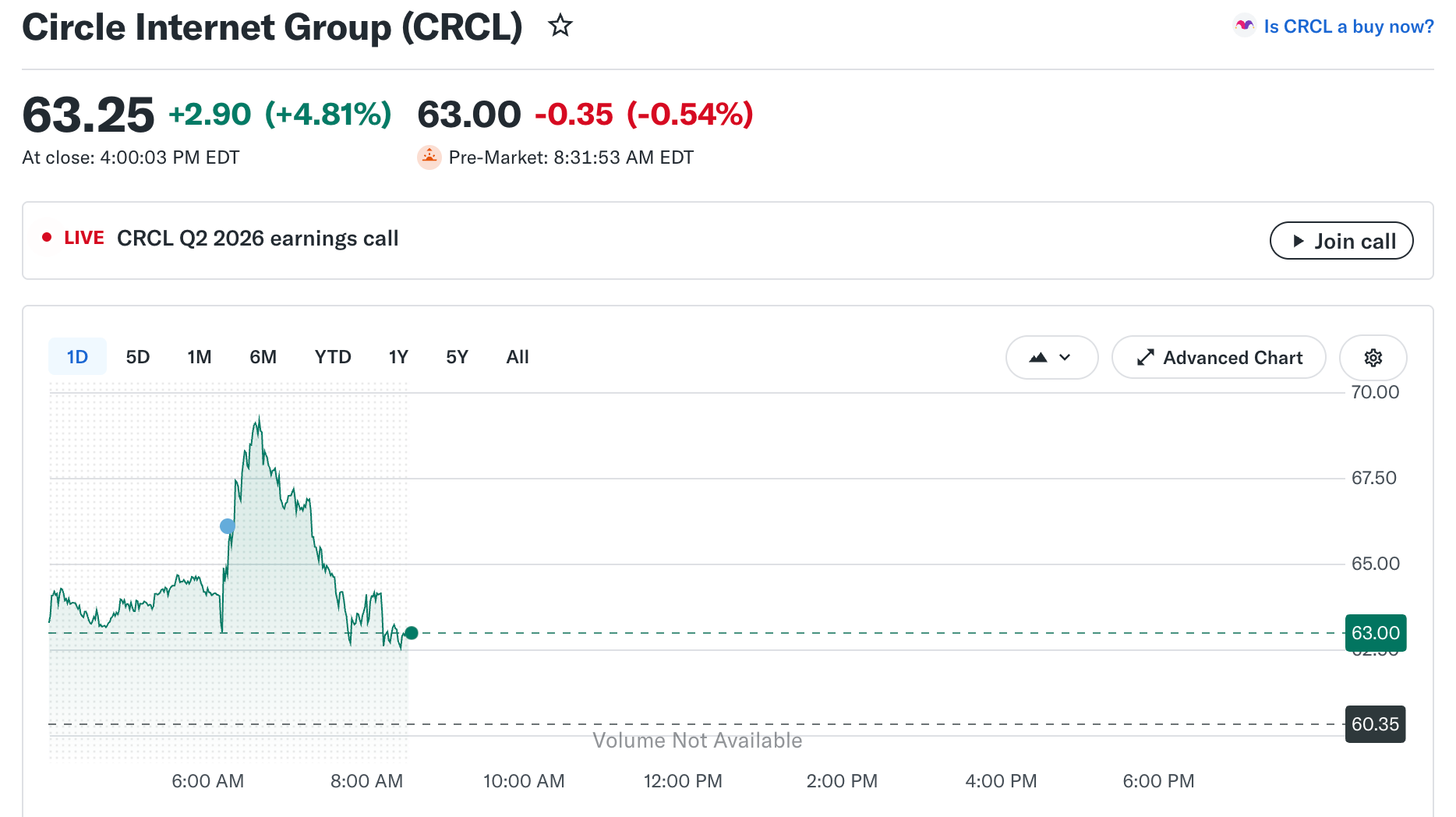
Affected by the earnings release, CRCL surged before the US market opened but later weakened. As of 20:31, it was temporarily quoted at $63, down 0.54% pre-market.
Core Data Interpretation
1. Total Revenue Missed Expectations but Reversed the Trend
As shown in the financial report, this quarter's Total Revenue and Reserve Income for Circle was $701 million. Although it did not meet market expectations ($717 million), it reversed the contraction trend from the previous quarter ($579 million ➡️ $658 million ➡️ $740 million ➡️ $770 million ➡️ $694 million ➡️ $701 million).
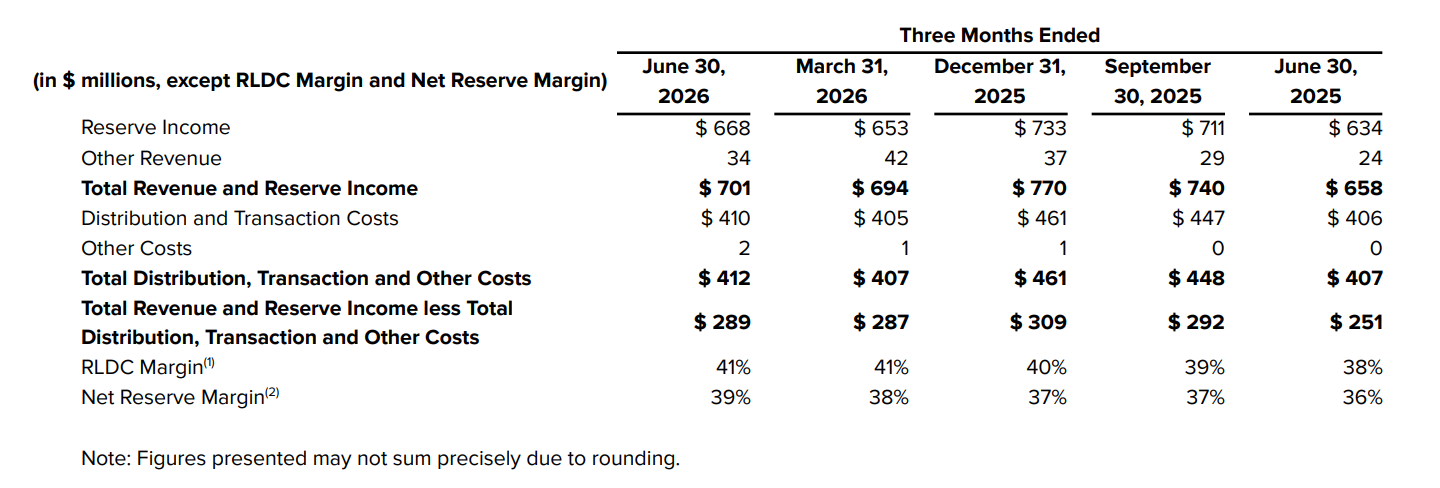
Breaking down the revenue structure, Reserve Income remains the absolute mainstay, recording $668 million in Q2, a year-on-year increase of 5% and a quarter-on-quarter increase of 2%.
2. USDC Average Circulation Still Growing, but Experienced Significant Outflow at Quarter-End
The growth in reserve income primarily benefited from the increase in USDC circulation — in the second quarter, USDC circulation showed a divergent trend of "average growth, quarter-end contraction."
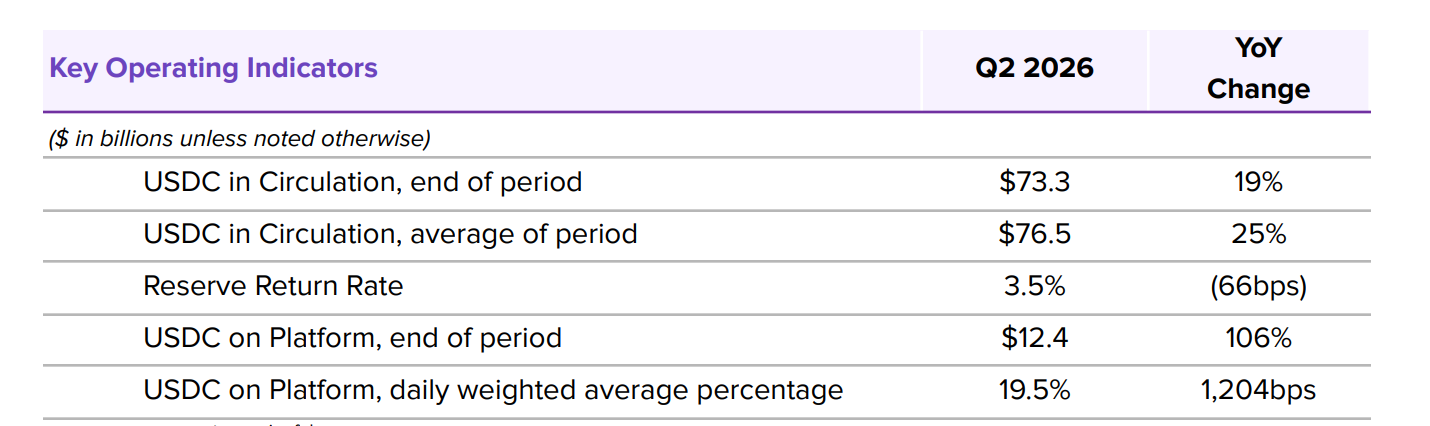
The financial report data shows that the average USDC circulation in Q2 was $76.5 billion, a year-on-year increase of 25%, also up about 2% quarter-on-quarter (average of $75.2 billion last quarter); however, the quarter-end circulation was $73.3 billion, which, despite a 19% year-on-year increase, shrank by about 4.8% compared to the $77 billion at the end of the previous quarter. This means the outflow of USDC funds mainly occurred during the quarter-end window. Although the overall scale is still expanding, the marginal trend warrants caution.
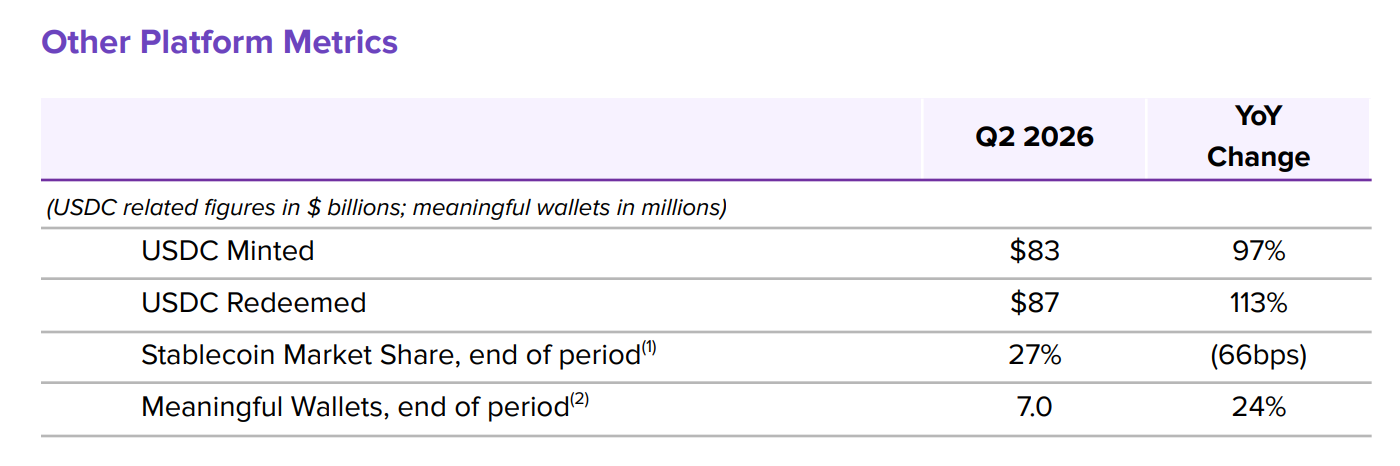
Another indicator worthy of caution is market share. The financial report shows that USDC's market share among dollar-denominated stablecoins at the end of this quarter was 27%, a year-on-year decrease of 66 basis points — against the backdrop of overall industry supply contraction, USDC did not manage to gain market share but rather experienced slight outflows.
3. Other Revenue Declined Quarter-on-Quarter, but Full-Year Guidance Was Significantly Revised Upwards
Excluding reserve income, Circle's Other Revenue this quarter was $34 million, a significant year-on-year increase of 41%, but a quarter-on-quarter decrease of 19%, breaking the growth trend of the previous five consecutive quarters ($21 million ➡️ $24 million ➡️ $29 million ➡️ $37 million ➡️ $42 million ➡️ $34 million).
Notably, Circle simultaneously revised its full-year FY2026 Other Revenue guidance upwards sharply from the previous $150 - $170 million to $310 - $330 million, almost doubling it, and specifically explained that this guidance includes recognized revenue from the ARC token pre-sale.
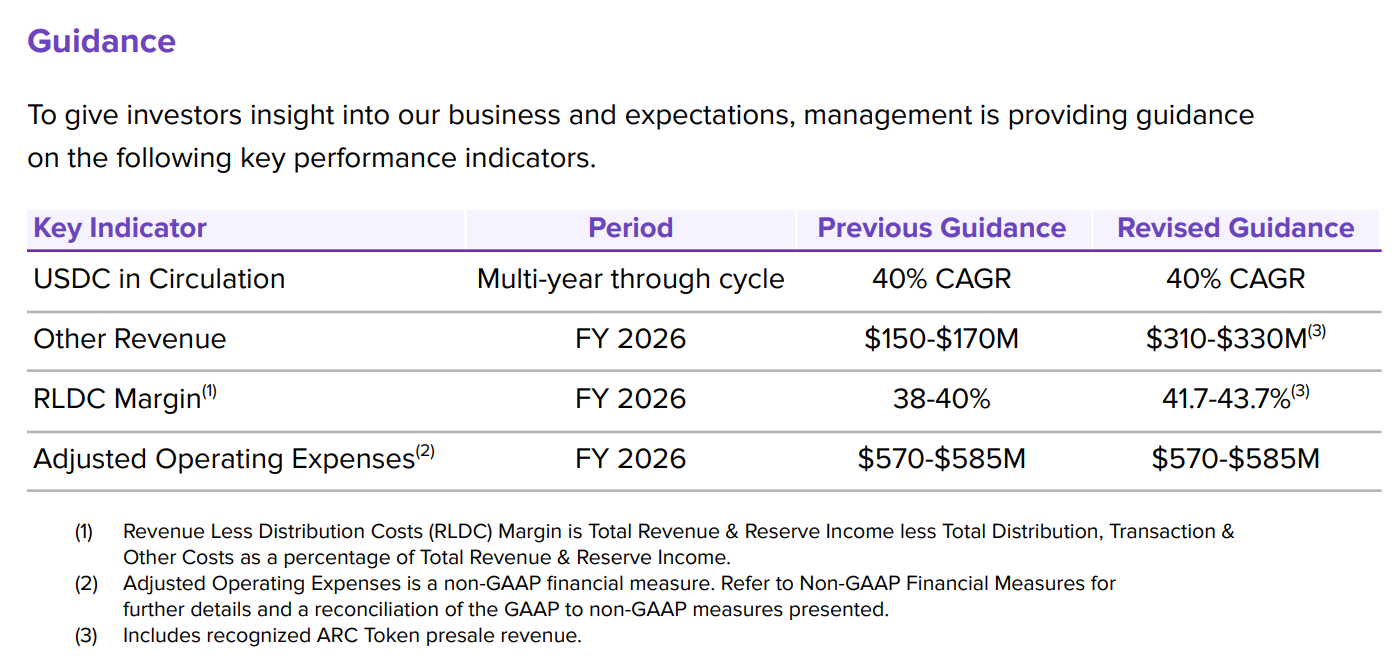
According to explanations from the Q1 earnings call, the ARC tokens held by Circle, after fulfilling the pre-sale agreement obligations, will be recognized at fair value as "Other Revenue" and directly included in RLDC and Adjusted EBITDA. This means Other Revenue for future quarters will be significantly elevated due to the accounting of ARC tokens. However, it is important to note that this portion of revenue is closer to a one-time book gain rather than sustainable subscription or service income; excluding the ARC impact, the growth slope of core Other Revenue still requires ongoing observation.
4. RLDC Margin Remains High, Distribution Cost Control Optimized
RLDC Margin is the most resilient indicator in Circle's quarterly financial report this quarter — this data refers to the profit margin after subtracting distribution costs from revenue, reflecting the core business profitability level after deducting distribution expenses, and is widely regarded as Circle's most crucial profitability metric.
In the second quarter, Circle's RLDC (Revenue Less Distribution Costs) was $289 million, a year-on-year increase of 15%; RLDC Margin reached 41%, up 3.02% year-on-year, flat compared to the previous quarter, showing a steady rise over the past five quarters (38% ➡️ 39% ➡️ 40% ➡️ 41% ➡️ 41%).
The significance of this data lies in the fact that, facing the headwind of declining reserve yields (attributed to the Fed lowering the federal funds rate), Circle still maintained its profit margin. The key behind this lies in the refined control of distribution costs — distribution and transaction costs in Q2 were $410 million, a mere 1% year-on-year increase, far below the 5% year-on-year growth rate of reserve income.
Similar to Other Revenue, Circle management also revised the full-year RLDC Margin guidance upwards, from 38–40% to 41.7–43.7%. However, it should be noted that this revision also includes the recognized ARC token pre-sale revenue. Therefore, the profitability numbers for the second half of the year will carry a certain "non-recurring" hue.
5. Distribution Remains the Largest Expense, Product Development Investment Ramped Up
On the expense side, Distribution and Transaction Costs remain Circle's largest cost item, reaching $410 million in Q2, a year-on-year increase of only 1%, with quarter-on-quarter growth also controlled within 1%.
From the perspective of Operating Expenses, under GAAP, Q2 was $254 million, a significant 56% year-on-year decrease, but this is mainly due to the base effect from last year's abnormally high stock-based compensation expenses ($435 million) caused by the IPO, and therefore holds little reference value.
More meaningful is Adjusted Operating Expenses, which were $146 million in Q2, a year-on-year increase of 23%, reflecting Circle's continued ramp-up in investment in product development, infrastructure, and AI capabilities. Breaking it down specifically, General & Administrative expenses increased to $66.3 million, IT infrastructure costs increased to $16.4 million, and Depreciation & Amortization expenses doubled year-on-year to $29.9 million. Combined with management's statements about continuous investment in product development, infrastructure, and AI capabilities, the growth in related expenses is likely highly correlated with businesses such as Arc, Agent Stack, and CPN.
Business Progress: Platformization Strategy Continues to Advance
In addition to financial data, several business-level developments disclosed in the Q2 financial report are also noteworthy.
First, the Arc network is officially entering the final countdown to launch. Circle announced that the Arc mainnet will officially launch on September 16th. The initial network validators include a host of traditional financial institutions such as BlackRock, DTCC, Galaxy, Visa, Mastercard, and Standard Chartered Bank. At the same time, BlackRock's tokenized money market fund BUIDL will be deployed on the Arc network, and DTCC plans to support the tokenization of assets held in DTC custody on Arc.
Compared to previous introductions that mostly remained at the technical roadmap and vision level, this disclosure signifies that Arc has begun to gain actual participation from traditional financial institutions. For Circle, Arc's positioning is no longer merely a public chain built around USDC, but an attempt to become the underlying infrastructure connecting stablecoins, RWA, and traditional financial institutions.
Another noteworthy business is the Circle Payments Network (CPN). The financial report shows, as of the end of Q2, CPN's annualized transaction volume over the past 30 days has increased to $14.7 billion, up about 76% from the $8.3 billion disclosed in Q1; the number of integrated financial institutions increased from 136 to 175, a quarter-on-quarter increase of 29%. Although CPN's direct contribution to revenue is still relatively limited currently, both transaction volume and the number of institutions indicate that this payment network is gradually accumulating network effects.
On the regulatory front, Circle also achieved important breakthroughs this quarter. The company has officially received approval from the US Office of the Comptroller of the Currency (OCC) to establish Circle National Trust, becoming one of the first stablecoin issuers to obtain a US federal trust bank charter; simultaneously, its application to establish Circle New York Trust was approved by the New York State Department of Financial Services (NYDFS).
For a stablecoin issuer that positions compliance as a core competency, these two charters not only further enhance Circle's regulatory standing within the US financial system but also provide a more solid institutional foundation for the future development of businesses such as custody, payments, and institutional finance.
Does the Financial Report Resolve Wall Street's Valuation Divide?
Yesterday, we published an article titled "On the Eve of Circle's Earnings, Wall Street Shows Major Divergence in CRCL Valuation." The article mentioned that on the eve of this quarterly report release, a clear divergence had already emerged on Wall Street regarding Circle's future value.
On August 3rd, Morgan Stanley (hereafter "MS") downgraded Circle's rating from "Equal Weight" to "Underweight" and significantly lowered its target price from $106 to $38; concurrently, TD Cowen initiated coverage of Circle for the first time with a "Buy" rating, setting a target price of $82.
The two institutions offered completely different rating judgments, and the core divergence reflected lies in how to assess Circle's revenue growth expectations — does Circle's long-term value come from USDC? Or from the digital financial infrastructure built around USDC?
Looking at this financial report, both sides' viewpoints have been corroborated to some extent.
On one hand, several issues of concern raised by Morgan Stanley still exist — USDC's quarter-end circulation continues to decline quarter-on-quarter, and market share has not increased; the company's revenue still mainly comes from reserve income; the full-year guidance for other revenue, although revised upwards sharply, the additional portion primarily comes from the recognition of ARC token pre-sale revenue, rather than sustained scaling of businesses like payments, API, or RWA. This means that Circle's profit model remains highly dependent on USDC's growth status and the interest rate environment in the short term.
On the other hand, new evidence supporting TD Cowen's bullish logic also seems to be increasing. The Arc mainnet is officially scheduled, traditional financial institutions like BlackRock and DTCC are joining the ecosystem, CPN continues to expand rapidly, and federal trust bank charters are secured... Although these businesses have not yet become revenue pillars, they are continuously enriching Circle's platformization layout.
In summary, the only definitive answer we can truly find from this financial report seems to be that "Circle is moving forward in the direction of platformization." As for whether these layouts can ultimately translate into sustained non-interest income growth and support the valuation logic of a digital financial infrastructure platform, it may still require verification over the next few quarters.