Circle's Pullback: Still Worth Buying?

marsbitPublicado em 2026-04-04Última atualização em 2026-04-04

Resumo

Circle: Still Worth Buying After the Pullback? Circle, the issuer of the second-largest stablecoin USDC, is at a critical juncture. Its current valuation of $15-20B primarily reflects its interest income from $770B in USDC reserves. However, data suggests a potential transformation into a fee-based digital dollar infrastructure network. Key evidence for this shift includes: * USDC's on-chain transaction volume grew 247% in FY2025, far outpacing its 72% circulation growth, indicating it's being *used* more, not just held. * Adjusted for on-chain noise, USDC dominates real economic settlement volume (64% per Visa data), despite USDT having 2.4x its market cap. Circle's three-layer revenue structure is evolving: 1. **Interest Income (95% of current revenue):** Tied to USDC circulation and interest rates. Faces headwinds from potential Fed cuts and a revenue-sharing agreement with Coinbase. 2. **Payment & Transaction Fees:** The key to becoming an infrastructure play. The Circle Payments Network (CPN) is scaling rapidly ($5.7B annualized TPV), and non-interest revenue surged to $37M/quarter. 3. **Settlement Platform (Arc):** A long-term bet on becoming an institutional settlement standard, though its value remains unproven. Near-term catalysts include the Coinbase revenue-sharing agreement renewal (Aug 2026) and potential full OCC bank charter approval. A 3-5x return is plausible if USDC circulation grows at 40% CAGR. A 10x return requires multiple successes: CPN scal...

Author: Leo Z

I. What is Circle

Circle is the issuer of USDC. USDC is the world's second-largest stablecoin, with a circulation of approximately $770 billion. Each USDC is backed by an equivalent amount of US dollar assets (primarily short-term US Treasury bonds) as reserves.

Circle's revenue source is simple: it invests these reserves in US Treasury bonds to earn an interest spread. FY2025 total revenue was $2.75 billion, with 95% coming from reserve interest. It went public in June 2025, with a current market capitalization of approximately $150-200 billion.

The market's pricing of Circle is essentially equal to "USDC circulation × interest rate × a conservative multiple." This means: if you believe Circle is merely a company that earns interest, the current pricing is roughly fair. If you believe it is transforming into a fee-based digital dollar infrastructure network, then the current price does not reflect this value at all.

This article aims to answer: Is this transformation happening? How much evidence is there? What is it worth?

II. Core Question: Is USDC Being "Held" or "Used"?

Before discussing valuation, answer a question more important than any financial model.

For the same $770 billion USDC, if it is just held by institutions to earn interest spread, then Circle is an interest rate-sensitive financial company, valued at 10-15x. If it is being frequently used for payments, settlements, cross-border transfers, and developer calls, then Circle is growing into a fee-based infrastructure network, valued at 25-30x.

Two key data points can help you judge:

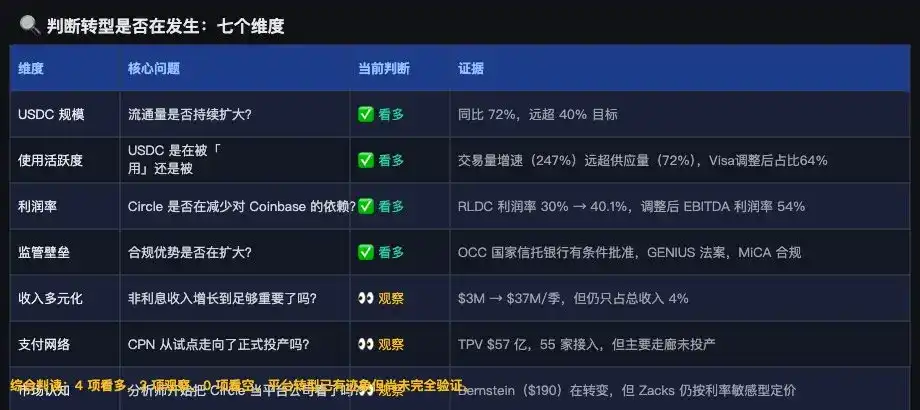
First, the growth rate of USDC's on-chain transaction volume far exceeds its circulation growth rate. In FY2025, USDC circulation grew by 72%, but on-chain transaction volume grew by 247%. This means each USDC dollar is being used more frequently. This is not "the stock is getting larger," but "the flow velocity is increasing."

Second, USDC has surpassed USDT to become the largest settlement asset. Visa Onchain Analytics filters out approximately 85% of on-chain noise (bots, internal exchange transfers, high-frequency arbitrage). After this adjustment, USDC accounts for 64% of real economic settlement volume (Mizuho, February 2026), while USDT accounts for only about 28%—even though USDT's circulation is 2.4 times that of USDC.

This gap itself is the strongest signal: USDC is transitioning from an "asset people hold" to a "network people use." But this transition is not yet complete—later we will discuss the conditions needed for it to be confirmed.

III. Three-Tier Revenue Structure

Circle's revenue is divided into three tiers. The market is almost only pricing the first tier.

Tier 1: USDC Interest Income—How Circle Makes Money Today

USDC is Circle's starting point and the source of 95% of its current revenue. As of the end of 2025, USDC circulation was $753 billion, a year-on-year increase of 72%, far exceeding Circle's own annualized growth target of 40%.

The revenue logic is simple: approximately 80% of USDC reserves are invested in short-term US Treasury bonds (via the BlackRock-managed USDXX fund), earning an interest spread.

Interest Income ≈ Average USDC Circulation × Reserve Yield

The reserve yield in Q4 2025 was 3.81%, down 68 basis points from the previous quarter. This exposes the core contradiction: circulation is growing rapidly, but interest rates are falling, and the two are offsetting each other. If the Fed's target rate drops to 3%, Circle would need USDC to grow to over $1.5 trillion to maintain its current income level.

Structural issue: Coinbase takes most of the revenue. According to the revenue-sharing agreement signed in 2023, 100% of the interest on USDC on the Coinbase platform goes to Coinbase, and Coinbase takes 50% of the interest off-platform. In FY2025, for every $1 of interest Circle earned, about 60 cents was given to distribution partners.

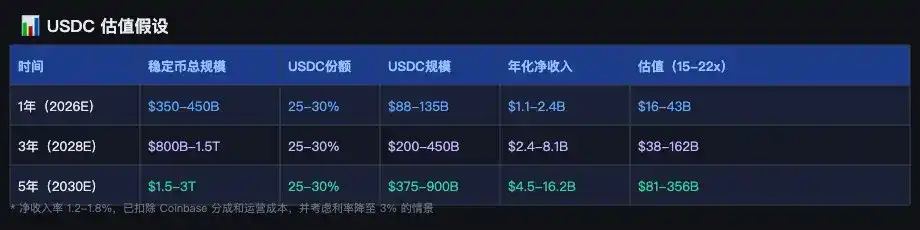
The good news is that margins are improving. The RLDC (Revenue Less Distribution Costs) margin expanded from 30.0% in Q4 2024 to 40.1% in Q4 2025. The net income rate is 1.2-1.8%, after deducting Coinbase's share and operating costs.
Tier 2: Payment & Transaction Revenue—The New Business in Development

This is the key to determining whether Circle can shed the "interest rate company" label.

CPN (Circle Payments Network) launched in May 2025, providing banks, payment companies, and enterprises with 24/7 cross-border settlement based on USDC. As of February 2026, the annualized TPV reached $5.7 billion, growing about 100-fold since launch. 55 institutions are connected, 74 are under review, and 500+ are in the pipeline. It covers 14 markets including Brazil, Canada, Hong Kong, India, Mexico, Nigeria, and the US.

But $5.7 billion compared to the global cross-border payment market of $160 trillion is still less than 0.04%. The value of CPN lies not in its current scale but in whether its growth can be sustained. If it captures 1% of the cross-border market, that would be $1.6 trillion in annualized transaction volume—the fees generated could approach or even exceed interest income and are not affected by interest rates.

CCTP (Cross-Chain Transfer Protocol) enables native cross-chain transfer of USDC through "burn-mint." It processed $41.3 billion in Q4 2025, a year-on-year increase of 3.7 times. USDC's cross-chain market share rose from 25% at the end of 2024 to 62% in January 2026, covering 30 chains. CCTP V2 introduced Fast Transfer fees—a new revenue source.

Other Revenue (non-interest income) is the most direct "evidence of transformation." In FY2025, it surged from $3 million per quarter to $37 million per quarter, including $24.7 million from subscription services, $12.2 million from transaction revenue, and $7 million from Canton Network validator node revenue. Management guidance for 2026 is $150-170 million.

This revenue is not affected by interest rates and does not require sharing with Coinbase. When it exceeds 10% of total revenue, the market may start to view Circle with a different valuation method. Currently, it is about 4%.

Tier 3: Settlement Platform—Long-Term Possibility

Arc is an institutional-grade settlement chain planned by Circle to launch its mainnet in 2026, with USDC as the native gas token. The testnet has already processed over 166 million transactions, with a confirmation time of 0.5 seconds, and 100+ institutions participating (including Goldman Sachs and Mastercard).

Arc's roadmap is divided into four phases:

M1 Public Testnet (completed) → M2 Real Funds On-Chain (2026) → M3 Margin/Collateral/Settlement Scenarios Live (2027-28) → M4 Integrated into Institutional Standard Operating Procedures (2029-30)

Before M2, Arc's value is zero. But if it eventually becomes the institutional settlement standard, Circle's value will no longer be that of a "fee company" but a "platform company." This is a necessary condition for 10x+ returns.

IV. Judging Whether the Transformation Is Happening: Seven Dimensions

Looking at any single indicator can be misleading. The key is to see if multiple dimensions are improving simultaneously—when scale, activity, margins, new revenue, and user growth all point in the same direction, the transformation is happening.
V. Three Most Important Tracking Metrics

1 USDC Circulation (Check Daily)

The base of Circle's income. Circulation × Reserve Yield = Interest Income. Track "Quarterly Average Circulation" rather than the end-of-period snapshot. Currently about $770 billion.

Data Sources: defillama.com/stablecoin/usd-coin (updated daily), circle.com/transparency (weekly reserve attestation)

2 USDC's Share of Visa-Adjusted Transaction Volume (Check Weekly)

Answers the core question: Is USDC being used or held? Supply is only 25%, but adjusted transaction volume is 64%—each USDC dollar does 2-3 times more work than a USDT dollar.

Data Source: visaonchainanalytics.com → Filter by Stablecoin → Click "Show % of Total" → Read the USDC line

3 Other Revenue, Non-Interest Income (Check Quarterly)

The only indicator that directly proves Circle is making money beyond interest. Not affected by interest rates, no sharing with Coinbase. Currently $37 million/quarter, guidance $150-170 million (2026). Valuation methods will change when it breaks through 10% of total revenue.

Data Sources: circle.com/pressroom (quarterly earnings reports), SEC EDGAR search for Circle Internet Group

VI. Near-Term Catalysts

Coinbase Revenue-Sharing Agreement Expiration (August 2026)

This is the single biggest catalyst within 24 months. Currently, Circle gives about 60% of its revenue to distribution partners. If renegotiation raises the RLDC margin from 40% to 50-55%, the effect would be equivalent to an instant 25-35% increase in profit. But Coinbase has little incentive to concede significantly—USDC distribution on the Coinbase platform remains Circle's biggest growth engine. The outcome is uncertain, but the direction is likely better than the status quo.

OCC National Trust Bank Charter

Conditionally approved in December 2025. Full approval would mean:可以直接在美联储开主账户 (earn IORB rate, eliminate counterparty risk), bypass commercial banks to handle the annual $483 billion mint/redemption flow, and build an insurmountable trust barrier for corporate and government adoption of USDC. No other stablecoin issuer has this.

x402 Foundation (Established April 2026)

Coinbase contributed the x402 payment protocol to the Linux Foundation. x402 activates the HTTP 402 status code as an internet-native payment layer, enabling AI agents, APIs, and applications to settle directly within HTTP interactions—using USDC by default.

Participants: Google, AWS, Stripe, Visa, Mastercard, Amex, Shopify, Microsoft, Cloudflare, Circle. If x402 becomes the standard for AI agent payments, every machine-to-machine microtransaction would increase USDC's usage (velocity) without needing to increase holdings (supply).

Note: x402 is led by Coinbase, not Circle. Impact on CRCL: mildly bullish, expands USDC's use cases but does not change the magnitude of the fundamentals.

VII. Conditions for 5-10x Returns

3-5x (High Confidence)—Purely from USDC Growth

USDC at a 40% CAGR reaches approximately $2-3 trillion by 2028. Even if rates drop to 3%, $2.5T × 1.5% net spread = $37.5 billion net income. At 20x, market cap is $750 billion. From the current $150-200 billion to $750 billion is about 4x. Requires no contribution from CPN or Arc.

10x (Requires Multiple Conditions to Materialize Simultaneously)

From $15-20B to $150-200B, must happen simultaneously:

1. CPN TPV breaks through $100 billion in 2-3 years, with at least one major corridor entering full production.

2. Coinbase revenue-sharing agreement improves, RLDC margin reaches 50%+.

3. Other Revenue exceeds 10% of total revenue, proving scalable non-interest income.

4. Arc reaches at least the M2 stage (real funds on-chain), starts being priced by the market.

Currently, only the second condition (margin) is clearly improving. A 10x return is a position you "earn," not one you "gamble" on.

VIII. Main Risks

Interest Rates Fall Faster Than USDC Grows

Q4 2025 already showed this signal: rates fell 68bps, partially offsetting 100% circulation growth. If the Fed drops to 2.5-3% in 2026-2027, there could be a window of 1-2 quarters of earnings below expectations.

Tether's Compliance

USDC's biggest differentiating advantage is compliance. But Tether earned $10 billion in the first three quarters of 2025 and is in talks with the Big Four accounting firms for a full audit. If Tether gains compliant status within 2-3 years, USDC's differentiated advantage could be significantly weakened. USDT currently has over 60% market share and a market cap of $1.83 trillion—it has ample resources.

Competition from New Yield-Bearing Stablecoins & Payment Giants Like Stripe

Ethena (USDe), Sky, and other new stablecoins are grabbing market share by paying yields directly to holders. Circle, bound by its regulatory compliance position, currently cannot pay interest directly to USDC holders.

Stripe is a founding member of the x402 Foundation and is also building its own stablecoin payment system. Stripe's strategy is to integrate all potential winning standards—its involvement does not represent exclusive support for USDC, nor does it preclude Stripe from launching its own stablecoin or deeply integrating USDT in the future.

IX. Conclusion

Circle is not a company that "will definitely become a trillion-dollar" company. But it might be one of the few fintech companies today that has the structural conditions to potentially reach that ceiling.
Current pricing almost only reflects USDC interest income. The market is asking: Is Circle an interest rate-driven financial company, or a fee-based digital dollar infrastructure? The answer is not yet certain—but the data is leaning towards the latter.

The core things to track are three: Is USDC circulation growing? Is each USDC dollar being used more frequently? Is non-interest income increasing? When all three improve simultaneously, the transformation is happening.

Data Sources: Circle IR, SEC EDGAR, DefiLlama, Visa Onchain Analytics, Artemis Terminal, CoinDesk, Mizuho Research

Disclaimer: This article does not constitute investment advice. All data is as of April 2026.

Criptomoedas em alta

Perguntas relacionadas

QWhat is the core business model of Circle and its primary source of revenue?

ACircle is the issuer of USDC, the world's second-largest stablecoin. Its core business model involves investing the dollar-denominated reserves backing USDC (primarily in short-term U.S. Treasuries) and earning the interest spread. For FY2025, approximately 95% of its total revenue of $2.75 billion came from this reserve interest income.

QWhat are the two key data points that suggest USDC is transitioning from an asset being 'held' to being 'used'?

AThe two key data points are: 1) USDC's on-chain transaction volume grew 247% in FY2025, significantly outpacing its 72% circulation growth, indicating each dollar is being used more frequently. 2) Adjusted data from Visa Onchain Analytics shows USDC accounts for 64% of real economic settlement volume, despite having a circulation only about 40% the size of USDT's, demonstrating it is the dominant asset for actual economic activity.

QWhat are the three layers of Circle's revenue structure as described in the article?

ACircle's three-layer revenue structure consists of: 1) USDC Interest Income: The primary current revenue from reserve investments. 2) Payment & Transaction Revenue: Income from new services like the Circle Payments Network (CPN) and the Cross-Chain Transfer Protocol (CCTP). 3) Settlement Platform: The potential long-term revenue from Arc, an institutional-grade settlement chain with USDC as its native gas token, which is not yet operational with real funds.

QWhat is identified as the single biggest catalyst for Circle within the next 24 months?

AThe expiration of the revenue-sharing agreement with Coinbase in August 2026 is identified as the single biggest catalyst. Currently, Circle shares approximately 60% of its interest revenue with partners like Coinbase. A renegotiation that improves Circle's Revenue Less Distribution Costs (RLDC) margin could significantly boost its profitability.

QAccording to the article, what conditions are necessary for Circle to achieve a potential 10x return on investment?

AA 10x return requires multiple conditions to be met simultaneously: 1) Circle Payments Network (CPN) TPV exceeding $100 billion within 2-3 years. 2) An improved Coinbase revenue-sharing agreement, raising RLDC margins to 50%+. 3) Non-interest revenue ('Other Revenue') exceeding 10% of total revenue. 4) The Arc settlement platform progressing to at least its M2 stage (real funds on-chain), allowing the market to begin pricing in its value.

Leituras Relacionadas

Full Debut Q&A! Fed Chair Wash: Firmly Adhering to 2% Inflation Target, Establishing Five Special Task Forces, Personally Did Not Submit Dot Plot

Federal Reserve Chair Kevin Warsh delivered his first FOMC press conference, maintaining the federal funds rate at 3.5%-3.75% and emphasizing the Committee's unanimous and explicit commitment to achieving its 2% inflation target. Key announcements included significant changes to Fed communication and operations. The policy statement was significantly shortened and, notably, forward guidance was removed. Chair Warsh broke from precedent by declining to submit his own economic forecasts and "dot plot." He announced the immediate formation of five special working groups focusing on: Fed communication, the balance sheet, data sources, productivity and employment (including AI's impact), and the inflation framework. These groups, which will include external experts, are tasked with recommending improvements by year-end. One key group will review the Fed's $6.7 trillion balance sheet to assess the roles of interest rates versus balance sheet tools in monetary policy. Warsh characterized the current restrictive stance of policy as "uneven," noting its effect on housing but questioning its impact on financial markets where conditions appear less restrictive. He expressed a desire to move away from a "Fed-speak" driven market, arguing that markets should react to economic data rather than Fed commentary to provide better informational signals. On inflation, he stated there is no need to reconsider the 2% target until the Fed re-establishes its commitment and capability to achieve it. Economic projections (SEP) from other officials showed a split on the rate outlook for 2024, with half expecting at least one hike and half forecasting unchanged or lower rates. The median projection saw the federal funds rate at 3.8% by year-end 2024. Following the announcements, risk assets sold off sharply, Treasury yields rose, and the dollar strengthened.

marsbitHá 13m

Full Debut Q&A! Fed Chair Wash: Firmly Adhering to 2% Inflation Target, Establishing Five Special Task Forces, Personally Did Not Submit Dot Plot

marsbitHá 13m

Full First Q&A! Fed Chair Warsh: Sticks to 2% Inflation Target, Establishes Five Special Working Groups, Personally Did Not Submit Dot Plot

The Federal Reserve, under new Chair Kevin Warsh, held its first FOMC meeting, maintaining the federal funds rate target range at 3.5% to 3.75%. The central bank issued a significantly shortened policy statement, explicitly removing forward guidance. Chair Warsh delivered a strong, unified commitment to achieving the 2% inflation target, stating the FOMC has the "capability and the commitment" to restore price stability and sees no need to review the target itself at this time. Warsh announced the immediate formation of five special working groups to examine and propose improvements in key areas by year-end: Fed communication, the balance sheet (including a review of the $6.7 trillion portfolio and its role in policy), data sources and methodology, productivity and employment (including AI's impact), and the inflation framework. In a break from tradition, Chair Warsh did not submit his own economic projections or "dot plot." The submitted Summary of Economic Projections (SEP) showed a split among other officials: half anticipate at least one rate hike this year, while half expect rates to remain steady or fall. The median projection sees the federal funds rate at 3.8% by year-end 2026. Warsh characterized the current policy stance as "uneven," noting restrictive effects in sectors like housing but less so in financial markets. He emphasized a desire to move away from a market dynamic overly focused on Fed signaling, advocating for markets to react more to economic data. On AI, he called it potentially the most significant economic change in his adult life, driving clear demand but with uncertain timing and scale on the supply side, creating a "race" between the two.

链捕手Há 16m

Full First Q&A! Fed Chair Warsh: Sticks to 2% Inflation Target, Establishes Five Special Working Groups, Personally Did Not Submit Dot Plot

链捕手Há 16m

The DeepSeek Financing Story

DeepSeek's financing round, totaling approximately 3 billion USD, concluded recently, revealing details about the process and key investors. The round was initiated around April with strict initial terms: a minimum commitment of 5 billion RMB, no syndication, and a pure RMB structure. These were later relaxed, with the minimum ticket size reduced to 1.5 billion RMB. A pivotal four-hour online investor meeting in mid-May served as the primary interaction for many backers with DeepSeek's founder, Liang Wenfeng. Despite not being a naturally eloquent speaker, Liang's philosophy deeply resonated. He consistently emphasized the company's singular focus on AGI (Artificial General Intelligence), the principle of "less is more," extreme caution in spending, and the paramount importance of team stability. His notable quotes included describing the team as "ordinary people doing extraordinary things" and stating that "AGI is a big enough thing; everything else is just process." The final investor list featured 10 entities, but underlying fund structures indicate participation from nearly 100 institutions and individuals. Notable lead investors include Monolith Capital (increasing its commitment from 1.5 to 3 billion RMB), Zhenxingu Capital, IDG Capital, and state-affiliated investors like Guozhitou. Conspicuously absent were major firms like Sequoia China and Hillhouse Capital, despite earlier speculation about their involvement. A core condition set by Liang Wenfeng for all investors, whether corporate or venture capital, was a strict prohibition against poaching DeepSeek employees or encouraging them to leave to start ventures. The financing process highlighted DeepSeek's unexpected openness to external capital, surprising many in the investment community. The company's low-profile nature, combined with its ambitious AGI vision and principled approach, fostered a sense of reverence among participating investors, many of whom were reluctant to discuss the deal publicly, preferring to maintain its discreet and purposeful ethos.

链捕手Há 23m

The DeepSeek Financing Story

链捕手Há 23m

The DeepSeek Fundraising Story

"The DeepSeek Funding Story: Insights from the $2.15 Billion Round" This article details behind-the-scenes narratives from DeepSeek's recent massive funding round. Key highlights include the legendary four-hour online investor meeting where CEO Liang Wenfeng, despite not being a charismatic speaker, impressed attendees with his focus on AGI and team stability. He emphasized the philosophy of "ordinary people doing extraordinary things" and a steadfast commitment to solely advancing intelligence. The fundraising process, initiated in April, saw initial demands for a minimum investment of 5 billion RMB, no syndication, and a pure RMB structure. These terms were later adjusted to a 1.5 billion RMB minimum to accommodate more investors. A notable absence was the lack of participation from major VC firms Sequoia China and Hillhouse Capital, despite early rumors, making IDG the only established VC in the final lineup. The investor list, while showing 10 entities, actually involved nearly 100 underlying institutions and individuals upon closer examination. Significant participants included Monolith Capital, which doubled its commitment to 3 billion RMB, and Zhenxingu Capital, an unexpected entrant. Liang Wenfeng's paramount condition for all investors was a strict agreement not to poach DeepSeek employees. The article reflects on DeepSeek's unexpected openness to funding and the mix of strategies—synergy, insight, brand alignment, and persistence—that secured investors a stake. The overarching sentiment among participants is one of pride and a shared belief in DeepSeek's potential to become a landmark Chinese company, driven by a profound sense of purpose in the AGI race.

marsbitHá 25m

The DeepSeek Fundraising Story

marsbitHá 25m

DAT Companies Take on Side Businesses

The article details the strategic shifts of Digital Asset Treasury (DAT) companies amid a prolonged market downturn. Initially popularized by firms like MicroStrategy, the DAT model—where companies hold cryptocurrencies on their balance sheets—has faced significant pressure as crypto ETFs eroded their investment thesis and bear markets strained finances. Key players are adapting in several ways. Some, like ETHzilla, have abandoned the model entirely. Others are pivoting towards becoming active, revenue-generating participants in the crypto ecosystem rather than passive holders. This evolution is taking two main paths: 1. **Transformation into Institutional Crypto Asset Managers:** Companies like SharpLink Gaming and GameSquare are leveraging their holdings to generate yield, moving beyond simple storage. They employ strategies like 100% ETH staking or using machine learning to optimize DeFi yields, positioning themselves as platforms offering institutional-grade crypto yield products. 2. **Becoming Blockchain Infrastructure Operators:** This is prominent in the Solana ecosystem. Firms like DeFi Development and SOL Strategies are acquiring validator businesses, issuing liquid staking tokens (e.g., dfdvSOL, fwdSOL), and integrating them into DeFi protocols. They generate fee-based revenue from these operations, building network effects. The article notes that successful转型 hinges on building operational expertise and defensible business models around crypto assets, such as technical advantages or deep ecosystem integration. However, these new paths carry risks like smart contract vulnerabilities or ecosystem dependence. Ultimately, this collective shift signals a maturation phase for the DAT movement. It highlights that in crypto, sustainable value is increasingly tied to active participation, cash flow generation, and providing real utility, rather than speculative capital allocation alone.

Foresight NewsHá 28m

DAT Companies Take on Side Businesses

Foresight NewsHá 28m

Trading

Spot
Futuros

Artigos em Destaque

O que é USDC(WORMHOLE)

USD Coin (Wormhole): Uma Visão Abrangente Introdução No mundo em rápida evolução das criptomoedas, o USD Coin (Wormhole), referido como $USDC(Wormhole), destaca-se como uma solução pioneira no panorama DeFi (Finanças Descentralizadas). Operando em várias plataformas de blockchain, incluindo Solana, o USD Coin (Wormhole) é mais do que apenas uma representação digital do dólar americano. Ele incorpora o espírito inovador das finanças modernas, permitindo transações intercadeias sem problemas e uma maior interoperabilidade entre diversos ecossistemas de blockchain através do avançado protocolo Wormhole. O que é o USD Coin (Wormhole)? O USD Coin (Wormhole) é uma versão tokenizada do dólar americano, projetada para facilitar transações sem atritos entre diferentes redes de blockchain. O seu objetivo principal é aumentar a liquidez e melhorar a funcionalidade do ecossistema DeFi. Ao aproveitar o protocolo Wormhole, que estabelece uma rede robusta de comunicação intercadeias, os utilizadores podem transferir tokens USDC sem esforço entre várias plataformas. Esta capacidade intercadeias marca um avanço significativo no uso de criptomoedas, promovendo um ecossistema mais interconectado e eficiente, onde os ativos podem fluir livremente entre diferentes blockchains. A proposta de valor do USD Coin (Wormhole) reside não apenas na sua estabilidade, estando atrelado ao dólar americano, mas também na sua capacidade de preencher lacunas entre ambientes de blockchain díspares. Esta abordagem inovadora promove um maior nível de participação entre utilizadores e desenvolvedores, pavimentando o caminho para novas e emocionantes aplicações nas finanças descentralizadas. Quem é o criador do USD Coin (Wormhole)? As origens do USD Coin (Wormhole) estão intrinsecamente ligadas à rede Wormhole, que foi desenvolvida pela Jump Crypto. Embora criadores individuais específicos não sejam documentados de forma proeminente, a Jump Crypto é notável pelo seu envolvimento no avanço da tecnologia blockchain e no suporte às suas aplicações nas finanças. Ao criar a rede Wormhole, a Jump Crypto desempenhou um papel vital na promoção de transferências de ativos intercadeias, aumentando a eficiência e diversidade do uso de criptomoedas. Quem são os investidores do USD Coin (Wormhole)? O sucesso do USD Coin (Wormhole) é apoiado por investimentos de vários fundos e organizações notáveis dentro do reino das criptomoedas. Os principais investidores incluem: Coinbase Ventures: Um relevante braço de capital de risco apoiado por uma das principais exchanges de criptomoedas da indústria, a Coinbase Ventures fornece capital essencial e suporte estratégico a projetos promissores de blockchain. Arrington XRP Capital: Especializando-se em ativos digitais, a Arrington XRP Capital reconhece o potencial de projetos inovadores como o USD Coin (Wormhole) e investiu de acordo para apoiar o seu desenvolvimento. Jump Trading: Como a organização-mãe da Jump Crypto, a Jump Trading traz não apenas investimento, mas uma vasta experiência em tecnologia de negociação e dinâmicas de mercado para fortalecer o projeto Wormhole. Como Funciona o USD Coin (Wormhole)? A estrutura operacional do USD Coin (Wormhole) é cuidadosamente projetada para facilitar transações intercadeias eficazes, maximizando a segurança e a eficiência. Aqui está uma visão simplificada de como funciona: Bloqueio de Ativos: Quando um utilizador deseja transferir USDC de uma blockchain para outra, ele primeiro bloqueia os seus tokens na blockchain de origem. Este processo assegura que os ativos estejam seguros e que sejam queimados ou movidos mais tarde. Mintagem de Tokens: Após os tokens serem bloqueados, uma quantidade equivalente de USDC é criada na blockchain de destino. Isso proporciona ao utilizador acesso aos seus fundos em uma nova plataforma, refletindo a flexibilidade que o protocolo Wormhole permite. Transferência Intercadeias: O protocolo Wormhole facilita de forma eficiente todo o processo de transferência. Ele assegura que, uma vez que o USDC é criado na cadeia de destino, os tokens equivalentes sejam queimados na cadeia de origem. O resultado é uma transferência de valor sem interrupções entre dois ambientes distintos de blockchain. Esta metodologia intercadeias assegura que as transações permaneçam seguras e transparentes, melhorando significativamente a liquidez dentro dos diferentes ecossistemas DeFi. Linha do Tempo do USD Coin (Wormhole) Compreender a evolução do USD Coin (Wormhole) fornece um contexto vital para a sua importância na arena das criptomoedas. Aqui está uma linha do tempo destacando marcos importantes na história do projeto: 2021: O projeto Wormhole é lançado, estabelecendo uma estrutura para transferências de ativos intercadeias e preparando o caminho para o desenvolvimento do USD Coin (Wormhole). 2022: A rede Wormhole enfrenta um desafio significativo com uma violação de segurança que resulta no roubo de 325 milhões de dólares. No entanto, o incidente é posteriormente tratado e reembolsado pela Jump Crypto, demonstrando o compromisso do projeto com a segurança e a transparência. 2023: O USD Coin (Wormhole) integra-se com o Protocolo de Transferência Intercadeias da Circle (CCTP), aprimorando suas capacidades para transferências intercadeias e solidificando ainda mais a sua posição dentro do ecossistema DeFi. 2024: O desenvolvimento contínuo e a expansão da rede Wormhole prosseguem, visando aumentar a utilidade e o alcance do USD Coin (Wormhole) e aprimorar sua estrutura operacional. Características Principais O sucesso do USD Coin (Wormhole) pode ser atribuído a várias características principais que o diferenciam de outras ofertas de criptomoedas: Interoperabilidade Intercadeias No cerne do USD Coin (Wormhole) está a sua capacidade de facilitar transferências sem problemas entre várias redes de blockchain. Esta interoperabilidade serve como um pilar para as finanças descentralizadas, permitindo que várias plataformas interajam entre si, acelerando assim a evolução dos serviços financeiros. Segurança Wormhole utiliza uma Rede de Guardiões bem projetada, composta por validadores de nós que garantem transações intercadeias seguras. Esta supervisão coletiva minimiza o risco de fraudes e proporciona aos utilizadores a confiança de que os seus ativos estão protegidos durante as transferências intercadeias. Aumento da Liquidez Ao permitir que o USDC circule livremente entre diferentes blockchains, o USD Coin (Wormhole) aumenta a liquidez no ecossistema DeFi. Esta liquidez aumentada pode promover uma negociação mais eficiente, contribuir para melhores estratégias de preços e melhorar a dinâmica geral do mercado que abrange vários ativos digitais. Conclusão O USD Coin (Wormhole) é uma inovação crucial no espaço blockchain, reforçando as capacidades das finanças descentralizadas (DeFi) e estabelecendo um ecossistema financeiro mais conectado. Com sua estrutura robusta para transações intercadeias, características de segurança e forte apoio de investidores respeitáveis, o USD Coin (Wormhole) está posicionado para desempenhar um papel fundamental no futuro das criptomoedas. À medida que o panorama das finanças digitais continua a evoluir, o USD Coin (Wormhole) não apenas abraça o futuro da interconectividade entre redes de blockchain, mas também reafirma o poder da tokenização e da tecnologia blockchain na transformação de como percebemos e utilizamos o valor em um mundo digital. Ao navegar pelas complexidades da funcionalidade intercadeias, demonstra uma abordagem sofisticada para capacitar a inclusão financeira e a inovação no mundo das criptomoedas.

86 Visualizações TotaisPublicado em {updateTime}Atualizado em 2024.12.03

O que é USDC(WORMHOLE)

O que é $USDC

Classic USDC: Uma Visão Abrangente Introdução ao Classic USDC No panorama em rápida evolução do mercado de criptomoedas, as stablecoins surgiram como componentes críticos, especialmente na provisão de estabilidade em meio à volatilidade que caracteriza os ativos digitais. Um desses projetos é o Classic USDC, uma iniciativa de moeda digital que visa oferecer um meio de troca estável e fiável. Ao manter uma paridade de 1:1 com o dólar dos EUA, o Classic USDC esforça-se por oferecer aos utilizadores um ativo digital de confiança, adequado para várias aplicações dentro dos ecossistemas web3 e de criptomoedas. O que é o Classic USDC? Classic USDC é fundamentalmente uma stablecoin, que é um tipo de criptomoeda projetada para minimizar a volatilidade de preços normalmente vista no mercado de ativos digitais. Especificamente, o Classic USDC aspira a representar de perto o valor do dólar dos EUA, garantindo que os utilizadores possam leverage esta moeda digital para transações, poupanças e outras atividades financeiras sem o receio de flutuações súbitas de preços que podem afetar muitas criptomoedas. O objetivo principal do Classic USDC é fornecer um equivalente digital fiável e digno de confiança do dólar dos EUA, projetado para integração perfeita em uma ampla gama de aplicações web3, plataformas de finanças descentralizadas (DeFi) e outros sistemas financeiros relacionados com cripto. Ao fornecer uma moeda digital estável, o Classic USDC procura facilitar o comércio cotidiano, tornar a tecnologia blockchain mais amigável para o utilizador e incentivar a adoção de criptomoedas para uso mainstream. Criador do Classic USDC A identidade do criador ou da equipa de desenvolvimento por trás do Classic USDC permanece largamente desconhecida, e a falta de transparência levou a um certo grau de incerteza em relação às origens do projeto. Enquanto muitas iniciativas de criptomoedas destacam proeminentemente seus fundadores e equipas de desenvolvimento, o Classic USDC não fornece informações claras sobre os seus criadores, o que levanta desafios para potenciais utilizadores ou investidores que ponderam a credibilidade e fiabilidade do projeto. Investidores do Classic USDC Além da ambiguidade em torno dos seus criadores, o Classic USDC também carece de especificidade em relação aos seus investidores. O apoio financeiro a um projeto pode frequentemente conferir-lhe credibilidade e estabilizar suas operações; no entanto, a ausência de fundações ou organizações de investimento documentadas que apoiem o Classic USDC levanta questões sobre sua estrutura de financiamento. Esta falta de clareza pode potencialmente dificultar a confiança dos stakeholders no projeto. Como Funciona o Classic USDC? A mecânica operacional do Classic USDC depende fortemente do seu sistema de reservas, que é fundamental para as bases de qualquer stablecoin. O Classic USDC compromete-se a manter uma reserva de ativos que correspondem diretamente ao valor da moeda digital em circulação. Especificamente, para cada token Classic USDC emitido, uma quantidade equivalente de ativos de apoio é retida em reserva, seja em dinheiro ou equivalentes de quase dinheiro. Esta estratégia é projetada para manter o valor do Classic USDC, oferecendo segurança aos utilizadores de que a troca dos seus tokens por dólares dos EUA é viável a qualquer momento. Esta estrutura de reserva tem como objetivo melhorar a estabilidade e fiabilidade do Classic USDC, posicionando-o como uma alternativa segura no mercado de criptomoedas. Ao garantir que o valor do Classic USDC está consistentemente correlacionado com o dólar dos EUA, o projeto aspira a gerar confiança entre os utilizadores que podem estar cautelosos em relação às dinâmicas mais amplas do mercado. Linha do Tempo do Classic USDC A história do Classic USDC é marcada por vários marcos-chave que refletem sua jornada e evolução dentro do ecossistema de criptomoedas: 2021: A invenção do Classic USDC é notada, introduzindo uma nova opção de moeda digital projetada para estabilidade. Durante este ano, os primeiros registros da atividade do token surgiram e os seus níveis de preço iniciais foram estabelecidos. 2024: O Classic USDC começa a experienciar flutuações notáveis de preço, à medida que o mercado de cripto no geral enfrenta várias tendências e a percepção dos utilizadores. Previsões sobre seu potencial futuro surgem, indicando um forte interesse por parte de observadores e analistas do mercado que vislumbram oportunidades de crescimento. Projeções Futuras Especialistas especulam que o Classic USDC pode alcançar níveis mais elevados de adoção e estabilidade nos próximos anos, com potenciais desenvolvimentos adicionais antecipados para 2025 e 2026. No entanto, estas projeções devem ser abordadas com otimismo cauteloso, pois o mercado de criptomoedas é inerentemente imprevisível, e vários fatores externos podem influenciar a trajetória do Classic USDC. Pontos Chave Sobre o Classic USDC Estabilidade: A proposta central do Classic USDC gira em torno da provisão de uma moeda digital que paralelize o valor do dólar dos EUA, garantindo assim estabilidade em um mercado frequentemente volátil. Sistema de Reserva: O compromisso do projeto em manter uma reserva de ativos para respaldar o seu valor sublinha a sua fiabilidade e solidez operacional. Integração Web3 e Cripto: O Classic USDC é projetado para facilitar uma fácil integração em várias aplicações, visando melhorar a experiência do utilizador e ampliar a aceitação de criptomoedas em transações do dia a dia. Poteial de Crescimento Futuro: Embora ainda esteja em emergente, o Classic USDC possui avenidas prospectivas para crescimento à medida que a consciência e a utilização de stablecoins aumentam nos contextos web3 e cripto. Conclusão O Classic USDC apresenta-se como uma iniciativa notável de stablecoin dentro da esfera das criptomoedas, esforçando-se por fornecer aos utilizadores uma moeda digital fiável que incorpore a estabilidade do dólar dos EUA. Apesar das incertezas em torno dos seus criadores e suporte financeiro, os princípios subjacentes do Classic USDC—centrados em garantias apoiadas por reservas—procuram posicioná-lo como uma opção confiável para indivíduos e empresas que navegam na economia digital. Com um olhar voltado para o futuro, os analistas de mercado estão ansiosos para observar como o Classic USDC evolui em resposta às dinâmicas mutáveis do panorama das criptomoedas, potencialmente estabelecendo-se como um jogador significativo no reino das stablecoins.

62 Visualizações TotaisPublicado em {updateTime}Atualizado em 2024.12.03

O que é $USDC

Como comprar USDC

Bem-vindo à HTX.com!Tornámos a compra de USD Coin (USDC) simples e conveniente.Segue o nosso guia passo a passo para iniciar a tua jornada no mundo das criptos.Passo 1: cria a tua conta HTXUtiliza o teu e-mail ou número de telefone para te inscreveres numa conta gratuita na HTX.Desfruta de um processo de inscrição sem complicações e desbloqueia todas as funcionalidades.Obter a minha contaPasso 2: vai para Comprar Cripto e escolhe o teu método de pagamentoCartão de crédito/débito: usa o teu visa ou mastercard para comprar USD Coin (USDC) instantaneamente.Saldo: usa os fundos da tua conta HTX para transacionar sem problemas.Terceiros: adicionamos métodos de pagamento populares, como Google Pay e Apple Pay, para aumentar a conveniência.P2P: transaciona diretamente com outros utilizadores na HTX.Mercado de balcão (OTC): oferecemos serviços personalizados e taxas de câmbio competitivas para os traders.Passo 3: armazena teu USD Coin (USDC)Depois de comprar o teu USD Coin (USDC), armazena-o na tua conta HTX.Alternativamente, podes enviá-lo para outro lugar através de transferência blockchain ou usá-lo para transacionar outras criptomoedas.Passo 4: transaciona USD Coin (USDC)Transaciona facilmente USD Coin (USDC) no mercado à vista da HTX.Acede simplesmente à tua conta, seleciona o teu par de trading, executa as tuas transações e monitoriza em tempo real.Oferecemos uma experiência de fácil utilização tanto para principiantes como para traders experientes.

308 Visualizações TotaisPublicado em {updateTime}Atualizado em 2026.06.02

Como comprar USDC

Discussões

Bem-vindo à Comunidade HTX. Aqui, pode manter-se informado sobre os mais recentes desenvolvimentos da plataforma e obter acesso a análises profissionais de mercado. As opiniões dos utilizadores sobre o preço de USDC (USDC) são apresentadas abaixo.

活动图片